

Vetting IT subcontractors is the process of systematically evaluating a firm's financial health, technical capabilities, compliance records, and contractual terms before awarding work on a public sector project. Prime contractors who skip or rush this process expose themselves to cost overruns, compliance failures, and schedule collapses. A rigorous evaluation typically takes 6–8 weeks and requires a minimum of 2 hours of financial review per subcontractor. That investment is small compared to the cost of replacing a failing sub mid-project on a government contract. The IT subcontractor selection process covers four core areas: financial stability, technical capability, regulatory compliance, and contract terms.
How to vet IT subcontractors: financial documents and metrics
Financial vetting is the foundation of the entire IT subcontractor selection process. A subcontractor that looks capable on paper can collapse mid-project if its cash flow is weak. Net margins in IT services run as low as 2–4%, which means even a modest payment delay can create a liquidity crisis.
The standard for evaluating IT service providers on financial grounds follows clear thresholds:
- Contracts over $500,000: Require three fiscal years of CPA-reviewed or audited financial statements. Reviewed statements are acceptable for mid-tier contracts; audited statements are the standard for large government awards.
- Subcontracts over $100,000: Check the D&B Failure Risk Score and PAYDEX rating. A D&B report costs $50–$150 and reveals payment behavior and credit risk in one document.
- Working capital: Request a current balance sheet and calculate working capital (current assets minus current liabilities). Low working capital signals cash flow risk even when the profit and loss statement looks healthy.
- Work-in-Progress (WIP) reports: WIP reports reveal over- or under-billing patterns that profit statements hide. A sub billing far ahead of actual work completed is a red flag for financial distress.
- Bank reference letters: Request a letter directly from the subcontractor's bank confirming the account is in good standing and the credit line is active.
- Legal standing: Verify the entity is registered and in good standing with the state, has no active tax liens, and carries no unresolved judgments.
Set minimum thresholds before you start reviewing. Decide in advance what working capital ratio or PAYDEX score disqualifies a firm. Applying thresholds after reviewing the documents introduces bias and inconsistency.
Pro Tip: Request the WIP schedule alongside the balance sheet, not as a separate follow-up. Subcontractors who hesitate to provide WIP data are often the ones with the most to hide.
How do you evaluate IT subcontractor technical capabilities and SLAs?
Technical capability evaluation is where most prime contractors make their biggest mistake. Project managers who rank IT vendors by price or demo quality alone miss the factors that determine real performance: security architecture, compliance posture, and the ability to scale under contract constraints.
Use a weighted evaluation matrix. Assign percentage weights to categories before you score any vendor. A practical framework for government IT projects looks like this:
- Security stack (25%): Does the subcontractor use multi-factor authentication, endpoint detection and response tools, and encrypted data transfer? Ask for their most recent security assessment or SOC 2 report.
- Compliance posture (25%): Can they demonstrate FedRAMP, FISMA, or NIST 800-53 alignment? For state-level contracts in Maryland, New York, or Florida, verify alignment with state-specific data handling requirements.
- Scalability (20%): Ask how they have handled scope increases on past government contracts. Request a specific example with measurable outcomes.
- SLA terms (20%): Best-practice SLA benchmarks set tiered response times: 15 minutes for critical incidents, 1 hour for high-priority issues, and 4 hours for normal requests. Any SLA that does not specify these tiers is not a real SLA.
- Contract flexibility (10%): Annual contracts with 30- to 60-day cancellation windows are the standard for low-risk IT subcontracting. Multi-year auto-renewals with narrow cancellation windows are a structural trap.
Pro Tip: Ask the subcontractor to walk you through a real incident they resolved under SLA pressure. Their answer reveals more about operational maturity than any written proposal.
SLA penalties deserve special scrutiny. Generic "99.9% uptime" promises are meaningless without defined measurement methods, exclusion lists, and remedies tied to actual productivity loss. Service credits that cover only a fraction of downtime costs do not constitute real accountability. Demand that SLA remedies be calculated against the actual cost of disruption to the government program.

Verify after-hours support coverage and onboarding processes. A subcontractor that cannot staff a government system during off-hours or that requires six weeks to onboard is a liability on any time-sensitive public sector contract.
Which compliance checks are critical for public sector IT subcontractors?
Compliance verification protects the prime contractor from regulatory exposure and contract termination. Every check must be current. An expired insurance certificate or a lapsed license is not a minor administrative issue on a government contract. It is grounds for disqualification.
The core compliance checklist for vetting IT contractors includes:
- SAM.gov exclusion check: Any firm on the System for Award Management exclusion list is ineligible for federal subcontracting. Run this check on every principal, not just the entity.
- License verification: Confirm current state business licenses and any required technology or security certifications. Check expiration dates, not just existence.
- Insurance certificates: Require certificates of insurance naming the prime as an additional insured. Verify directly with the insurer, not just from the certificate copy.
- OSHA and safety records: Review the subcontractor's Experience Modification Rate (EMR). An EMR above 1.0 indicates above-average incident rates.
- Litigation and lien history: Search court records for active lawsuits, payment disputes, and tax liens. A pattern of payment disputes with lower-tier vendors signals cash flow problems.
Automating compliance verification reduces human error and cuts verification time from hours to seconds. Tools that pull SAM.gov, OSHA, and license data automatically produce more consistent results than manual checks.
| Compliance area | Verification method | Disqualifying condition |
|---|---|---|
| SAM.gov exclusion | Automated SAM.gov query | Any active exclusion |
| Insurance coverage | Direct insurer confirmation | Expired or insufficient limits |
| State license | State licensing board portal | Expired or suspended license |
| Litigation history | Court record search | Pattern of payment disputes |
| OSHA/EMR | Safety record request | EMR above 1.0 |
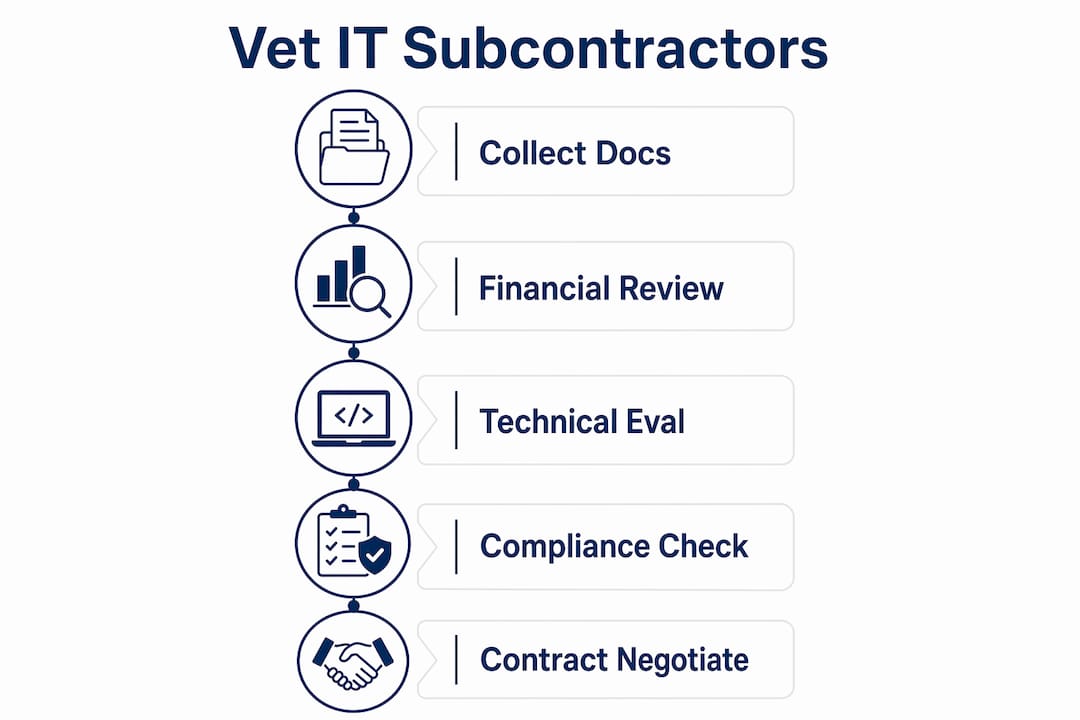
Establish a documented prequalification system with written rejection thresholds. Consistency protects the prime from bid protests and ensures the process holds up to audit scrutiny.
How to negotiate contracts with IT subcontractors for government projects
A well-structured contract is the last line of defense after vetting. Effective subcontractor contracts specify scope, schedule milestones, payment retainage, insurance requirements, default terms, and dispute resolution methods. Each element carries a distinct risk function.
- Scope definition: Write precise inclusions and exclusions for every deliverable. Vague scope language is the primary driver of change order disputes on government IT projects.
- Schedule milestones: Tie milestones directly to the master project schedule. Include float allowances and specify what constitutes a schedule breach.
- Payment terms and retainage: Standard retainage on government subcontracts runs 5–10% of each payment. Retainage is released upon verified completion of defined milestones, not at the subcontractor's request.
- Insurance requirements: Name the prime contractor as an additional insured on the subcontractor's general liability and professional liability policies. Require notification of any policy changes.
- Default and termination clauses: Include a cure period (typically 7–14 days) before termination for cause. Specify what constitutes a material breach and what remedies are available.
- Dispute resolution: Specify the jurisdiction and method, whether mediation, arbitration, or litigation. For Maryland, New York, and Florida contracts, confirm the governing law clause matches the contract location.
Avoid auto-renewal traps. A multi-year contract with a 10-day cancellation window gives the prime contractor almost no exit flexibility. The public sector contracting standard favors annual terms with clearly defined renewal conditions.
Review the data portability clause before signing. If the subcontractor hosts government data, the contract must specify that all data transfers to the prime or the agency within a defined period after contract end. Missing this clause creates serious compliance exposure.
Key takeaways
Rigorous IT subcontractor vetting requires financial analysis, weighted technical scoring, compliance verification, and contract precision to protect prime contractors on government projects.
| Point | Details |
|---|---|
| Financial vetting thresholds | Require three years of audited financials for contracts over $500,000 and a D&B check for contracts over $100,000. |
| WIP reports over P&L statements | Working capital and WIP schedules reveal cash flow risks that profit statements do not show. |
| Weighted technical scoring | Score subcontractors on security, compliance, and scalability before price to avoid selecting on demos alone. |
| SLA specificity | Require tiered response times and remedies tied to actual productivity loss, not generic uptime percentages. |
| Ongoing compliance monitoring | Run annual requalification and event-driven re-screenings after incidents, acquisitions, or key personnel changes. |
Vetting is a system, not a checklist
The most common failure I see from prime contractors is treating vetting as a one-time gate rather than a continuous process. A subcontractor who passes financial review in january can be in serious trouble by july if a major client leaves or a key line of credit closes. That change will not announce itself.
Prequalification works best as an ongoing firewall when it includes annual requalification and event-driven re-screenings triggered by personnel changes, acquisitions, or incident reports. The prime contractors who avoid mid-project subcontractor failures are the ones who built a living performance scorecard with predefined downgrade triggers. When a subcontractor's score drops below a threshold, the system flags them for re-screening automatically. That removes the human tendency to give a familiar vendor the benefit of the doubt.
Automation closes the gap between annual reviews. Manually checking SAM.gov exclusions, license renewals, and insurance certificates for a roster of active subs is slow and error-prone. Automated verification tools catch lapses in real time. The prime contractors who use them find compliance gaps that manual processes miss entirely.
The other pattern worth naming is reactive vetting. Some project managers only run deep checks after a problem surfaces. By then, the damage is usually done. A standardized, documented process applied before award and maintained throughout the contract life cycle is the only version that actually protects the prime.
— Randy
Work with a prime-ready IT subcontractor from day one
Primereadysub, the public-facing brand of Rutledge & Associates, LLC, is built specifically for prime contractors who need a subcontractor that arrives contract-ready. As an SDVOSB, woman-owned, and SBA-certified firm, Primereadysub owns clearly defined scopes in cloud-native modernization, compliance automation, and real-time data analytics for state and federal agencies. There is no staff augmentation and no hand-holding required. If you are managing a compliance-heavy government IT program in Maryland, New York, or Florida, explore what a prime-ready IT partner looks like before your next award. You can also review the IT subcontracting checklist to align your vetting standards before the next solicitation closes.
FAQ
What financial documents should I request when vetting IT subcontractors?
Request three fiscal years of CPA-reviewed or audited financial statements for contracts over $500,000, plus a current WIP schedule and bank reference letter. For contracts over $100,000, also pull a D&B Failure Risk Score and PAYDEX rating.
How long does a full IT subcontractor vetting process take?
A thorough evaluation takes 6–8 weeks. Financial review alone requires a minimum of 2 hours per subcontractor to cover statements, WIP reports, and credit checks.
What SLA terms should I require from an IT subcontractor?
Require tiered response times: 15 minutes for critical incidents, 1 hour for high-priority issues, and 4 hours for normal requests. Reject any SLA that limits remedies to service credits without accounting for actual productivity loss.
How do I verify a subcontractor's compliance status for a federal contract?
Run a SAM.gov exclusion check on the entity and all principals, confirm current insurance certificates directly with the insurer, and verify state licenses through the relevant licensing board portal.
How often should I re-screen active IT subcontractors?
Re-screen annually at minimum. Trigger additional re-screenings immediately after incidents, key personnel changes, or ownership acquisitions to maintain compliance throughout the contract life cycle.