

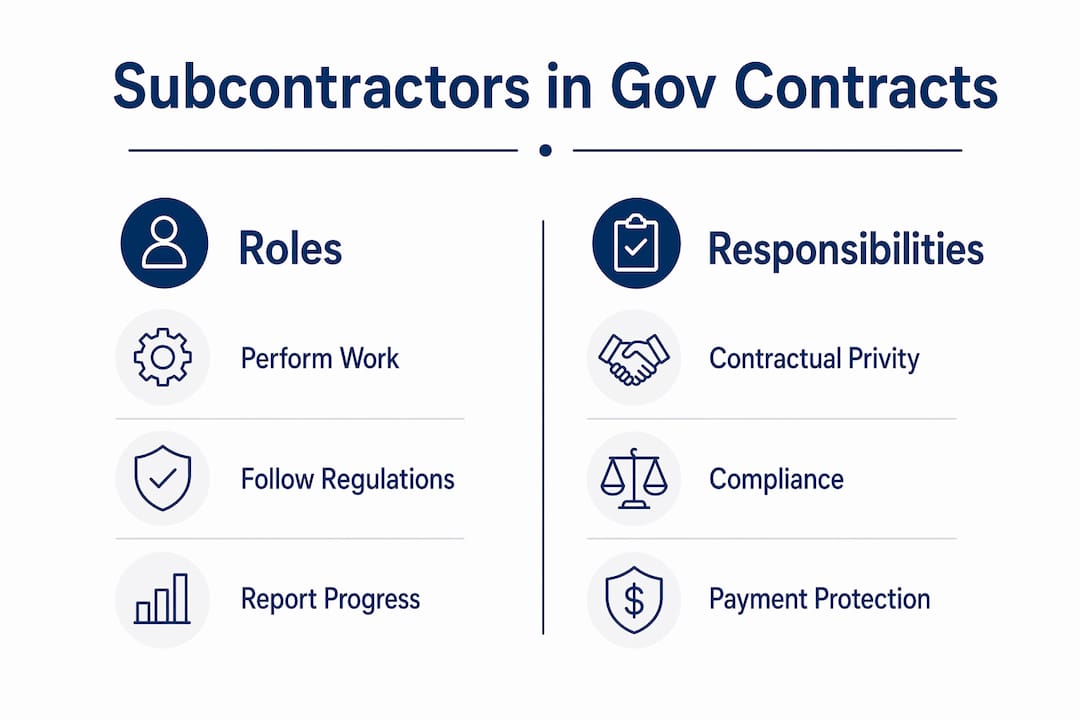
Subcontractors in government contracting are defined as entities that perform specific portions of a prime contract without holding a direct agreement with the government itself. The role of subcontractors in government is to extend the capacity of prime contractors, bring specialized expertise, and enable broader participation in public sector work that no single firm could accomplish alone. Understanding this structure is not optional for government officials, prime contractors, or policy makers. It is the foundation of how federal and state agencies actually get complex work done.
How do subcontractors function within government contracting frameworks?
The structural relationship between primes and subcontractors is governed by a concept called contractual privity. Prime contractors have privity with the government; subcontractors do not. This single fact carries enormous legal and operational weight. It means the government holds the prime accountable for everything, including the performance and compliance of every subcontractor in the chain.
Determining who qualifies as a subcontractor depends on whether the vendor's work is integral to prime contract performance, not merely the label used in an agreement. A firm providing incidental supplies is a vendor. A firm writing code that directly fulfills a deliverable is a subcontractor. This distinction matters because it triggers a different set of legal obligations.

The primary governance mechanism is the flow-down clause. FAR and DFARS flow-down mechanisms pass contractual requirements from prime contractors down to subcontractors, ensuring that government policies apply throughout the supply chain. These clauses cover everything from labor standards and equal opportunity requirements to cybersecurity protocols and audit access rights.
Key structural elements that define how subcontractors operate within government frameworks include:
- Privity limitation: Subcontractors cannot sue the government directly for payment or contract disputes. Their legal recourse runs through the prime.
- Flow-down obligations: Primes must incorporate specific FAR and DFARS clauses into subcontracts, making subcontractors legally bound by the same standards as the prime.
- Contracting officer consent: For certain subcontracts above defined thresholds, the government's contracting officer must approve the subcontractor selection before work begins.
- Multi-tier complexity: Multi-tier subcontracting requires primes to flow down clauses and manage compliance indirectly across multiple layers, which compounds governance demands significantly.
Pro Tip: When structuring a subcontracting agreement, map every applicable FAR clause to the specific scope of work before the contract is signed. Retroactive flow-down corrections are costly and create compliance gaps that auditors will find.
Why is small business participation central to government subcontracting?
Subcontracting is not purely an operational tool. Subcontracting serves as both an economic development policy and a governance mechanism embedded directly in federal procurement law. The Small Business Act establishes statutory goals for small business participation, and those goals are enforced through subcontracting plans required on larger federal contracts.
Federal contracts above certain dollar thresholds require prime contractors to submit a Small Business Subcontracting Plan under FAR 52.219-9. These plans set specific percentage goals for subcontracting to categories including Women-Owned Small Businesses (WOSB), HUBZone firms, Service-Disabled Veteran-Owned Small Businesses (SDVOSB), and other disadvantaged groups. Missing these goals carries real consequences, including negative past performance ratings that affect future contract awards.
The practical pathway for small businesses to enter the government market follows a recognizable sequence:
- Register in SAM.gov and identify NAICS codes that align with the firm's core capabilities, since prime contractors search by these codes when sourcing subcontractors.
- Use SBA's Sub-Net platform, which allows small businesses to find subcontracting opportunities by SIC and NAICS codes, giving firms direct visibility into active prime contractor solicitations.
- Pursue certifications such as SDVOSB, WOSB, or SBA 8(a) status, since certified firms are specifically sought by primes trying to meet their subcontracting plan goals.
- Build a track record as a subcontractor before pursuing prime contracts directly. Subcontracting experience is recognized in past performance evaluations and builds the relationships that lead to teaming arrangements on future bids.
The Department of Transportation's Office of Small and Disadvantaged Business Utilization actively supports this pipeline, connecting small firms with prime contractors across DOT-funded programs. For firms like Rutledge & Associates, which holds SDVOSB, woman-owned, and SBA certifications, this structure creates direct access to prime contractors who need certified partners to satisfy their subcontracting plan requirements.
How does compliance oversight apply to subcontractors in IT modernization?
IT modernization contracts introduce a compliance layer that general construction or services subcontracting does not face at the same intensity. When subcontractors handle Covered Defense Information (CDI) or Controlled Unclassified Information (CUI), they become subject to DFARS 252.204-7012, which requires implementation of NIST SP 800-171 controls and cyber incident reporting within 72 hours. The prime contractor is responsible for flowing these requirements down and verifying compliance.
The table below contrasts the compliance obligations that fall on prime contractors versus subcontractors in a typical defense IT modernization program:
| Obligation | Prime contractor | Subcontractor |
|---|---|---|
| NIST SP 800-171 implementation | Must verify subcontractor compliance | Must implement all 110 controls |
| Cyber incident reporting | Must report to DoD within 72 hours | Must notify prime immediately upon discovery |
| System Security Plan (SSP) | Must maintain and review | Must maintain for all covered systems |
| Flow-down clause inclusion | Must include DFARS 252.204-7012 in subcontracts | Must flow down to lower-tier subs handling CUI |
| Supply chain visibility | Accountable for entire chain | Responsible for own vendors and suppliers |
Incomplete supply-chain security visibility can undermine entire IT modernization programs. A single subcontractor with inadequate access controls or an unreported breach can trigger contract termination, suspension of the prime, and program delays that cost agencies months of recovery time. This is not a theoretical risk. Defense IT programs have faced exactly these outcomes when compliance was treated as a paperwork exercise rather than an operational requirement.
Risk management in defense IT depends on every subcontractor's ability to implement cybersecurity requirements and report incidents on time. Primes that treat subcontractor compliance as a checkbox rather than an ongoing verification process expose themselves to liability that the government will not absorb.
Pro Tip: Require subcontractors handling CUI to submit their System Security Plan and SPRS score before contract execution, not after. Waiting until after award to discover a subcontractor's security posture is a risk management failure, not a scheduling issue.
What payment protections apply to subcontractors on government projects?
Subcontractors on federal projects do not have the same direct payment rights as prime contractors, but they are not without legal protection. The Miller Act and the Prompt Payment Act together form the primary statutory framework governing payment on federal construction contracts. These statutes require payment bonds and mandate timely payment to subcontractors, providing a legal mechanism to prevent project delays caused by financial disruption.
At the state level, protections vary but can be equally specific. Under Texas law, for example, prime contractors must pay subcontractors within 10 days of receiving payment from the government. Payment becomes overdue on day 11, and subcontractors gain enforcement rights including the right to suspend work after proper notice. This kind of statutory precision gives subcontractors real leverage that many do not realize they hold.
Practical steps subcontractors can take to protect their financial position on government projects include:
- Document every deliverable and milestone with written acceptance from the prime, since payment disputes almost always center on whether work was completed and accepted.
- Track payment timelines against the Prompt Payment Act and applicable state statutes, and send formal written notice immediately when a payment deadline is missed.
- Verify that a payment bond exists before starting work on federal construction projects. The Miller Act requires bonds on contracts above $150,000, and the bond is the subcontractor's primary recourse if the prime defaults.
- Include dispute resolution clauses in subcontracts that specify timelines, escalation procedures, and governing law, so that payment disagreements do not become open-ended litigation.
Understanding these protections is part of the function of subcontractors in government work. Financial security for subcontractors translates directly into project continuity for the government.
Key takeaways
Subcontractors in government contracting operate without direct government contracts, making prime contractor oversight the single most critical factor in compliance, performance, and financial protection across the entire supply chain.
| Point | Details |
|---|---|
| Privity defines accountability | Subcontractors have no direct government contract; all accountability flows through the prime. |
| Flow-down clauses govern compliance | FAR and DFARS clauses must be incorporated into subcontracts to extend legal obligations down the chain. |
| Small business goals are enforceable | Subcontracting plans under FAR 52.219-9 set binding percentage goals for WOSB, SDVOSB, and HUBZone firms. |
| IT modernization raises the compliance stakes | DFARS 252.204-7012 requires subcontractors handling CUI to implement NIST SP 800-171 and report breaches within 72 hours. |
| Payment protections exist but require action | The Miller Act and Prompt Payment Act provide legal recourse, but subcontractors must document deliverables and track deadlines to enforce those rights. |
What working in government IT subcontracting actually teaches you
Most discussions of subcontractor roles focus on the legal framework and stop there. What that framing misses is the operational reality: compliance in government IT is not a static checklist. It is a continuous management problem that most primes are not staffed to solve alone.
What I have observed across public sector IT programs is that the primes who struggle most are not the ones who lack technical capability. They are the ones who treat subcontractor management as an administrative function rather than a core delivery function. When a subcontractor's NIST controls are not verified until the first audit, or when a payment dispute surfaces because milestone acceptance was never documented, the root cause is almost always a gap in how the prime structured the relationship from day one.
The subcontractors who deliver the most value in these programs are the ones who own a clearly defined scope, bring their own compliance posture to the table, and require minimal oversight to produce auditable outcomes. That is not a coincidence. It is the result of selecting partners who understand that government contracting demands a different operating model than commercial work.
For policy makers and contracting officers, the implication is direct: subcontracting plan requirements and flow-down clauses are only as effective as the prime's willingness to enforce them. Structural accountability without operational follow-through produces compliance theater, not compliance. The prime contractor responsibilities that matter most are the ones exercised before the first deliverable is due.
— Randy
How Primereadysub supports prime contractors in government IT programs
Prime contractors managing complex, compliance-heavy government IT programs need subcontractors who arrive ready to perform, not ones who require hand-holding through every regulatory requirement. Primereadysub, operating as Rutledge & Associates, LLC, is built specifically for this role. Certified as an SDVOSB, woman-owned, and SBA-certified firm, Primereadysub helps primes satisfy their subcontracting plan goals while delivering cloud-native modernization, compliance automation, and real-time program visibility across state and federal programs in Maryland, New York, and Florida. Explore how Primereadysub supports IT modernization for prime contractors managing public sector contracts, or visit the main partnership page to review capabilities and past outcomes directly.
FAQ
What is the role of subcontractors in government contracts?
Subcontractors perform specific portions of a prime contract without holding a direct agreement with the government. They extend the prime's capacity and bring specialized skills, while the prime retains full accountability for compliance and performance.
What are a prime contractor's responsibilities toward subcontractors?
Prime contractors must flow down applicable FAR and DFARS clauses, monitor subcontractor compliance, obtain contracting officer consent where required, and pay subcontractors on time per the Prompt Payment Act.
Do subcontractors need to comply with cybersecurity requirements?
Yes. Subcontractors handling Covered Defense Information must implement NIST SP 800-171 controls and report cyber incidents within 72 hours under DFARS 252.204-7012, with the prime responsible for verifying that compliance.
How do small businesses access government contracts through subcontracting?
Small businesses can find subcontracting opportunities through SBA's Sub-Net platform and by obtaining certifications such as SDVOSB or WOSB, which primes actively seek to meet their Small Business Subcontracting Plan goals under FAR 52.219-9.
What payment protections do subcontractors have on federal projects?
The Miller Act requires payment bonds on federal construction contracts above $150,000, and the Prompt Payment Act mandates timely payment. State laws, such as Texas's 10-day payment rule, add additional enforcement rights at the project level.