

Many prime contractors treat "subcontractor" and "partner" as interchangeable terms. They are not. A subcontracting partnership is a defined legal and operational structure where the prime contractor holds the direct government contract and engages a subcontractor to perform a discrete portion of the work. Understanding what is subcontracting partnership means goes beyond knowing that two organizations are working together. It means understanding accountability, regulatory flow-down obligations, and compliance responsibilities that the Federal Acquisition Regulation (FAR) places squarely on the prime.
Table of Contents
- Key Takeaways
- What is subcontracting partnership in public sector contracts
- Regulatory compliance framework for subcontracting
- Subcontracting vs partnership models: teaming and joint ventures
- Practical guidance for managing subcontracting partnerships
- Common misconceptions and challenges in subcontracting
- My take on what actually makes subcontracting partnerships work
- How Primereadysub supports your subcontracting goals
- FAQ
Key Takeaways
| Point | Details |
|---|---|
| Prime retains full accountability | The prime holds the government contract and is legally responsible for all subcontractor performance and compliance. |
| Flow-down clauses are mandatory | Specific FAR clauses must transfer from the prime contract into each subcontract agreement to satisfy regulatory requirements. |
| Subcontracting differs from teaming | Teaming is a pre-award pursuit arrangement; subcontracting is a post-award performance relationship with different legal implications. |
| Small business plan obligations apply | Large contracts require formal subcontracting plans with documented goals, reporting, and tracking in SBA's SUBNet database. |
| Vendor classification affects compliance | A vendor's role in contract deliverables, not the contract label, determines whether flow-down obligations apply. |
What is subcontracting partnership in public sector contracts
At its core, a subcontracting partnership is a structured, hierarchical relationship where the prime contractor holds the government contract and delegates defined portions of work to a subcontractor. The subcontractor does not have privity with the government. This means the government's legal relationship is exclusively with the prime, and the prime answers for everything the subcontractor does or fails to do.
The subcontracting definition under the FAR is more precise than everyday usage suggests. A subcontractor is not simply any vendor a prime pays. The distinction rests on whether the vendor's work is directly essential to performing the government contract. A firm providing off-the-shelf supplies with no customization for contract performance is typically a vendor or supplier, not a subcontractor. The difference matters because subcontractors trigger specific regulatory obligations that suppliers do not.
Key structural components of the subcontracting relationship include:
- Prime contract authority. The prime receives the government's statement of work and is the sole accountable party to the contracting officer.
- Subcontract agreement. A formal written agreement defines the subcontractor's scope, deliverables, timelines, and compliance requirements.
- Flow-down clauses. The prime must pass certain FAR and agency-specific clauses into the subcontract. These clauses obligate the subcontractor to comply with the same regulatory standards the prime faces.
- No government privity. The subcontractor cannot bill the government directly or appeal to the contracting officer. All communication flows through the prime.
Pro Tip: When structuring a subcontract agreement, map every relevant FAR clause in the prime contract and determine which require flow-down. Skipping this step is one of the fastest ways to create a compliance gap that surfaces during an audit.
Understanding the prime-sub relationship this way clarifies why managing subcontracting partnerships demands more rigor than managing ordinary vendor relationships. The prime carries the risk, the regulatory burden, and the performance consequences regardless of where execution actually occurs.
Regulatory compliance framework for subcontracting
The regulatory dimension of understanding subcontracting partnerships is where many prime contractors underestimate their exposure. The prime is not just a pass-through for work. The prime is responsible for ensuring that subcontractor compliance aligns with every applicable FAR clause, particularly those related to labor standards, equal opportunity, cybersecurity, and small business participation.
Here is a practical sequence for managing the compliance framework in a subcontracting partnership:
- Identify mandatory flow-down clauses. Review the prime contract's clause matrix and flag every FAR provision that requires flow-down. Some clauses flow down automatically; others only if specific conditions are met. The prime must make this determination before executing any subcontract.
- Establish a small business subcontracting plan. For large contracts above the applicable threshold, the FAR requires a formal written plan. This plan must include small business goals by socioeconomic category, such as SDVOSB, WOSB, and HUBZone firms, along with the specific dollar amounts and percentages targeted.
- Post opportunities in SBA's SUBNet database. Primes with subcontracting plans must actively post subcontracting opportunities so qualified small businesses can find them. This is not optional. It is a documented compliance step that auditors check.
- Monitor subcontractor performance continuously. The prime must implement a system for tracking subcontractor deliverables, compliance posture, and adherence to schedule. Passive oversight is not sufficient under FAR expectations.
- Submit required reports. The Individual Subcontract Report (ISR) and Summary Subcontract Report (SSR) must be submitted through the Electronic Subcontracting Reporting System (eSRS) on schedule. Missed or inaccurate reports directly affect past performance ratings.
The administrative demands of managing a small business subcontracting plan extend well beyond vendor selection. They require documentation, sequencing, and ongoing oversight throughout the life of the contract.
Pro Tip: Assign a dedicated compliance lead whose sole responsibility is tracking subcontracting plan progress. Many primes discover reporting gaps only at submission time, when correction is far more difficult and potentially more visible to the contracting officer.
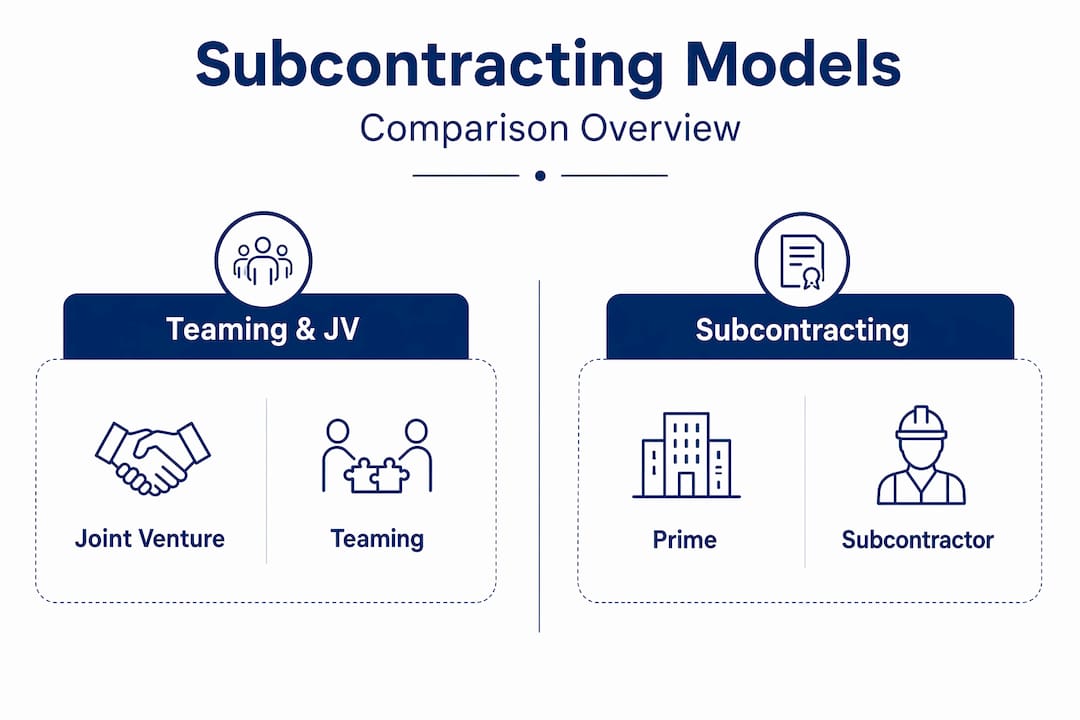
Subcontracting vs partnership models: teaming and joint ventures
Not all collaborative government contracting arrangements are subcontracting partnerships. Project managers who conflate teaming agreements, joint ventures, and subcontracts with one another create structural mismatches that carry real legal and operational consequences.
| Characteristic | Teaming Agreement | Joint Venture | Subcontracting Partnership |
|---|---|---|---|
| When it occurs | Pre-award pursuit | Pre-award or post-award | Post-award performance |
| Legal structure | Informal collaboration | New legal entity | Prime-sub hierarchy under prime contract |
| Privity with government | Prime only | JV entity | Prime only |
| Risk distribution | Shared pursuit risk | Shared performance risk | Prime bears full risk |
| Past performance credit | Separate | Shared (JV past perf.) | Prime earns prime credit |
| Best used for | Competitive positioning | Capacity combination | Defined scope execution |
Teaming agreements are pre-award collaboration tools. They help firms pursue opportunities together without forming a new legal entity. Once the contract is awarded, the team typically transitions into a prime-subcontractor structure. Project managers should treat that transition as a formal milestone requiring a subcontract agreement, not just a continuation of the teaming arrangement.
Joint ventures, by contrast, create new legal entities and share both risk and past performance credit across the venture members. Subcontracting keeps the prime-sub hierarchy intact and concentrates all government-facing accountability with the prime. The choice between these models affects everything from bonding requirements to SBA size standard calculations.
The practical implication for project managers is straightforward. If your teaming agreement assumed that a partner would function as a co-equal, but your post-award contract structure places them as a subcontractor, you now have a management expectation mismatch. Early alignment between pre-award teaming assumptions and post-award subcontract execution plans prevents significant friction.
Practical guidance for managing subcontracting partnerships
Effective subcontracting management is not a compliance checkbox exercise. It is an operational discipline that directly determines project outcomes. The advantages of subcontracting are real, including accessing specialized expertise, meeting small business goals, and distributing technical risk. But those advantages only materialize when the partnership is structured and managed correctly.

The starting point is vendor classification. When screening potential subcontractors, the essential question is whether the vendor's work has a meaningful nexus to contract deliverables. If the answer is yes, the vendor is likely a subcontractor under the FAR, regardless of what the contract calls them. That classification triggers flow-down obligations and compliance monitoring requirements.
The following practices consistently distinguish well-managed subcontracting partnerships from problematic ones:
- Define scope with precision. Vague scopes create performance disputes. A strong subcontractor agreement specifies deliverables, acceptance criteria, timelines, and the specific contract clauses that flow down to the subcontractor.
- Build monitoring into the project plan. Performance monitoring should not be an afterthought. Create a subcontractor performance review cadence from day one, documenting quality, schedule adherence, and compliance status.
- Maintain document trails. Every direction given to a subcontractor, every performance concern raised, and every deviation approved should be in writing. This protects the prime during disputes and audits.
- Leverage certifications strategically. Engaging certified small businesses, particularly SDVOSB or WOSB firms, can advance small business subcontracting plan goals while bringing specialized capabilities to the team.
Pro Tip: When evaluating IT subcontractors for public sector contracts, look for firms that own defined scopes rather than providing staff augmentation. Scope-owning subcontractors tend to deliver cleaner past performance documentation and require less prime oversight on day-to-day execution.
The right IT subcontractor also reduces the prime's compliance overhead, not just its technical workload. This matters enormously on programs where the prime's bandwidth is already stretched across multiple contract requirements.
Common misconceptions and challenges in subcontracting
Several recurring misunderstandings consistently create problems for prime contractors managing subcontracting partnerships. Recognizing them early is the most efficient form of risk management.
- Misclassifying vendors as non-subcontractors. Because labels do not determine subcontractor status under the FAR, primes who classify a critical supplier as a vendor to avoid flow-down obligations are creating a compliance liability. The auditors look at function and necessity, not contract titles.
- Underestimating the administrative workload. A small business subcontracting plan sounds manageable until you are three months into performance and realize that tracking, reporting, and documenting goals across multiple subcontractors demands dedicated staff resources and systematic processes.
- Assuming the teaming agreement covers the subcontract. A teaming agreement is not a subcontract. It does not flow down FAR clauses, define deliverables, or create enforceable performance obligations. Treating it as though it does is a structural error.
- Neglecting dispute prevention in the subcontract agreement. Most subcontract disputes stem from ambiguous scope language, undefined change order processes, or unclear acceptance criteria. A well-structured agreement anticipates these failure points before they occur.
Balancing oversight with operational flexibility is genuinely difficult. Subcontractors perform better when they have enough autonomy to apply their expertise. But the prime cannot afford to step back so far that compliance monitoring lapses. The answer is structured oversight with defined checkpoints, not constant supervision.
My take on what actually makes subcontracting partnerships work
I've watched primes approach subcontracting partnerships with two very different mental models, and the results are consistently predictable based on which one they hold.
The first group treats subcontracting as a procurement exercise. They find a vendor, sign a subcontract, and expect the work to flow. When compliance issues surface, they are genuinely surprised. The second group treats subcontracting as an accountability structure. They invest in the agreement design, the flow-down analysis, and the monitoring cadence before a single deliverable is due. Those primes almost never get blindsided.
What I've learned is that the most undervalued investment in a subcontracting partnership is front-end clarity. A subcontract agreement that precisely defines scope, acceptance criteria, and reporting obligations saves weeks of rework and eliminates most disputes before they start. Regulatory compliance rarely fails because primes don't know the rules. It fails because they didn't operationalize the rules into their actual contract management processes.
The other thing I've observed is that small business subcontracting plans are frequently treated as proposal artifacts rather than living management tools. The moment award happens, the plan gets filed and forgotten until the first ISR is due. That's when the gap between planned goals and actual subcontracting activity becomes visible, and by then it's genuinely difficult to course correct.
Strong subcontracting partnerships are not complex in principle. They require clear roles, written agreements built around compliance requirements, and consistent performance monitoring. The primes who get this right protect their contracts, hit their small business goals, and build a subcontractor bench that gives them a real competitive advantage on future bids.
— Randy
How Primereadysub supports your subcontracting goals
For prime contractors managing IT modernization programs in the public sector, finding a subcontractor that owns a defined scope with minimal oversight is genuinely rare. Primereadysub, operated by Rutledge & Associates, LLC, is certified as an SDVOSB, woman-owned, and SBA-certified small business, which means engaging them directly advances your small business subcontracting plan goals.
Their focus is not staff augmentation. They deliver outcomes across cloud-native modernization, compliance automation, DevOps pipelines, and real-time analytics for state and federal agencies. That scope-owning model reduces the prime's compliance burden while producing the kind of documented, measurable results that strengthen past performance narratives.
If you're a prime managing programs in Maryland, New York, or Florida, explore the prime-ready IT solutions that Primereadysub brings to the table, and learn specifically how they serve prime contractors in complex, compliance-heavy government programs.
FAQ
What is a subcontracting partnership in federal contracting?
A subcontracting partnership is a structured relationship where a prime contractor, who holds the government contract, delegates a defined portion of work to a subcontractor. The prime retains full legal accountability to the government, and the subcontractor has no direct privity with the contracting agency.
How does a subcontractor differ from a vendor or supplier?
The distinction rests on the vendor's role in contract performance. A subcontractor's work has a direct and meaningful nexus to the prime's contract deliverables, which triggers FAR flow-down obligations. A vendor supplying standard off-the-shelf goods without customization for the contract typically does not meet that threshold.
What is a subcontracting plan and when is it required?
A small business subcontracting plan is required when a large contractor receives a federal contract above the applicable dollar threshold. It must include specific goals by small business category, documentation of how the prime will meet those goals, and regular reporting through SBA's Electronic Subcontracting Reporting System.
How does subcontracting differ from a teaming agreement?
Teaming agreements are pre-award arrangements designed to help firms pursue contract opportunities together. Subcontracting is a post-award performance relationship where the prime contracts work to another firm under a formal subcontract agreement with regulatory flow-down obligations attached.
What happens if a prime misclassifies a vendor as a non-subcontractor?
Misclassifying a vendor who performs essential contract work as a non-subcontractor means the required FAR flow-down clauses may never be applied to that relationship. This creates a compliance gap that auditors can identify, potentially resulting in contract performance issues and legal liability for the prime.