

IT risk management is the ongoing discipline of identifying, quantifying, and managing technology-related threats to keep them aligned with an organization's risk appetite. For public sector IT managers, this is not a periodic audit exercise. It is a continuous program anchored to a live risk register, named owners, and measurable thresholds. Frameworks like NIST RMF, ISO 31000, and FAIR provide the structural backbone, while risk appetite statements at the board level translate policy into operational decisions. Agencies that treat this as a one-time project consistently find themselves unprepared when incidents occur. The ones that build it as a living program stay ahead of exposure.
What is the guide to risk management in IT?
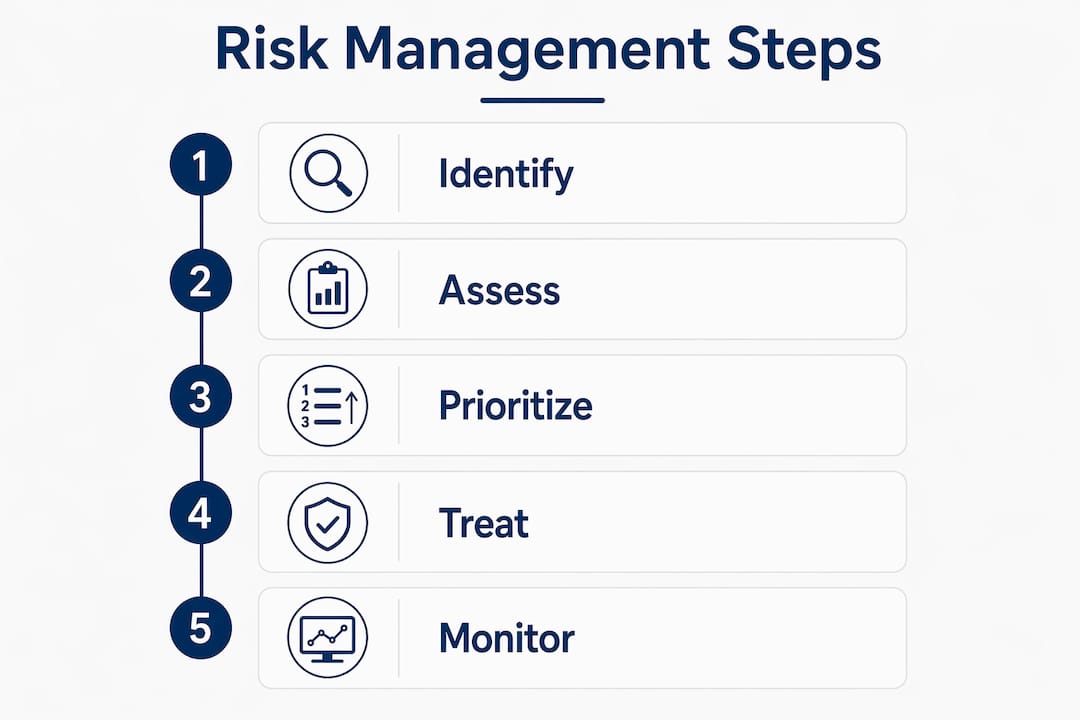
IT risk management is defined by five repeating phases: identification, assessment, prioritization, treatment, and monitoring. Each phase feeds the next, and the cycle never stops. Managing IT risk is a business priority, not just a technical issue, because disruptions cause financial and reputational damage that extends well beyond the IT department.

1. Risk identification
Identification starts with a complete asset inventory. Every server, application, endpoint, and data flow must be cataloged before you can assess what threatens it. This step is where most programs stumble. Asset inventory is the most common failure point in IT risk management, largely because shadow IT applications and legacy systems go undetected during audits. A forgotten procurement portal running on an unsupported server is a real risk, even if no one remembers it exists.
2. Risk assessment
Assessment assigns likelihood and impact to each identified risk. Qualitative methods use scales like High, Medium, and Low. Quantitative methods, such as FAIR (Factor Analysis of Information Risk), assign dollar values to potential losses. Combining qualitative and quantitative methods gives programs both breadth and depth. Qualitative scoring moves fast and works well for initial triage. Quantitative analysis gives executives the financial context they need to approve budgets.
3. Prioritization and treatment
Prioritization ranks risks by their combined score so limited resources go to the highest exposures first. Treatment has four options: mitigate, remediate, accept, or transfer. Remediation fixes the root cause; mitigation reduces the consequence without eliminating the source. Accepting a risk requires a documented decision with a named approver. Transferring risk, typically through cyber insurance or contractual clauses, shifts financial liability but not operational responsibility.
4. Continuous monitoring
Monitoring is what separates a program from a project. Key Risk Indicators (KRIs) track leading signals of increasing exposure. When a KRI crosses a defined threshold, the program escalates automatically rather than waiting for a quarterly review.
Pro Tip: Set KRI thresholds at two levels: a warning level that triggers a review and a critical level that triggers an escalation to leadership. This prevents both under-reaction and alarm fatigue.
How do frameworks like NIST, ISO 31000, and FAIR guide IT risk management?
No single framework covers every need. Public sector agencies typically combine two or three to get full coverage.
NIST RMF's seven-step process (Prepare, Categorize, Select, Implement, Assess, Authorize, Monitor) maps directly to federal mandates and FedRAMP requirements. It is the default standard for federal agencies and widely adopted by state agencies that receive federal funding. Its strength is structure. Its limitation is that it is control-focused rather than risk-quantification-focused.
ISO 31000 operates at a higher level. It provides principles and guidelines for integrating risk management into organizational governance. It does not prescribe specific controls. Instead, it defines how risk management should connect to leadership decisions, resource allocation, and performance measurement. Agencies that need a governance-level framework to satisfy oversight bodies often anchor to ISO 31000.
FAIR fills the quantification gap. It translates risk scenarios into probable financial loss ranges, which is the language that budget committees and elected officials understand. FAIR works best as a complement to NIST or ISO 31000, not as a standalone program.
| Framework | Primary purpose | Best suited for | Key strength |
|---|---|---|---|
| NIST RMF | Structured control selection and authorization | Federal and state agencies with federal funding | Compliance alignment |
| ISO 31000 | Governance-level risk integration | Agencies needing board-level risk oversight | Organizational integration |
| FAIR | Quantitative financial risk analysis | Budget justification and executive reporting | Dollar-value risk estimates |
Pro Tip: Start with NIST RMF for compliance structure, layer ISO 31000 for governance integration, and use FAIR selectively for the top five risks that require budget decisions. Running all three simultaneously from day one creates overhead without proportional benefit.
What are the challenges in managing third-party and supply chain risks?
Third-party risk is the fastest-growing exposure category in public sector IT. 49% of all data breaches originate with third-party vendors. That figure means nearly half of all incidents trace back to a vendor, contractor, or software supplier rather than an internal failure.
The core challenge is visibility. Agencies often have accurate inventories of their own systems but incomplete pictures of what their vendors access, store, or transmit. A managed service provider with privileged access to a state payroll system represents a significant exposure point, even if the agency's own controls are strong.
Practical vendor risk workflows require four consistent actions:
- Vendor inventory: Maintain a current list of all third parties with access to agency systems or data, categorized by access level and data sensitivity.
- Pre-contract assessment: Require vendors to complete a security questionnaire and provide evidence of relevant certifications (SOC 2, FedRAMP, StateRAMP) before contract award.
- Contract clauses: Include breach notification timelines, audit rights, and data handling requirements in every contract. Vague language creates gaps that vendors exploit unintentionally.
- Ongoing monitoring: Review vendor security posture at least annually, or after any significant incident at the vendor. Do not rely solely on the initial assessment.
Agencies vetting IT subcontractors for government projects can apply a structured evaluation process. Primereadysub publishes a detailed breakdown of how to vet IT subcontractors that covers both technical and contractual criteria relevant to public sector programs.
How do you assign risk ownership and ensure accountability?
Risk ownership is the most common structural failure in IT risk programs. A risk assigned to "the IT department" or "the security team" has no real owner. Risks without a named individual and a deadline effectively have no owner at all. Treatment plans stall, remediation dates pass, and the risk register becomes a historical document rather than a management tool.
Effective ownership structures share three characteristics:
- Named individual: One person is accountable for each risk, not a team or a role. That person may delegate tasks, but accountability stays with them.
- Clear deadline: Every open risk has a target remediation or mitigation date. Dates without consequences are suggestions. Build escalation triggers for missed deadlines.
- Regular reporting cadence: Risk owners report status on a defined schedule, monthly for high risks and quarterly for medium and low risks. This keeps the register current and surfaces blockers early.
Public sector agencies face a specific challenge here. Staff turnover, reorganizations, and contractor transitions frequently orphan risks. Build a process to reassign ownership whenever a named owner leaves a role.
Pro Tip: Tie risk ownership to performance reviews for senior IT managers. When risk treatment outcomes appear in annual evaluations, ownership becomes a professional priority rather than an administrative task.
What tools and metrics support continuous monitoring in IT risk management?
The risk register is the single source of truth for the entire program. All dashboards and program documents reflect views of the register, not separate data sources. When the register is current and accurate, every downstream report is reliable. When it is not, every report misleads.
KRIs and KPIs serve different functions. KPIs measure past performance. KRIs measure forward-looking signals of increasing risk. A risk register without KRIs is a historical document, not a management tool. The distinction matters because KPIs tell you what happened; KRIs tell you what is about to happen if no action is taken.
| Metric type | Example | Purpose |
|---|---|---|
| KRI | Percentage of unpatched critical vulnerabilities | Signals rising exposure before an incident |
| KRI | Number of vendors with overdue security reviews | Flags third-party risk accumulation |
| KPI | Mean time to remediate critical findings | Measures program execution speed |
| KPI | Percentage of risks with named owners | Tracks accountability coverage |
Integrating vulnerability scan data directly into the risk register closes the gap between technical findings and management visibility. When a scan identifies a critical finding, it should automatically create or update a risk entry rather than sitting in a separate security tool that leadership never sees. Agencies that use real-time compliance dashboards reduce the lag between detection and executive awareness significantly.
Key Takeaways
Effective IT risk management in the public sector requires a continuous program anchored to a live risk register, named individual owners, and KRIs that signal exposure before incidents occur.
| Point | Details |
|---|---|
| Risk management is continuous | Treat it as a living program with a live register, not a periodic audit project. |
| Framework selection matters | Combine NIST RMF for compliance, ISO 31000 for governance, and FAIR for financial quantification. |
| Third-party risk is the leading exposure | 49% of breaches originate with vendors; maintain a current vendor inventory and require ongoing assessments. |
| Named ownership drives execution | Assign each risk to one individual with a deadline. Team-level assignments produce no accountability. |
| KRIs enable proactive management | Forward-looking indicators tied to thresholds let programs act before incidents occur, not after. |
Why most IT risk programs fail before the first audit
I have seen agencies build technically sound risk registers that collapse within six months. The register is complete, the framework is documented, and the controls are mapped. Then a key staff member leaves, a vendor contract renews without a security review, and three shadow IT applications appear after a department buys a SaaS tool without IT involvement. The program looks intact on paper and is functionally blind in practice.
The uncomfortable reality is that most IT risk programs are built for audits, not for operations. They satisfy a point-in-time requirement and then drift. The agencies that sustain effective programs treat risk management the way they treat financial reporting: as a continuous obligation with real consequences for gaps, not a compliance checkbox.
Two things separate programs that last from those that do not. First, risk appetite is formally defined at the leadership level and reviewed annually. Without a documented risk appetite, every treatment decision is a judgment call with no reference point. Second, shadow IT is treated as a permanent threat, not a one-time discovery. Practitioners consistently find that shadow IT and legacy assets are missed during identification, which undermines the entire prioritization process. Build a standing process to detect new assets quarterly, not just during annual reviews.
Public sector agencies also benefit from connecting risk management to broader IT modernization goals. When risk reduction is tied to modernization outcomes, it gets budget attention and executive sponsorship. Without that connection, it competes for resources against every other IT priority and usually loses.
— Randy
Primereadysub supports public sector IT risk programs
Public sector agencies managing complex IT environments need more than a framework document. They need implementation support that connects risk management to real operational outcomes. Primereadysub, operating as Rutledge & Associates, LLC, specializes in IT modernization for state and government agencies, with direct experience in compliance automation, real-time dashboards, and audit-ready program delivery. As an SDVOSB and SBA-certified firm, Primereadysub works as a high-value subcontracting partner for prime contractors on compliance-heavy programs. Agencies in Maryland, New York, and Florida can explore how IT modernization partnerships translate risk management frameworks into working programs with measurable results.
FAQ
What is IT risk management?
IT risk management is the continuous process of identifying, assessing, prioritizing, and treating threats to an organization's technology environment. It is anchored to a live risk register and aligned to a formally defined risk appetite.
Which framework is best for public sector IT risk management?
NIST RMF is the most widely adopted framework for public sector agencies, particularly those with federal funding or federal reporting requirements. Combining it with ISO 31000 for governance and FAIR for financial quantification provides the most complete coverage.
How often should a risk register be updated?
A risk register should be updated continuously as new risks are identified and existing risks change status. At minimum, high-rated risks require monthly review and all risks require quarterly review.
Why do IT risk programs fail?
The most common failure points are incomplete asset inventories that miss shadow IT, risk assignments without named individuals, and programs built for audit cycles rather than ongoing operations.
What is the difference between a KRI and a KPI in IT risk management?
KPIs measure past performance, such as mean time to remediate. KRIs are forward-looking indicators that signal rising exposure before an incident occurs, such as the percentage of unpatched critical vulnerabilities above threshold.