

Prime contractors and procurement officers evaluating r-associates.com alternatives need partners that satisfy three non-negotiable criteria: demonstrated technical capability in cloud, automation, and data analytics; verifiable federal contracting experience; and full compliance with SBA subcontracting requirements. The strongest substitutes are not generalist IT shops. They are specialized firms that own clearly defined scopes, carry relevant socio-economic certifications, and align with the evaluation framework the 18F De-risking Guide recommends for federal IT procurements.
When screening similar sites to r-associates.com, prioritize:
- Compliance posture: Active SAM registration, SBA certifications (SDVOSB, WOSB, HUBZone), and a subcontracting plan history
- Technical approach: Cloud-native architecture, DevOps pipelines, and compliance automation rather than generic staff augmentation
- Staffing plan: Named personnel with government project experience, not just resumes on file
- Similar experience: Documented government IT modernization outcomes at comparable scope and complexity
- Transparent pricing: Fixed-price or outcome-based models that let you evaluate cost alongside risk
Key criteria to evaluate IT modernization partners for federal contracts
The 18F De-risking Guide identifies four core evaluation factors for federal IT procurements: technical approach, staffing approach, similar experience, and price. Each factor carries real weight, and none should be treated as a checkbox.
- Technical approach: Does the partner propose cloud-native re-architecting, automation, or analytics solutions, or do they default to legacy processes? Proposals that describe specific tools, architectures, and delivery methods signal genuine capability.
- Staffing approach: Look for named key personnel with government IT experience, not generic role descriptions. A staffing plan that identifies who will actually do the work reduces delivery risk.
- Similar experience: Code repositories tied to projects of comparable size and complexity are the most objective evidence of capability. If your evaluation team lacks technical depth, bring in a technical advisor.
- Price: Cost must be weighed against the other three factors. A low bid from a partner with a thin technical approach or unproven staffing plan often costs more in the long run.
- Certifications: SDVOSB, WOSB, 8(a), and HUBZone status affect set-aside eligibility and subcontracting goal credit. Verify these through SAM.gov before shortlisting.
Pro Tip: When reviewing proposals from r-associates.com replacement options, ask each firm to provide a past performance reference from a federal or state agency project of similar scope. Generic commercial references do not translate to government IT delivery.
For a deeper look at applying these criteria, the public-sector vendor selection guide from Primereadysub walks through 18F-aligned evaluation techniques in practical terms.
What federal subcontracting compliance actually requires
Federal subcontracting obligations are not optional at certain contract thresholds. Contracts exceeding the federal threshold for substantial contracts for services, or $1.5 million for construction, require prime contractors to submit an acceptable small business subcontracting plan before award.
- Subcontracting plan content: Goals expressed as percentages of total subcontracted dollars, broken out by socio-economic category (small business, SDVOSB, WOSB, HUBZone, 8(a))
- SAM registration: Every subcontractor must be registered in SAM to certify eligibility for small business and socio-economic program contracts
- Market research: Prime contractors must conduct outreach through SAM, SBA SUB-Net, and business matchmaking events to identify qualified small business subcontractors
- Performance goals: The federal government targets at least 23% of federal contracting dollars going to small businesses annually, with specific sub-goals for each socio-economic program
- Good-faith effort: Agencies verify compliance through subcontracting reports. Failure to make a good-faith effort can affect past performance ratings and future award eligibility.
Any alternative partner you select must carry current SAM registration and the certifications that match your subcontracting plan goals. Verifying this before proposal submission prevents compliance gaps that can delay or void awards.
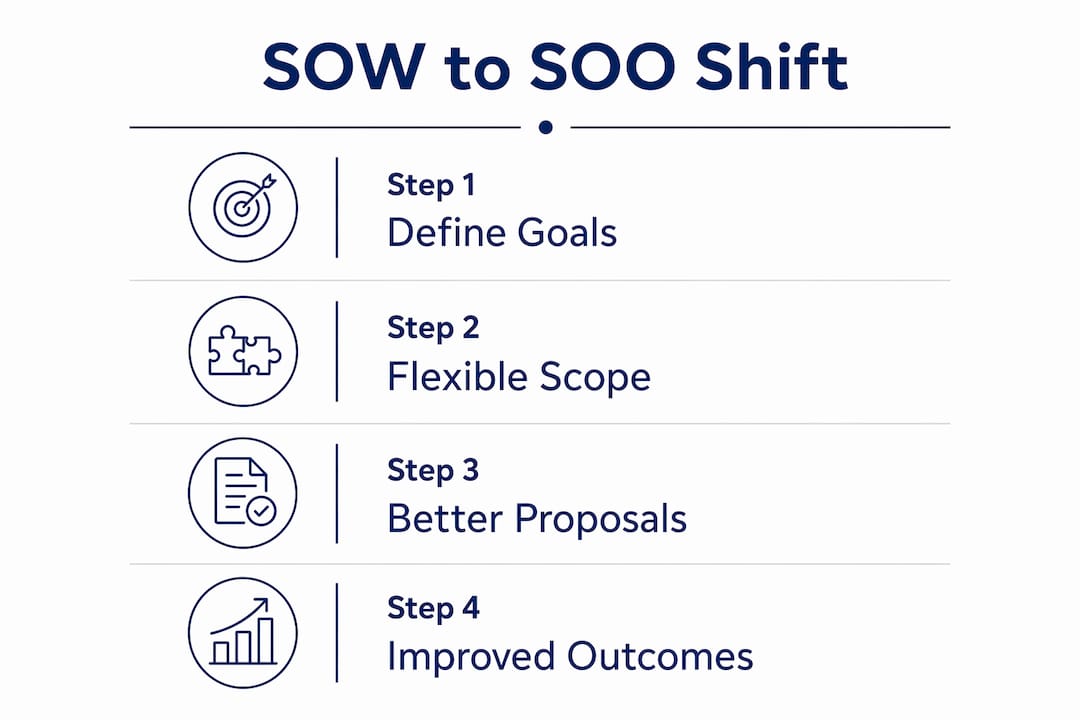
Why shifting from SOW to SOO produces better IT modernization outcomes
The Statement of Objectives model gives partners the latitude to propose modern technical solutions rather than conforming to a prescriptive process the agency defined years ago. GSA guidance confirms that SOO-based solicitations invite partners to propose how they will meet agency objectives, rather than dictating the method.
- SOW model: Prescribes specific tasks, deliverables, and processes. Works well for commodity services but constrains innovation in IT modernization.
- SOO model: States the agency's goals and desired outcomes. Partners propose their own technical approach and staffing plan, which surfaces more capable and creative solutions.
- Proposal quality: Under SOO, a partner's technical approach section becomes a genuine differentiator. Firms that default to staff augmentation or COTS promises without verification tend to underperform against partners with purpose-built delivery models.
- COTS caution: The De-risking Guide warns that COTS and SaaS solutions often require extensive modification before fitting government regulatory needs. Verify vendor claims by contacting other agencies that have deployed the same product.
Procurement officers who shift to SOO models consistently receive proposals that better reflect what modern IT modernization actually looks like: cloud-native architecture, automated compliance pipelines, and real-time reporting rather than legacy system maintenance dressed up in new language.
Rutledge & Associates as a leading alternative IT modernization partner
Rutledge & Associates, LLC operates as a specialized digital systems firm focused on modernizing legacy government IT through cloud-native re-architecting, automation, data analytics, and security solutions. The firm holds SDVOSB, woman-owned, and SBA certifications, making it directly applicable to multiple socio-economic subcontracting goal categories.
- Technical capabilities: DevOps pipelines, compliance automation, real-time dashboards, and audit readiness solutions built for public sector regulatory environments
- Scope ownership model: The firm takes ownership of clearly defined scopes rather than providing staff augmentation, which reduces prime contractor oversight burden on complex, compliance-heavy programs
- Government client base: Active experience serving state agencies and government departments in Maryland, New York, and Florida
- Outcome focus: Documented results include reduced processing times, improved audit compliance, and real-time program visibility for agency clients
- Certifications: SDVOSB and WOSB status supports prime contractors' subcontracting plan goals across multiple socio-economic categories simultaneously
For prime contractors evaluating r-associates.com competitors, Rutledge & Associates represents a partner that aligns with 18F evaluation criteria on all four dimensions: a defined technical approach, named staffing, government-specific similar experience, and outcome-based pricing.
Profiles of leading alternative subcontractors in federal IT modernization
The federal IT modernization subcontracting market includes several firm categories worth evaluating alongside r-associates.com substitutes.
Outcome-focused small business specialists like Rutledge & Associates take ownership of defined deliverables, such as compliance automation or cloud migration, rather than billing by the hour. This model fits prime contractors who need a subcontractor to perform independently within a larger program structure. For a comparison of firms with this profile, the government IT contracting guide from Primereadysub covers essential procurement principles and subcontracting structures.

Certified socio-economic firms with active 8(a), HUBZone, or SDVOSB status address multiple subcontracting plan goals simultaneously. Prime contractors working under contracts above the $750,000 threshold benefit from partners whose certifications count toward multiple goal categories in a single subcontract. Evaluating firms with this profile is also covered in the Sciproglobal.com alternatives analysis, which examines technical approach and staffing criteria for government IT bids.
Analytics and automation specialists focus on data pipeline modernization, real-time reporting, and automated compliance monitoring. These firms are particularly relevant for agencies managing high-volume transactions or audit-intensive programs where manual reporting creates compliance risk.
What strong performance looks like in federal IT modernization contracts
The most instructive performance patterns in federal IT modernization subcontracting share a common structure: a clearly scoped deliverable, a defined technical method, and a measurable outcome tied to agency operations.
Firms that have replaced manual compliance reporting with automated audit pipelines for state agencies consistently demonstrate two results: faster audit cycle times and fewer findings per audit period. Both outcomes are directly attributable to the technical approach, not the volume of hours billed. This pattern aligns with what the 18F De-risking Guide identifies as the predictor of contract success: a partner whose technical approach and staffing plan are specific enough to evaluate before award.
Cloud migration projects that follow a cloud-native re-architecting model, rather than a lift-and-shift approach, tend to produce more durable outcomes. Agencies that have moved workloads to cloud-native architectures report improved system availability and reduced infrastructure maintenance costs compared to agencies that migrated legacy applications without re-architecting them.
Geographic coverage and federal agency reach of alternative partners
Federal IT modernization subcontractors vary significantly in their geographic footprint and agency relationships. Prime contractors should assess coverage relative to the performance location requirements in their prime contract.
Rutledge & Associates maintains active government relationships in Maryland, New York, and Florida, three states with substantial federal agency presence and active IT modernization programs. Firms operating in the Washington, D.C. metro area often hold relationships with civilian federal agencies through state and local contract vehicles that translate to federal subcontracting experience. Remote delivery capability has become a practical standard for cloud and automation work, meaning geographic proximity matters less for technical delivery than it does for on-site compliance reviews or agency stakeholder meetings. Confirm whether your prime contract requires on-site presence before filtering partners by location alone.
Red flags and critical questions when evaluating government IT subcontractors
Certain patterns in subcontractor proposals consistently predict delivery problems in federal IT modernization programs.
Questions to ask every candidate:
- Can you provide a past performance reference from a government IT modernization project of comparable scope?
- Who are the named key personnel, and what is their specific government IT experience?
- How do you handle scope changes within a fixed-price or outcome-based engagement?
- Is your SAM registration current, and which SBA certifications are active?
Red flags that warrant disqualification:
- Proposals that describe COTS or SaaS solutions as working "out of the box" without referencing agency-specific customization experience
- Staffing plans that list roles without naming personnel or describing their government project history
- Pricing that is significantly below market without a clear explanation of how the scope is bounded
- No documented similar experience at the federal or state government level
For additional guidance on improving contract outcomes through subcontractor selection, Primereadysub covers the performance and compliance factors that most affect federal IT program success.
Key Takeaways
The strongest r-associates.com alternatives combine SBA certifications, a defined technical approach, and documented government IT modernization outcomes that satisfy 18F evaluation criteria.
| Point | Details |
|---|---|
| Compliance thresholds matter | Federal contracts exceeding $750,000 for services or $1.5 million for construction require a formal small business subcontracting plan before award. |
| Four evaluation factors | The 18F De-risking Guide recommends assessing technical approach, staffing, similar experience, and price together. |
| SOO over SOW | Statement of Objectives models invite modern technical proposals rather than locking partners into legacy processes. |
| Certifications drive goal credit | SDVOSB and WOSB certifications count toward multiple socio-economic subcontracting goal categories simultaneously. |
| SAM registration is prerequisite | Every subcontractor must hold active SAM registration to qualify for small business and socio-economic program contracts. |