

Public-sector vendor selection is defined as the formal process by which government agencies evaluate, score, and award contracts to suppliers based on technical capability, financial stability, and regulatory compliance. This guide to public-sector vendor selection addresses the full procurement lifecycle, from early market engagement through contract governance, with particular focus on IT modernization projects. Federal standards like FAR Part 39 now shape how agencies structure solicitations and deliverables. The public sector procurement process typically spans 2 to 18 months after verbal commitment, depending on deal size and procurement path. That range reflects the complexity procurement officers face daily.
What are the essential vendor evaluation criteria in public procurement?
Vendor evaluation in public procurement requires scoring suppliers across five core dimensions: financial health, past performance, technical expertise, regulatory compliance, and overall value. Price alone does not predict delivery success, especially in IT modernization where technical debt and security risk compound over time.
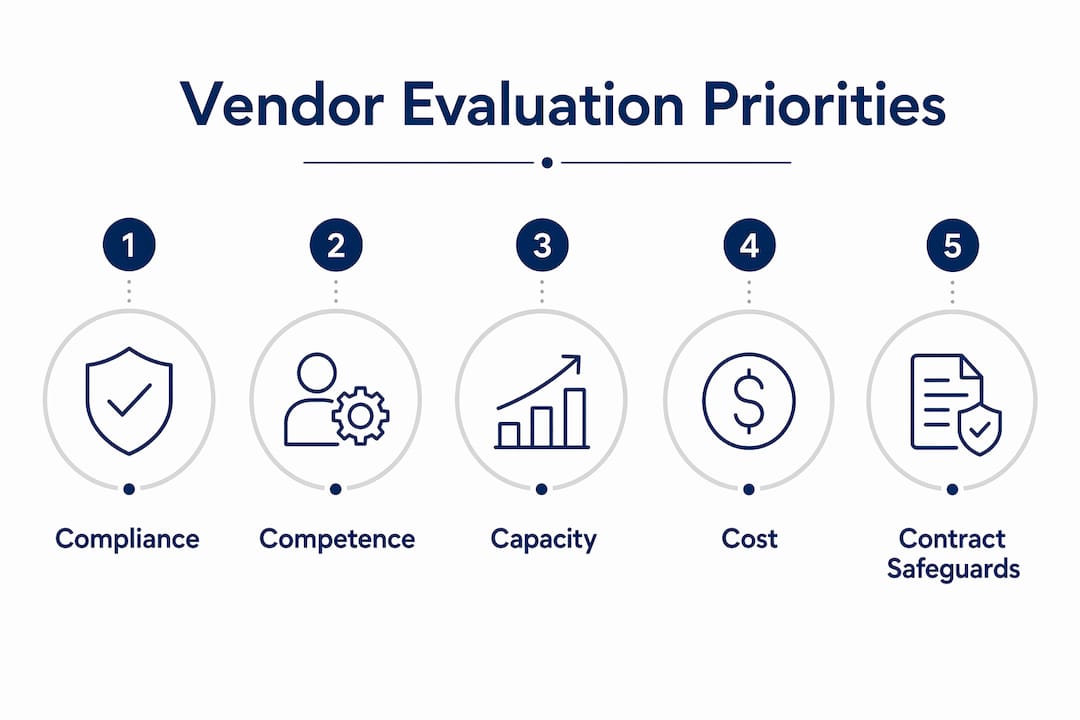
The 10 Cs of supplier selection provides a structured framework that goes well beyond cost. The criteria include competence, capacity, commitment, control, cash, cost, consistency, culture, clean (ethical standing), and communication. Each criterion addresses a dimension of supplier risk that a price-only review misses entirely.
Weighting scores give procurement officers a defensible, auditable basis for decisions. A typical IT modernization scorecard might assign 30% to technical capability, 25% to past performance, 20% to compliance posture, 15% to price, and 10% to management approach. Adjusting weights to reflect project risk produces more accurate vendor rankings than flat scoring.
Key evaluation dimensions to include in every vendor assessment checklist:
- Financial health: Audited financials, bonding capacity, and cash flow stability
- Technical expertise: Demonstrated experience with cloud-native architecture, DevOps pipelines, and compliance automation
- Past performance: Verified references from comparable public-sector contracts
- Regulatory compliance: Active FedRAMP authorization, FISMA alignment, and Section 508 accessibility
- Value proposition: Total cost of ownership across the full contract period, not just year-one pricing
Pro Tip: Avoid lowest-price technically acceptable (LPTA) evaluation models for IT modernization. LPTA works for commodity purchases. For complex systems work, it consistently selects vendors who underestimate scope and then seek modifications.
How have 2025–2026 regulatory updates transformed IT vendor selection?
Two regulatory changes now define the federal IT procurement environment. Both carry direct consequences for how procurement officers structure solicitations and evaluate vendors.
-
FAR Part 39 modular contracting: The updated rule requires modular contracting for federal IT acquisitions, with each component delivered within a maximum of 18 months from solicitation date. Monolithic multi-year contracts are no longer compliant. This forces vendors to demonstrate agile delivery capability, not just long-term project management credentials.
-
OMB M-26-10 CIO oversight: The OMB memo mandates centralized CIO control over IT contracts, with agencies submitting monthly logs to the Federal CIO covering utilization rates and pricing transparency. The goal is to prevent price gouging and eliminate redundant technology investments across agencies.
-
Security and accessibility requirements: Vendors must now document FedRAMP authorization status, zero-trust architecture alignment, and Section 508 compliance as baseline requirements, not optional additions.
-
Roadmap transparency mandates: Agencies increasingly require vendors to submit product roadmaps as part of solicitation responses, with quarterly review commitments built into contract terms.
-
Protest risk management: Centralized CIO review creates a documented record that strengthens agency positions in bid protest proceedings.
"Centralized CIO control and monthly IT contract transparency are redefining procurement oversight, making standardized architecture and pricing transparency critical for every vendor entering the federal market."
The practical implication is clear. Procurement officers must now build modular deliverable schedules into every IT solicitation. Vendors who cannot demonstrate 18-month delivery cycles for discrete components will not survive technical evaluation. This shifts the competitive advantage toward firms with proven agile delivery records in government environments.
What practical steps improve vendor selection outcomes in IT modernization?
The highest-value period in any procurement cycle is the pre-solicitation phase. Early engagement, 6 to 18 months before formal RFP, gives procurement officers the time to define clear, measurable requirements and shape evaluation criteria before vendors begin responding. Waiting until the RFP drops to clarify requirements produces vague solicitations that attract unqualified bidders.

Requirements development works best when end-users, IT architects, and procurement officers collaborate directly. End-users identify functional gaps. IT teams translate those gaps into technical specifications. Procurement officers convert specifications into evaluation criteria with measurable thresholds. This three-way collaboration produces solicitations that vendors can price accurately and agencies can evaluate objectively.
Practical steps that consistently improve selection outcomes:
- Start market research early: Issue Requests for Information 12 months before solicitation to understand vendor capabilities and realistic pricing ranges.
- Form cross-functional evaluation committees: Include economic buyers, IT leads, security officers, and end-user representatives. Each role catches blind spots the others miss.
- Define measurable acceptance criteria: Specify latency thresholds, uptime requirements, and data processing benchmarks in the solicitation, not after award.
- Use competitive negotiation models for complex buys: Narrowing to a final pool of three vendors enables nuanced trade-offs on risk, innovation, and contract flexibility that traditional RFP checklists cannot capture.
- Score independently before committee discussion: Individual scoring before group deliberation reduces anchoring bias and produces more reliable rankings.
Pro Tip: Document every evaluation committee decision with written rationale, not just scores. Thorough documentation is the single most effective defense against a successful bid protest.
For procurement officers managing IT partner selection across multiple agencies or programs, a standardized evaluation playbook reduces inconsistency and speeds each subsequent procurement cycle.
How to integrate performance validation and contract safeguards into vendor agreements?
Contract terms set at award determine whether a vendor relationship succeeds or fails over a multi-year engagement. Performance service level agreements (SLAs) must include measurable metrics, not aspirational language. Latency targets expressed as p95 and p99 percentiles, availability minimums of 99.9% or higher, and incident response time windows give agencies objective grounds for remediation or termination.
Roadmap transparency requirements protect agencies from sudden feature removals that disrupt operations. Contracts should require quarterly roadmap reviews and a minimum 90-day deprecation notice before any feature is retired. That notice window gives agencies time to adjust workflows or procure replacement capabilities without service disruption.
| Contract Safeguard | Recommended Standard | Risk Addressed |
|---|---|---|
| Availability SLA | 99.9% uptime minimum | Service continuity |
| Latency SLA | p95 response under 500ms | Performance degradation |
| Deprecation notice | 90 days minimum | Feature removal disruption |
| Data egress rights | Full export within 30 days | Vendor lock-in |
| Roadmap review | Quarterly joint sessions | Misaligned product direction |
Data egress and migration rights deserve explicit contract language. Agencies that cannot extract their data within a defined window after contract termination face operational paralysis and significant re-procurement costs. Requiring full data export within 30 days of contract end, in a standard format, eliminates this risk at the drafting stage.
Joint governance boards with defined escalation paths keep vendor relationships on track between formal reviews. A board that meets monthly, reviews SLA performance, and has authority to trigger remediation plans catches problems before they become contract disputes.
Pro Tip: Include dual-run windows in contracts for major feature migrations. Requiring vendors to operate old and new functionality in parallel for 60 days eliminates the risk of a forced cutover that breaks dependent agency workflows.
What jurisdictional variations and cooperative purchasing options matter most?
Public procurement rules vary significantly across federal, state, and local jurisdictions. Sole-source thresholds range from under $10,000 in some local governments to $250,000 or higher at the federal level. Procurement officers who assume federal rules apply to state or local contracts create compliance exposure that surfaces during audits.
Cooperative purchasing agreements offer the most direct path to faster vendor selection. NASPO ValuePoint and Sourcewell allow agencies to purchase off competitively bid master contracts, bypassing the full RFP cycle entirely. This reduces procurement timelines from months to weeks for commodity and near-commodity IT services.
Key considerations for cooperative purchasing and jurisdictional compliance:
- Verify piggyback clause authority: Not all jurisdictions permit cooperative purchasing. Confirm statutory authority before using a cooperative contract.
- Check pricing alignment: Cooperative contract pricing must meet or beat what the agency could achieve through its own competitive process to satisfy auditors.
- Understand K-12 versus higher education rules: K-12 districts often face stricter competitive bidding thresholds and board approval requirements than state universities operating under more flexible procurement authority.
- Use pre-approved vendor lists strategically: Many state agencies maintain qualified vendor lists that allow faster award for pre-vetted suppliers. Getting on these lists requires proactive engagement, not reactive bidding.
Procurement officers managing public-sector IT partnerships across multiple jurisdictions benefit from maintaining a jurisdiction-specific compliance matrix. That matrix tracks sole-source thresholds, cooperative purchasing authority, and approval chain requirements for each entity the agency works with regularly.
Key Takeaways
Effective public-sector vendor selection requires combining structured evaluation criteria, regulatory compliance, early market engagement, and enforceable contract safeguards across every phase of the procurement lifecycle.
| Point | Details |
|---|---|
| Use the 10 Cs framework | Evaluate vendors across competence, capacity, compliance, and eight other criteria beyond price. |
| Engage 6–18 months early | Pre-solicitation engagement produces clearer requirements and stronger evaluation criteria. |
| Apply FAR Part 39 modular rules | Structure IT deliverables in components with a maximum 18-month delivery window per module. |
| Build SLAs with measurable metrics | Require p95 latency targets, 99.9% uptime, and 90-day deprecation notices in every IT contract. |
| Use cooperative purchasing strategically | NASPO ValuePoint and Sourcewell contracts cut procurement timelines significantly where authorized. |
What I've learned about procurement that most guides won't tell you
The most consequential shift I've observed in public-sector procurement is not regulatory. It is cultural. Procurement officers who treat vendor selection as a compliance exercise produce compliant contracts that fail operationally. Officers who treat it as strategic risk management produce contracts that deliver outcomes.
The vendors who win the best public-sector IT contracts are not always the ones with the lowest price or the longest past performance list. They are the ones who engaged 12 months before the RFP dropped, shaped the evaluation criteria through market research responses, and arrived at solicitation with a solution already calibrated to the agency's actual problem. Procurement officers who understand this dynamic can use it. Issuing a detailed RFI early, then tracking which vendors respond with genuine technical depth, tells you more about vendor capability than any proposal document.
The governance piece is where most contracts quietly fail. Award is treated as the finish line when it is actually the starting line. Joint roadmap boards, monthly SLA reviews, and documented escalation paths are not bureaucratic overhead. They are the mechanisms that keep a vendor accountable when the project hits its inevitable complications. Build them into the contract before award, not after the first missed milestone.
— Randy
How Primereadysub supports public-sector IT modernization
Rutledge & Associates, LLC operates as a prime-ready IT modernization partner for state agencies and government departments navigating complex procurement and compliance requirements. Certified as an SDVOSB, woman-owned, and SBA-certified firm, Primereadysub delivers outcomes-driven modernization services including DevOps pipelines, compliance automation, and real-time program dashboards. These capabilities align directly with the modular contracting requirements under FAR Part 39 and the CIO oversight mandates in OMB M-26-10. Primereadysub operates in Maryland, New York, and Florida, providing high-value, low-oversight subcontracting for prime contractors managing compliance-heavy programs. Procurement officers looking for a qualified IT modernization partner with a documented delivery record can review Primereadysub's Maryland-specific services for regional program support.
FAQ
What is public-sector vendor selection?
Public-sector vendor selection is the formal government process of evaluating and awarding contracts to suppliers based on technical capability, compliance, and value. The process typically spans 2 to 18 months depending on contract size and procurement path.
What does FAR Part 39 require for IT contracts?
FAR Part 39 requires modular contracting for federal IT acquisitions, with each deliverable component completed within a maximum of 18 months from solicitation date. Monolithic multi-year IT contracts no longer meet federal compliance standards.
How do cooperative purchasing agreements speed up procurement?
Cooperative agreements like NASPO ValuePoint and Sourcewell allow agencies to buy off pre-competed master contracts, eliminating the need for a full RFP cycle. This reduces procurement timelines from months to weeks where jurisdictional authority permits their use.
What SLA terms should every IT vendor contract include?
Every IT vendor contract should specify a minimum 99.9% availability requirement, p95 latency thresholds, a 90-day feature deprecation notice period, and full data egress rights within 30 days of contract termination.
When should procurement officers begin vendor engagement?
Procurement officers should begin market research and vendor engagement 6 to 18 months before the formal solicitation date. Early engagement produces clearer requirements, more competitive responses, and stronger evaluation criteria.