

Effective IT project staffing for government modernization comes down to three decisions made early: who is on the team, how their roles are defined, and whether the staffing model can adapt as the project evolves. Agencies and contractors that get these decisions right tend to deliver on time; those that treat staffing as a secondary concern often face lengthy hiring delays that derail even well-funded programs. This IT project staffing guide addresses each decision with specificity, drawing on federal guidance from the U.S. Department of Energy and the Government Accountability Office (GAO).
The core elements of a sound government IT staffing plan include:
- Team composition that reflects the actual technical work: cloud engineers, DevOps practitioners, security specialists, and product owners, not just project managers
- Clear role definitions with documented accountability for both government and contractor staff
- Alignment with federal standards such as FISMA, CMMC, and FedRAMP from the earliest planning phase
- Integrated Program Teams (IPTs) that blend internal agency expertise with vendor capability
- A multi-pronged workforce strategy combining hiring, contracting, cross-training, and automation
- Continuous staffing adjustments tied to project milestones rather than fixed at contract award
Table of Contents
- How to evaluate vendor staffing proposals for government IT projects
- How Integrated Program Teams (IPTs) structure government IT modernization
- Why a multi-pronged staffing strategy addresses the IT skills gap
- Expert insights on IT modernization staffing from Primereadysub and Rutledge & Associates
- Key Takeaways
How to evaluate vendor staffing proposals for government IT projects
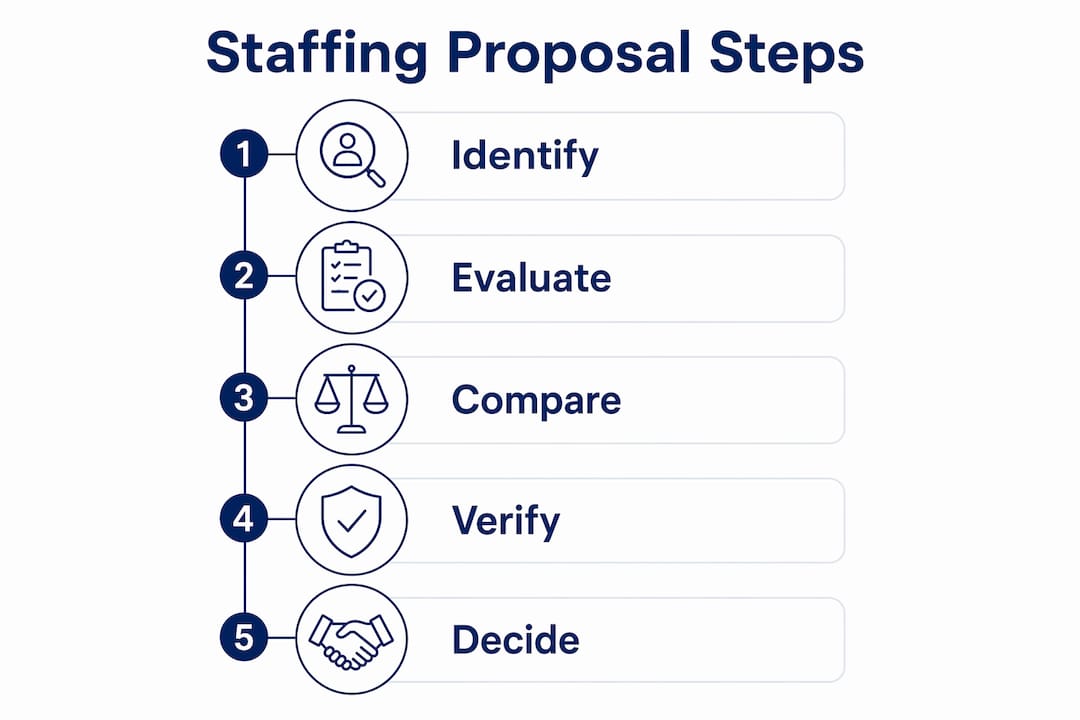
The strongest signal in any vendor proposal is not the methodology section. Staffing approach is a far more reliable indicator of how much iterative development experience a vendor actually has. Agencies should structure solicitations so that evaluation focuses explicitly on stated skills and team composition rather than general project management philosophy.
Several criteria consistently separate strong proposals from weak ones:
- Team composition over credentials: Look for named roles that reflect modern development practices, including technical leads, product owners, and design leads, not just program managers with PMP certifications.
- Key personnel discipline: Limit named key personnel to two or three positions at most, typically a project lead, a technical lead, and optionally a design lead. Requiring dozens of named personnel creates rigidity in a fluid talent market without improving quality control.
- Verbal interviews: Verbal interview sessions with key personnel, structured as timed, unstructured question-and-answer exchanges, confirm whether the people named in a proposal can actually do the work described. Written proposals alone cannot verify this.
- Agile and iterative experience: Proposals should demonstrate familiarity with sprint-based delivery, continuous integration, and iterative testing, not waterfall assumptions dressed in agile language.
- Security and compliance readiness: Vendors should identify applicable frameworks, such as FISMA or CMMC, and show they have addressed clearance requirements before the project begins, not after award.
Pro Tip: Avoid the temptation to over-specify staffing requirements in the solicitation. Overly rigid requirements narrow the competitive field without improving outcomes. Focus evaluation criteria on demonstrated experience and team dynamics, then use verbal interviews to validate what the proposal claims.
Reviewing how to vet IT subcontractors before award can help agencies build more defensible evaluation frameworks.

How Integrated Program Teams (IPTs) structure government IT modernization
IPTs are cross-functional teams that combine government staff and contractor personnel under a shared governance structure. The GAO identifies three characteristics that define a high-performing IPT: effective executive leadership, a well-composed team, and clear operational processes. Each characteristic depends on the others; a well-composed team with weak executive oversight tends to drift when project scope shifts.
The structural elements of a functioning IPT include:
| IPT Component | Purpose | Who Owns It |
|---|---|---|
| Formal charter | Documents purpose, scope, goals, and performance measures | Executive leadership |
| Executive review | Ensures alignment with mission at each project phase | Agency CIO or IV-D Director |
| Core team roles | Assigns technical, design, product, and PM responsibilities | Program manager |
| Subject matter experts | Rotate in and out based on phase-specific needs | Agency and vendor leads |
| Accountability mechanisms | Tracks deliverables and flags scope changes | Government product owner |
The charter is not a formality. IPT charters must be reviewed and updated at the start of each work phase, with executive concurrence documented each time. Agencies that skip this step often find that the team's original scope no longer matches the project's actual direction by the midpoint of delivery.
Government staff in leadership roles within the IPT serve a function vendors cannot replicate. In-house technical staff can credibly assess vendor deliverables and confirm contract adherence in ways that external parties cannot. Placing a government product owner at the center of day-to-day vendor interaction, rather than delegating that role to the vendor itself, is one of the clearest differentiators between programs that deliver and those that stall.
For agencies managing multiple contractors, guidance on multi-partner IT projects offers practical frameworks for keeping IPT coordination functional across organizational boundaries.
Why a multi-pronged staffing strategy addresses the IT skills gap
The federal government cannot hire its way out of the IT skills gap. The U.S. Department of Energy's Scaling IT Modernization Playbook states this directly: a single approach is insufficient, and agencies must combine hiring, contracting, cross-training, and automation to build the workforce capacity that modernization requires. Relying on permanent hiring alone produces the kind of timeline delays that push project costs well beyond original estimates.
A practical multi-pronged strategy works across four tracks, echoing broader strategie per la protezione dati nelle PMI italiane that emphasize hiring, contracting, and workforce development approaches.
- Hiring with pipeline thinking: Treat talent acquisition as a continuous function, not a vacancy response. Agencies that build candidate pipelines before roles open consistently reduce time-to-fill compared to those that begin recruiting only after a position becomes urgent.
- Contracting and staff augmentation: Contract staffing fills specialist roles, particularly in cybersecurity, cloud architecture, and DevOps, faster than permanent hiring can. The key is defining the scope of contractor work clearly enough that oversight remains manageable.
- Cross-training internal staff: The Department of Energy playbook recommends that agencies incentivize training by declaring it a business goal, allocating dedicated time during work hours, and tying skill development to specific project outcomes. Cross-training reduces dependency on any single vendor or contractor for critical capabilities.
- Automation as a workforce multiplier: Automating compliance checks, reporting workflows, and testing pipelines reduces the volume of manual work that requires scarce specialized staff. This is particularly relevant for agencies managing FISMA compliance or audit documentation at scale.
Compliance documentation and clearance requirements must be identified before recruitment begins, not after a candidate is selected. Preparing security frameworks in advance, including background investigation tiers and applicable compliance packages, consistently reduces onboarding delays. Agencies that assemble this documentation from scratch for each placement extend their hiring timelines unnecessarily.
Expert insights on IT modernization staffing from Primereadysub and Rutledge & Associates
Primereadysub, operating as Rutledge & Associates, LLC, brings a specific perspective to government IT staffing: the most effective modernization partnerships are built around clearly defined deliverables, not open-ended staff augmentation. The firm is certified as an SDVOSB (Service-Disabled Veteran-Owned Small Business), woman-owned, and SBA-certified, with active work across state and federal agencies in Maryland, New York, and Florida. That combination of certifications and public-sector focus shapes how the firm approaches staffing for complex, compliance-heavy programs.
The practical staffing principles that emerge from this experience include:
- Own the scope, not just the headcount. Subcontracting arrangements that define outcomes, rather than hours, give prime contractors cleaner oversight and give agencies clearer accountability.
- Keep in-house technical leadership in the decision seat. Vendor teams perform better when a government product owner or technical lead is actively engaged, not passively receiving status reports.
- Align staffing plans with compliance timelines. For programs subject to FedRAMP, CMMC, or state-level audit requirements, staffing decisions made without reference to compliance milestones create downstream bottlenecks.
- Use automation to extend the reach of your technical staff. DevOps pipelines, compliance automation, and real-time dashboards reduce the manual burden on specialized roles, allowing smaller teams to maintain audit readiness without constant intervention.
- Build for low oversight, not zero oversight. The goal of a well-structured subcontracting arrangement is to reduce the management burden on the prime, not to eliminate visibility entirely.
Outcome-driven subcontracting with well-defined deliverables consistently produces better results than arrangements where scope is left to evolve informally. The most effective modernization projects balance internal government leadership with external vendor expertise, using both for iterative delivery rather than assigning one side all the technical authority.
Agencies and prime contractors evaluating their current staffing approach can find additional context in Primereadysub's guidance on IT partnership success for public sector projects.
Key Takeaways
Effective government IT modernization staffing requires structured IPTs, multi-pronged workforce strategies, and outcome-defined vendor scopes aligned with federal compliance requirements from the start.
| Point | Details |
|---|---|
| Evaluate proposals by team composition | Focus solicitations on stated skills and staffing models, not general methodology; limit key personnel clauses to two or three roles. |
| Charter and review IPTs at every phase | IPT charters must be updated with executive concurrence at the start of each work phase to stay aligned with shifting mission needs. |
| Combine four workforce tracks | Hiring, contracting, cross-training, and automation together address the IT skills gap; no single approach is sufficient on its own. |
| Prepare compliance documentation early | Identifying applicable frameworks such as FISMA or CMMC before recruitment begins consistently reduces onboarding and clearance delays. |
| Define subcontract scopes by outcome | Arrangements built around deliverables rather than hours give prime contractors cleaner oversight and agencies clearer accountability. |