

Government agencies and contractors face a recurring challenge: teams with overlapping missions rarely operate as one. Knowing how to improve agency collaboration is not a matter of goodwill alone. It requires deliberate structure, the right technology, and communication protocols that hold up under the pressure of compliance deadlines, budget constraints, and multi-stakeholder scrutiny. This guide walks through the foundational prerequisites, execution strategies, common pitfalls, and measurement frameworks that produce measurable results on public-sector projects.
Table of Contents
- Key takeaways
- How to improve agency collaboration: the foundational prerequisites
- Step-by-step strategies to boost collaboration during execution
- Common pitfalls in agency collaboration
- Measuring improved collaboration outcomes
- My perspective on what actually changes outcomes
- Putting these strategies to work with the right partner
- FAQ
Key takeaways
| Point | Details |
|---|---|
| Build trust before tools | Psychological safety and clear roles must exist before any collaboration technology delivers value. |
| Define communication protocols | A communication charter specifying which tool serves which purpose prevents information silos from forming. |
| Involve agencies early | Proactive engagement at the planning phase prevents costly reactive firefighting later in the project. |
| Measure both dimensions | Track quantitative indicators like meeting recurrence and qualitative feedback to assess collaboration health. |
| Run pilots before scaling | Test new collaboration approaches with a small team before rolling them out organization-wide. |
How to improve agency collaboration: the foundational prerequisites
Before any collaboration strategy takes hold, three conditions must exist: trust, clarity, and the right tools in the right order. Skipping any one of them is why many public-sector collaboration efforts stall after a promising start.
1. Psychological safety and trust
Teams with trust share ideas more openly and produce higher-quality collaborative outcomes. In government settings, where accountability structures are steep and political dynamics are real, trust does not form automatically. It requires consistent behavior from leadership: acknowledging uncertainty, crediting contributions, and modeling candid communication. Contractors working within agency environments face this acutely. They are often perceived as outsiders until they demonstrate reliability through delivery, not promises.
2. A communication charter
One of the most practical ways to improve agency communication is to define which tool serves which purpose before the project begins. A defined communication charter specifying, for example, that Slack handles quick questions, Asana tracks task progress, and email covers formal documentation, actively prevents information silos. Without this structure, teams default to parallel channels that fracture institutional knowledge.
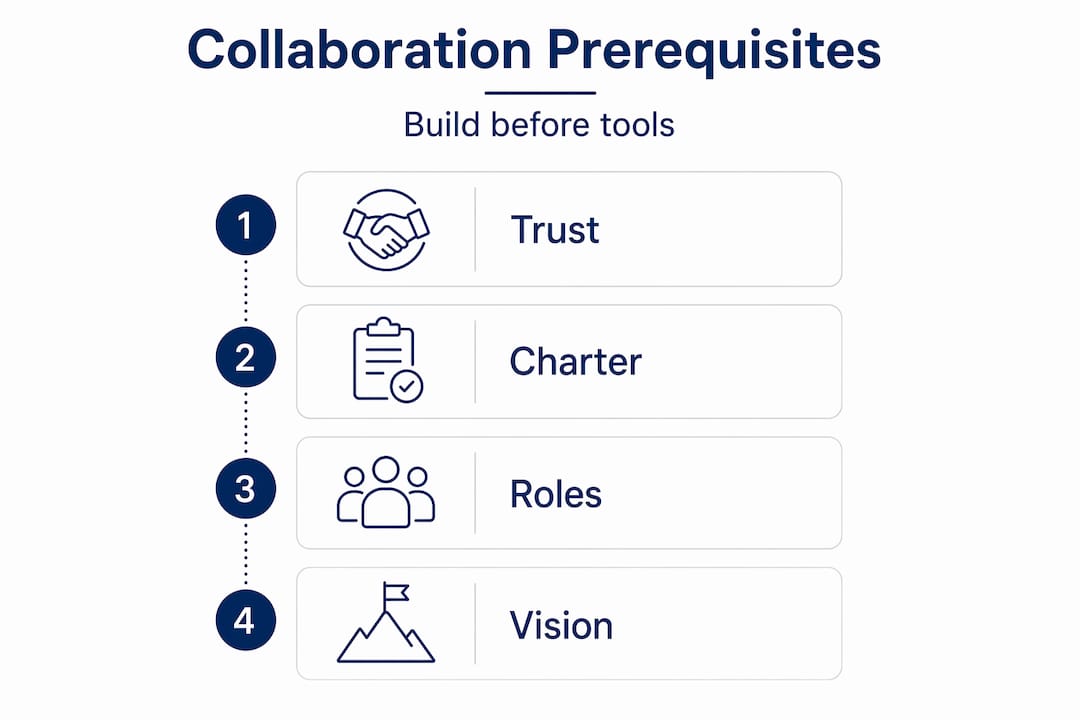
3. Clear roles and ownership frameworks
Frameworks like RACI and DACI clarify who is Responsible, Accountable, Consulted, and Informed on each deliverable. In multi-contractor and multi-agency environments, role ambiguity is a primary source of duplicated work and missed handoffs. Assigning these roles at project kickoff, and revisiting them at phase transitions, reduces confusion without restricting how individuals do their work.

4. Technology that fits the workflow
Introducing tools without a communication charter risks creating more silos and confusion, not less. Collaboration tools for agencies must be selected based on what workflows already exist, then configured to support them. A new project management platform that nobody uses consistently is worse than a shared spreadsheet everyone trusts.
- Audit existing tools before adding new ones
- Align tool selection with IT security and procurement requirements
- Train teams on when to use each tool, not just how
- Plan for onboarding contractors who may use different systems
5. A shared vision
Teams that agree on the destination tolerate disagreements about the route. A shared vision statement for the project, reviewed and acknowledged by all agencies and contractors at the outset, creates a reference point that outlasts personnel changes.
Pro Tip: Before your first cross-agency meeting, send a short pre-meeting prompt asking each participant what success looks like from their team's perspective. Pre-meeting prompts allow deeper contributions rather than reactive answers, and the responses often surface alignment gaps that would otherwise take months to identify.
Step-by-step strategies to boost collaboration during execution
Once the foundation is in place, the following steps represent the best practices for agency collaboration during active project work.
-
Involve agencies at the strategy phase, not just execution. Proactive agency engagement at the strategic planning phase saves time and budget by surfacing roadblocks early. An agency that learns of a compliance requirement in week ten of a project will always cost more to accommodate than one that flagged it in week one. Shifting external partners into early planning sessions is one of the highest-return changes a project lead can make.
-
Standardize recurring workflows. Daily stand-ups limited to 15 minutes keep momentum and expose blockers without consuming meeting bandwidth. Kickoff meetings, mid-sprint reviews, and close-out retrospectives should follow a consistent format so participants know what to prepare and what to expect.
-
Unify technology where possible. Teams that unify their technology tools and embed meeting intelligence see smoother project workflows and fewer lost insights. Meeting intelligence tools that auto-capture decisions and action items are particularly valuable in government contexts where audit trails matter and personnel turnover is common.
-
Promote open information sharing. In public-sector projects, information hoarding often stems from risk aversion, not intention. Creating explicit norms around proactive disclosure, sharing draft documents, flagging risks early, and acknowledging mistakes without penalty shifts the information culture over time.
-
Build inclusivity into team processes. Effective agency collaboration tips consistently point to the same finding: the teams with the best outcomes are those where every stakeholder feels their input is both invited and considered. Rotating facilitation roles, using structured discussion formats, and explicitly soliciting input from quieter team members all make a measurable difference.
Pro Tip: When managing multi-partner IT projects, designate a single "collaboration owner" who is distinct from the project manager. This person is responsible for the quality of team interaction, not just deliverable tracking. The distinction prevents collaboration health from being deprioritized when schedules tighten.
The table below compares unstructured collaboration against a structured approach on key execution dimensions.
| Execution dimension | Unstructured collaboration | Structured collaboration |
|---|---|---|
| Decision documentation | Verbal, often lost | Captured in meeting intelligence tools |
| Role clarity | Assumed or informal | Defined via RACI or DACI at kickoff |
| Agency involvement timing | Reactive, late in project | Proactive, at planning phase |
| Information sharing | Siloed by team or tool | Centralized per communication charter |
| Meeting outcomes | Variable, action items unclear | Consistent, assigned with owners |
Common pitfalls in agency collaboration
Even well-intentioned collaboration efforts run into predictable problems. Recognizing these patterns before they become costly is half the work.
-
Reactive rather than proactive engagement. Agencies brought in only to review deliverables, rather than shape them, tend to raise objections that require expensive rework. This is the most common and most preventable collaboration failure in public-sector contracting.
-
Tool fragmentation. When different contractors bring their own preferred platforms and no protocol exists to govern them, project knowledge gets distributed across systems nobody fully controls. With 62% of employees working remotely at least part time, distributed teams without centralized workspaces waste significant time locating information that should be immediately accessible.
-
Undefined ownership. When two people each believe they own a deliverable, it either gets done twice or not at all. When nobody believes they own it, it disappears. Role frameworks solve this, but only if they are enforced after the kickoff meeting.
-
Meeting overload without outputs. Meetings that produce no documented decisions or assigned action items are a form of collaboration debt. They consume time, create the appearance of progress, and leave teams uncertain about what was actually decided.
-
Asynchronous communication gaps. Hybrid and distributed teams on public-sector projects frequently lose context because updates happen in live meetings rather than documented channels. Building asynchronous communication practices into project norms protects information continuity across time zones and schedules.
"The teams that struggle most with collaboration are rarely failing because of bad technology or bad people. They are failing because nobody explicitly designed how the team would work together."
Measuring improved collaboration outcomes
Knowing whether collaboration has actually improved requires tracking both what can be counted and what can only be described.
The People, Process, Technology (PPT) framework offers a practical structure here. On the people side, qualitative surveys and retrospective interviews reveal whether team members feel heard, informed, and confident about their roles. On the process side, quantitative benchmarks give a clearer picture.
Research on effective collaboration measurement points to specific indicators worth tracking: recurring meetings as a share of total meeting time, and hours per week spent searching for project information. A healthy benchmark is below 25% recurring meetings and under five hours per week searching for project data. Teams consistently above those thresholds are likely experiencing either over-meeting or information fragmentation.
| Metric type | Indicator | Healthy benchmark |
|---|---|---|
| Quantitative | Recurring meeting rate | Below 25% of total meeting volume |
| Quantitative | Time searching for project info | Under 5 hours per week per person |
| Qualitative | Team confidence in role clarity | High scores in retrospective surveys |
| Qualitative | Perceived information transparency | Consistent positive feedback across agencies |
Before rolling out new collaboration practices organization-wide, piloting them with a smaller cross-functional team produces two benefits: it generates evidence for leadership skeptics, and it exposes friction points that are far cheaper to fix at small scale. Sharing documented results from pilots also builds internal momentum. Outcome-focused partnerships depend on proving value at each phase, not just at project close.
My perspective on what actually changes outcomes
I have seen plenty of public-sector projects invest heavily in collaboration platforms and still finish late, over budget, or both. The technology was not the problem. The missing ingredient was almost always early agency involvement combined with psychological safety.
What I have learned working with government agencies and contractors is that the most productive teams are not necessarily the ones with the most sophisticated tools. They are the ones where people feel safe saying "I do not know" or "this scope is unclear to me" without fearing it will reflect poorly on them. That kind of environment does not emerge from a team-building exercise. It gets built through repeated, consistent behavior from whoever leads the collaboration.
The other pattern I keep coming back to is this: small structural shifts produce disproportionately large results. Adding a pre-meeting prompt, designating a collaboration owner, or running a 15-minute daily stand-up does not sound significant. But these practices compound over weeks and months. They change how information flows, how problems get surfaced, and how quickly teams recover from setbacks.
Agencies and contractors that treat collaboration as a deliverable in its own right, not just a condition of delivery, consistently produce better outcomes. And importantly, they are far more pleasant to work with on the next contract. That matters in the public sector, where long-term relationships drive a significant share of work.
If there is one misconception worth correcting, it is the assumption that better tools equal better teamwork. Only 4% of companies have built the capability to produce consistent returns from AI collaboration tools. The bottleneck is rarely access to technology. It is the absence of the human scaffolding that makes technology useful.
— Randy
Putting these strategies to work with the right partner
The strategies covered here require not just intent but execution capacity. For prime contractors and government agencies managing complex IT modernization programs in Maryland, New York, and Florida, finding a subcontracting partner that owns a clearly defined scope without requiring heavy oversight is a significant part of making collaboration work at scale.
Primereadysub, the public-sector brand of Rutledge & Associates, LLC, specializes in exactly this kind of engagement. The firm brings cloud-native architecture, compliance automation, and real-time program visibility to multi-partner environments where audit readiness and delivery accountability matter. Learn how their IT modernization partnership model supports prime contractors navigating collaboration-heavy programs. You can also explore their full public sector service portfolio and review how past engagements have reduced processing times and improved cross-agency transparency.
For agencies in Maryland specifically, Primereadysub offers regional expertise aligned with state procurement frameworks through their Maryland IT modernization services.
FAQ
What is the first step to improve agency collaboration?
The first step is establishing psychological safety and clear role frameworks before any tools or workflows are introduced. Without trust and defined ownership, even well-designed processes tend to break down under project pressure.
How do collaboration tools help government agencies?
Collaboration tools for agencies reduce information fragmentation and capture decisions that would otherwise be lost in verbal exchanges. Their value depends entirely on having a communication charter that specifies which tool serves which purpose.
Why should agencies be involved early in project planning?
Early agency involvement at the strategic planning phase prevents late-stage objections and expensive rework. Surfacing compliance requirements or scope conflicts in week one costs far less than addressing them in week ten.
How do you measure whether collaboration has improved?
Track quantitative benchmarks like recurring meeting rates and time spent searching for project information, alongside qualitative feedback from team retrospectives. Benchmarks under 25% recurring meetings and five hours per week of information searching indicate healthy collaboration.
What is a communication charter and why does it matter?
A communication charter is a documented agreement specifying which tool handles which type of communication across a project team. It prevents the tool fragmentation and digital silos that consistently undermine cross-agency collaboration on public-sector programs.