

The four outcomes any contract readiness platform must deliver for a prime contractor are: continuous compliance automation, NIST SP 800-171A evidence mapping tied to assessment procedures (not just the 110 controls), automated clause flowdowns with IDIQ/task-order hierarchy awareness, and auditable prime-to-sub collaboration through permissioned portals. Without all four, a platform is merely a document repository with a compliance veneer.
What to do this week:
- Add these four capabilities as minimum requirements in your next RFP or sources-sought response.
- Schedule vendor demos using the checklist in Section 5 and require live evidence-workflow demonstrations, not slide decks.
- Define a 30-day pilot scope: one active contract, one subcontractor, and a measurable audit-readiness milestone.
Table of Contents
- What does a contract readiness platform actually do for primes?
- Core features primes must require from any readiness platform
- How platforms must align with NIST SP 800-171A, CMMC, and continuous posture
- How to evaluate vendors: demo checklist, red flags, and pricing
- Integrations, data model, and subcontractor workflows that reduce prime-sub friction
- Procurement-ready artifacts: RFP language, scoring rubric, and pilot SOW
- Key Takeaways
- Why primes should treat readiness as an outcomes contract
- Rutledge & Associates supports prime compliance pilots
- Authoritative sources and further reading
What does a contract readiness platform actually do for primes?
The phrase "contract readiness platform" is not a formal procurement category. In practice, it describes a system that converts inbound prime contracts into auditable obligation records, extracts and maps FAR/DFARS clauses, pushes flowdowns to subcontractors, links evidence to compliance assessment procedures, and maintains a continuous compliance posture rather than a periodic document-gathering sprint.
This is meaningfully different from a generic contract lifecycle management (CLM) tool. A standard CLM tracks milestones and signatures. A prime-grade readiness platform understands federal constructs: CLIN/SLIN structures, IDIQ/task-order hierarchies, DCMA audit expectations, and CMMC evidence requirements. Native GovCon CLM systems avoid long configuration cycles precisely because these constructs are pre-configured rather than custom-built.
What these platforms typically do not replace: prime program management systems, full ERP accounting modules, or HR/payroll functions. Scope clarity matters when building your RFP requirements.
Core features primes must require from any readiness platform
Procurement teams need a prioritized checklist, not a feature wish list. The table below maps each capability to its prime-specific risk and a suggested RFP priority weight.
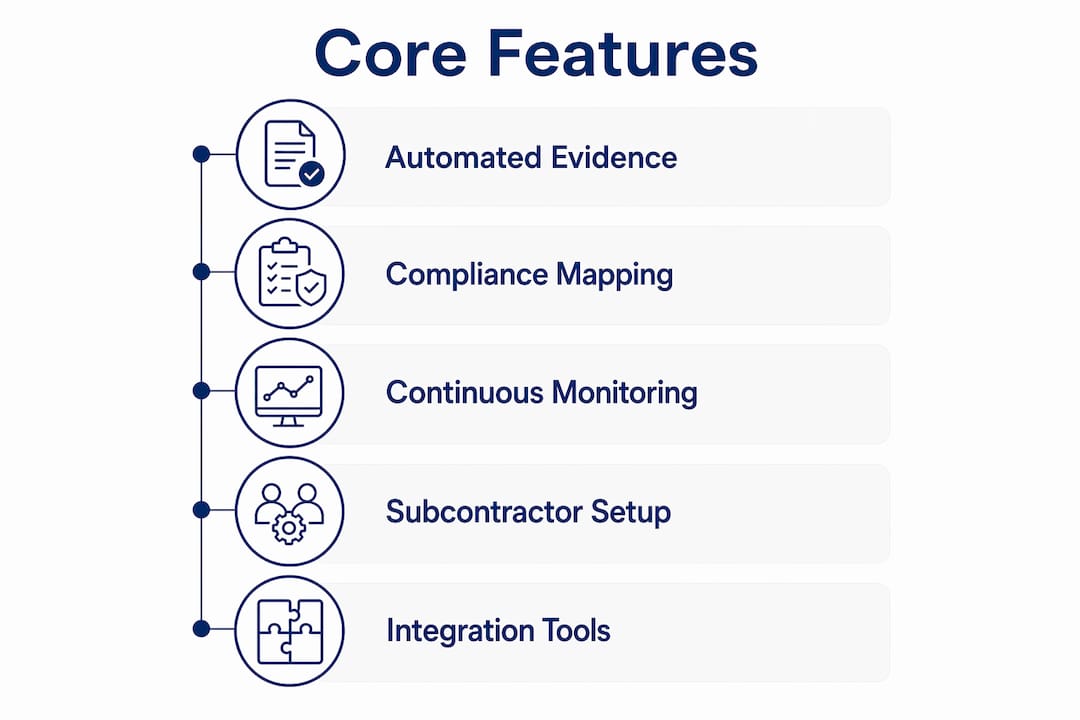
| Feature | Why It Matters to Primes | Priority |
|---|---|---|
| Continuous compliance automation | Replaces periodic document gathering; reduces audit-time surprises | High |
| NIST SP 800-171A evidence mapping | Auditors validate evidence against assessment procedures, not just the 110 controls | High |
| Automated clause flowdown extraction | Saves operational hours per contract and closes gaps between prime and sub obligations | High |
| IDIQ/task-order hierarchy support | Tracks funding, CLINs, and delivery requirements across task orders | High |
| Subcontractor portal with role-based permissions | Lets subs manage documents and respond to requirements without email chains | Medium |
| Timestamped audit trails and chain-of-custody logs | Produces evidence packages C3PAOs and DCMA reviewers can follow | High |
| ERP/CLM/GRC/SSO/SIEM integrations | Prevents data silos and manual re-entry across compliance and financial systems | Medium |
| Threshold automation (SAT, TINA, CAS) | Triggers required documentation automatically when procurement thresholds are crossed | Medium |
Must-have checklist for RFP minimum requirements:
- Automated extraction of clauses and CLINs from contract PDFs on ingestion
- Evidence linkage to NIST SP 800-171A assessment procedures (not just control numbers)
- Automated flowdown assignment to named subcontractors with acceptance workflows
- Role-based subcontractor portal with document management and audit trail
- Continuous monitoring dashboard with gap alerts and POA&M tracking
- Published integration connectors for Deltek Costpoint, a GRC platform, and SSO
Pro Tip: When writing RFP requirements, specify behavior, not features. Write "the platform shall automatically extract FAR/DFARS clauses from an uploaded contract PDF and link each clause to the corresponding NIST SP 800-171A assessment procedure within 24 hours of ingestion" rather than "the platform shall support clause management."
How platforms must align with NIST SP 800-171A, CMMC, and continuous posture
Platforms must map evidence to NIST SP 800-171A assessment procedures, not just the list of 110 security requirements. This distinction is the primary cause of over-scoring and subsequent audit failure: a firm that checks off all 110 requirements without linking evidence to the corresponding assessment procedure will not survive a C3PAO review.
SPRS scores compound this risk. A SPRS entry is a time-bound snapshot, not a permanent pass. Primes must treat SPRS currency and POA&M closure as ongoing obligations, and they must require the same of their subcontractors. A score that was accurate at award can become a liability if material changes occur and the entry is not updated.
A capable platform captures the specific evidence types auditors expect: timestamped configuration baselines, access-control logs with reviewer approvals, chain-of-custody records for CUI handling, and incident response artifacts. Platforms that offer continuous monitoring dashboards with linked evidence and mock-assessment support surface gaps before a formal audit rather than during one.
How to evaluate vendors: demo checklist, red flags, and pricing
Vendor selection criteria (required before shortlisting):
- SOC 2 Type II attestation at minimum; FedRAMP authorization when the platform processes CUI in a cloud environment
- Native support for FAR/DFARS clause libraries and NIST SP 800-171A assessment procedure mapping
- Documented GovCon data model: CLIN/SLIN/ACRN fields, IDIQ/task-order hierarchy, flowdown inheritance
- Published integration matrix with named connectors (Deltek Costpoint, a GRC platform, SSO provider, SIEM)
- Customer references from prime contractors with active IDIQ vehicles or multi-tier subcontractor programs
- Documented pilot-to-full-rollout timeline with measurable audit-readiness milestones
Demo request language (paste into vendor invitations):
- "Please demonstrate live extraction of FAR/DFARS clauses from a sample contract PDF and show how each clause maps to a NIST SP 800-171A assessment procedure."
- "Show the subcontractor portal: how a sub receives a flowdown assignment, uploads evidence, and how the prime sees a timestamped audit trail."
- "Walk through your continuous monitoring dashboard: how does the system alert on a compliance gap and what does the evidence package look like for a C3PAO reviewer?"
Red flags to disqualify a vendor:
- Flowdowns are manual: the prime copies and pastes clause text into subcontract templates
- Evidence is stored as unlinked file attachments with no reference to an assessment procedure
- No subcontractor portal; communication happens outside the platform
- No published SOC 2 report or FedRAMP authorization for cloud deployments handling CUI
- Implementation timeline is open-ended with no defined audit-readiness milestone
On pricing, a facilitated mock assessment from a third party typically runs $15,000–$30,000 for small-to-mid contractors. Platform licensing varies widely by contract volume and user count; expect pilot costs to be scoped separately from enterprise licensing. Require vendors to provide total cost of ownership across a 12-month period, including implementation, training, and integration work.
Pro Tip: Ask vendors for their median time from contract ingestion to a complete, audit-ready evidence package on a new task order. A platform that cannot answer this question with a specific number has not automated the workflow.
Integrations, data model, and subcontractor workflows that reduce prime-sub friction
The integration question is not about checking boxes. Connector maturity matters: a pre-built, tested connector to Deltek Costpoint behaves differently from a generic API that requires custom middleware. Primes managing multiple active contracts across agencies need integrations that pass data bidirectionally, not just export files.

The data model underneath the platform determines whether subcontractor obligations inherit correctly. A platform built on a native GovCon data model carries CLIN/SLIN/ACRN fields, clause metadata, and flowdown inheritance as first-class objects. When a new task order arrives under an IDIQ vehicle, the platform should automatically propagate the relevant clauses and evidence requirements to the named subcontractors without manual intervention.
Practical onboarding considerations for multi-entity organizations: subcontractor portals should support role-based access so a sub's compliance officer sees only their obligations, not the prime's full contract record. Automated flowdown assignment, evidence collection workflows, and acceptance timestamps should all be logged in a single audit trail. For primes managing contract onboarding across government teams, the difference between a native portal and an email-based process is measurable in hours per task order.
Procurement-ready artifacts: RFP language, scoring rubric, and pilot SOW
RFP language snippets:
- Clause extraction: "The platform shall automatically extract all FAR/DFARS clauses from an uploaded contract PDF within 24 hours of ingestion and map each clause to the corresponding NIST SP 800-171A assessment procedure."
- Continuous monitoring: "The platform shall maintain a real-time compliance posture dashboard with automated gap alerts, POA&M tracking, and evidence currency indicators tied to SPRS submission requirements."
- Flowdown automation: "The platform shall automatically assign applicable flowdown clauses to designated subcontractors and record acceptance timestamps in a tamper-evident audit log."
Vendor scoring rubric:
| Evaluation Dimension | Weight | Scoring Criteria |
|---|---|---|
| Compliance model (continuous vs. manual) | — | Automated, real-time posture vs. periodic self-assessment |
| Federal contract support (IDIQ/CLIN/flowdowns) | — | Native GovCon data model with CLIN/SLIN/ACRN fields |
| Evidence management (NIST 800-171A alignment) | — | Evidence linked to assessment procedures, not just control numbers |
| Subcontractor collaboration | 15% | Permissioned portal, automated flowdown assignment, audit trail |
| Integrations (ERP/GRC/SSO/SIEM) | 10% | Named, tested connectors with published integration matrix |
| Security certifications | 5% | SOC 2 Type II; FedRAMP where CUI is processed in cloud |
| Implementation timeline | 5% | Defined pilot milestone; documented time-to-audit-readiness |
Pilot SOW checklist:
- Scope: one active prime contract, one to three subcontractors, 30-day performance window
- Success criteria: All FAR/DFARS clauses extracted and mapped to NIST SP 800-171A procedures; all flowdowns assigned and accepted by subs with timestamped records; compliance posture dashboard live with gap alerts active
- Data access: prime provides contract PDF, existing SPRS score, and current POA&M; vendor provides sandbox environment with production-equivalent security controls
- Security requirements: all CUI handled within a FedRAMP-authorized or equivalent environment; vendor provides SOC 2 Type II report before data transfer
Key Takeaways
A prime-grade contract readiness platform must deliver continuous compliance automation, NIST SP 800-171A evidence mapping, automated clause flowdowns, and auditable prime-to-sub collaboration — platforms missing any one of these four capabilities create measurable award and audit risk.
| Point | Details |
|---|---|
| Evidence mapping is the critical differentiator | Link evidence to NIST SP 800-171A assessment procedures, not just the 110 controls, or risk audit failure. |
| SPRS currency is an ongoing obligation | A SPRS score is a time-bound snapshot; primes must keep it current and require the same of subcontractors. |
| Native GovCon data models save time | Pre-configured CLIN/SLIN/IDIQ support reduces implementation time versus bolt-on enterprise CLM tools. |
| Pilot scope before full commitment | Define a 30-day pilot with a named contract, named subs, and a measurable audit-readiness milestone before licensing. |
| Primereadysub as implementation partner | Rutledge & Associates delivers defined-scope compliance automation pilots for primes, with measurable audit-readiness outcomes. |
Why primes should treat readiness as an outcomes contract
The conventional framing in GovCon compliance is that readiness is a state you achieve before an audit. That framing is wrong, and it is expensive. Readiness is a workflow, and the primes that build it as an embedded operational process rather than a periodic document-gathering exercise consistently outperform those that treat it as a compliance event.
Rutledge & Associates approaches this differently. As an SDVOSB, woman-owned, SBA-certified firm, the organization focuses on owning clearly defined scopes within complex, compliance-heavy programs rather than providing open-ended staff augmentation. The emphasis is on measurable outcomes: reduced processing times, demonstrable audit readiness, and real-time program visibility through DevOps pipelines, compliance automation, and analytics dashboards. That outcome orientation is what makes the prime-ready partner model structurally different from a body-shop arrangement.
What primes often underestimate is how much of their compliance burden originates in the subcontract tier. A platform that automates flowdowns and captures sub-level evidence does not just reduce the prime's administrative load. It changes the risk profile of the entire program. The benefits of automation for primes in government contracts are most visible precisely at that prime-to-sub boundary, where manual processes create the largest gaps.
Rutledge & Associates supports prime compliance pilots
Primes that need to move from a manual compliance posture to an auditable, automated one, without a 12-month implementation cycle, have a direct path through Rutledge & Associates. The firm scopes pilots around a single active contract and a defined subcontractor set, delivers a measurable audit-readiness outcome within 30 days, and operates under a fixed scope rather than an open-ended engagement. That means low oversight for the prime and a clear success criterion from day one.
The firm serves public-sector primes primarily in Maryland, New York, and Florida, with a focus on government IT modernization programs that carry CUI handling requirements, CMMC obligations, or active DCMA oversight. If your program fits that profile, the next step is a scoped conversation about pilot parameters. Contact Rutledge & Associates at primereadysub.com to request a pilot scope or a tailored statement of work.
Authoritative sources and further reading
- NIST SP 800-171A assessment procedures (CMMC Hub): Explains why evidence must be mapped to assessment procedures rather than control numbers, and covers mock-assessment costs and reassessment timelines. Primary reference for compliance alignment and RFP evidence requirements.
- SPRS currency and POA&M obligations (SaltyCloud): Covers the time-bound nature of SPRS scores and the ongoing obligation to keep entries current after material changes. Use for continuous posture requirements.
- GovCon CLM constructs (TechnoMile): Defines native federal constructs including FAR/DFARS clause management, CLIN/SLIN tracking, and IDIQ/task-order hierarchies. Use for data model requirements in RFPs.
- Automated contract ingestion (R3 Solutions): Describes automated extraction of CLINs, clauses, and delivery requirements and the operational time savings that result.
- CPSR/DCMA audit trail automation (CPSR ProDocs IQ): Covers automatic clause flowdown tracking, threshold automation, and timestamped audit trails designed for DCMA reviews.
- Subcontractor portal capabilities (GovPort): Describes centralized prime-to-sub document management, requirements visibility, and communication workflows.
- Continuous monitoring and mock assessments (GetFedReady): Covers real-time dashboards, linked evidence, and mock-assessment support for defense contractors preparing for formal audits.
- FAR CUI Rule and flowdown obligations (Federal Register, October 2023): The proposed FAR clause 52.239-ZZ and related provisions establishing incident reporting, SBOM requirements, and CUI flowdown obligations to subcontractors.
- SAM.gov entity registration: Required registration for prime awardees; annual renewal obligation and Unique Entity ID assignment relevant to subcontractor onboarding workflows.