

The bid preparation process is the critical sequence of steps a prime contractor must follow to submit a compliant and competitive government technology contract proposal. Skipping or rushing any step creates compliance gaps that evaluators use to eliminate bids before scoring begins. Federal RFP responses require 40–120 hours of dedicated effort. That range reflects the real cost of doing this work correctly. Prime contractors and procurement officers who treat bid preparation as a structured discipline win more contracts than those who treat it as a writing exercise.
What prerequisites are required before starting a bid?
Registration comes before everything else. SAM.gov registration takes 2–4 weeks to process, and an expired registration disqualifies a bid automatically. Build that timeline into every pursuit calendar, not just the first one.
Beyond SAM.gov, many state and local agencies maintain separate vendor portals. Maryland, New York, and Florida each operate their own procurement systems with distinct registration requirements. A contractor pursuing public sector IT work across multiple states needs active registrations in each relevant portal before the solicitation drops.
The go/no-go decision belongs at this stage, not after the team has spent weeks writing. A disciplined go/no-go evaluation rated against each evaluation factor protects your business development budget. Rate your competitive alignment on a 1–5 scale across technical capability, past performance, price competitiveness, and teaming strength. Pursue only the opportunities where your total score justifies the investment.
Key prerequisites to complete before drafting begins:
- SAM.gov registration: Confirm active status and renewal date. Renewals lapse annually.
- State and local portals: Register in every portal relevant to the solicitation's issuing agency.
- Amendment tracking: Set up SAM.gov amendment feeds for the specific solicitation number.
- Teaming agreements: Execute any required teaming or subcontracting agreements before submission.
- Certifications: Confirm that SDVOSB, SBA, or other required certifications are current and documented.
Pro Tip: Set a calendar alert 60 days before your SAM.gov expiration. A lapsed registration during an active pursuit is one of the most avoidable disqualifications in federal contracting.
How do you analyze solicitation requirements for full compliance?

Read the RFP twice before writing a single word. The first read builds comprehension. The second read is a compliance audit where you flag every "shall," "must," and "required" instruction. These words carry legal weight in government solicitations. Missing one is grounds for elimination.
The Compliance Matrix is the primary tool for tracking every mandatory requirement before drafting begins. Build it as a spreadsheet with the following columns:
- RFP section reference: The exact section number from the solicitation.
- Requirement text: The verbatim "shall" or "must" statement.
- Proposal section: Where your response addresses this requirement.
- Owner: The team member responsible for that section.
- Status: Draft, in review, or complete.
This matrix becomes your quality control document throughout the entire writing process. Every section owner checks their row before submitting content for review.
| Compliance Matrix Column | Purpose |
|---|---|
| RFP section reference | Ties each requirement to its source location |
| Requirement text | Preserves exact agency language for response alignment |
| Proposal section | Maps the requirement to your document structure |
| Owner | Assigns accountability for each response |
| Status | Tracks progress from draft to final |
The official question window is a tool most contractors underuse. Submitting clarifying questions during this window produces binding agency interpretations of the Statement of Work. Those answers become part of the solicitation record. A well-placed question can clarify ambiguous scope language that would otherwise force your team to guess.
Pro Tip: Track every amendment and official Q&A response in a dedicated log. Agency answers issued after the question window close date carry the same binding weight as the original RFP.
What steps build a strong bid team and evidence base?
The bid team structure determines proposal quality more than writing talent alone. Assign a compliance lead who owns the matrix and tracks every requirement through final submission. Assign separate content owners for the technical approach, management approach, past performance, and pricing volume. No single person should own more than one major volume.
Past performance is where many technology contractors leave points on the table. Evaluators want specific, quantified metrics, not narrative descriptions. "Reduced processing time by 40%" scores higher than "improved agency efficiency." Pull your metrics from contract deliverables, agency acceptance letters, and performance assessment reports before the writing phase begins.
Build your evidence library before drafting opens:
- Past performance references: Three to five contracts with quantified outcomes aligned to the solicitation's scope.
- Key personnel resumes: Tailored to the specific evaluation criteria, not generic CVs.
- Certifications and clearances: Copies of SDVOSB, SBA 8(a), ISO, or security clearance documentation as required.
- Case studies: One to two page summaries showing problem, approach, and measurable result.
- Subcontractor documentation: Teaming agreements, capability statements, and relevant past performance from partners.
Align every piece of evidence to the evaluation criteria listed in Section M of the RFP. Evaluators score against those criteria. Evidence that does not connect to a criterion does not improve your score.
How do you write a proposal that scores well with evaluators?
Writing for evaluators means mapping every section heading and opening sentence to the language of the evaluation criteria. If Section M says "demonstrated experience in cloud migration," your technical approach heading should use that exact phrase. Evaluators work from a scoring rubric. Make their job easy.
Start each section with a direct claim, then support it with quantified evidence. "Our DevOps pipeline reduced deployment time by 60% for the Maryland Department of Health" is a scorable sentence. "We have extensive experience in DevOps" is not. The difference is specificity.
Effective proposal writing follows this structure for every major section:
- Opening claim: State your key differentiator in the first sentence.
- Evidence: Follow immediately with a metric, case study reference, or certification.
- Methodology: Explain how you will deliver the same result for this agency.
- Risk mitigation: Address the agency's likely concern about your approach.
- Transition: Connect this section's strength to the next evaluation criterion.
The executive summary carries disproportionate weight. Many evaluators read it first and form an initial impression before scoring begins. Write it last, after all technical sections are complete, so it accurately reflects the proposal's strongest points.
Pricing belongs in a separate volume and must align precisely with the technical approach. A pricing volume that contradicts the staffing model or timeline in the technical volume creates a credibility problem that evaluators note. Reconcile both volumes before final review.
Pro Tip: Mirror the solicitation's Section L instructions exactly when organizing your proposal volumes. Deviating from the required structure is a formatting compliance failure, and compliance failures are the leading cause of elimination before technical scoring begins.
What are the best practices for final review and submission?
The final review phase is not a proofreading exercise. It is a compliance audit against the matrix you built at the start. Run through every row and confirm the corresponding proposal section addresses the requirement completely, uses the correct format, and falls within any page limits.
Follow these steps in the final 48 hours before submission:
- Run the compliance matrix end to end. Every row must show "complete" status.
- Check all formatting requirements. Font size, margin width, and page limits are leading causes of disqualification.
- Confirm all required forms are included. SF-33, representations and certifications, and any agency-specific attachments.
- Verify amendment acknowledgment. Track and acknowledge every amendment through SAM.gov before submitting.
- Submit at least 2 hours early. Submission portals crash and lag under deadline traffic. Agencies treat technical failures as the bidder's responsibility.
Submitting a proposal two hours before the deadline is not a buffer for convenience. It is a risk management decision. Portal failures during the final hour before close are common, and agencies have no obligation to accept late submissions regardless of the technical cause. Save every confirmation receipt, email acknowledgment, and upload timestamp the moment you receive them.
After submission, maintain a complete record of all correspondence, amendment acknowledgments, and confirmation receipts. If a protest or clarification request arises, that documentation is your defense.
Key Takeaways
A compliant, evidence-first proposal built on a Compliance Matrix and submitted well before the deadline gives prime contractors the strongest foundation for winning government technology contracts.
| Point | Details |
|---|---|
| Register early | Complete SAM.gov and state portal registrations 2–4 weeks before pursuing any solicitation. |
| Build a Compliance Matrix | Map every "shall" and "must" requirement to a proposal section before writing begins. |
| Use quantified evidence | Replace generic claims with specific metrics tied directly to evaluation criteria. |
| Submit 2 hours early | Portal failures are the bidder's responsibility; early submission eliminates that risk. |
| Track every amendment | Acknowledge all solicitation amendments via SAM.gov to keep your bid current and compliant. |
What I have learned from watching bids succeed and fail
The most consistent pattern I see in failed bids is not weak technical content. It is a team that started writing before they finished reading. The compliance matrix feels like overhead when you are under deadline pressure. Skipping it feels like gaining time. It is not. Every hour saved by skipping the matrix costs three hours in rework when a missed requirement surfaces during final review.
The go/no-go decision is where I see the most money wasted. Teams pursue opportunities out of habit or optimism rather than competitive alignment. A disciplined go/no-go process is not pessimism. It is resource management. The effort required for a federal IT bid is real, and spreading that effort across pursuits you cannot win dilutes the quality of the ones you can.
The question window is the most underused tool in the entire process. I have watched contractors submit proposals based on their interpretation of ambiguous scope language when a single well-crafted question would have produced a binding agency answer. Use the window. Read the official Q&A guidance before the window closes. The answers agencies provide are not suggestions. They are part of the contract record.
One more observation: last-minute submission disasters are entirely predictable and entirely preventable. The two-hour rule exists because portal failures are not rare. They happen on nearly every major solicitation deadline. The contractors who submit early are not being cautious. They are being professional.
— Randy
How Primereadysub supports prime contractors in IT modernization bids
Prime contractors pursuing government technology contracts need subcontractors who own their scope, deliver measurable outcomes, and require minimal oversight. Primereadysub, operating as Rutledge & Associates, LLC, brings SDVOSB, woman-owned, and SBA-certified credentials alongside a track record in cloud-native modernization, compliance automation, and real-time program visibility for state and federal agencies. For primes building teams for complex, compliance-heavy IT programs in Maryland, New York, and Florida, Primereadysub provides the documented past performance and technical depth that strengthens a bid. Contractors evaluating teaming partners can also review the partner selection guide for criteria that align with public sector IT pursuits.
FAQ
What is the bid preparation process in government contracting?
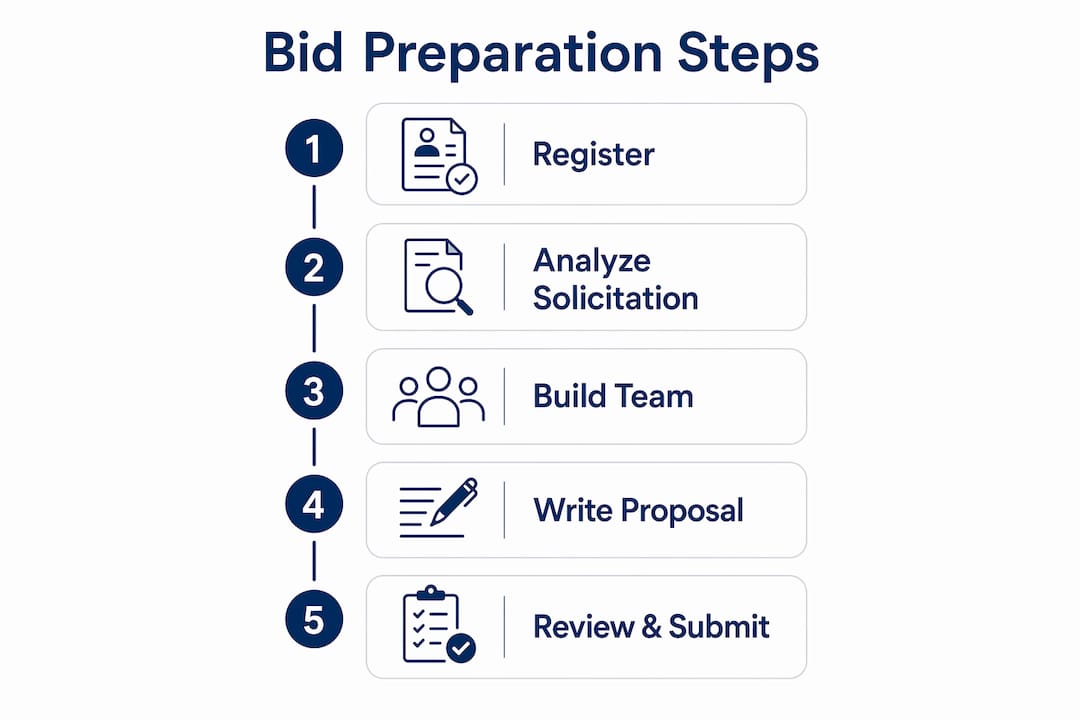
The bid preparation process is the structured sequence of steps a contractor follows to produce a compliant and competitive proposal in response to a government solicitation. It includes registration, solicitation analysis, compliance matrix development, team assembly, proposal writing, and submission.
How long does it take to prepare a federal IT bid?
Federal RFP responses require 40–120 hours of dedicated effort, depending on the complexity of the solicitation and the contractor's prior preparation. New vendors must also budget 2–4 weeks for SAM.gov registration before they are eligible to submit.
What is a Compliance Matrix and why is it required?
A Compliance Matrix is a tracking document that maps every mandatory RFP requirement to a specific proposal section and assigns an owner. It is the primary tool for confirming that a proposal addresses every "shall" and "must" statement before submission.
What causes most proposals to be eliminated before scoring?
Formatting and content compliance failures are the leading cause of proposal elimination. Issues like incorrect font size, exceeded page limits, and missing required forms disqualify bids before evaluators reach the technical content.
When should a proposal be submitted to avoid rejection?
Submit at least 2 hours before the stated deadline. Submission portals frequently experience technical failures during peak deadline traffic, and agencies treat late submissions as the bidder's responsibility regardless of the technical cause.