

A government Request for Proposal (RFP) is an official solicitation document that agencies use to invite detailed proposals for a complete solution, evaluated on technical capability, past performance, and price. Understanding government RFPs is the single most important skill a prime contractor or small business owner can develop before bidding on government contracts. The federal procurement system processes hundreds of billions of dollars in contracts annually through this mechanism, and the difference between winning and losing frequently comes down to how well a team reads, interprets, and responds to the solicitation itself. This guide breaks down the regulatory framework, the solicitation types, the communication rules, and the practical steps that produce competitive proposals.
How do RFIs, RFQs, and RFPs differ?
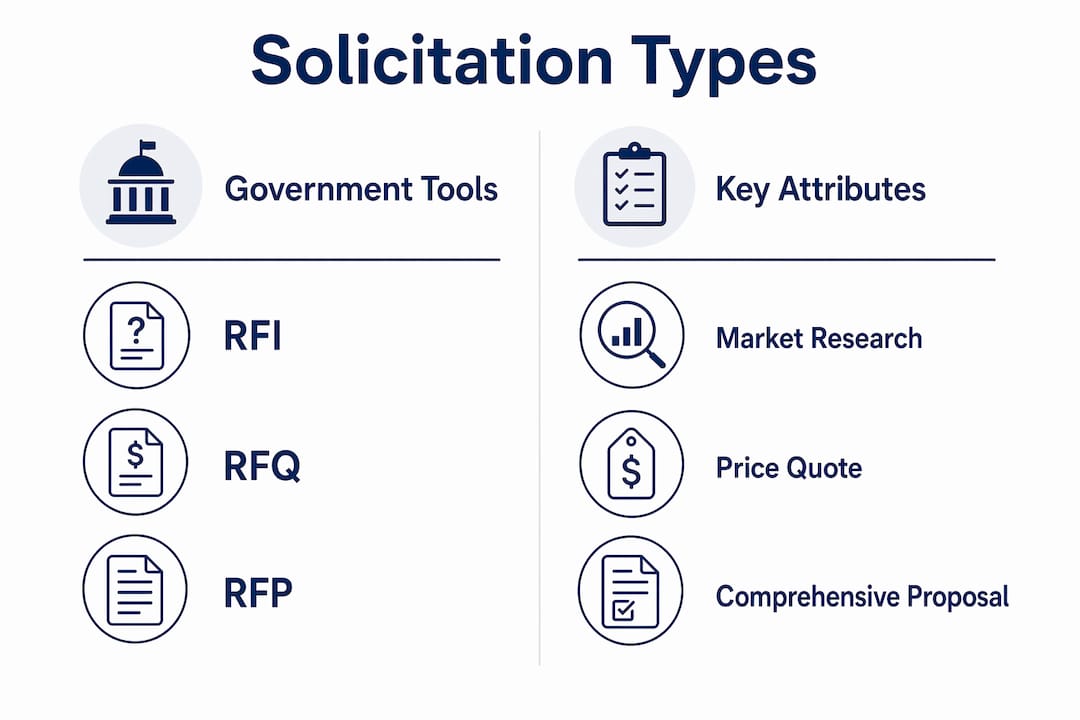
GSA guidance defines three distinct solicitation types that serve different purposes in the government procurement lifecycle: the Request for Information (RFI), the Request for Quotation (RFQ), and the Request for Proposal (RFP). Treating all three the same way is one of the most common and costly mistakes contractors make.
An RFI is a market research tool. The government issues it to gather information from industry before a formal acquisition begins. Responding to an RFI does not constitute a bid, and no contract award follows directly from it. Think of it as the agency taking the temperature of the market.
An RFQ is used when the government already knows exactly what it needs and wants pricing. The evaluation is primarily price-based, and the submission is a quotation rather than a full proposal. RFQs are common for simplified acquisitions and orders against existing vehicles like GSA Schedule contracts.
An RFP is the most demanding of the three. It solicits a comprehensive solution and evaluates offerors on multiple factors simultaneously.

| Solicitation type | Primary purpose | Submission type | Evaluation focus | Procurement stage |
|---|---|---|---|---|
| RFI | Market research | White paper or capability statement | Not evaluated for award | Pre-solicitation |
| RFQ | Pricing request | Quotation | Primarily price | Defined requirement |
| RFP | Full solution request | Technical and price proposal | Technical, past performance, price | Competitive negotiation |
Pro Tip: Match your response effort to the solicitation type. An RFI deserves a concise capability statement, not a 50-page proposal. Saving your full effort for RFPs is how you protect your team's capacity and improve your win rate.
What does the federal regulatory framework say about RFPs?
FAR 15.203 mandates that RFPs are the required vehicle for negotiated acquisitions, meaning any procurement where the government expects to evaluate proposals and potentially negotiate before awarding a contract. This regulation is the foundation of the entire government proposal process, and every prime contractor needs to understand its structure.
The two most critical sections inside any RFP are Section L and Section M. Section L contains the instructions to offerors, telling you exactly how to organize and format your proposal. Section M contains the evaluation criteria, telling you how the government will score what you submit. Reading Section M before anything else is the single most efficient habit a proposal team can build.
Evaluation factors are governed by FAR 15.304 and FAR 15.305, which require agencies to identify all factors and subfactors that will be used to evaluate proposals. These typically include:
- Technical approach: How well your solution addresses the stated requirements
- Management approach: Your plan for delivering the work on time and within scope
- Past performance: Your track record on similar contracts, assessed for relevance and quality
- Price or cost: Your proposed cost, evaluated for realism and reasonableness
Past performance carries particular weight. Evaluators assess whether your prior work is relevant in scope, complexity, and dollar value to the current requirement. For firms new to government contracting, new-to-government firms receive a neutral evaluation rating rather than a penalty, which means a well-structured technical proposal can still compete effectively.
Compliance is non-negotiable. Winning proposals depend on mapping every mandatory RFP requirement to specific proposal sections using a traceability matrix. Evaluators score only what is clearly compliant and traceable. Writing quality alone does not compensate for missed requirements.
How does the amendment and communication process work?
The government procurement process includes structured communication channels between agencies and offerors, and understanding these channels is where many contractors lose ground. FAR Subpart 15.2 encourages early industry-government exchanges to improve proposal quality and reduce misunderstanding. These pre-solicitation exchanges, including industry days, draft RFP reviews, and one-on-one meetings, represent the highest-leverage moments in the entire acquisition cycle.
Once an RFP is released, the communication rules tighten considerably. FAR 15.306 defines three distinct types of exchanges:
- Clarifications are limited exchanges that allow the government to resolve minor ambiguities without allowing material changes to a proposal. They are not guaranteed and cannot be used to fix substantive weaknesses.
- Communications occur before the competitive range is established and allow the government to address issues that might otherwise eliminate an offeror.
- Discussions are substantive negotiations that occur after the competitive range is determined. They allow offerors to revise proposals, but only firms inside the competitive range participate.
The practical implication is significant. Contractors who rely on post-submission discussions to correct proposal weaknesses are gambling. There is no guarantee your firm makes the competitive range, and clarifications cannot substitute for a compliant initial submission.
Amendments to the RFP are equally critical. Agencies post amendments and official Q&A responses publicly, and these documents modify RFP requirements, evaluation criteria, and deadlines. Missing an amendment can mean submitting a proposal that no longer complies with the current solicitation.
Pro Tip: Set up automated alerts on SAM.gov for every solicitation you are tracking. When an amendment drops, review it the same day. Changes to Section M evaluation criteria after initial release are not uncommon, and they can shift your entire proposal strategy.
What are best practices for reading and responding to government RFPs?
Reading a government solicitation effectively requires a deliberate sequence. Skimming from page one to the end is how teams miss critical requirements buried in attachments or amendments. The following order produces the clearest picture of what the government actually wants and how it will score your response.
- Read Section M first. Evaluation criteria define what matters. Everything else in your proposal should be built to satisfy these factors explicitly.
- Read Section L second. Instructions tell you how to format and organize your submission. Non-compliance with page limits, font requirements, or volume structure can result in rejection before evaluation begins.
- Read the Statement of Work or Performance Work Statement. This is the technical heart of the RFP. Identify every "shall" statement, which represents a mandatory requirement, every "should" statement, which represents a strong preference, and every "may" statement, which represents an option.
- Check eligibility requirements. Certifications, clearances, and small business set-aside designations must be confirmed before investing proposal effort. Bidding on a contract you are ineligible to win wastes resources and damages your SAM.gov record.
- Build a compliance matrix. Create a spreadsheet that maps every "shall" requirement to a specific section of your proposal. This tool serves as both a writing guide and a final quality check before submission.
- Review all attachments and amendments. Wage determinations, data rights clauses, and security requirements often appear in attachments rather than the base document.
- Confirm submission logistics. Late proposals are almost always rejected. The "late is late" principle is strictly enforced in federal procurement. Proposals must be received by the deadline, not merely sent.
For small businesses without an extensive government contract history, the past performance section requires particular attention. Frame relevant commercial or subcontract experience in terms of scope, complexity, and outcomes. Include a risk mitigation narrative that demonstrates your awareness of delivery challenges and your plan to address them. Evaluators respond to specificity and evidence, not general claims of capability.
Selecting the right teaming partners before submission also strengthens proposals significantly. Resources like public sector IT partnering guidance can help prime contractors identify subcontractors whose past performance and technical capabilities fill gaps in their own proposal.
Key takeaways
Winning a government contract requires understanding the RFP structure, the regulatory framework, and the communication rules before writing a single word of your proposal.
| Point | Details |
|---|---|
| Match effort to solicitation type | RFIs, RFQs, and RFPs require different levels of response; misallocating effort reduces win rates. |
| Read Section M before Section L | Evaluation criteria define what scores; instructions define how to format the response. |
| Build a compliance matrix | Map every "shall" requirement to a proposal section to prevent evaluators from missing your compliance. |
| Monitor amendments immediately | Changes to evaluation criteria or deadlines posted after RFP release can invalidate an unprepared proposal. |
| New firms receive neutral past performance ratings | Structured experience narratives and risk mitigation plans allow new-to-government firms to compete effectively. |
What working with government RFPs actually teaches you
Most contractors approach their first government RFP the way they would approach a commercial proposal: lead with your capabilities, tell a compelling story, and trust the evaluator to connect the dots. That approach fails in federal procurement, and it fails consistently.
What I have observed working alongside public sector primes and small businesses is that the firms who win are not necessarily the most technically capable. They are the most disciplined readers. They find the evaluation criteria, they build the compliance matrix, and they write directly to the scoring rubric. Every paragraph in their technical volume maps to a specific factor in Section M. The evaluator never has to search for evidence of compliance.
The second pattern I see in winning teams is early engagement. They attend industry days. They submit questions during the draft RFP period. They read every amendment the day it posts. This is not extra work. It is the work. By the time the final RFP drops, they already understand the agency's priorities well enough to write a proposal that reads like it was built for that specific program.
For small businesses, the past performance challenge is real but manageable. Framing subcontract work, state-level contracts, or commercial projects in terms of relevance and outcomes gives evaluators something to assess. A neutral rating with a strong technical proposal beats a weak technical proposal with an excellent past performance record.
The firms that struggle are the ones waiting for discussions to fix their proposals. FAR 15.306 makes clear that discussions are not guaranteed, and clarifications cannot rescue a non-compliant submission. Submit a complete, compliant proposal every time, and treat any post-submission exchange as a bonus rather than a safety net.
— Randy
How Primereadysub supports prime contractors on complex RFPs
Prime contractors pursuing government IT modernization contracts face a specific challenge: the technical scope in these RFPs is demanding, the compliance requirements are detailed, and evaluators expect demonstrated outcomes rather than general capability statements. Primereadysub operates as a prime-ready subcontracting partner for exactly these programs. As an SDVOSB, woman-owned, and SBA-certified firm, Rutledge & Associates brings cloud-native re-architecting, compliance automation, and real-time analytics capabilities that strengthen a prime's technical proposal with concrete, traceable deliverables. For primes building teams for public sector IT programs, Primereadysub provides defined scope ownership and documented outcomes that translate directly into competitive past performance narratives. You can also explore partnership advantages for public sector primes to understand how strategic teaming improves proposal scores.
FAQ
What is a government RFP?
A government RFP (Request for Proposal) is a formal solicitation document that agencies issue to invite detailed proposals for a complete solution, evaluated on technical capability, past performance, and price. It is used in negotiated acquisitions under FAR Part 15.
How is an RFP different from an RFQ?
An RFP solicits a full technical and management proposal evaluated on multiple factors, while an RFQ requests pricing for a known requirement and is evaluated primarily on price. GSA guidance defines both types as distinct stages in the procurement lifecycle.
What are Section L and Section M in a government RFP?
Section L contains the instructions to offerors covering format, page limits, and submission requirements. Section M contains the evaluation criteria that determine how the government scores each proposal. Reading Section M first is the most efficient way to orient your proposal strategy.
Can a small business with no government contracts win an RFP?
Yes. Firms without prior government contract history receive a neutral past performance rating rather than a negative one. Presenting relevant commercial or subcontract experience with specific outcomes and a risk mitigation plan allows new-to-government firms to compete on the strength of their technical proposal.
What happens if you submit a proposal late?
Late proposals are almost always rejected under the strict "late is late" rule in federal procurement. A proposal must be received by the agency before the specified deadline time, regardless of when it was sent or what caused the delay.