

For U.S. government IT subcontracting, the most productive portals are SBA SUBNet, Dynamic Small Business Search (DSBS), SAM.gov, the GSA Subcontracting Directory, eSRS, GSA eBuy, and prime contractor supplier-diversity portals. Each serves a distinct function: some broadcast your profile to primes searching proactively, others document your outreach for FAR compliance, and a few surface live task orders and RFQs. Using only one is the most common mistake small IT firms make.
| Portal | Best For | Reach | Registration Required | Cost | Posting Types | Primary Audience |
|---|---|---|---|---|---|---|
| Primereadysub | Defined-scope IT modernization subcontracting | Federal, state, local | SAM + capability packet | N/A | Outcome-owned work packages | Prime contractors, agencies |
| SBA SUBNet | Finding/posting sources-sought | Federal | None to search; profile to post | Free | Sources-sought, subcontracting notices | Primes, small businesses |
| DSBS | Being discovered by primes | Federal | SAM.gov profile | Free | Searchable firm profiles | Prime contractors |
| SAM.gov | Vetting, registration, opportunity alerts | Federal | SAM registration | Free | Pre-solicitation, awards, sole-source | All federal contractors |
| GSA Subcontracting Directory | Identifying primes with subcontracting plans | Federal (GSA) | None to search | Free | Prime contractor listings | Small businesses |
| eSRS | Spotting primes with unmet SB goals | Federal | None to search | Free | Subcontracting progress reports | Small businesses |
| GSA eBuy / state portals | Task orders, RFQs, state IT opportunities | Federal + state/local | GSA schedule or state registration | Free/varies | RFQs, RFIs, task orders | Schedule holders, agencies |
| Prime supplier portals | Inbound visibility to prime procurement teams | Prime-specific | Capability statement, CAGE, NAICS | Free | Vendor registrations | Prime SBLOs, procurement teams |
Quick-start priorities:
- Verify your DSBS profile is current with technical keywords and past performance
- Set keyword and NAICS alerts on SUBNet and SAM.gov
- Register on at least three major prime supplier-diversity portals
- Monitor eSRS for primes reporting shortfalls against small-business goals
Table of Contents
- What does registration actually require for IT subcontracting portals?
- How do you evaluate which IT subcontracting portal fits your situation?
- How long does the subcontracting process take from discovery to award?
- What does it cost to use these portals?
- How do you protect sensitive data on subcontracting portals?
- What are the common pitfalls when using these portals?
- Key Takeaways
- Why the portal list matters less than what you do after you find a prime
- Primereadysub delivers defined-scope IT modernization for public-sector primes
- Authoritative sources for verifying requirements and tracking prime activity
What does registration actually require for IT subcontracting portals?
SAM.gov is the foundation. While SAM registration is not strictly required to win a subcontract, an active profile accelerates prime vetting and feeds your DSBS listing automatically. Beyond SAM, every portal and prime supplier portal expects a capability statement that includes your CAGE code, NAICS codes mapped to your actual IT services, relevant certifications (SDVOSB, 8(a), HUBZone), and at least two past-performance references framed around outcomes, not just task descriptions.
Response windows on sources-sought notices are generally short. RFIs on GSA eBuy may close quickly. Build your capability packet before you need it, not after a notice appears.
How do you evaluate which IT subcontracting portal fits your situation?
Three dimensions matter most for IT-specific work: opportunity volume, exclusivity of access, and the quality of the audience reading your listing.

SUBNet has lower volume than SAM.gov but higher signal quality because every posting is a prime actively soliciting subcontractors. DSBS reaches primes before they post publicly, which is the highest-value discovery channel for specialized IT firms. Prime supplier portals are exclusive by design: only registered vendors appear in searches, which reduces competition from firms that never completed registration. GSA eBuy surfaces schedule-driven RFQs that rarely appear elsewhere.
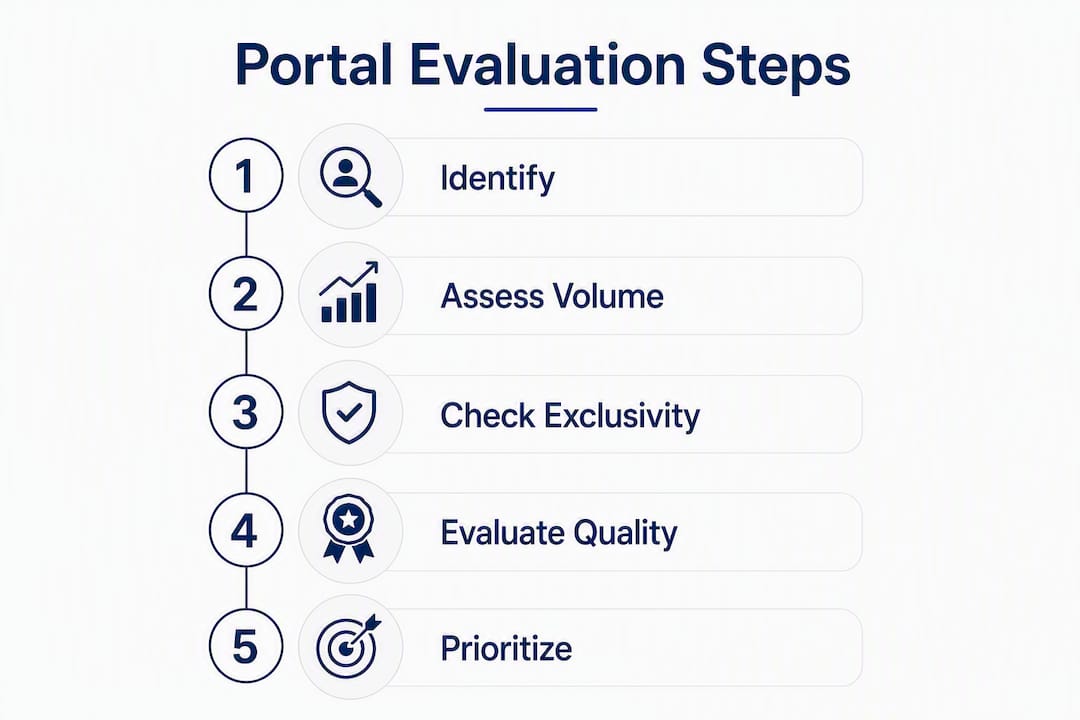
For IT modernization specifically, prioritize portals where the audience is a prime's Small Business Liaison Officer (SBLO) or a contracting officer, not a general procurement inbox.
How long does the subcontracting process take from discovery to award?
The timeline varies by contract vehicle and agency, but a realistic sequence looks like this:
- Opportunity discovery to capability submission: 1–3 weeks
- Prime evaluation and teaming agreement negotiation: 4–8 weeks
- Prime proposal submission and agency evaluation: 8–16 weeks
- Award and subcontract execution: 2–6 weeks post-prime award
Total elapsed time from first contact to a signed subcontract on competitive federal programs often spans several months. State and local vehicles can move faster, particularly under existing IDIQ or master service agreements. For government contract timelines tied to specific vehicles, check the solicitation's period of performance and the prime's proposal due date.
What does it cost to use these portals?
Every government-run portal covered here is free. SAM.gov registration, DSBS profile maintenance, SUBNet search, GSA Subcontracting Directory access, and eSRS report review carry no fees. GSA eBuy is free for schedule holders; obtaining a GSA schedule itself involves proposal preparation costs but no registration fee.
The real cost is time: maintaining an accurate SAM/DSBS profile, writing a targeted capability statement for each prime's context, and following up with SBLOs. Third-party services that charge to "submit your profile" to government databases are unnecessary and sometimes misleading. Avoid them.
How do you protect sensitive data on subcontracting portals?
Post only what is necessary for vetting. Your CAGE code, NAICS codes, certifications, and a high-level capability statement are sufficient for public profiles. Proprietary methodologies, pricing models, and client-specific past-performance details belong in direct communications with primes under a Non-Disclosure Agreement, not in a public portal profile.
On prime supplier portals, review the data-use terms before uploading documents. Some portals share registered vendor data across affiliated procurement teams; others restrict it to the registering business unit. Confirm scope before submitting anything beyond standard registration fields.
What are the common pitfalls when using these portals?
SUBNet's posting capability has experienced outages, so primes and subs should not treat it as a reliable sole channel. More broadly, the portals that generate the most visible activity (SAM.gov, SUBNet) attract the most generic outreach, which means a standard capability statement blends into the noise.
Watch for these red flags when engaging primes through any portal:
- Requests for detailed technical proposals before a teaming agreement is signed
- Primes who cannot provide a contract number or solicitation reference for the work they describe
- Supplier portal registrations that ask for financial statements or banking details upfront
- Vague scope descriptions with no NAICS code or period of performance
SUBNet functions primarily as a documentation tool under FAR 52.219-9, not a lead pipeline. Treating it as your primary sourcing channel produces dated records but few actual opportunities.
Key Takeaways
A multi-channel approach combining DSBS profile optimization, SUBNet monitoring, and direct prime supplier-portal registration consistently outperforms relying on any single IT subcontracting portal.
| Point | Details |
|---|---|
| DSBS is your proactive channel | Keep your profile current with technical keywords; primes search it before posting publicly. |
| SUBNet is documentation, not a pipeline | Use it to establish dated outreach records under FAR 52.219-9, then pursue leads through DSBS and prime portals. |
| eSRS signals motivated primes | Primes reporting shortfalls against small-business goals are actively seeking compliant subcontractors. |
| Capability packets win vetting | Map services to the prime's contract risks; include CAGE, NAICS, certifications, and outcome-focused past performance. |
| Primereadysub | Offers defined-scope IT modernization work packages for primes seeking a contract-ready SDVOSB subcontractor. |
Why the portal list matters less than what you do after you find a prime
Most small IT firms spend their energy monitoring portals and too little on what happens after they identify a motivated prime. The portals are the map; the capability packet is the vehicle. A generic outreach email sent to a prime's SBLO after finding them on the GSA Subcontracting Directory produces almost nothing. The same contact, paired with a capability statement that explicitly addresses the prime's contract scope, compliance obligations, and technical gaps, produces a conversation.
Federal subcontracting is a strategic pathway for building past performance that accelerates future prime bids. That means every subcontract engagement should be documented, scoped clearly, and tied to a deliverable your firm owns end-to-end. Staff augmentation arrangements rarely produce the kind of past performance that moves a firm toward prime status. Defined-scope work packages do.
The portals covered here are well-maintained and free. The real differentiator is whether your firm shows up to a prime conversation with a compliance-ready offer or a generic introduction.
Primereadysub delivers defined-scope IT modernization for public-sector primes
Primereadysub is the contract-ready subcontractor for prime contractors managing complex, compliance-heavy government IT programs in Maryland, New York, and Florida. The firm delivers outcome-owned work packages covering legacy system modernization, cloud-native re-architecting, DevOps and CI/CD pipeline implementation, compliance automation, and real-time analytics dashboards, without the overhead of staff augmentation arrangements.
To engage, send your CAGE code, relevant NAICS codes, a brief scope description, and two past-performance bullets to the Primereadysub team. Expect an initial response within five business days. For primes evaluating a contract-ready IT subcontracting partner, the landing page includes capability details and a direct contact path.
Authoritative sources for verifying requirements and tracking prime activity
- SAM.gov Contract Opportunities: — Set keyword and NAICS alerts; verify socioeconomic certifications; search award notices to identify recent prime winners.
- GSA Subcontracting Directory: — Identify primes with active subcontracting plans and reporting obligations.
- DSBS (via SBA): — Maintain your profile with current NAICS codes, keywords, and past performance; this is the primary proactive discovery channel for prime sourcing.
Document every outreach action with dates and portal references. Under FAR 52.219-9, primes must demonstrate good-faith efforts to meet small-business subcontracting goals, and a dated SUBNet posting or DSBS search record supports that compliance trail.