

For U.S. government agencies and prime contractors, the most effective procurement solution for public-sector IT modernization is outcomes-driven modular contracting under 41 U.S.C. 2308, structured as defined-scope increments with performance-based acceptance criteria. The recommended partner posture is an outcomes-owned delivery firm experienced in cloud-native re-architecture, DevSecOps, and continuous compliance, not a staff augmentation shop. Start with Increment 1: a discovery and prototype phase scoped tightly enough to solicit, award, and deliver before the program drifts.
Table of Contents
- Why do modular, outcomes-focused procurements outperform prescriptive awards?
- Which contract vehicles work best for defined-scope modernization increments?
- How do you write an outcomes-focused SOW or Performance Work Statement?
- How should you evaluate proposals and select the right vendor mix?
- What are realistic timelines and cost drivers for modular IT modernization?
- What contract clauses and security baselines belong in every award?
- How do you govern delivery and monitor vendor performance after award?
- How does Primereadysub structure a defined-scope modernization engagement?
- Why does change management determine whether procurement transitions succeed?
- How should you manage vendor relationships after award?
- What does a thorough contract closeout process look like?
- What training and support do procurement teams need to execute this approach?
- Key Takeaways
- What procurement teams consistently get wrong, and how to fix it
- Primereadysub's outcomes-owned modernization services
- Authoritative sources and references for procurement teams
Why do modular, outcomes-focused procurements outperform prescriptive awards?
The legal case is straightforward. 41 U.S.C. 2308 requires modular contracting "to the maximum extent practicable" for major IT systems, with increments awarded within 180 days of solicitation and delivered within 18 months of award. FAR Part 39 implements that statute and reinforces acquisition planning, risk analysis, and prototyping as standard practice. The programmatic case is equally clear.
Key benefits of modular, outcomes-focused contracting:
- Lower program risk. Smaller increments contain failure. A troubled increment does not sink the whole program.
- Faster time to value. Agencies receive working capability in months, not years.
- Easier testing and acceptance. Defined acceptance criteria make pass/fail decisions objective.
- Technology refresh flexibility. Short increment cycles allow technology choices to evolve.
- Stronger contractor incentives. Outcome-based pricing ties payment to delivered capability, not hours logged.
The GAO's IT acquisition high-risk guidance reinforces this directly: agencies that continue spending heavily on legacy maintenance without portfolio rationalization face compounding risk. The Technology Modernization Fund (TMF) exists precisely to fund agencies willing to commit to measurable modernization outcomes.
Pro Tip: Avoid "big bang" procurements. If an increment cannot stand alone and be delivered within 18 months, it is too large. Break it further.

Which contract vehicles work best for defined-scope modernization increments?
Choosing the right vehicle depends on program maturity, scope certainty, and competitive strategy. The table below maps common situations to recommended vehicles.
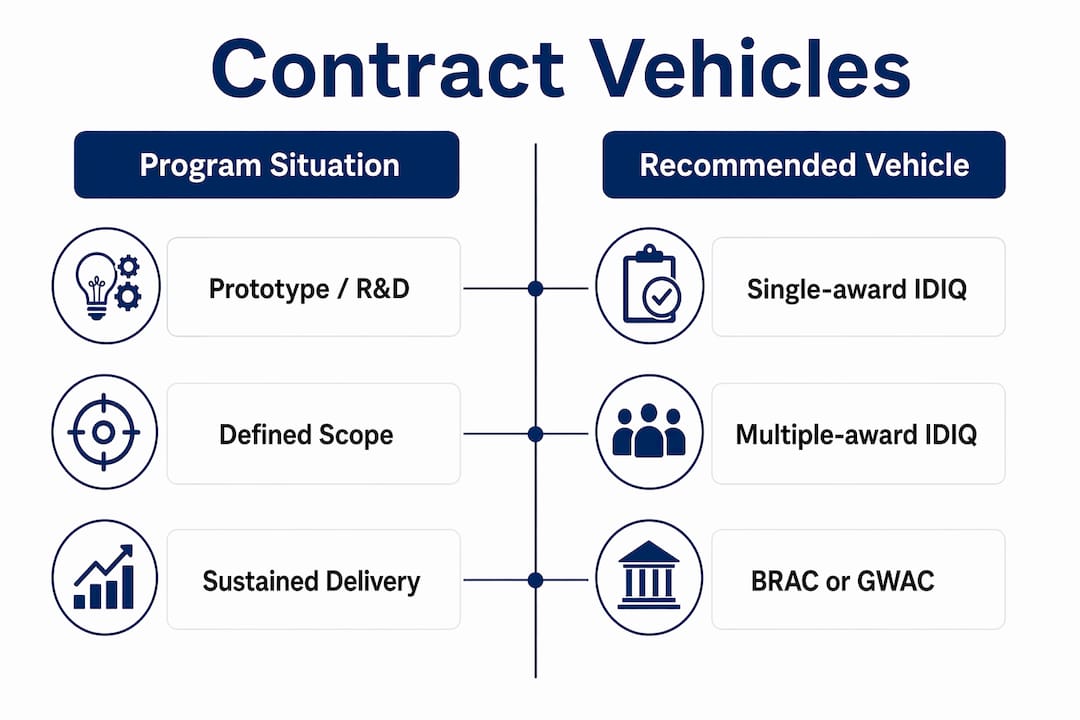
| Program Situation | Recommended Vehicle | Pricing Shape |
|---|---|---|
| Prototype / R&D increment | Single-award with short option periods | Fixed-price or hybrid FP/T&M |
| Repeating delivery increments | IDIQ or BPA with task orders | Fixed-price per sprint or release |
| Enterprise-wide modernization | GWAC or GSA Schedule order | Hybrid, transitioning to fixed-price |
| Sustainment and operations | Single-award IDIQ | Fixed-price with SLA incentives |
FAR 39.103 explicitly supports IDIQs, BPAs, and single-award contracts with short option periods for modular acquisitions. Hybrid pricing, combining fixed-price and time-and-materials line items, is appropriate when scope uncertainty is high early but narrows as velocity and price history develop.
Additional vehicle considerations:
- Structure options so each increment can be re-competed if performance is poor.
- Use GWACs such as GSA's IT Schedule 70 or SEWP for faster on-ramps when agency-specific vehicles are unavailable.
- For flexible contracting in public-sector IT, option periods of 6–12 months per increment preserve competitive leverage.
Pro Tip: Request sprint-sized pricing in proposals. The TechFAR Handbook provides sample language and confirms that contracting officers can evaluate price reasonableness using per-sprint unit pricing, team size, and velocity estimates.
How do you write an outcomes-focused SOW or Performance Work Statement?
A well-written Performance Work Statement (PWS) specifies what success looks like, not how the contractor must achieve it. Over-prescribing implementation methods is the single most common drafting error, and it reliably produces bids that are expensive, inflexible, and hard to accept-test.
PWS/SOW essentials checklist:
- Objectives and success metrics — state the measurable outcome, not the technical method.
- Interoperable interfaces and standards — specify APIs, data formats, and integration points.
- Acceptance gates — define the criteria that trigger payment and increment close.
- Data migration expectations — volume, format, validation rules, and rollback requirements.
- Sustainment and training requirements — include in the same increment when possible.
Sample acceptance criteria language:
- All functional tests pass at ≥95% automated coverage.
- System response time meets agreed performance thresholds under load.
- Vulnerability scan returns zero critical findings at acceptance.
- Audit-readiness artifacts (evidence packages, access logs, configuration baselines) are delivered and verified.
Early market engagement before the RFP is released helps procurement teams test whether their draft requirements reflect what the market can actually deliver. Skipping that step is how agencies end up with rigid, outdated specs. For outcome-based contracting examples, reviewing prior awards in similar domains accelerates PWS drafting considerably.
Pro Tip: Require a live CI/CD pipeline demonstration and compliance automation artifacts as a mandatory acceptance deliverable for every software increment, not just a document.
How should you evaluate proposals and select the right vendor mix?
Evaluation for compliance-heavy IT modernization should weight security posture and past performance heavily. Technical approach matters, but a contractor who cannot demonstrate automated compliance evidence is a governance liability from day one.
Evaluation matrix dimensions:
| Dimension | Weight Guidance | Key Evidence to Request |
|---|---|---|
| Technical approach | High | Architecture narrative, integration test plan |
| Past performance | High | References with measurable outcomes (processing time, uptime, audit results) |
| Security and compliance | High | NIST SP 800-series alignment statement, FedRAMP authorization (cloud) |
| CI/CD and DevSecOps | Medium-High | Live pipeline demo, automated test coverage report |
| Price realism | Medium | Sprint-priced proposal, team size, velocity estimates |
| Staffing continuity | Medium | Key personnel resumes, retention plan |
Questions to ask bidders during evaluation:
- Can you demonstrate a working CI/CD pipeline with automated security gates?
- What is your approach to continuous monitoring and SIEM integration?
- Provide references where you reduced processing time or improved audit readiness with measurable figures.
- Show your compliance automation artifacts from a prior government engagement.
For a detailed vendor selection framework, weighting security and past performance above price is especially important on programs subject to FISMA, FedRAMP, or state-level security mandates.
What are realistic timelines and cost drivers for modular IT modernization?
Timeline targets per increment:
- Solicitation to award: target 180 days, per 41 U.S.C. 2308.
- Award to delivery: target 18 months maximum.
- Discovery and prototype increment: typically 3–6 months delivery.
- Production increment: typically 9–18 months depending on integration complexity.
Primary cost drivers:
- Legacy system integration complexity and data migration volume.
- Security and compliance effort, particularly FedRAMP authorization for cloud environments.
- Software license costs and ongoing sustainment.
- Outcomes-based pricing versus staff augmentation, where outcomes pricing typically reduces oversight overhead.
Risk mitigation checklist:
- Keep increments small enough that a failed increment does not halt the program.
- Write contractual acceptance gates that trigger payment only on verified delivery.
- Run a prototype phase before committing to full production scope.
- Define clear integration interfaces so increments remain interoperable.
- Plan sustainment and license management within the same increment budget where feasible.
Public-sector procurement risk shares structural similarities with operational risk in other government service domains, where incremental, evidence-based risk assessment consistently outperforms single-point evaluations.
What contract clauses and security baselines belong in every award?
Every modernization award should include clauses that protect the agency's data, preserve competitive leverage, and require continuous security evidence, not just a one-time assessment.
Required clause categories:
- Modular increment delivery schedule with milestone dates and acceptance gates.
- Rights to re-compete subsequent increments if performance thresholds are missed.
- Data ownership and portability: the agency owns all data and code at all times.
- Security and incident response: mandatory notification timelines and remediation SLAs.
- CI/CD and test automation requirements as a contractual deliverable.
Security baseline requirements:
- NIST SP 800-series alignment for all system components.
- FedRAMP authorization required for any cloud-hosted service processing federal or sensitive state data.
- Encryption at rest and in transit, with key management documented.
- Continuous vulnerability scanning with findings tracked in the agency's SIEM.
- Automated compliance evidence retained and accessible for audit at any time.
Pro Tip: Require bidders to submit a documented compliance automation plan with their offer, not just a security narrative. A plan without automation tooling is a manual process waiting to fail an audit.
How do you govern delivery and monitor vendor performance after award?
Governance structure determines whether modular delivery stays on track or quietly drifts. Assign clear roles before the first sprint begins.
Governance roles:
- Agency PMO: program-level oversight, budget, and escalation authority.
- Contracting Officer Representative (COR): day-to-day contract compliance and acceptance.
- Product Owner: sprint priorities, backlog management, and acceptance sign-off.
- Lead Integrator: cross-increment technical coordination and interface management.
- Security and QA Representatives: continuous monitoring and test gate verification.
KPI and dashboard items:
| KPI | Target / Threshold |
|---|---|
| Sprint velocity | Consistent with baseline estimate |
| Mean time to restore (MTTR) | Per SLA in contract |
| Security findings closed | Critical findings remediated promptly |
| Feature acceptance rate | High percentage per sprint |
| Cost variance to baseline | Within ±5% per increment |
Reporting cadence: weekly sprint reviews, monthly increment status reports to the PMO, and a formal acceptance gate review at each increment milestone. Escalation paths should be documented in the contract and tested in the first sprint.
How does Primereadysub structure a defined-scope modernization engagement?
Rutledge & Associates, LLC (operating as Primereadysub) structures engagements as outcome-owned work packages, not staff augmentation. Each engagement follows a four-phase increment model:
- Discovery and prototype (Increment 1): current-state assessment, architecture recommendation, and working prototype with acceptance criteria defined.
- Production build (Increment 2): cloud-native re-architecture, DevOps pipeline implementation, and data migration with automated compliance evidence.
- Compliance and dashboard layer (Increment 3): audit-readiness automation, real-time performance dashboards, and SIEM integration.
- Sustainment and training (Increment 4): knowledge transfer, end-user training, and ongoing monitoring support.
Measurable outcomes from this model include reduced processing times, audit-readiness dashboards that replace manual evidence collection, and real-time program visibility for agency leadership.
Pro Tip: When issuing a subcontract for a defined-scope package, require the subcontractor to own the acceptance criteria, not just the labor. Primereadysub's model is built around that accountability.
Why does change management determine whether procurement transitions succeed?
Technology transitions fail at the human layer more often than the technical one. Procurement officers and program managers who treat change management as a post-award afterthought typically encounter resistance that delays acceptance testing and inflates sustainment costs.
Effective change management during a procurement transition starts before the solicitation is issued. Stakeholder mapping, communication planning, and early user group involvement in requirements development all reduce resistance at go-live. Training requirements belong in the PWS, not in a separate follow-on contract. GSA's IT modernization resources include communities of practice that support workforce development alongside technical adoption.
How should you manage vendor relationships after award?
Post-award vendor management is where most of the value in modular contracting is either captured or lost. A vendor who receives clear performance data, timely feedback, and collaborative problem-solving will consistently outperform one managed at arm's length through contract compliance alone.
Establish a structured relationship cadence: weekly operational touchpoints, monthly performance reviews against the KPI dashboard, and a quarterly strategic review that looks ahead to the next increment. Document issues in writing, but resolve them in conversation first. For public-sector IT partnership models, the most productive relationships treat the vendor as a delivery partner with shared accountability for outcomes, not a commodity supplier.
What does a thorough contract closeout process look like?
Contract closeout on a modular increment is an opportunity to capture lessons learned before they are forgotten. A complete closeout includes: final acceptance documentation, verified data and code ownership transfer, license reconciliation, security artifact archival, and a formal lessons-learned session with the delivery team.
The lessons-learned output should feed directly into the next increment's SOW. Patterns that caused acceptance delays, integration friction, or compliance gaps in one increment are predictable problems in the next unless the PWS addresses them explicitly. Closeout is also the moment to decide whether to re-compete the next increment or exercise an option, based on performance data rather than inertia.
What training and support do procurement teams need to execute this approach?
Contracting officers and CORs managing modular IT procurements need working knowledge of Agile delivery concepts, sprint-based pricing evaluation, and automated compliance evidence review. These are not optional skills on a DevSecOps program.
The TechFAR Handbook is the primary training reference for Agile procurement within FAR authorities. GSA's IT modernization communities of practice offer peer learning and sample documents. Agencies should budget for COR training on CI/CD pipeline review and security artifact evaluation as part of the program management plan, not as an afterthought.
Key Takeaways
Outcomes-driven modular contracting under 41 U.S.C. 2308, with defined-scope increments, performance-based acceptance criteria, and a delivery partner who owns results, is the most defensible and effective procurement approach for public-sector IT modernization.
| Point | Details |
|---|---|
| Modular contracting is required by law | 41 U.S.C. 2308 mandates modular IT contracting; increments should be awarded within 180 days of solicitation and delivered within 18 months of award. |
| Outcomes-based PWS beats prescriptive specs | Specify measurable acceptance criteria and integration standards; avoid dictating implementation methods. |
| Weight security and past performance highest | Require NIST SP 800-series alignment, FedRAMP authorization for cloud, and CI/CD pipeline demos from all bidders. |
| Governance and KPIs sustain momentum | Assign COR, product owner, and security roles before the first sprint; track velocity, MTTR, and acceptance rates. |
| Primereadysub delivers outcome-owned packages | Rutledge & Associates structures engagements as defined-scope increments with measurable outcomes, not staff augmentation. |
What procurement teams consistently get wrong, and how to fix it
The most persistent mistake in public-sector IT procurement is writing a statement of work that describes a technical solution rather than a desired outcome. It produces bids that are expensive to evaluate, difficult to accept-test, and nearly impossible to re-compete when performance is poor. The fix is straightforward in principle and harder in practice: specify what the system must do, what it must prove, and what evidence the contractor must deliver, then stop.
A few things worth demanding from every bidder, regardless of program size: sprint-priced proposals so you can evaluate cost reasonableness at the increment level, a live CI/CD pipeline demonstration before award, and documented evidence of automated compliance from a prior government engagement. If a bidder cannot show those three things, the risk profile of that award is higher than the price suggests.
Primereadysub's focus on defined-scope, outcomes-owned delivery is a direct response to what happens when those standards are not enforced. The programs that succeed are the ones where accountability for outcomes is written into the contract from day one.
Primereadysub's outcomes-owned modernization services
Government agencies and prime contractors that need a defined-scope delivery partner for IT modernization, compliance automation, or DevOps pipeline implementation will find Primereadysub's model purpose-built for compliance-heavy programs. The firm delivers cloud-native re-architecting, audit-readiness dashboards, and CI/CD pipeline implementation as outcome-owned work packages, with measurable acceptance criteria built into every engagement.
As an SDVOSB, woman-owned, and SBA-certified firm, Primereadysub qualifies for set-aside vehicles and brings documented experience on state and federal programs in Maryland, New York, and Florida. The first step is a capability brief scoped to your Increment 1 discovery and prototype phase. Request a readiness assessment to define the scope, acceptance criteria, and contracting vehicle for your first modernization increment.
Authoritative sources and references for procurement teams
Primary legal and policy references every contracting officer and program manager should have on hand:
- 41 U.S.C. 2308 — Statutory authority for modular IT contracting; 180-day award and 18-month delivery targets.
- FAR Part 39 — Acquisition of Information Technology; modular contracting implementation and risk management guidance.
- FAR 39.103 — Modular contracting clause authority; vehicle and pricing flexibility.
- TechFAR Handbook — Sample contract language, sprint-based pricing guidance, and Agile procurement practice tips.
- GAO IT Acquisition High-Risk Report (GAO-25-107852) — Nine critical actions for IT acquisition reform; portfolio rationalization and modernization prioritization.
- GSA IT Modernization Resources — Training, communities of practice, and cloud adoption guidance for agency teams.
- GovTech Procurement Practice Note (World Bank) — Early market engagement and requirements validation best practices.
- NIST SP 800-series — Security and privacy controls baseline for federal and state IT systems.
- FedRAMP — Cloud authorization program; required for cloud services processing federal data.
- Technology Modernization Fund (TMF) — Federal funding mechanism for prioritized IT modernization investments with repayment terms.
| Resource | Use Case |
|---|---|
| TechFAR Handbook | Sample PWS language, sprint pricing, Agile contracting |
| FAR Part 39 / 39.103 | Legal authority for modular contracting and vehicle selection |
| GAO High-Risk Report | Justifying modernization investment and portfolio review |
| GSA IT Modernization | COR training, cloud adoption, communities of practice |
| NIST SP 800-series | Security baseline requirements for contract clauses |
| FedRAMP | Cloud authorization requirements for hosted services |
| TMF | Funding source for qualifying modernization programs |