

Public sector subcontracting is the practice where a prime contractor delegates specific portions of a government contract to specialized businesses, creating a structured path for smaller firms to participate in government work. The federal government channels over $160 billion annually through subcontracting, with roughly 23% of federal contract dollars flowing to small businesses through this mechanism. For procurement officials and prime contractors alike, understanding why subcontracting in public sector programs works is not optional. It shapes how agencies get work done, how small businesses grow, and how compliance frameworks like the Federal Acquisition Regulation (FAR) and the Contractor Performance Assessment Reporting System (CPARS) function in practice.
Why subcontracting in public sector programs accelerates revenue
The single most compelling reason firms pursue government subcontracting is speed. Prime contract proposal cycles range 6–18 months, while subcontracting can generate revenue within weeks of a prime contractor's ramp-up. That gap is not trivial for a small business managing payroll and overhead.
Subcontracting delivers immediate cash flow without requiring a firm to carry the full administrative burden of a prime contract. The prime handles the contracting officer relationship, invoicing cycles, and contract modifications. The subcontractor delivers a defined technical scope and gets paid. This division of labor is one of the clearest public sector outsourcing advantages available to growing firms.
The benefits of public sector subcontracting on the revenue side include:
- Faster market entry. A firm can begin work on a federal program within weeks rather than waiting through a full procurement cycle.
- Reduced proposal costs. Subcontractors typically respond to a prime's request for information rather than writing a full government proposal, cutting business development costs significantly.
- Predictable scope. Subcontracts define a specific deliverable, making resource planning more accurate than open-ended prime contracts.
- Lower compliance overhead. The prime absorbs the bulk of FAR compliance requirements, freeing the subcontractor to focus on technical delivery.
Pro Tip: Align your service offerings to the specific task orders a prime contractor is already winning. Review USASpending.gov to identify which primes hold active contracts in your agency of interest, then approach them with a defined scope that fills a gap in their current team.
How subcontracting builds past performance and agency relationships
Past performance is the currency of government contracting. Without documented delivery history, a firm cannot credibly compete for prime contracts. Subcontracting is the most direct way to build that record.

Winning 2–3 subcontracts builds past performance and agency relationships that enable prime bids within 3–4 years. That timeline is realistic and achievable for firms that treat each subcontract as a credential, not just a revenue event. The key is ensuring that performance gets documented in CPARS, the federal system that evaluates contractor delivery quality.
A structured approach to building past performance through subcontracting follows four steps:
- Identify target agencies. Focus on two or three agencies whose mission aligns with your technical capabilities. Depth of relationship matters more than breadth at this stage.
- Pursue relevant prime contractors. Find primes already holding contracts with your target agencies. Offer a clearly scoped service that complements their existing team.
- Deliver flawlessly. Treat prime contractors as clients: flawless execution on each subcontract is the key to securing recurring work and long-term partnerships.
- Document everything. Request CPARS entries and written references after each engagement. Proper CPARS documentation is critical for leveraging past performance in future prime bids.
Subcontracting also teaches something no proposal writing course can replicate: agency culture. Subcontracting is a strategic learning tool that enables firms to understand agency priorities and operational rhythms before they ever hold a prime contract. Knowing how a contracting officer communicates, what a program manager actually values, and where an agency's pain points live is intelligence that shapes winning proposals for years.
Pro Tip: After each subcontract, schedule a brief debrief with the prime's program manager. Ask what worked, what could improve, and whether they anticipate follow-on work. That conversation builds the relationship and surfaces your next opportunity simultaneously.
Why prime contractors rely on subcontracting
Prime contractors do not subcontract as a favor to small businesses. They subcontract because FAR mandates it and because their CPARS ratings depend on it. Prime contractors seek small business subcontractors to meet FAR subcontracting goals, giving subcontractors real negotiation leverage that most firms underestimate.
Failure to meet mandatory small business subcontracting goals results in negative CPARS ratings, directly reducing a prime's competitiveness on future bids. That consequence gives qualified subcontractors a position of genuine strength at the negotiating table. A prime that needs to hit its small business utilization target before a contract period closes will move quickly to engage a capable subcontractor.
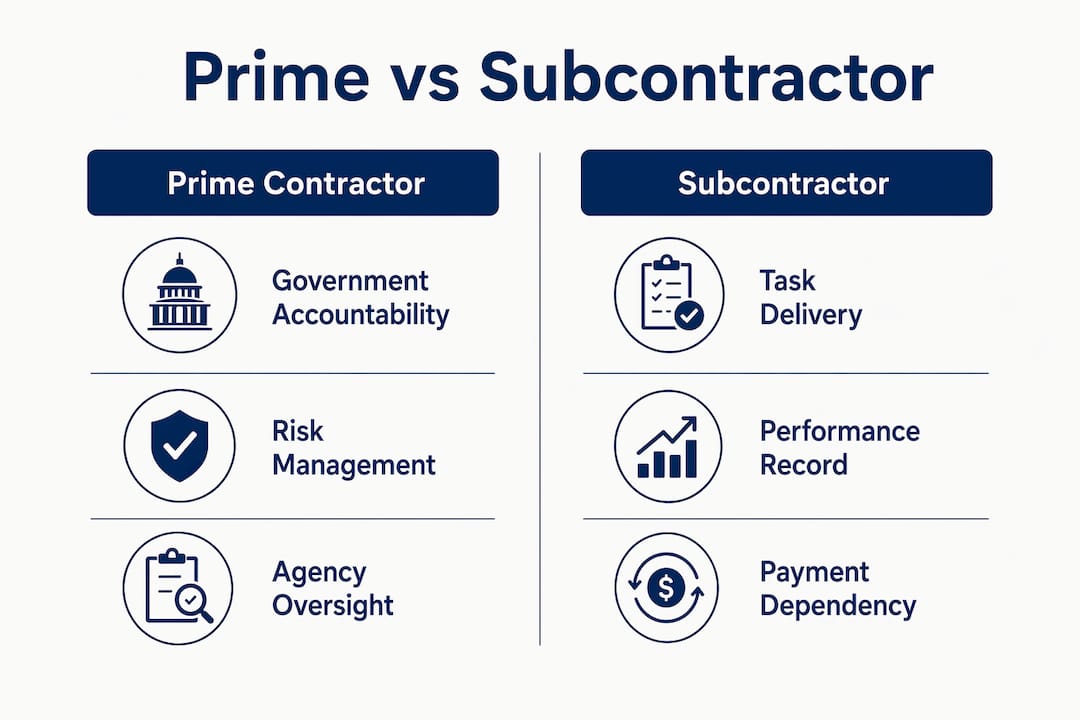
The table below compares how risk and responsibility are distributed between primes and subcontractors in a typical government engagement.
| Dimension | Prime contractor | Subcontractor |
|---|---|---|
| Government accountability | Full contract responsibility | None directly |
| Proposal burden | Complete government proposal | Responds to prime's request |
| Compliance overhead | FAR, DFARS, reporting requirements | Defined by subcontract terms |
| Revenue timeline | 6–18 months from pursuit to award | Weeks from prime award |
| Performance risk | Rated directly in CPARS | Rated by prime; may appear in CPARS |
| Scope complexity | Full program management | Focused technical deliverable |
Primes hold government accountability and manage subcontractors, simplifying agency oversight through centralized responsibility. Government agencies prefer a single accountable prime. That preference is structural, not a preference for convenience. It means the prime absorbs contract risk while the subcontractor executes a defined scope with less overhead and faster payment cycles. For procurement officials, this structure reduces management complexity without sacrificing delivery quality. You can read more about partnering for public sector IT to understand how these relationships are structured in practice.
Common misconceptions about subcontracting in government projects
The most damaging myth in government contracting is that subcontracting is a consolation prize. It is not. Subcontracting is best seen as a strategic alignment choice, balancing risk, overhead, and growth potential rather than serving as a fallback position. High-growth firms use subcontracting deliberately to gain competitive advantages before they are ready to prime.
Several misconceptions consistently cost subcontractors money and opportunity:
- "Subcontractors have no leverage." This is false. Many subcontractors underestimate their leverage because prime contractors have an obligatory need to meet formal subcontracting goals. That obligation can be negotiated into fair scopes and competitive rates.
- "Vague scopes are fine." Vague scopes create disputes, scope creep, and unpaid work. Every subcontract should define deliverables, acceptance criteria, and payment milestones in writing before work begins.
- "The prime will handle documentation." Subcontractors must proactively ensure their performance records are documented. Waiting for the prime to manage CPARS entries is a common error that hinders future prime bidding.
- "Any prime is a good prime." Vet prime contractors before signing. Review their CPARS history, check their payment reputation, and confirm they have a track record of supporting subcontractors through contract modifications.
Best practices for subcontractors in public sector projects come down to four disciplines: negotiate clear scopes, document performance proactively, deliver without exception, and build relationships that outlast individual contracts. Firms that apply these disciplines consistently find that subcontracting generates not just revenue but a portfolio of credentials that opens prime contract doors. The guide to subcontractor performance covers these responsibilities in detail.
Pro Tip: Before signing a subcontract agreement, request the prime's payment history on similar contracts. Slow payment from a prime is a structural problem, not an exception. Protect your firm by including payment terms and dispute resolution clauses in every agreement.
Key Takeaways
Subcontracting in the public sector is the fastest path to government revenue, documented past performance, and the agency relationships needed to compete as a prime contractor.
| Point | Details |
|---|---|
| Revenue speed advantage | Subcontracting generates income in weeks versus the 6–18 month prime proposal cycle. |
| Past performance pathway | Winning 2–3 subcontracts builds the CPARS record needed to bid as a prime within 3–4 years. |
| Prime contractor compliance need | FAR mandates small business subcontracting goals, giving qualified subs real negotiation leverage. |
| Risk and scope clarity | Subcontractors carry focused technical scopes with less overhead; primes absorb full contract risk. |
| Documentation is non-negotiable | Proactive CPARS documentation after each subcontract is the foundation of future prime bids. |
The strategic case most procurement officials miss
I have watched firms spend years pursuing prime contracts they were not ready to win, while ignoring subcontracting opportunities that would have built exactly the credentials they needed. The pattern is consistent and costly.
What I find most underappreciated is how subcontracting functions as an incubator. A firm that spends three years delivering well-scoped subcontracts to a single agency learns more about that agency's procurement culture than most prime contractors know after a decade of arms-length contract management. That knowledge compounds. It shapes proposals, informs pricing, and builds the personal relationships that influence source selection in ways no evaluation rubric fully captures.
The compliance dimension matters too. Firms that learn FAR requirements, CPARS dynamics, and subcontract administration as a subcontractor arrive at prime contracting with operational habits already formed. They do not have to learn compliance while simultaneously managing a government program. That sequencing is a genuine competitive advantage.
For procurement officials specifically, the importance of subcontracting in government extends beyond small business utilization metrics. A healthy subcontracting ecosystem produces a deeper bench of capable prime contractors over time. When agencies invest in relationships with subcontractors today, they build the competitive base that drives better prime proposals five years from now. That long view is worth holding.
— Randy
How Primereadysub supports public sector subcontracting
Primereadysub, operating as Rutledge & Associates, LLC, is an SDVOSB, woman-owned, and SBA-certified IT modernization firm that works as a high-value subcontractor for prime contractors on complex government programs in Maryland, New York, and Florida. The firm specializes in clearly defined technical scopes including DevOps pipelines, compliance automation, and real-time dashboards, delivering outcomes that reduce processing times and support audit readiness without requiring heavy oversight from the prime. For prime contractors seeking a prime-ready IT partner that meets small business subcontracting goals while delivering measurable results, Primereadysub brings the credentials, certifications, and track record that compliance-heavy programs demand.
FAQ
What is public sector subcontracting?
Public sector subcontracting is the arrangement where a prime contractor delegates a defined portion of a government contract to a specialized firm. The subcontractor delivers a specific technical scope while the prime retains full accountability to the government agency.
Why do prime contractors need subcontractors?
Prime contractors are required under FAR to meet mandatory small business subcontracting goals. Failure to meet these goals results in negative CPARS ratings, which directly reduces their competitiveness on future government bids.
How does subcontracting build past performance?
Each completed subcontract creates a documented delivery record in CPARS. Winning 2–3 subcontracts provides the past performance evidence needed to compete as a prime contractor within 3–4 years.
What leverage do subcontractors have in negotiations?
Subcontractors hold real leverage because prime contractors must meet formal small business utilization targets. That compliance obligation gives qualified subcontractors the standing to negotiate fair scopes and competitive rates rather than accepting whatever terms the prime initially offers.
What are the biggest risks for subcontractors in government projects?
The two most common risks are vague contract scopes that lead to unpaid work and failure to document performance in CPARS. Both are preventable through clear written agreements and proactive communication with the prime contractor throughout the engagement.