

A subcontracting model is the structured framework a prime contractor uses to delegate specific, defined tasks to external specialists while retaining full legal accountability to the government client. This explainer for subcontracting models covers the core legal distinctions, the most common model types used in government IT projects, and the compliance practices that protect prime contractors from costly liability. Understanding subcontracting agreements is not optional in public sector work. Federal regulations, flow-down clauses, and IRS reporting rules create a compliance environment where structural clarity directly affects project outcomes and audit readiness.
What is an explainer for subcontracting models in government IT?
A subcontracting model defines how work, risk, and accountability flow between a prime contractor, one or more subcontractors, and the government client. The industry term for this arrangement is a "prime-subcontractor relationship," and it operates under a strict legal principle called privity of contract. Privity means the subcontractor has no direct legal relationship with the government. The prime contractor holds full accountability for project completion and compliance, regardless of how much work a subcontractor performs. That accountability structure is the defining feature of every subcontracting model.
The practical implication is significant. If a subcontractor misses a deliverable or fails a compliance audit, the government holds the prime responsible. This is why choosing the right subcontracting model and drafting airtight agreements matters as much as selecting the right subcontractor.
How subcontracting models function within the government IT project lifecycle
The accountability chain runs in one direction: government client to prime contractor, then prime contractor to subcontractor. The government client never interacts directly with the subcontractor on contractual matters. Subcontractor claims run only against the prime, not against the project owner. This legal separation protects the government but concentrates risk at the prime level.
Contractual layering and flow-down clauses
Flow-down clauses are provisions in the prime contract that the prime contractor passes down to subcontractors, making those terms legally binding on the sub. The compliance risk here is real. Flow-down clauses legally bind subcontractors even when they have never reviewed the full prime contract. A subcontractor who signs a subcontract agreement without understanding the underlying prime contract terms can unknowingly accept obligations they cannot meet.
Key contractual elements in any government IT subcontracting arrangement include:
- Scope of work: Precisely defined deliverables with measurable acceptance criteria
- Flow-down clauses: Federal Acquisition Regulation (FAR) clauses that pass compliance obligations to the sub
- Payment terms: Specific clauses governing when and how the prime pays the subcontractor
- Termination provisions: Conditions under which either party can exit the agreement
- Audit rights: Prime contractor's right to inspect subcontractor records for compliance verification
Tax and reporting obligations
IRS rules create specific reporting duties for prime contractors who engage subcontractors. Payments exceeding $600 annually require a 1099-NEC filing, but the prime has no payroll tax withholding obligation. That distinction matters because misclassifying a subcontractor as an employee triggers back taxes, penalties, and potential debarment from future government contracts.
Pro Tip: Collect a completed IRS Form W-9 from every subcontractor before issuing the first payment. This protects you from backup withholding requirements and simplifies year-end 1099-NEC filing.
What are the common types of subcontracting models?
Types of subcontracting models vary by scope, tier structure, and the degree of specialization involved. Three models appear most frequently in public sector IT projects.

First-tier subcontracting places a single subcontractor directly below the prime. The prime manages the sub directly, communication is straightforward, and accountability is easy to track. This model works well for projects where one specialized capability, such as cloud migration or compliance automation, supplements the prime's core delivery.
Specialty trade subcontracting brings in a subcontractor for a narrow, highly technical function. In government IT, this often means a cybersecurity firm handling Authority to Operate (ATO) documentation or a data analytics firm building real-time dashboards. The engagement is short-term and task-specific. Subcontracting is best suited for defined, short-term specialized tasks, making specialty trade arrangements a natural fit for compliance-heavy IT programs.
Multi-tier subcontracting involves the prime's direct subcontractor engaging additional sub-tier subcontractors. This model handles large, complex programs but introduces significant management overhead and legal exposure.
| Model type | Best use case | Key risk | Administrative load |
|---|---|---|---|
| First-tier | Single specialty capability | Scope creep | Low |
| Specialty trade | Narrow technical function | Deliverable quality | Low to medium |
| Multi-tier | Large, complex programs | Lien waiver gaps, compliance gaps | High |
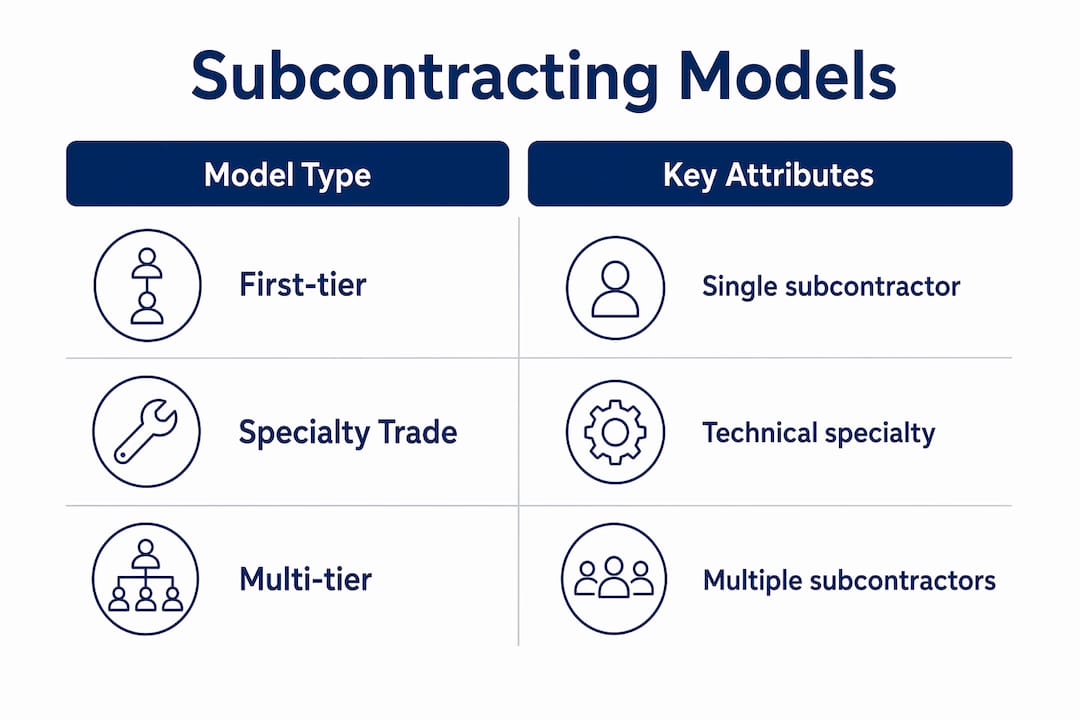
Selecting the right model depends on three factors: scope specificity, project duration, and the prime's capacity to manage oversight. A multi-tier arrangement on a short-duration project creates unnecessary legal exposure without proportional benefit.
Pro Tip: For government IT projects under 12 months, default to first-tier or specialty trade arrangements. Multi-tier structures require lien waiver tracking and compliance documentation that adds weeks of administrative work per project phase.
What are the benefits and challenges of subcontracting for public sector primes?
The benefits of subcontracting are concrete and measurable. Subcontracting reduces total employment costs by 25–35% compared to hiring equivalent full-time staff. That savings comes from eliminating benefits, payroll taxes, and overhead costs. For prime contractors managing fluctuating government contract volumes, this cost structure is a significant operational advantage.
Beyond cost, subcontracting allows primes to scale delivery capacity without permanent headcount. A prime contractor can bid on a larger contract knowing a qualified subcontractor covers a defined technical scope. This capacity scaling is why approximately 38% of small businesses engage in subcontracting annually to meet project demands.
The challenges are equally real and require deliberate management.
- Communication gaps: Multi-tier arrangements create information delays that affect deliverable quality and timeline adherence.
- Liability concentration: The prime absorbs all legal risk from subcontractor failures, including compliance violations.
- Vetting burden: Selecting unqualified subcontractors on government IT projects creates audit findings that follow the prime's record.
- Compliance documentation: FAR-mandated flow-down clauses require the prime to verify subcontractor compliance, not just assume it.
Vetting subcontractors before contract award is the most effective risk control available to prime contractors. Reviewing past performance records, certifications, and financial stability before signing a subcontract agreement prevents the majority of mid-project failures. The IT subcontractor vetting process for government projects requires specific documentation steps that differ from commercial sector practices.
Best practices for managing subcontracting compliance in government IT
Effective subcontracting management in government IT follows a clear sequence of steps. Skipping any step creates compounding compliance risk.
-
Define scope before soliciting subcontractors. Vague scope statements produce misaligned proposals and unenforceable agreements. Write deliverables in measurable terms with specific acceptance criteria tied to contract milestones.
-
Draft a comprehensive subcontract agreement. Treat the subcontract agreement as the primary source of truth for managing risk. Include payment terms, flow-down clauses, audit rights, and termination conditions. Generic templates create gaps that become disputes.
-
Review the prime contract with your subcontractor. Prime contractors must share relevant prime contract sections so subcontractors understand their flow-down obligations. Subcontractors who understand the full compliance picture perform better and create fewer audit findings.
-
Track lien waivers across all tiers. Failure to track sub-tier lien waivers creates legal and financial exposure for prime contractors. Build a lien waiver collection schedule into the project management plan from day one.
-
Establish regular compliance check-ins. Monthly reviews of deliverable status, documentation completeness, and compliance milestones catch problems before they become contract violations. Document every review in writing.
-
Maintain a subcontract administration log. Record all amendments, payment approvals, and correspondence. Government auditors review subcontract files, and gaps in documentation create findings even when the underlying work was performed correctly.
The IT subcontracting checklist for public sector projects covers each of these steps in detail and includes documentation templates aligned with FAR requirements.
Key Takeaways
Choosing the right subcontracting model and managing it with documented compliance practices is the single most effective way a prime contractor controls risk on government IT projects.
| Point | Details |
|---|---|
| Prime accountability is absolute | The prime contractor holds full legal responsibility regardless of subcontractor performance. |
| Model selection drives risk | First-tier and specialty trade models carry lower administrative and legal risk than multi-tier arrangements. |
| Flow-down clauses bind subcontractors | Subcontractors accept prime contract obligations through flow-down clauses, even without seeing the full contract. |
| Cost savings are real | Subcontracting cuts total employment costs by 25–35% compared to equivalent full-time hires. |
| Documentation prevents audit findings | Lien waiver tracking, compliance logs, and written check-ins protect primes during government audits. |
What I've learned about subcontracting models that most guides skip
Working in and around government IT contracting, the pattern I see most often is this: prime contractors spend significant energy selecting the right subcontractor and almost no energy structuring the subcontract agreement itself. That imbalance is where projects fail.
The privity doctrine is not an abstraction. When a subcontractor delivers defective work on a federal IT modernization program, the government does not negotiate with the sub. It holds the prime. I have seen prime contractors lose follow-on contract opportunities because a sub-tier compliance failure appeared in their past performance record. The prime had no idea the sub-tier firm existed until the audit finding arrived.
The other pattern worth naming is over-reliance on multi-tier chains without lien waiver discipline. Multi-tier subcontracting is sometimes unavoidable on large programs, but it requires a level of administrative rigor that most prime contractor teams underestimate. Building that rigor into the project plan from the start, rather than retrofitting it after a payment dispute, is the difference between a clean closeout and a legal dispute.
Long-term subcontractor relationships built on clear agreements and consistent communication outperform transactional arrangements on every metric that matters in government IT: deliverable quality, audit readiness, and contract renewal rates. The advantages of IT subcontracting compound over time when the relationship is structured correctly from the start.
— Randy
How Primereadysub supports prime contractors in government IT
Primereadysub, the public-facing platform for Rutledge & Associates, LLC, is built specifically for prime contractors who need a prime-ready IT modernization partner with defined scope ownership and minimal oversight requirements. Rutledge & Associates holds SDVOSB, woman-owned, and SBA certifications, making the firm a compliance-ready subcontracting partner for federal and state government programs. The firm delivers outcomes in cloud-native re-architecting, compliance automation, DevOps pipelines, and real-time dashboards across programs in Maryland, New York, and Florida. Prime contractors working on complex, compliance-heavy IT programs can review subcontracting partnership options for public sector primes to assess fit before initiating a conversation.
FAQ
What is a subcontracting model in government IT?
A subcontracting model is the structured framework defining how a prime contractor delegates specific tasks to a subcontractor while retaining full legal accountability to the government client. The subcontractor has no direct contractual relationship with the government.
What types of subcontracting models are most common in public sector IT?
First-tier, specialty trade, and multi-tier subcontracting are the three most common models. First-tier and specialty trade arrangements carry lower compliance overhead and work best for defined, short-duration technical scopes.
What are the tax obligations when paying a subcontractor?
Prime contractors must issue a 1099-NEC for any subcontractor paid more than $600 in a calendar year. No payroll tax withholding applies, but misclassifying a subcontractor as an employee triggers IRS penalties.
What is a flow-down clause and why does it matter?
A flow-down clause passes prime contract obligations directly to the subcontractor, making those terms legally binding. Subcontractors can be bound by FAR compliance requirements they have never reviewed if the subcontract agreement includes a broad flow-down provision.
How does a prime contractor reduce risk in multi-tier subcontracting?
Tracking lien waivers from all sub-tier subcontractors and conducting regular compliance documentation reviews are the two most effective controls. Failure to collect sub-tier lien waivers creates legal and financial exposure that falls entirely on the prime contractor.