

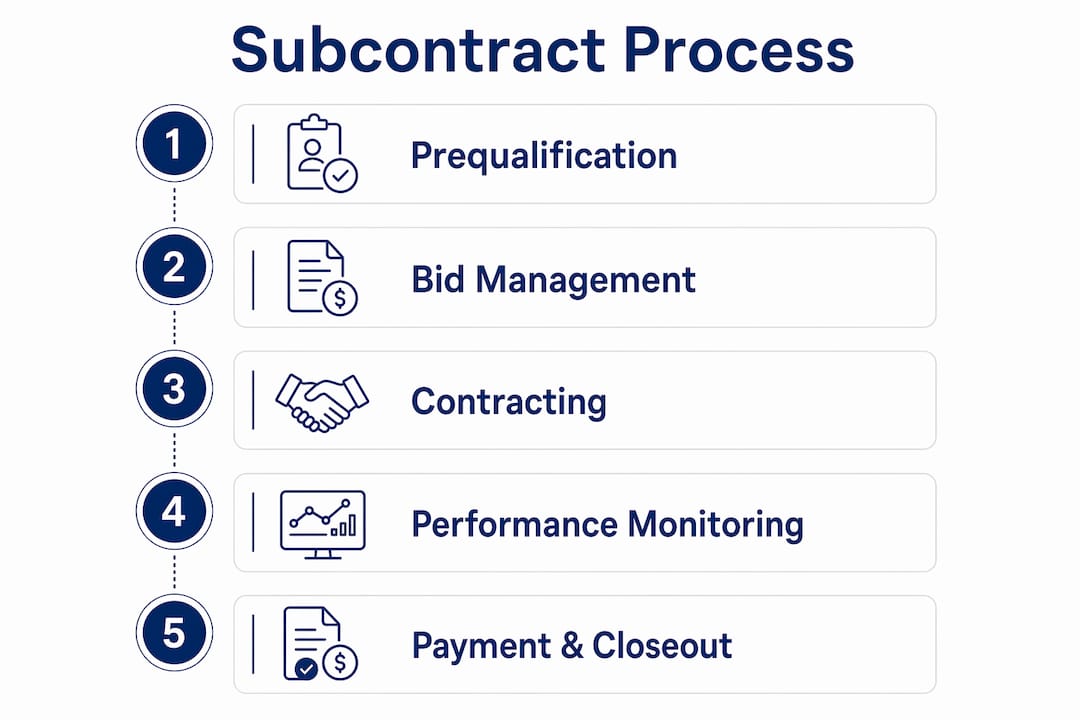
Step by step subcontract administration is the process of managing subcontractor agreements through defined phases that align scope, schedule, compliance, and payments to deliver public sector technology projects on time and within budget. The industry term for this discipline is subcontract administration, and it covers every stage from prequalification through final closeout. Subcontractors perform 80–90% of physical labor on major projects, which means a weak administration process directly threatens your profitability and your agency client's outcomes. This guide walks prime contractors and project managers through each phase with 2026 best practices built for compliance-heavy government IT environments.
What prerequisites are essential before starting subcontract administration?
Effective subcontract administration begins before a single bid goes out. Prime contractors must establish the administrative infrastructure that will govern every subcontractor relationship on the project.
Standardize your master subcontract agreement
Prime contractor agreements do not automatically flow down to subcontractors. Each subcontract must explicitly define enforceable scope, schedule, and payment terms. A master subcontract template should include deliverable definitions, milestone dates, invoicing procedures, retainage terms, and termination clauses. Standardizing this document across all subcontractors reduces negotiation time and closes the legal gaps that generate disputes.
Develop a prequalification process
Prequalification filters out subcontractors who cannot meet your compliance or performance standards before they are ever invited to bid. Your prequalification questionnaire should cover financial stability, relevant past performance on government IT contracts, cybersecurity certifications such as FedRAMP or CMMC compliance, and insurance requirements. For public sector technology projects in states like Maryland, New York, and Florida, agency-specific certification requirements may also apply. Collecting this data upfront protects you from onboarding a subcontractor who fails a compliance audit mid-project.
Select the right technology platform
Contract management software is not optional on compliance-heavy government programs. Platforms like Procore, Autodesk Build, and GCPay provide bid management, document control, compliance tracking, and payment processing in one environment. The table below compares key features relevant to public sector subcontract administration.

| Feature | Procore | Autodesk Build | GCPay |
|---|---|---|---|
| Bid management | Yes | Yes | No |
| Compliance tracking | Yes | Yes | Limited |
| Payment processing | Limited | Limited | Yes |
| Document control | Yes | Yes | No |
| Government reporting | Limited | Limited | No |
Set up automated compliance alerts so certification expirations trigger notifications before they become violations. This single step prevents the most common audit finding on public sector IT programs.
Pro Tip: Build your IT subcontracting checklist before issuing the first solicitation. A checklist tied to your master subcontract template catches missing documents before they become contract deficiencies.
How to execute the step by step subcontract administration process from bid to contract
The bid-to-contract phase sets the terms that govern every interaction with a subcontractor for the life of the project. Errors here compound into costly change orders and schedule delays.
-
Create a bid leveling spreadsheet. Bid leveling requires a detailed spreadsheet listing each scope item per bidder to identify missing items and compare pricing on an equal basis. Without this step, the lowest bid often reflects a narrower scope, not a better price.
-
Clarify inclusions and exclusions in writing. Vague scope language is the primary driver of change orders and project disputes. Before award, send each finalist a written scope clarification letter and require a signed acknowledgment. This document becomes part of the subcontract record.
-
Issue a formal scope letter post-award. The scope letter confirms the award, defines the exact deliverables, and sets the contract start date. It is not the subcontract itself, but it creates a binding record of intent that protects both parties during contract finalization.
-
Execute the standardized subcontract. Use your master template with the scope letter attached as an exhibit. Confirm that all flow-down clauses from your prime contract are included, particularly those related to data security, audit rights, and reporting requirements common in government IT programs.
-
Run a structured onboarding protocol. Onboarding for public sector IT subcontractors should include document submission (insurance certificates, W-9, security clearance documentation), a kickoff meeting with defined agenda, and system access provisioning. Use a contract onboarding checklist to confirm each step is complete before work begins.
-
Confirm mobilization readiness. Best practices require confirming subcontractor site arrival 48–72 hours before the scheduled start date. For IT projects, this means confirming VPN access, credentialing, and environment readiness, not just physical presence.
Pro Tip: Bid leveling is often overlooked but is the single best tool for identifying scope gaps before they become change orders. Spend an extra two hours on the spreadsheet and save weeks of dispute resolution later.
How do you monitor subcontractor performance and compliance during execution?
Performance monitoring is where most subcontract administration processes break down. Prime contractors who rely on informal check-ins instead of structured oversight create the conditions for schedule slippage and compliance failures.
Pull-planning coordination meetings are the most effective tool for aligning subcontractor dependencies. Pull-planning sessions identify dependencies needed to meet upcoming milestones by working backward from deliverable dates. For IT projects, this means mapping integration dependencies, testing windows, and environment handoffs across all active subcontractors.
Detailed rolling three-week lookahead schedules improve schedule adherence more than any other single practice. This level of scheduling detail bridges the gap between high-level program milestones and daily task execution. Require each subcontractor to submit their three-week lookahead at every coordination meeting.
Document everything in writing. Documenting all deviations, RFIs, and change order requests by subcontract and date enables pattern recognition and early risk identification. A subcontractor generating a disproportionate share of RFIs signals a scope or capability problem that needs attention before it becomes a schedule event.
Key monitoring metrics and escalation protocols for public sector IT subcontracts:
- Schedule adherence rate: Percentage of committed tasks completed on time per three-week lookahead
- RFI volume by subcontractor: High RFI counts indicate scope ambiguity or skill gaps
- Change order ratio: Tracks scope creep and bid accuracy over time
- Punch list item count: Measures quality at each delivery milestone
- Safety and security incidents: Required reporting for most government IT programs
- Certification currency: Active status of all required compliance certifications
Written documentation significantly strengthens your position in subcontractor disputes. Verbal complaints are routinely disregarded in formal proceedings. Every performance concern must be documented with a date, a specific description, and a required corrective action.
When a subcontractor underperforms, issue a written cure notice and allow 48–72 hours for corrective action before escalating. This process is specified in standard subcontract provisions and protects you legally if termination becomes necessary.
Pro Tip: Track subcontractor performance metrics including punch-list items, change-order ratios, and safety incidents across projects. Integrate these into a preferred subcontractor list that informs future bid invitations.
Retainage of 5–10% of each payment provides financial leverage to maintain quality through punch list completion. Release retainage only after all deliverables are accepted, all lien waivers are received, and all compliance documentation is current.
What are the payment procedures and closeout steps in subcontract administration?
Payment administration is the most relationship-sensitive part of the subcontract administration process. Inconsistent or delayed payments are the leading cause of subcontractor disengagement on long-duration government IT programs.
Standardizing pay applications on AIA G702/G703 forms with fixed monthly submission dates improves payment accuracy and builds trust with subcontractors. Consistent 30-day payment cycles reduce payment-related inquiries and keep subcontractors focused on delivery rather than cash flow management. For IT projects without physical construction, equivalent schedule-of-values formats tied to deliverable milestones serve the same function.
The table below summarizes the payment process milestones, required documentation, and target timelines for public sector IT subcontracts.
| Milestone | Required Documentation | Target Timeline |
|---|---|---|
| Monthly pay application | AIA G702/G703 or equivalent, lien waiver | Submitted by 25th of month |
| Prime review and approval | Annotated pay app, compliance check | Within 7 days of receipt |
| Payment release | Approved pay app, conditional lien waiver | Net-30 from submission date |
| Retainage release | Punch list sign-off, final lien waiver | Within 30 days of acceptance |
| Final payment | All closeout docs received | Within 14 days of closeout |
The closeout phase requires a structured checklist to avoid leaving compliance gaps that trigger audit findings. Required closeout documents for public sector IT subcontracts include:
- Final unconditional lien waivers from the subcontractor and all sub-tiers
- Warranty letters covering software, integrations, and any delivered systems
- Operations and maintenance manuals for all deployed technology components
- As-built documentation reflecting final system configurations
- Security and compliance certifications confirming all access has been terminated
- Signed acceptance letter from the agency client or prime contractor
Final payment triggers only after all items on the closeout checklist are verified and filed. Tracking retainage balances in your contract management platform prevents accidental early release and keeps your audit trail clean.
Key takeaways
Systematic subcontract administration, executed phase by phase from prequalification through closeout, is the single most reliable way to protect profitability and compliance on public sector IT projects.
| Point | Details |
|---|---|
| Standardize before you solicit | A master subcontract template with flow-down clauses prevents legal gaps before the first bid goes out. |
| Bid leveling prevents scope disputes | Normalize all bids on a line-item spreadsheet to identify missing scope before award. |
| Written documentation wins disputes | Every performance concern, deviation, and cure notice must be dated and filed in writing. |
| Structured payment cycles build trust | AIA G702/G703 pay apps with net-30 cycles reduce subcontractor inquiries and keep projects moving. |
| Closeout is a compliance event | Final payment releases only after lien waivers, warranty letters, and as-built docs are verified. |
What I've learned managing subcontracts on government IT programs
The biggest mistake I see prime contractors make is treating bid leveling as a formality. They collect three bids, pick the lowest number, and move on. Six months later, they are writing change orders to cover scope that was never in the winning bid to begin with. The spreadsheet takes two hours. The change orders take two months.
The second pattern I see consistently is verbal performance management. A project manager calls the subcontractor's lead, expresses concern, and considers the issue addressed. When the problem escalates, there is no paper trail. The written cure notice process exists precisely because verbal complaints carry no weight in a formal dispute. Every conversation about performance should be followed by an email summary that same day.
Technology platforms like Procore and GCPay have made compliance tracking far more manageable than it was five years ago. But the platform only works if the data going in is accurate. I have seen teams use Procore beautifully for document storage and then track actual compliance status on a spreadsheet that nobody updates. The tool is only as good as the discipline behind it.
The prime contractors who consistently deliver on public sector IT programs share one trait. They treat subcontract administration as a project management function, not a procurement afterthought. They assign a dedicated subcontract administrator, run structured coordination meetings, and review performance metrics at every project status call. That discipline is what separates programs that close cleanly from programs that end in disputes and audit findings.
Understanding subcontracting partnerships as a long-term relationship, not a transactional arrangement, also changes how you manage performance. Subcontractors who know you track their metrics and reward strong performance with repeat work have a real incentive to deliver. That is the foundation of a preferred subcontractor list that actually improves program outcomes over time.
— Randy
How Primereadysub supports prime contractors in public sector IT
Primereadysub, operating as Rutledge & Associates, LLC, works with prime contractors on compliance-heavy government IT programs in Maryland, New York, and Florida. The firm holds SDVOSB, woman-owned, and SBA certifications, and delivers clearly defined scopes rather than staff augmentation. That means low oversight for the prime and full accountability for outcomes. Services cover DevOps pipelines, compliance automation, real-time dashboards, and audit-ready documentation. For prime contractors who need a subcontractor that owns its scope and meets government reporting requirements without hand-holding, Primereadysub is built for that role. Learn more about IT modernization partnership options for your next public sector program.
FAQ
What is subcontract administration in public sector IT projects?
Subcontract administration is the systematic process of managing subcontractor agreements from prequalification through final closeout, covering scope, schedule, compliance, and payments. On government IT programs, it also includes flow-down clause enforcement and agency-specific reporting requirements.
How do you handle an underperforming subcontractor?
Issue a written cure notice specifying the performance deficiency and require corrective action within 48–72 hours before escalating to remedial action or termination. Written documentation is required to protect the prime contractor's legal position.
What is bid leveling and why does it matter?
Bid leveling is the process of normalizing competing bids on a line-item spreadsheet to identify scope gaps and compare pricing on equal terms. It prevents awarding to a low bidder who excluded critical scope items.
When should retainage be released to a subcontractor?
Retainage, typically 5–10% of each payment, releases only after punch list completion, final lien waiver receipt, and acceptance of all closeout documentation. Releasing retainage before these conditions are met creates audit exposure on government contracts.
What documents are required to close out a subcontract?
Closeout requires final unconditional lien waivers, warranty letters, operations and maintenance manuals, as-built system documentation, and a signed acceptance letter. On public sector IT programs, termination of system access and updated compliance certifications are also required before final payment.