

Subcontractor performance management is the systematic process of evaluating, tracking, and improving subcontractor contributions to keep public sector projects on schedule, within budget, and in compliance. Prime contractors and project managers who apply a structured guide to subcontractor performance consistently outperform those who rely on informal oversight. The core tools in this discipline include performance scorecards, prequalification databases, real-time cost tracking, and AI-powered monitoring platforms. Each of these methods addresses a different failure point in the subcontractor relationship, from bid selection through final closeout.
What are the key subcontractor evaluation criteria for public sector projects?
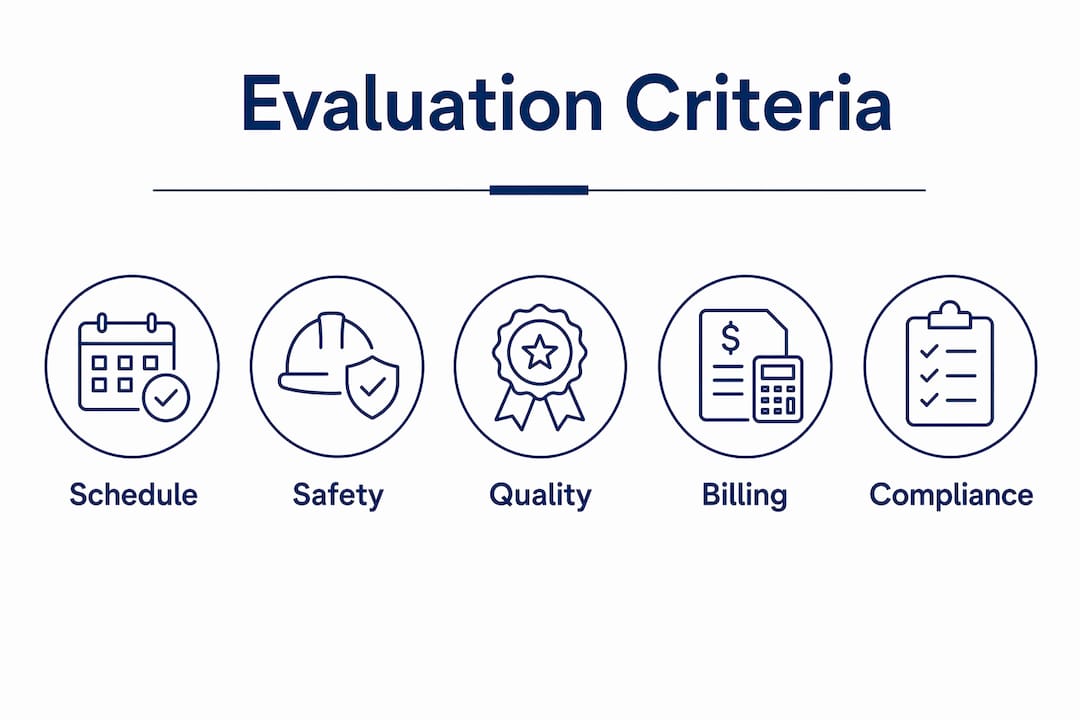
Subcontractor evaluation criteria define the specific dimensions a prime contractor measures to score vendor performance objectively. The six most critical categories are schedule adherence, safety compliance, quality and rework rate, communication responsiveness, billing accuracy, and scope compliance. Each category should carry a weighted score so that a single weak area does not hide a deeper problem.
Safety compliance deserves special attention in public sector work. The Experience Modification Rate (EMR) is the industry's standard safety benchmark. An EMR of 1.0 represents the industry average. Most prime contractors use EMR thresholds of 1.2–1.25 as the cutoff for disqualifying a subcontractor from bidding. Exceeding that threshold signals a pattern of workplace incidents that creates liability for the entire project team.
Pro Tip: Set minimum passing scores for individual scorecard categories, not just a total score. A subcontractor who scores perfectly on billing but fails safety can still pass an overall threshold. Minimum category thresholds prevent that masking effect.
The table below shows a practical weighting model for public sector subcontractor scorecards.
| Evaluation category | Suggested weight | Common disqualification signal |
|---|---|---|
| Schedule adherence | 25% | Consistent delays beyond 5% of milestone dates |
| Safety compliance (EMR) | 25% | EMR above 1.25 |
| Quality and rework rate | 20% | Rework exceeding 3% of contract value |
| Billing accuracy | 15% | Repeated overbilling or unsupported invoices |
| Communication responsiveness | 10% | Response times exceeding 48 hours on RFIs |
| Scope compliance | 5% | Unauthorized scope changes without written approval |
Establish evaluation weights before the bidding phase, not after award. Defining criteria upfront removes lowest-price bias and produces repeatable, defensible decisions. That discipline matters especially in public sector contracting, where procurement decisions face audit scrutiny.
How to implement continuous subcontractor performance feedback
Continuous feedback is more effective than end-of-project reviews because it gives subcontractors the chance to correct problems before they compound. Ongoing feedback loops allow subcontractors to adjust in real time, which prevents minor schedule slips from becoming contract disputes.
A practical continuous feedback program follows four steps:
- Schedule bi-weekly check-ins. Short, structured meetings focused on scorecard metrics keep both parties aligned. Use a shared agenda tied directly to the evaluation categories.
- Document every conversation. Written records of feedback protect the prime contractor during disputes and create a paper trail for audit purposes. Project management platforms like Procore or Autodesk Construction Cloud support this documentation automatically.
- Share scorecard data with the subcontractor. Transparency builds trust and removes the perception that scoring is arbitrary. When subcontractors see their own numbers, they respond to them.
- Escalate formally when thresholds are breached. A written notice tied to a specific scorecard category is more defensible than a verbal warning. Attach a corrective action plan with a defined timeline.
"Top-performing subcontractor relationships depend on transparency, regular communication, and data-driven feedback loops." — Construction Placements, Subcontractor Management Best Practices 2026
Public sector project managers often skip mid-project check-ins because they feel time-consuming. The cost of that shortcut shows up in change orders, schedule extensions, and compliance findings. A 30-minute bi-weekly check-in is a fraction of the cost of a single contract dispute. For IT-specific public sector work, the public sector contracting tips from Primereadysub cover how to structure these feedback protocols within compliance-heavy programs.
What technological tools enhance subcontractor performance tracking?
Technology does not replace sound management judgment. It gives project managers faster access to the data they need to exercise that judgment. Three categories of tools matter most for subcontractor performance tracking: AI-powered reality capture, performance scorecard software, and centralized project management platforms.

AI-powered reality capture tools, such as those offered by OpenSpace, produce measurable results. AI tools reduce issue resolution times by up to 50% and cut site visits by over 30%. That reduction in site visits directly lowers overhead costs for prime contractors managing multiple subcontractors across dispersed public sector sites.
Pro Tip: Pair AI monitoring tools with a centralized subcontractor database. The AI captures site conditions; the database stores the historical performance record. Together, they create a complete picture that survives staff turnover.
The comparison below shows how different tool categories address specific management problems.
| Tool category | Primary function | Key benefit for prime contractors |
|---|---|---|
| AI reality capture (e.g., OpenSpace) | Visual site documentation | Faster issue detection, fewer site visits |
| Scorecard software (e.g., Trueleveler) | Structured performance scoring | Consistent, auditable vendor evaluations |
| Project management platforms (e.g., Procore, Autodesk) | Schedule, RFI, and document management | Centralized communication and compliance records |
| Subcontractor databases | Historical performance storage | Prevents loss of institutional knowledge |
Dedicated subcontractor management software produces a measurable productivity lift. 91% of general contractors report increased productivity after adopting these platforms. That figure reflects not just faster data entry but better decision-making based on complete information. You can also explore how AI solutions for construction support subcontractor workflow management at the field level.
What are best practices for prequalification and vendor database management?
Prequalification is the single highest-return activity in subcontractor management. Thorough prequalification prevents roughly 80% of downstream performance and project failure issues. That figure reflects the compounding effect of vetting insurance, bonding, financial health, and safety records before a subcontractor ever sets foot on a project.
A complete prequalification checklist for public sector projects includes:
- Insurance verification. Confirm general liability, workers' compensation, and professional liability coverage meet contract minimums.
- Bonding capacity. Verify the subcontractor's bonding limit covers the full contract value.
- Financial health review. Request two years of financial statements. Look for negative working capital or excessive debt ratios.
- Safety record. Pull the EMR and OSHA 300 logs. Disqualify any vendor above the 1.25 EMR threshold.
- Reference checks. Contact at least two prior prime contractors from similar public sector projects.
- License and certification verification. Confirm all required state and local licenses are current.
The vendor database is where prequalification data lives between projects. Centralizing subcontractor data prevents the loss of institutional knowledge when a project manager leaves or transfers. Without a database, that knowledge walks out the door. With one, every future bid decision draws on a documented history of scores, safety records, and contact information.
Maintain the database actively. Remove vendors who have not responded to bid requests in 18 months or who have scored below acceptable thresholds on two consecutive projects. Onboard new subcontractors through the same prequalification process, regardless of referral source. Consistency in the process produces consistency in the vendor pool. For IT subcontractors specifically, the IT subcontracting checklist from Primereadysub provides a detailed prequalification framework tailored to public sector technology programs.
How do performance metrics and real-time cost tracking prevent delays?
Cost overruns and schedule delays share a common cause: late detection. Weekly payment reconciliation tied to site progress is the most reliable method for catching problems before they become crises. Waiting for month-end reports delays problem detection by weeks. That delay is expensive.
A practical real-time cost tracking process works as follows:
- Require progress-based payment applications. Subcontractors submit payment requests tied to a schedule of values, not to calendar dates. Each line item corresponds to a defined scope element.
- Reconcile weekly against site progress. Compare billed amounts to actual field progress. A subcontractor billing 60% complete on a scope that is 40% built is overbilling by 20 percentage points.
- Flag overbilling immediately. Issue a written notice within 48 hours of detecting a discrepancy. Document the variance in the project management platform.
- Track underbilling as well. Consistent underbilling signals a subcontractor who is falling behind and may not be reporting it. Both patterns carry risk.
- Connect cost data to scorecard scores. Billing accuracy is a scored category. Cost tracking data feeds directly into the subcontractor's performance record.
Subcontractors who consistently exceed bid averages by 30% or more, or who regularly fail to respond to bid requests, should be flagged in the vendor database. That pattern predicts future performance problems. Catching it early keeps the bid list clean and the project budget intact.
Pro Tip: Build the payment reconciliation schedule into the subcontract agreement itself. When the reconciliation cadence is a contractual requirement, subcontractors treat it seriously from day one.
Key Takeaways
Effective subcontractor performance management requires structured evaluation criteria, continuous feedback, and centralized data systems working together from prequalification through project closeout.
| Point | Details |
|---|---|
| Use weighted scorecards | Assign category weights before bidding to produce objective, auditable vendor decisions. |
| Set minimum category thresholds | Prevent a high total score from masking a failing safety or financial result. |
| Implement continuous feedback | Bi-weekly check-ins tied to scorecard data resolve issues before they become contract disputes. |
| Prequalify every vendor | Thorough upfront vetting prevents the majority of downstream performance failures. |
| Reconcile costs weekly | Comparing billed amounts to site progress weekly catches overbilling and schedule slippage early. |
What I have learned managing subcontractors in public sector programs
The most common mistake I see prime contractors make is treating the scorecard as a report card rather than a management tool. A score calculated at project closeout tells you what went wrong. A score reviewed bi-weekly tells you what to fix. The difference in outcome between those two approaches is significant.
The second pattern worth naming is the reliance on individual project managers as the sole repository of subcontractor knowledge. When that PM moves to another program, the institutional memory goes with them. A centralized vendor database is not a technology preference. It is a risk management requirement. Public sector auditors expect documented, consistent decision-making. A database of historical scores, safety records, and bid history provides exactly that.
The third observation is about technology adoption. Prime contractors who resist AI monitoring tools often cite cost. The math rarely supports that resistance. A 50% reduction in issue resolution time and a 30% reduction in site visits produce savings that exceed the platform cost on most mid-size public sector projects. The barrier is usually change management, not economics.
Finally, the prequalification step is where most performance problems are actually solved. A subcontractor with an EMR above 1.25, weak bonding capacity, and no verifiable public sector references will not perform better once they are on your project. The data available before award predicts the outcome after award with high reliability. Invest the time upfront.
— Randy
How Primereadysub supports public sector prime contractors
Prime contractors managing compliance-heavy public sector IT programs need subcontractors who own clearly defined scopes and require minimal oversight. Primereadysub, the public-facing platform of Rutledge & Associates, LLC, is built for exactly that role. Certified as an SDVOSB, woman-owned, and SBA-certified firm, Primereadysub delivers outcomes-driven IT modernization services including DevOps pipelines, compliance automation, and real-time dashboards across Maryland, New York, and Florida. For primes seeking a contract-ready IT partner who meets prequalification standards from day one, Primereadysub provides documented past performance, audit-ready compliance records, and defined deliverables. Maryland-based primes can review regional service details specific to state agency programs.
FAQ
What is subcontractor performance management?
Subcontractor performance management is the structured process of evaluating, tracking, and improving subcontractor contributions using defined metrics such as schedule adherence, safety compliance, and billing accuracy. It applies throughout the project lifecycle, from prequalification through closeout.
What subcontractor evaluation criteria matter most in public sector projects?
Schedule adherence, safety compliance (measured by EMR), quality and rework rate, and billing accuracy are the highest-weight criteria. Safety compliance carries particular weight because an EMR above 1.25 is a common disqualification threshold.
How often should prime contractors review subcontractor performance?
Bi-weekly check-ins tied to scorecard data produce the best outcomes. Continuous feedback allows subcontractors to correct course in real time rather than receiving a failing score at project end.
What does prequalification prevent?
Thorough prequalification prevents roughly 80% of downstream subcontractor performance and project failure issues by vetting insurance, bonding, financial health, and safety records before contract award.
How does real-time cost tracking improve subcontractor management?
Weekly reconciliation of progress-based payment applications against actual site progress detects overbilling and schedule slippage early. Waiting for month-end reports delays problem detection by weeks and increases financial risk.