

Contract readiness is defined as a business's demonstrated ability to meet the technical, administrative, and compliance requirements needed to win and perform public-sector contracts. It functions as the primary filter government buyers use to assess risk before award. Procurement officials rely on readiness evidence to evaluate whether a contractor can deliver without oversight failures or compliance gaps. Understanding this concept is the first step toward competing effectively in public-sector markets, where incomplete preparation leads directly to bid rejection.
What is contract readiness, and what are its critical components?
Contract readiness covers five distinct capability areas. Each one signals a different dimension of reliability to the government buyer. A contractor who addresses all five presents a lower risk profile and a clearer path to award.
1. Legal and administrative readiness
Registration in SAM.gov, active entity records, and current certifications form the baseline. For small businesses, certifications such as SDVOSB, 8(a), or SBA-certified status open set-aside opportunities that are otherwise unavailable. Missing or expired registrations disqualify bids before evaluation begins.
2. Operational and financial stability
A contractor must demonstrate a cost structure that supports contract performance. This includes documented labor categories, a functioning invoicing process, and clear separation of direct and indirect costs. Financial instability signals execution risk to procurement officers reviewing proposals.
3. Capability and offer alignment

The contractor's technical approach must map directly to the solicitation's requirements. Generic capability statements fail because they force the buyer to interpret fit. Specific, evidence-backed claims tied to the scope of work reduce that interpretive burden.
4. Past performance and credibility
Relevant references from prior contracts carry significant weight at evaluation. Government buyers treat past performance as a proxy for future execution. References should match the contract type, dollar value, and technical domain of the opportunity being pursued.
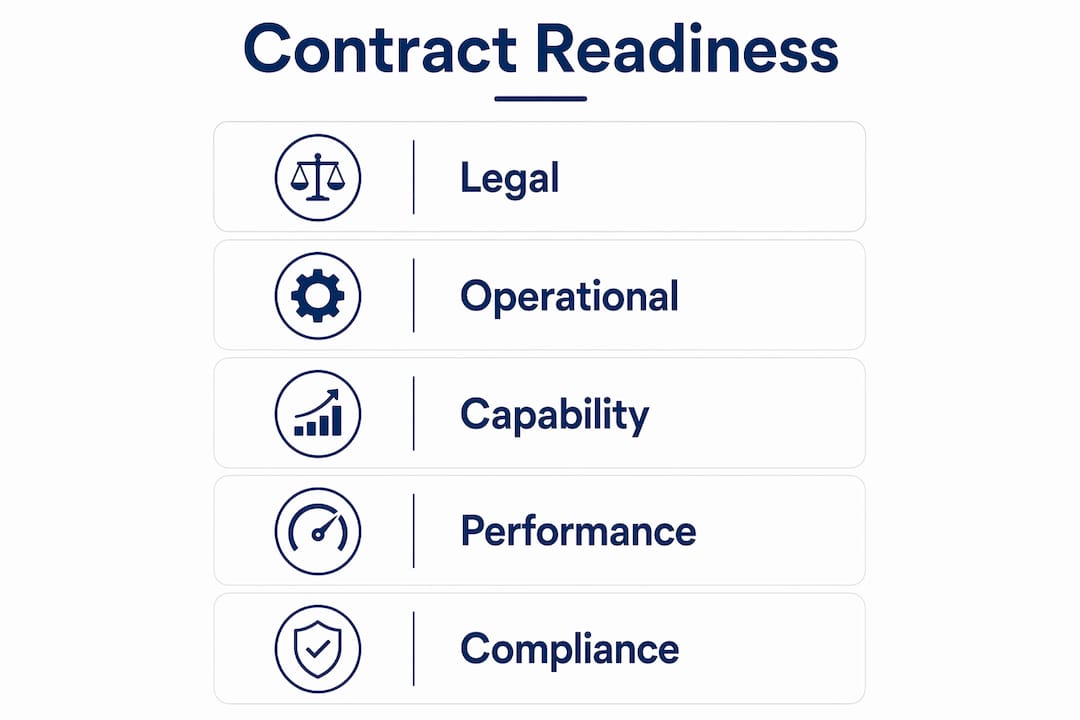
5. Compliance and execution infrastructure
Documented policies, communication protocols, and records management systems show that the contractor can sustain performance over the contract period. This includes version-controlled documentation, defined escalation paths, and audit-ready records.
Pro Tip: Build a single readiness binder that consolidates registrations, certifications, past performance write-ups, and key policies. Update it quarterly so it is ready to support any bid on short notice.
How do capture readiness and audit readiness support government contract bidding?
Capture readiness and audit readiness address two separate but equally critical phases of the contract lifecycle. Capture readiness applies before a solicitation is released. Audit readiness applies throughout contract performance.
Capture readiness: winning before the bid drops
Capture readiness is a pre-solicitation evaluation that fixes bid preparation gaps early, reducing wasted resources on non-winnable bids. The goal is to assess competitive position before committing proposal resources. This means researching the customer's priorities, identifying incumbents, and mapping your capabilities against the anticipated requirements.
- Research the opportunity early. Identify the contracting office, the program manager, and any prior awards for the same requirement. Public databases like USASpending.gov and SAM.gov provide this data without cost.
- Build win themes before writing. Win themes are specific, evidence-backed reasons why your offer is the best fit. They must connect your past performance to the buyer's stated priorities.
- Conduct a gap analysis. Compare your current capabilities against the anticipated evaluation criteria. Gaps identified six months before a solicitation can be addressed. Gaps identified during proposal writing cannot.
- Qualify the opportunity. Not every bid is worth pursuing. A structured go or no-go decision process prevents resource drain on low-probability pursuits.
Pro Tip: Effective capture readiness strategies, including early opportunity research and building win themes, position contractors for more competitive proposals. Start capture activities at least 90 days before the anticipated solicitation release.
Audit readiness: sustaining compliance after award
Audit readiness focuses on accounting systems supporting compliant cost accumulation and billing under FAR standards. The Defense Contract Audit Agency (DCAA) evaluates accounting systems through pre-award SF 1408 audits and post-award reviews. Both assess whether the system is designed correctly and whether it operates as designed every day.
Common audit readiness failures include:
- Inadequate separation of direct versus indirect costs
- Poor timekeeping practices that cannot support labor cost claims
- Failure to exclude unallowable costs from billing
- Documentation inconsistencies between written policy and actual daily practice
Contractors cannot self-initiate official DCAA audits. They should instead conduct internal readiness self-assessments using official checklists to prepare for government-initiated reviews. Mock audits serve this purpose well. They surface weaknesses before an auditor does, giving the contractor time to remediate without the pressure of a formal finding.
Why is contract readiness important to government procurement officials?
Government buyers prioritize reduced risk and clear evidence of capability over perfection. This is the central insight that most contractors miss. Buyers do not expect flawless proposals. They expect proposals that make evaluation easy and risk visible.
"Vague or generic responses in bidding lead to rejections since they force interpretation by the buyer, increasing perceived risk. Government buyers seek reduced risk and clarity; businesses achieve readiness by providing transparent, verifiable evidence of their capability tailored to specific contract requirements."
From the procurement official's perspective, a contractor who demonstrates readiness reduces the administrative burden of evaluation. Documented processes, clear pricing structures, and verifiable past performance all shorten the time between solicitation and award. That speed matters in agencies with constrained acquisition workforces.
Incomplete or ambiguous submissions create the opposite effect. They generate clarification requests, extend evaluation timelines, and signal that the contractor may struggle with contract administration after award. Procurement officials interpret vague responses as evidence of execution risk, not just proposal weakness.
The importance of contract readiness extends to policy-level mandates as well. UK government SME spending targets of up to 33% by 2025 make readiness a primary filter at the Pre-Qualification Questionnaire stage. That policy context shows how readiness functions not just as a competitive advantage but as a structural requirement in markets with formal supplier diversity goals.
For contract managers overseeing supplier performance, readiness evidence also informs subcontractor selection. A subcontractor who arrives with current registrations, documented quality controls, and audit-ready financials requires less oversight. That reduced oversight translates directly into lower program management costs. Reviewing IT subcontracting criteria for public sector projects gives contract managers a practical framework for applying this standard consistently.
How can organizations assess and improve their contract readiness?
Readiness assessment begins with an honest gap analysis across the five component areas. The Pre-award Accounting System Adequacy Checklist, published by DCAA, provides a structured starting point for the financial and compliance dimensions. For capture and capability readiness, internal workshops that map current offerings against target contract types produce the clearest picture.
Building a repeatable readiness process
The table below compares two approaches to readiness management. One treats readiness as a project. The other treats it as an ongoing operational discipline.
| Approach | Characteristics | Outcome |
|---|---|---|
| One-time checklist | Completed before a specific bid, then set aside | Gaps reappear between bids; audit findings increase |
| Continuous readiness | Monthly reviews, updated documentation, leadership oversight | Consistent compliance; faster bid response times |
Readiness is a continuous process rather than a one-time checklist, requiring ongoing internal reviews and leadership commitment to sustain compliance. Contractors who treat it as a project find themselves rebuilding from scratch before each major bid. Contractors who treat it as an operational rhythm maintain a competitive baseline at all times.
Practical steps to improve readiness now
- Maintain a living audit binder. Updating this binder monthly helps contractors respond promptly and consistently to audit information requests, reducing disruptions. Include reconciled financials, timekeeping records, and current policy documents.
- Conduct quarterly self-assessments. Use the DCAA Pre-Award Accounting System Adequacy Checklist as a scoring tool. Assign ownership for each finding.
- Align documented policies with daily practice. Failure to enforce internal controls daily leads to audit findings even with excellent documented policies. Walk the process, not just the paperwork.
- Schedule mock audits annually. Contractors conducting mock audits reduce audit findings and remediation efforts compared to reactive compliance approaches. Treat the mock audit report as a project plan.
- Review and refine after every submission. Post-bid reviews identify which readiness gaps affected the proposal. Closing those gaps before the next bid cycle compounds improvement over time.
Understanding how government contracts work provides the structural context that makes these readiness steps meaningful. Readiness without that context produces compliance theater rather than genuine competitive positioning.
Key Takeaways
Contract readiness is the continuous, documented capability to meet technical, administrative, and compliance requirements across all phases of the public-sector contract lifecycle.
| Point | Details |
|---|---|
| Readiness is ongoing, not one-time | Monthly reviews and leadership oversight sustain compliance between bids. |
| Capture readiness starts before solicitation | Gap analysis and win themes built 90+ days early improve proposal quality. |
| Audit readiness requires daily discipline | Policies must be followed in practice, not just documented, to pass DCAA review. |
| Buyers reward clarity and evidence | Specific, verifiable capability claims reduce perceived risk and speed evaluation. |
| Documentation is a competitive asset | An updated audit binder and reconciled records accelerate both bids and audits. |
What I've learned about readiness after years in government procurement
Most contractors treat contract readiness as a pre-bid scramble. They pull together registrations, dust off past performance write-ups, and call it done. That approach works once, maybe twice. It does not build a sustainable position in public-sector markets.
The contractors I've seen succeed consistently share one habit: they treat readiness as an operational standard, not a proposal task. Their timekeeping is clean every week, not just before an audit. Their certifications are renewed before expiration, not after a bid is disqualified. Their past performance narratives are updated after every contract milestone, not reconstructed from memory six months later.
The uncomfortable truth is that most audit failures I've observed were not caused by bad accounting. They were caused by good policies that nobody actually followed. The gap between documented procedure and daily practice is where audit findings live. Closing that gap requires leadership attention, not just a better binder.
For procurement officials evaluating contractors, the most reliable readiness signal is not a polished proposal. It is the contractor who can answer a clarification question in 24 hours with a document that already existed. That speed reveals an operational discipline that no proposal template can fake.
— Randy
Primereadysub supports public-sector contract readiness
Primereadysub, operating as Rutledge & Associates, LLC, brings SDVOSB, woman-owned, and SBA-certified credentials to public-sector IT modernization contracts in Maryland, New York, and Florida. The firm delivers compliance automation, DevOps pipelines, and real-time program dashboards under clearly defined scopes, not staff augmentation arrangements. That model reduces oversight burden for prime contractors and satisfies the audit readiness standards that government buyers require. Contract managers looking for a prime-ready IT modernization partner with documented controls and a proven public-sector track record will find Primereadysub built for exactly that role.
FAQ
What is the contract readiness definition in government contracting?
Contract readiness is a contractor's demonstrated ability to meet the technical, administrative, and compliance requirements needed to win and perform public-sector contracts. It reduces risk for government buyers and improves evaluation efficiency.
What does a contract readiness checklist typically include?
A contract readiness checklist covers active SAM.gov registration, current certifications, documented cost accounting practices, past performance references, timekeeping systems, and version-controlled policies aligned with FAR standards.
What is the difference between capture readiness and audit readiness?
Capture readiness addresses pre-solicitation positioning and bid strategy. Audit readiness addresses accounting system compliance under FAR and DCAA standards throughout contract performance.
Why is contract readiness important for small businesses?
Small businesses face readiness as a primary filter at the Pre-Qualification Questionnaire stage. Incomplete registrations or missing certifications disqualify bids before technical evaluation begins.
How can a contractor improve audit readiness quickly?
Maintaining a living audit binder updated monthly and conducting annual mock audits are the two highest-impact steps. Both reduce the gap between documented policy and daily practice.