

Digital transformation typically falls into six recognized types: business process, business model, domain, cultural/organizational, cloud/operational, and customer experience/ecosystem. Each maps to a different strategic objective, so the type you should prioritize depends on what problem you're actually solving.
If your goal is efficiency, start with process transformation. If you need new revenue, look at business model change. Market expansion points to domain transformation. Adoption or people problems call for cultural work. Scaling infrastructure means cloud/operational modernization. Retention and loyalty issues belong in customer experience and ecosystem transformation.
- Process: automate and redesign workflows
- Business model: change how you capture value
- Domain: enter new markets or adjacent industries
- Cultural/organizational: change skills, incentives, and governance
- Cloud/operational: modernize infrastructure to enable scale
- Customer/ecosystem: redesign journeys and partner networks
Jump to the section matching your current objective. The rest of this guide breaks down each type in detail, along with the technologies, examples, and frameworks that make the choice concrete.
Key Takeaways
Choosing the right type of digital transformation, and matching it to a framework and governance model built for that type, determines whether a program delivers measurable results or stalls in pilot purgatory.
| Point | Details |
|---|---|
| Six canonical types | Business process, business model, domain, cultural, cloud/operational, and customer/ecosystem each solve a different problem. |
| Match type to objective | Efficiency needs process work; new revenue needs business model change; scaling needs cloud/operational modernization. |
| Modernize before transforming | Legacy infrastructure gaps often block business model or domain efforts until cloud/operational work is funded first. |
| Pick one framework per level | Mixing strategic and execution frameworks at the same decision table creates confusion, not clarity. |
| Scope defined outcomes | Primereadysub delivers outcome-owned modernization work packages, including DevOps, compliance automation, and dashboards, for compliance-heavy government programs. |
Table of Contents
- What Is Digital Transformation, and Why Does the Type Matter?
- The Six Types of Digital Transformation at a Glance
- Business Process Transformation: Fixing How Work Gets Done
- Business Model Transformation: Changing How You Capture Value
- Domain Transformation: Expanding Into New Markets or Services
- Cultural and Organizational Transformation: Changing How People Work
- Cloud and Operational Transformation: Modernizing the Foundation
- Customer Experience and Ecosystem Transformation: Redesigning the Relationship
- What Drives Transformation, and Which Technologies Enable It
- Real Examples of Digital Transformation by Type
- How to Build a Digital Transformation Strategy
- Comparing McKinsey, MIT CISR, Gartner, and BCG Frameworks
- What Experience With Compliance-Heavy Programs Actually Teaches
- Partner With a Firm That Owns the Outcome, Not Just the Hours
- Sources
What Is Digital Transformation, and Why Does the Type Matter?
Digital transformation means using digital tools and data to change how an organization creates and delivers value, not just digitizing an existing process. The distinction matters because a scanned PDF workflow isn't transformation. A redesigned approval chain that cuts a 30-day permit cycle to five days is.
Two dimensions determine what kind of effort you're actually running: depth and breadth. Depth ranges from incremental improvement to radical reinvention. Breadth ranges from a single team's workflow to changes that touch an entire firm or its partner network.
Industry analysts broadly group digital transformation into five or six distinct categories spanning process, business model, domain, culture, operations, and ecosystem engagement, according to Prosci's classification. Knowing which category you're in changes everything downstream:
- Which metrics count as success
- Who needs to sign off on governance
- How much budget and time the effort realistically needs
- Whether you need a pilot or a multiyear program
A team modernizing its ticketing system needs different oversight than a leadership team pivoting to a subscription revenue model. Treating both as generic "digital transformation" is how governance breaks down.
The Six Types of Digital Transformation at a Glance
Each type solves a distinct problem, and most real programs touch more than one.
- Business process transformation removes friction from how work gets done
- Business model transformation changes how the organization earns
- Domain transformation extends the organization into new markets
- Cultural/organizational transformation rewires skills and incentives
- Cloud/operational transformation rebuilds the infrastructure underneath everything else
- Customer experience/ecosystem transformation redesigns the relationship with the people you serve
These types overlap constantly. A cloud migration often has to happen before a business model shift can even be attempted, and a process redesign frequently forces cultural change whether leadership planned for it or not.
Business Process Transformation: Fixing How Work Gets Done
Process transformation targets three things: lower cost, faster cycle times, and fewer errors. It's the most tactical of the six types, and often the fastest to show results.
The usual toolkit includes robotic process automation (RPA), workflow orchestration engines, and API integration that connects previously siloed systems. A state licensing board that automates document intake and validation, for instance, can turn a multi-week manual review into a same-day decision with a clean audit trail.
Start diagnosing your own process gaps with these questions:
- Where do handoffs require a human to retype or reenter data?
- What is the actual cycle time from request to resolution, measured, not estimated?
- How many approval steps exist because "that's how it's always worked"?
- Which errors keep recurring, and are they caused by the process or the tool?
Pro Tip: Map your worst bottleneck before buying any automation software. Tools fix broken steps faster; they don't fix a broken process.
Business Model Transformation: Changing How You Capture Value
Business model transformation is a different animal from process work. It changes what the organization sells, how it prices, or who pays. Signals you're in this territory: leadership is discussing subscription pricing, data monetization, or platform fees rather than cost-cutting.
This type typically requires:
- Platform infrastructure that can support new pricing logic
- Monetization tooling and billing systems built for recurring or usage-based revenue
- Analytics that can prove the new model is actually working, not just launched
A software vendor moving from perpetual licenses to a usage-based model is a commercial example; commercial outcomes get measured in net new recurring revenue and customer retention, not tickets closed.
Because this type touches revenue directly, it needs executive sponsorship and a longer time horizon than process work. Give it 18 to 48 months, not a quarter.
Domain Transformation: Expanding Into New Markets or Services
Domain transformation is the right move when your organization has digital capability to spare but has hit a ceiling in its current market. It's less about fixing what exists and more about using digital infrastructure to enter somewhere new.
- It typically relies on ecosystem models: partner APIs, marketplace platforms, and shared data standards
- It requires careful partner selection, since the organization's reputation now depends on someone else's execution
- Regulatory readiness has to be assessed early, especially when the new domain crosses into a differently regulated sector
A logistics company that opens its shipping API to third-party retailers, effectively becoming a platform rather than just a carrier, is a domain move. The risk isn't technical. It's picking partners who can't meet your compliance bar.
Cultural and Organizational Transformation: Changing How People Work
Cultural transformation gets triggered when new technology sits unused because nobody changed how people are trained, evaluated, or incentivized to work with it. It's the type most often skipped, and the one most often blamed when a program stalls.
Core activities include:
- Leadership alignment on what success actually looks like
- Retraining programs tied to the new workflow, not generic digital literacy courses
- Incentive structures that reward the new behavior instead of the old one
- Governance updates so decision rights match the new operating model
Adoption rate and time-to-proficiency are the metrics that matter here, not deployment counts. The most common pitfall is declaring victory at go-live, then watching usage decay over the following two quarters.
Pro Tip: If your rollout plan doesn't include a named owner for adoption 90 days after launch, you don't have a cultural transformation plan. You have a deployment.

Cloud and Operational Transformation: Modernizing the Foundation
Cloud and operational transformation covers infrastructure migration, platform engineering, and DevOps practices that let an organization move faster and scale without rebuilding from scratch every time. It's frequently the least visible type to end users and the most foundational to everything else.
- Migration off legacy mainframes or on-premises systems to cloud-native or hybrid architecture
- Platform engineering that gives development teams self-service infrastructure
- CI/CD pipelines that shrink release cycles from months to days
The trade-offs are real: faster delivery and lower long-term operating cost, weighed against migration risk and new security surface area. Practitioner case evidence shows that modernizing legacy systems first frequently unlocks faster benefit realization in every other transformation type on this list. If your team can't ship a new feature without a six-week infrastructure request, treat cloud work as its own funded project with its own completion criteria before layering a business model or domain initiative on top.
Customer Experience and Ecosystem Transformation: Redesigning the Relationship
This type focuses on the journey the customer or constituent actually experiences, and increasingly, on the partner network that delivers it. The goal is almost always retention and lifetime value, not acquisition.
- CRM platforms and personalization engines that tailor interactions in real time
- Analytics that track journey friction points, not just satisfaction surveys after the fact
- API marketplaces that let third parties extend the core service
A government agency that replaces a fragmented, multi-portal citizen experience with a single unified case-status dashboard is a customer experience play. Net Promoter Score, churn rate, and revenue per user are the standard KPIs, though a public-sector version might substitute case resolution time and complaint volume for revenue metrics.
What Drives Transformation, and Which Technologies Enable It
Four pressures push most organizations into transformation: competitive threat, regulatory change, shifting customer expectations, and cost pressure. Each tends to point toward a different type, though they frequently overlap in practice.
- Competition usually drives business model or domain transformation
- Regulation usually drives process transformation and compliance automation
- Customer expectations drive customer experience and ecosystem work
- Cost pressure drives process and cloud/operational transformation
The enabling technologies map cleanly to these types: cloud infrastructure underpins nearly everything else, automation and RPA power process work, AI and machine learning increasingly support both process automation and customer personalization, and APIs enable domain and ecosystem plays.
Forrester's own analysis warns that organizations frequently conflate ambitious "transformation" language with the more mundane, necessary work of modernizing core digital capabilities first. Skipping that step is one of the most common reasons transformation budgets get spent without results to show for it.
When selecting vendors or technology partners, weigh integration complexity with existing systems, total cost over a three-year horizon rather than initial license cost, and whether the vendor has delivered in a regulated environment if compliance is part of your scope.
Real Examples of Digital Transformation by Type
Concrete outcomes help calibrate what's realistic for each type.
- Process: A state agency automates permit intake and document validation, cutting review time from weeks to days and reducing manual data entry errors.
- Business model: A manufacturer shifts from selling equipment to selling equipment-as-a-service with usage-based billing, generating recurring revenue instead of one-time sales.
- Domain: A retail bank opens its payment infrastructure via API to fintech partners, entering the embedded-finance market without building consumer products itself.
- Cultural: A hospital system retrains clinical staff and rebuilds incentive structures around a new electronic health record, measuring adoption by charting completion time rather than software login counts.
- Cloud/operational: A public-sector IT department migrates a decades-old mainframe system to a cloud-native architecture, enabling faster deployment cycles for future programs.
- Customer/ecosystem: A utility company launches a self-service outage-reporting app connected to a partner network of field crews, cutting resolution time and complaint volume.
Scale varies widely. Process fixes can run incremental and cheap; business model and domain shifts tend to be radical and expensive. Match your budget expectations accordingly.
How to Build a Digital Transformation Strategy
Converting this taxonomy into a funded program takes a structured decision process, not just enthusiasm.
- Map your top business objective to a type. Revisit the opening list. Don't skip this step even when it feels obvious.
- Size the portfolio, not just one project. Most real transformation efforts are a mix of pilots, scale-ups, and longer business-model bets running in parallel.
- Pick one framework per decision level. Use a strategic framework for board-level direction, a program framework for execution, and don't mix the two at the same table.
- Set governance before funding. Define who owns adoption metrics, who approves scope changes, and how often the framework gets reassessed.
- Pace by initiative type. Pilots typically run three to six months, scale-up efforts six to eighteen months, and business-model transformation eighteen to forty-eight months.
A compact strategy document, like Forrester's Digital-Strategy-On-A-Page template, forces the kind of clarity that a 40-slide deck usually buries. For agencies scoping integration-heavy work, a clear statement of work covering integration points upfront avoids the scope creep that kills mid-sized modernization programs.
Pro Tip: If you can't name the single metric that proves an initiative worked, you haven't scoped it. You've just started it.
Comparing McKinsey, MIT CISR, Gartner, and BCG Frameworks
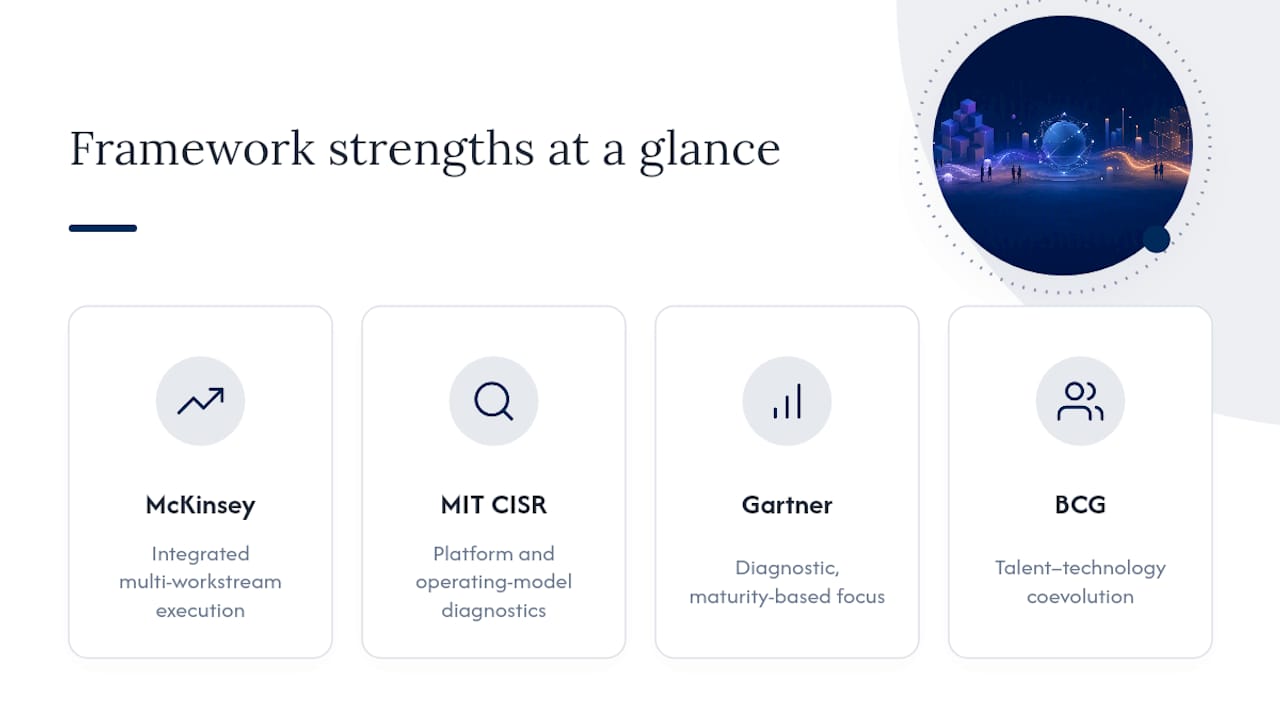
Frameworks differ mainly in what problem they're built to solve, not in which one is objectively "best." McKinsey's 4D approach is strongest for integrated program execution across multiple workstreams. MIT CISR's work centers on platform and operating-model diagnostics. Gartner's frameworks lean diagnostic and maturity-based. BCG's "Bionic" approach emphasizes the coevolution of talent and technology over pure process redesign, according to a comparative review of framework strengths.
A 2026 comparative analysis found that frameworks diverge primarily in managerial logic and recommended building a context-fit selection matrix rather than assuming one framework fits every organization:
Frameworks vary meaningfully in their emphasis on coherence, phased change, capability development, or technology modernization. The right choice depends on organizational context, not framework popularity.
That same research on framework classification recommends reassessing framework fit every 12 to 18 months rather than treating the initial choice as permanent. Practitioner literature consistently points to weak governance, cultural resistance, and scope mismatch, applying a radical framework to what is really an incremental modernization project, as the most common failure modes across every framework studied.
What Experience With Compliance-Heavy Programs Actually Teaches
The programs that succeed in regulated environments share one trait: someone owns a clearly defined scope with a measurable outcome, rather than a team being handed an open-ended mandate to "modernize."
The failure pattern repeats often enough to name. Sponsors reach for radical transformation language when the real need is incremental cloud/operational modernization, then get blindsided by legacy data constraints nobody scoped for, and skip the adoption plan because the technology felt like the finish line.
Three things a sponsor can do in the next 90 days: name the single KPI that defines success for the initiative, audit legacy data dependencies before writing the statement of work, and assign a named owner for post-launch adoption, not just deployment.
Partner With a Firm That Owns the Outcome, Not Just the Hours
Choosing the right type of transformation is only half the work. Executing it in a compliance-heavy environment, where audit readiness and legacy constraints can derail even a well-scoped project, is where most programs actually stall. Primereadysub is built specifically for that gap: a Service-Disabled Veteran-Owned, woman-owned, SBA-certified firm that takes on defined-scope modernization work packages instead of staff augmentation, so agencies and prime contractors get an owned outcome rather than another set of hourly hands.
That focus covers legacy system modernization, DevOps pipelines, compliance automation, and real-time reporting dashboards for state agencies across Maryland, New York, and Florida. If your next initiative needs a partner who scopes the work, owns the KPI, and hands over an audit-ready result, start a conversation with Primereadysub about your program.
Enterprise teams tackling business process transformation on the automation side may also find Docupow's guide to enterprise automation useful for evaluating document and workflow tooling.
Sources
- Types of digital transformation - Prosci blog
- Growth-mode digital strategy: modernize and transform - Forrester blog
- A comparative analysis of digital transformation management frameworks and a context-fit selection matrix (2026)