

Integration points are the software endpoints — APIs, adapters, message queues, ETL pipelines, and gateway boundaries — that connect legacy government systems to modern cloud-native architectures during a migration. Getting them wrong means data drift, audit failures, and costly rollbacks. Getting them right starts in the statement of work, before a single line of code is written.
Three requirements belong in every SOW before work begins:
- Define trust and boundary controls. Require that every integration endpoint enforces platform identity (Azure Active Directory managed identity or equivalent), mutual TLS, and network segmentation. No application-level credential storage is permitted.
- Require parallel data flows and reconciliation. Mandate a parallel-run window where both legacy and cloud systems process the same transactions. Specify a minimum reconciliation pass rate as an acceptance gate before cutover.
- Mandate IaC modules and audit evidence. Deliverables must include modular Terraform templates, automated compliance scan results, and immutable audit logs. These are not optional documentation; they are contractual artifacts.
Key Takeaways
Phased hybrid migration with parallel data flows, platform-enforced identity controls, and IaC-delivered audit evidence are the three non-negotiable requirements for integration points in public-sector legacy modernization.
| Point | Details |
|---|---|
| Require IaC as a deliverable | Modular Terraform templates and compliance scan results must be contractual artifacts, not optional documentation. |
| Mandate parallel-run reconciliation | Specify a minimum reconciliation pass rate and a parallel-run window as acceptance gates before cutover approval. |
| Enforce platform identity | Require Azure Active Directory managed identities, Key Vault secret management, and mutual TLS at every integration endpoint. |
| Prioritize by compliance exposure | Address integration points touching PII or FedRAMP-controlled data in the earliest phases before operational-impact tiers. |
| Primereadysub delivers defined-scope outcomes | Rutledge & Associates, LLC provides IaC modules, telemetry dashboards, and reconciliation reports under outcome-owned work packages for agencies and primes. |
Table of Contents
- What types of integration points should you specify in the SOW?
- How do you design integration points to be secure and auditable?
- What phased migration patterns reduce downtime and data risk?
- What infrastructure and observability evidence should you require?
- What architecture patterns work best in public-sector projects?
- What compliance evidence and acceptance criteria should the SOW demand?
- How should you evaluate vendors and defined-scope offers?
- How do you prioritize which integration points to address first?
- How do you keep integration points available and handle failover in the cloud?
- What security and compliance requirements apply to cross-agency data exchange?
- What delivering integration points in public-sector modernization actually teaches you
- Rutledge & Associates, LLC delivers auditable integration points for primes and agencies
- Sources
What types of integration points should you specify in the SOW?
Each integration type solves a different problem. Mapping the right type to the right use case prevents over-engineering and keeps the procurement scope defensible.
| Integration Type | Primary Use Case | Preferred Tooling |
|---|---|---|
| API façade | Expose legacy data via modern REST/GraphQL without rewriting the backend | Azure API Management, custom adapters |
| Anti-corruption adapter | Translate between legacy data models and modern schemas | Apache Camel, custom middleware |
| Message queue / event bus | Decouple high-volume, asynchronous transactions | Azure Service Bus, Apache Kafka |
| ETL / landing zone | Bulk data migration and ongoing synchronization | Azure Data Factory, SQL Server Integration Services (SSIS) |
| API gateway | Centralized policy enforcement, rate limiting, auth | Azure API Management, federated gateway |
| Middleware / ESB | Orchestrate multi-system workflows in hybrid environments | Apache Camel, MuleSoft (legacy contexts) |
When choosing among these types, consider three factors:
- Latency and volume. Real-time, low-latency needs favor API façades or gateways. High-volume batch workloads favor ETL pipelines built on Azure Data Factory or SSIS.
- Regulatory footprint. Systems handling PII or controlled unclassified information need boundary-enforced gateways with audit trails at every hop, not lightweight adapters.
- Migration phase. Early phases favor anti-corruption adapters that preserve legacy authority while new services are built. Later phases shift toward event-driven pipelines and microservice APIs.
Systematic reviews confirm that middleware, standardized APIs, and microservice decomposition reduce re-engineering effort and enable phased migration in government contexts.
How do you design integration points to be secure and auditable?
Identity and boundary enforcement must come before application logic. An integration point that relies on application-level secrets or implicit network trust is a compliance liability regardless of how well the business logic is written.
Required controls for every integration endpoint:
- Platform identity. Use Azure Active Directory managed identities or workload identity federation. No service accounts with static passwords.
- Secret management. Store all credentials, certificates, and connection strings in Azure Key Vault. Rotate secrets on a defined schedule and log every access.
- Mutual TLS. Enforce mTLS between services at the network boundary, not just at the application layer.
- Private endpoints. Route traffic between services over private Azure Virtual Network endpoints. Disable public internet access for backend integration services.
- Network segmentation. Apply Network Security Groups and Azure Policy to enforce least-privilege traffic flows. No broad "allow all" rules between integration tiers.
- Automated policy enforcement. Use Azure Policy or Open Policy Agent to enforce controls at the platform level so individual application teams cannot bypass them.
Pro Tip: Enforce security controls at the platform layer using Azure Policy assignments rather than per-application configuration. A policy that blocks public endpoint creation across the subscription is far more reliable than asking each development team to remember a checklist item.
Cloud security guidance for migration projects reinforces that embedding security controls at the infrastructure layer, rather than the application layer, is the most durable approach for regulated environments.
What phased migration patterns reduce downtime and data risk?
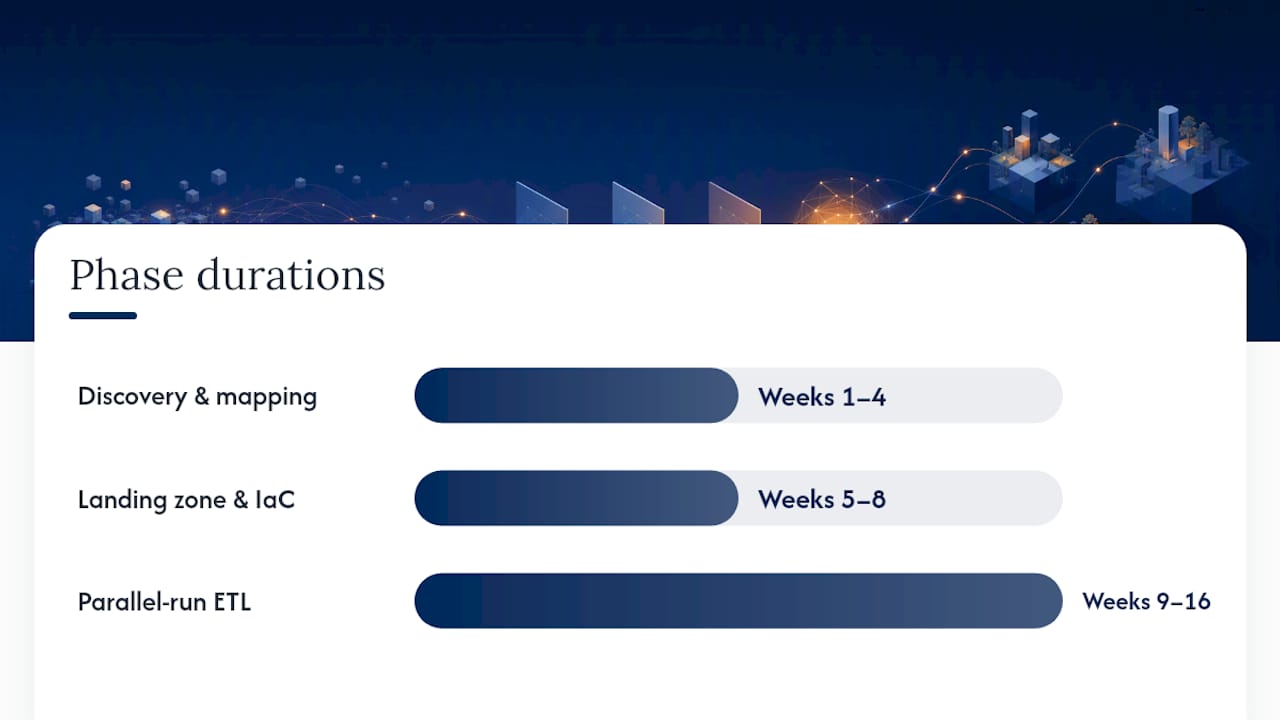
Phased hybrid migration, combining parallel data flows with gradual service refactoring, reduces both downtime and reconciliation risk more reliably than a big-bang cutover. Federal case studies confirm that hybrid ETL with parallel data flows minimized reconciliation issues and reduced DBA maintenance workload during migration.
Practical phased timeline to include in contracts:
- Discovery and dependency mapping (weeks 1–4). Catalog all integration endpoints, data flows, and upstream/downstream dependencies. Deep application and data discovery is the single most underestimated phase; governance and security must be designed here, not retrofitted later.
- Landing zone and IaC scaffolding (weeks 5–8). Deploy modular Terraform templates for networking, identity, and storage. Automated compliance scans run from day one.
- Parallel-run ETL (weeks 9–16). Azure Data Factory or SSIS pipelines run alongside the legacy system. Both systems process identical transactions; reconciliation reports are generated daily.
- Incremental service refactoring over several weeks in the mid-phase. Apply a hybrid decomposition approach — structural, behavioral, and semantic analysis — to identify microservice candidates. High-risk services refactor last.
- Cutover and decommission in the final phase of the timeline. Cutover only after reconciliation pass rates meet the contractual threshold. Rollback triggers and runbooks are pre-approved before this phase begins.
Acceptance criteria to include in the SOW:
- Reconciliation pass rate of 99.9% or higher over a defined parallel-run window before cutover approval
- Parallel-run comparison window spanning multiple full business cycles
- Documented rollback trigger conditions and tested rollback procedures
What infrastructure and observability evidence should you require?
Require modular Terraform templates, reusable landing-zone modules, and automated compliance scan results as contractual deliverables, not supplementary documentation. Declarative IaC modules reduce configuration drift, decrease provisioning time, and generate the compliance evidence auditors need.
Observability requirements to specify:
- Azure Monitor for infrastructure-level metrics, alerting, and availability tracking
- Application Insights for distributed application telemetry, dependency mapping, and failure analysis
- Log Analytics workspaces with defined retention periods and role-based access controls
- Jaeger or equivalent distributed tracing for end-to-end request tracing across microservices and integration hops
| Acceptance Artifact | What to Require | Pass Condition |
|---|---|---|
| IaC policy scan results | Terraform plan output + OPA/Checkov scan report | Zero high-severity findings |
| Drift detection report | Automated drift scan against baseline state | No unmanaged resource changes |
| Telemetry coverage map | Application Insights coverage across all integration endpoints | All defined endpoints instrumented |
| Runbook evidence | Tested runbooks for failover, rollback, and secret rotation | Signed and version-controlled |
What architecture patterns work best in public-sector projects?
Three patterns dominate government modernization work: the API façade with an Anti-Corruption Layer (ACL), event-driven pipelines with durable queues, and hybrid-cloud gateway and landing zones. Each addresses a different risk profile.
API façade + Anti-Corruption Layer. The ACL sits between the modern API surface and the legacy system, translating data models without requiring the legacy system to change. Strangler fig patterns and ACLs allow new user-facing services to launch while the legacy system remains the authoritative data source, enabling zero-downtime feature delivery. Kubernetes and Docker containerize the ACL and new microservices, keeping them independently deployable.

Event-driven pipelines with durable queues. Azure Service Bus or equivalent message brokers decouple producers from consumers, absorb traffic spikes, and provide a durable audit trail of every transaction. This pattern suits high-volume benefit processing, permit workflows, and cross-agency notifications.
Hybrid-cloud gateway and landing zones. Federated API management separates the governance control plane from agency data planes. Central policy (authentication, rate limiting, audit logging) is enforced at the control plane; live traffic flows through agency-level gateways. This avoids a central bottleneck while enabling cross-agency auditability. Mono2Micro can assist in identifying service boundaries within monolithic codebases before containerizing with Docker and orchestrating with Kubernetes.
Pro Tip: Require that the vendor's architecture diagram explicitly labels where identity enforcement, audit logging, and reconciliation checkpoints live. A diagram without those labels is not an architecture; it is a topology sketch.
What compliance evidence and acceptance criteria should the SOW demand?
Require evidence, not promises. IaC modules, automated control scans, immutable audit logs, and reconciliation reports are the only acceptable proof of compliance readiness.
| Failure Mode | Acceptance Test | Remediation SLA |
|---|---|---|
| Data drift between legacy and cloud | Daily reconciliation report with pass/fail threshold | Resolve within one day of detection |
| Unplanned downtime at integration endpoint | Availability monitoring alert with incident ticket | Restore within RTO defined in SOW |
| Secret or credential exposure | Key Vault access log review; no plaintext secrets in IaC | Immediate rotation; root-cause report delivered promptly |
| Misconfigured network boundary | Automated policy scan showing NSG/firewall rules | Remediate before next deployment gate |
Audit-readiness deliverables to list in the SOW:
- Signed control evidence packages mapped to NIST SP 800-53 control families
- Automated test scripts and archived results for each integration endpoint
- Immutable audit logs with defined retention (minimum 90 days, longer for FedRAMP High)
- Signed runbooks for all operational procedures affecting integration points
Cloud governance practices reinforce that policy baselines and audit evidence must be built into the delivery pipeline from the start, not assembled at the end of a project.
How should you evaluate vendors and defined-scope offers?
Prefer vendors that deliver auditable artifacts under a defined scope rather than those offering staff augmentation with vague deliverables. An outcomes-focused delivery model means the vendor owns the result, not just the hours.
Questions to ask every vendor:
- What IaC modules will you deliver, and how are they version-controlled?
- How do you structure the parallel-run reconciliation window, and what pass rate triggers cutover approval?
- What runbooks do you provide for failover, rollback, and secret rotation?
- Can you provide FedRAMP authorization documentation or FIPS 140-2 compliance evidence for your toolchain?
- How do you staff the engagement — defined-scope delivery team or time-and-materials augmentation?
Red flags that indicate a risky offer:
- Refusal to deliver IaC as a contractual artifact
- No telemetry or observability plan beyond basic uptime monitoring
- Absence of a parallel-run or reconciliation methodology
- Vague rollback procedures ("we'll assess at the time")
- Staff-augmentation-only pricing with no defined deliverables or acceptance criteria
- No evidence of prior public-sector modernization work or relevant certifications
Reviewing common modernization mistakes before finalizing the SOW helps procurement teams avoid the patterns that most frequently cause schedule and compliance failures.
How do you prioritize which integration points to address first?
Not all integration points carry equal risk. Prioritization should follow three axes: compliance exposure, operational impact, and data sensitivity.
Compliance exposure ranks highest. Any integration point that touches PII, controlled unclassified information, or systems subject to FedRAMP or FISMA controls must be addressed in the earliest phases. A misconfigured boundary here creates audit findings that can halt the entire program.
Operational impact determines sequencing within the compliant tier. Integration points on the critical path for daily operations — benefit disbursement, case management, financial reconciliation — carry the highest downtime risk and need the most rigorous parallel-run windows and rollback plans.
Data sensitivity and volume inform tooling choices. High-volume, low-sensitivity flows can use ETL pipelines with batch reconciliation. Low-volume, high-sensitivity flows need synchronous APIs with end-to-end encryption and per-request audit logging. A hybrid IT approach lets agencies sequence this work without forcing a simultaneous cutover across all tiers.
How do you keep integration points available and handle failover in the cloud?
Availability at integration points requires active design, not passive hope. The SOW must specify availability targets, failover mechanisms, and tested recovery procedures as contractual requirements.
Strategies to require:
- Multi-zone deployment. Deploy integration services (API gateways, message brokers, ETL orchestrators) across at least two Azure availability zones. Single-zone deployments are not acceptable for production integration endpoints.
- Health probes and circuit breakers. Require health probe configurations on all load-balanced integration services and circuit-breaker patterns in microservice-to-microservice calls to prevent cascade failures.
- Durable message queues. Use Azure Service Bus with dead-letter queues so failed messages are captured and replayable rather than silently dropped.
- Geo-redundant storage. Landing zone storage accounts must use geo-redundant replication for any data that feeds downstream reconciliation.
- Tested failover runbooks. Failover procedures must be tested in a non-production environment before go-live and documented with step-by-step instructions, expected recovery times, and rollback decision points.
Recovery time objectives and recovery point objectives belong in the SOW as hard contractual thresholds, not aspirational targets.
What security and compliance requirements apply to cross-agency data exchange?
Cross-agency data exchange introduces a distinct set of controls beyond what a single-agency deployment requires. The boundary between agencies is a trust boundary, and every integration point crossing it must be treated as an external interface.
Required controls for cross-agency integration points:
- PKI-based federation. Agency-to-agency API calls must use certificate-based mutual authentication. Shared secrets or API keys alone are not sufficient for cross-agency trust.
- Data classification enforcement. Every payload crossing an agency boundary must carry a data classification label. Integration points must enforce that only data at or below the agreed classification level transits the boundary.
- Aggregated audit trails. Each agency gateway must emit structured audit logs to a centralized Log Analytics workspace. The SOW must specify log schema, retention, and access controls.
- Attribute-based access control. Use Azure Active Directory claims and conditional access policies to enforce that only authorized agency systems and roles can invoke cross-agency endpoints.
- Incident notification SLAs. The SOW must specify how quickly a breach or anomaly at a cross-agency integration point must be reported to all affected agencies and to the relevant oversight body.
Federated API management provides the reference architecture for this: a shared governance control plane sets the policy baseline, and each agency enforces it at its own gateway without routing live traffic through a central chokepoint.
What delivering integration points in public-sector modernization actually teaches you
The most consistent lesson from public-sector modernization work is that the integration point is where the program either earns or loses trust. A well-specified API boundary with reconciliation evidence and an immutable audit trail gives the program office something concrete to show auditors, oversight bodies, and agency leadership. A vague "we'll connect the systems" commitment gives them nothing.
Two patterns cause the most avoidable failures. First, programs that skip the anti-corruption layer in the name of speed end up with modern UX sitting on top of legacy data models that were never designed for the new service's assumptions. The result is data quality failures that surface six months after go-live, when the parallel-run window has ended. Second, programs that accept staff augmentation in place of defined-scope delivery end up owning the integration architecture themselves, without the IaC, runbooks, or telemetry to maintain it.
The SOW language matters more than the technology choice. Requiring reconciliation pass rates, IaC deliverables, and tested rollback procedures as acceptance gates forces the vendor to design for auditability from the start, not as an afterthought.
Rutledge & Associates, LLC delivers auditable integration points for primes and agencies
Primereadysub (Rutledge & Associates, LLC) is an SDVOSB, woman-owned, SBA-certified firm that owns defined-scope modernization work packages for government agencies and prime contractors — delivering the exact artifacts this guide requires rather than supplementing your team with hours.
Under a defined-scope engagement, Primereadysub delivers:
- Modular Terraform IaC templates with automated compliance scan results
- Azure Monitor, Application Insights, and Log Analytics telemetry dashboards
- Parallel-run reconciliation reports and acceptance evidence packages
- DevSecOps pipelines with embedded security controls and drift detection
- Signed runbooks for failover, rollback, and secret rotation
Primereadysub serves agencies and primes in Maryland, New York, and Florida. To discuss a defined-scope integration or modernization work package, visit Rutledge & Associates, LLC or review the prime contractor services page.
Sources
- Modernizing On-Prem Government Systems to Cloud-Native Architectures: A U.S. Public Sector Case Study
- Legacy system integration and hybrid cloud interoperability — literature review (DIVA Portal)
- Hybrid decomposition framework for legacy-to-cloud migration (IJIRMP S paper)
- Cloud modernization in the public sector: lessons from legacy-to-cloud migrations - BIBISERV