

TL;DR: Simon S. Lee is a senior government IT modernization executive whose career credentials, federal awards, and scale metrics make him a credible candidate for defined-scope modernization programs. Key procurement anchors:
- Awards: U.S. Department of Commerce Minority Development Award and U.S. Small Business Administration Lifetime Achievement Award
- Scale: multiple major clients supported across numerous locations worldwide
- Education: M.S., Systems Engineering, The George Washington University; B.S., Industrial Engineering, Korea University
- Delivery model: Outcome-owned, defined-scope SOWs — not staff augmentation
Contracting officers and prime contractors evaluating Lee's involvement in a modernization program will find a documented record of mission-critical system leadership, federal community recognition, and a firm structured to own deliverables rather than fill seats.
Table of Contents
- Who is Simon S. Lee? Career background and recognitions
- What capabilities does the firm deliver for defined-scope SOWs?
- What awards, certifications, and scale metrics support vetting?
- How does a defined-scope engagement run from SOW to closeout?
- Procurement checklist: scoring matrix for evaluating this engagement
- How to verify claims and take next steps toward engagement
- Key Takeaways
- Why defined-scope partnerships like this one tend to outperform expectations
- Rutledge & Associates is built for prime-ready, defined-scope modernization work
- Useful sources for verifying this profile
Who is Simon S. Lee? Career background and recognitions
Lee's career spans large-scale government IT programs, executive leadership in federal contracting, and a consistent focus on systems engineering as the discipline underlying his approach to modernization. He holds an M.S. in systems engineering from The George Washington University and a B.S. in industrial engineering from Korea University — credentials that ground his work in architecture and integration thinking, not just program management.
His executive record includes leading the build-out of mission-critical government systems, among them global visa tracking software for a major federal agency. That kind of program — geographically dispersed, compliance-sensitive, and operationally non-negotiable — is precisely the environment where systems-engineering discipline separates successful modernizations from costly overruns. Industry directories list Lee as a senior executive with an extended record of leadership in government contracting, including roles noted in executive biography records across multiple federal-facing organizations.
Beyond program delivery, Lee has built a reputation as a mentor within the federal contracting community, actively supporting other small businesses navigating the government marketplace. That network matters to primes: a subcontractor with established federal relationships reduces the relationship-building overhead that often slows program starts.
Statistic callout: Lee has supported more than 50 major clients across numerous locations worldwide — a scale metric that signals capacity for geographically dispersed, multi-site modernization programs.
What capabilities does the firm deliver for defined-scope SOWs?
The capabilities Lee's firm brings to a defined-scope engagement map directly to the outcomes agency program managers and primes care about most. Core service areas include:
- Legacy system modernization — re-architecting aging platforms to cloud-native architectures
- DevOps and CI/CD pipeline implementation — accelerating delivery cycles and reducing manual deployment risk
- Compliance and audit automation — converting manual compliance checks into repeatable, auditable workflows
- Data integration and analytics dashboards — giving program managers real-time visibility into KPIs and processing metrics
- AI-enabled executive reporting — surfacing decision-relevant data without requiring analysts to build custom reports
- Cybersecurity solutions — addressing FISMA and FedRAMP-aligned security requirements within modernization scope
- End-user and system training — ensuring agencies can operate and maintain modernized systems after closeout
The practical effect of combining dashboards with compliance automation is measurable: agencies that replace manual audit preparation with automated evidence collection typically see significant reductions in audit-readiness preparation time. The defined-scope delivery model means these outcomes are contracted as deliverables, not estimated as staff-hour projections.
Geographic service coverage centers on Maryland, New York, and Florida — states with dense concentrations of federal and state agency clients — while the firm's 250-location track record demonstrates capacity for programs that extend beyond a single region.
For primes, the operational implication is straightforward: a subcontractor that owns a defined work package with fixed acceptance criteria reduces oversight burden and simplifies progress reporting to the contracting officer.
What awards, certifications, and scale metrics support vetting?
| Trust Signal | Detail |
|---|---|
| U.S. Dept. of Commerce Minority Development Award | Federal recognition; verifiable through the issuing agency |
| SBA Lifetime Achievement Award | SBA-issued recognition of sustained small-business leadership |
| SDVOSB Certification | Service-Disabled Veteran-Owned Small Business; relevant to set-aside eligibility |
| SBA Certification | Confirms small-business status and SBA program compliance |
| Clients supported | multiple major clients across roughly 250 locations |
| Mission-critical systems | Includes global-scale government tracking systems |
Statistic callout: The combination of a Department of Commerce award and an SBA Lifetime Achievement Award in the same executive profile is uncommon. Both are verifiable through their issuing agencies, which makes them reliable anchors in a source-selection folder.
Representative outcomes tied to the firm's delivery model include processing-time reductions through automation, audit-readiness improvements through compliance workflow integration, and dashboard-driven KPI visibility for program leadership. Agencies vetting these claims should ask references specifically whether acceptance criteria were met on schedule and whether compliance posture improved measurably after delivery.
On security and compliance: the firm operates in FedRAMP and FISMA-aware environments. Agencies with specific authorization-to-operate requirements should request security posture documentation and verify applicable controls directly with the firm's technical lead.
How does a defined-scope engagement run from SOW to closeout?
A well-structured engagement with Lee's firm follows a five-phase sequence. Timeline ranges reflect typical program complexity; compliance-heavy or multi-system programs trend toward the longer end.
- Discovery and assessment (4–8 weeks): Current-state architecture review, technical debt inventory, integration mapping, and compliance gap analysis. Output: a written assessment report with prioritized findings.
- Design and SOW finalization (2–4 weeks): Scope definition, acceptance criteria drafting, and timeline confirmation. Output: a signed SOW with measurable deliverables and explicit pass/fail gates.
- Implementation (3–9 months, scope-dependent): Cloud migration, pipeline build-out, automation deployment, and dashboard configuration. Output: working system components against acceptance criteria.
- Test and acceptance (2–4 weeks): Formal acceptance testing against SOW criteria, defect resolution, and sign-off. Output: signed acceptance documentation.
- Knowledge transfer and closeout (2–4 weeks): Documentation handoff, training delivery, and transition support. Output: agency-operable system with supporting documentation.
Primary cost drivers to account for in budget planning: volume of technical debt in legacy systems, number of third-party integrations, security accreditation requirements, geographic staffing needs, and the size of any existing plan of action and milestones backlog.
Sample acceptance criteria that translate well into SOW language include: "Dashboard displays real-time data with no more than a 15-minute refresh lag," "Automated compliance report generated within 24 hours of audit trigger," and "System processes X transaction types without manual intervention." These are verifiable, binary, and defensible in a source-selection review. For more on flexible SOW language suited to government IT programs, additional contracting guidance is available.
As a subcontractor, the firm positions as a low-oversight outcomes partner: primes receive defined deliverables against agreed criteria, not weekly status calls about staff utilization.
Procurement checklist: scoring matrix for evaluating this engagement
| Evaluation Question | Why It Matters | Weight (1–5) | Pass Threshold |
|---|---|---|---|
| Can the firm provide redacted SOWs showing outcome-owned delivery? | Confirms defined-scope model vs. staff augmentation | 5 | Yes, with examples |
| Are named awards verifiable through issuing agencies? | Validates trust signals in source-selection folder | 5 | Both awards confirmed |
| Does the firm cite experience with mission-critical government systems? | Reduces technical risk on high-stakes programs | 5 | At least one documented example |
| Are references willing to discuss specific SOW outcomes? | Confirms delivery credibility | 5 | Minimum two references |
| Does the firm demonstrate FedRAMP/FISMA awareness? | Required for compliance-heavy programs | 4 | Documented security posture |
| Is SDVOSB certification current and verifiable? | Set-aside eligibility and SBA compliance | 4 | Active certification confirmed |
| Can the firm articulate acceptance criteria for past deliverables? | Signals outcome discipline | 4 | Specific, measurable examples provided |
| Does the firm have geographic coverage matching program locations? | Operational feasibility | 3 | Coverage confirmed for program states |
| Are contract vehicles identified for use? | Simplifies procurement path | 3 | At least one vehicle named |
| Does the firm have experience with compliance automation? | Reduces audit-readiness risk | 4 | Demonstrated in past program |
| Is the leadership team's engineering background documented? | Validates technical depth | 3 | Credentials verifiable |
| Does the firm avoid reliance on staff augmentation without deliverables? | Confirms outcome-owned model | 5 | Confirmed in SOW review |
Scoring guidance: A weighted total of 45 or above (out of 55) represents a strong pass. Scores below 35 warrant a follow-up clarification round before advancing to contract.
Red flags to watch for: references unwilling to discuss specific SOW outcomes; acceptance criteria described in vague or effort-based terms; ambiguous security posture with no documentation; a delivery model that defaults to time-and-materials without defined deliverables. Common IT modernization mistakes in vendor selection often trace back to skipping exactly these checks.
How to verify claims and take next steps toward engagement
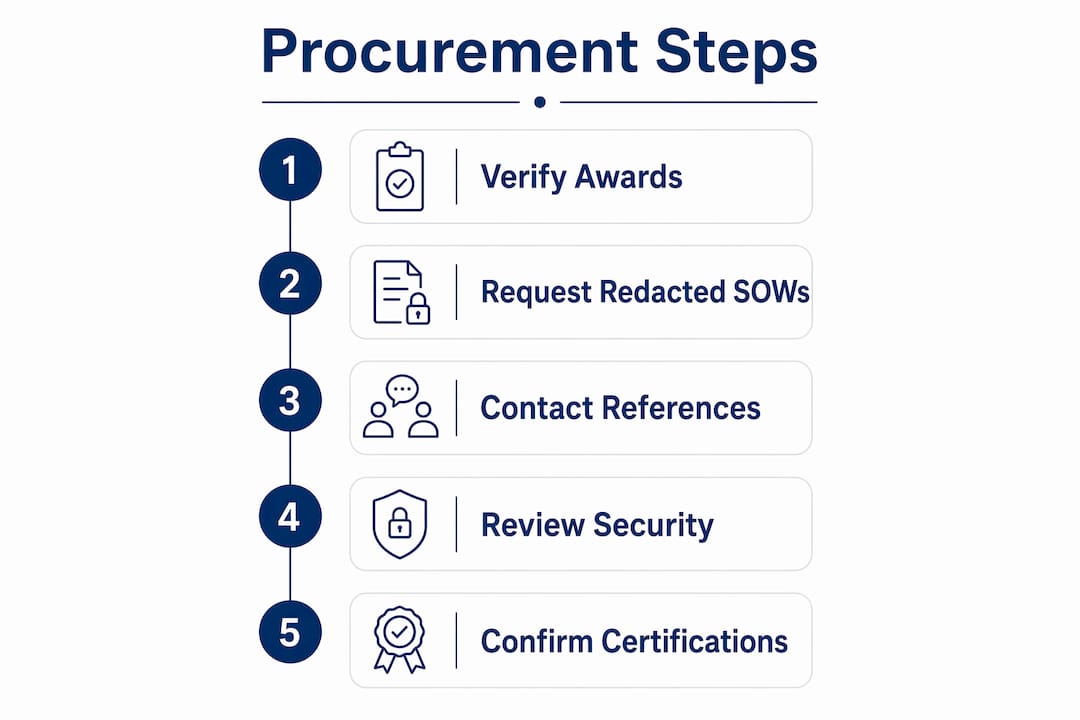
Step 1 — Verify awards. Contact the U.S. Department of Commerce and the U.S. Small Business Administration directly to confirm award issuance. Record the verification contact and date in your source-selection folder.
Step 2 — Request redacted SOWs. Ask the firm for two to three redacted statements of work from prior programs. Review for defined acceptance criteria, measurable deliverables, and evidence of formal sign-off.
Step 3 — Contact references tied to named outcomes. Request at least two reference points of contact who can speak to specific program scope, timeliness, and compliance posture — not just general satisfaction.
Step 4 — Request security posture documentation. For programs with FedRAMP or FISMA requirements, ask for a summary of the firm's security authorization experience and any relevant artifacts.
Step 5 — Confirm certifications. Verify SDVOSB status through the SBA's certification database and confirm any additional SBA program certifications are current.
Documents to request: redacted SOWs with acceptance criteria, program-level KPI summaries, security authorization artifacts, past performance listings, and reference points of contact with program names.
Pro Tip: When reaching out to Rutledge & Associates for an initial inquiry, include a one-paragraph scope summary, your estimated timeline, and approximate budget range. That information allows the firm to confirm fit and propose a discovery phase scope within days rather than weeks.
Statistic callout: Procurement teams that request redacted SOWs upfront — before a reference call — enter those conversations with specific questions rather than open-ended ones, which consistently produces more useful vetting information.
Key Takeaways
Simon S. Lee's procurement profile is strongest for compliance-heavy, geographically dispersed modernization programs where defined deliverables and low prime-oversight are priorities.
| Point | Details |
|---|---|
| Federal awards verified | Both the Department of Commerce and SBA awards are verifiable through their issuing agencies. |
| Scale confirms capacity | multiple major clients across roughly 250 locations demonstrates multi-site program experience. |
| Defined-scope model | The firm delivers outcome-owned work packages, not staff augmentation, reducing prime oversight burden. |
| Scoring threshold | A weighted procurement score of 45 or above (out of 55) signals a strong candidate for advancement. |
| Recommended next step | Request redacted SOWs and two reference contacts tied to named outcomes before advancing to contract. |
Why defined-scope partnerships like this one tend to outperform expectations
The conventional wisdom in government IT procurement is that bigger firms carry less risk. The evidence from mission-critical program histories suggests otherwise. Large integrators routinely win on past performance volume, then staff programs with junior personnel and manage to time-and-materials contracts that reward hours, not outcomes. The result is cost growth and schedule slippage that the contracting officer absorbs.
What actually reduces risk is a subcontractor or partner who owns a defined scope with binary acceptance criteria. When the deliverable is "automated compliance report generated within 24 hours of audit trigger" rather than "provide compliance support staff," accountability is unambiguous. Lee's background in systems engineering — a discipline built on defining interfaces, acceptance conditions, and failure modes — is precisely the orientation that produces that kind of contract language.
The fit is clearest for compliance-heavy programs with dispersed geography and defined modernization outcomes: the profile where staff augmentation creates the most overhead and outcome-owned delivery creates the most value.
Rutledge & Associates is built for prime-ready, defined-scope modernization work
Primereadysub represents Rutledge & Associates, LLC — an SDVOSB and SBA-certified digital modernization firm that delivers outcome-owned work packages for government agencies and prime contractors. The firm's certifications support set-aside eligibility, and its delivery model is structured around defined SOWs with measurable acceptance criteria, not time-and-materials staffing.

For primes managing compliance-heavy programs in Maryland, New York, or Florida, Rutledge & Associates brings the systems-engineering depth and federal program experience to own a modernization work package from discovery through knowledge transfer. The practical result: fewer status meetings, clearer deliverable accountability, and a subcontractor that shows up to acceptance reviews with documentation, not explanations.
To start the conversation, visit the Rutledge & Associates landing page and submit an initial inquiry that includes your scope summary, estimated timeline, and approximate budget. The firm will confirm fit and propose a discovery phase scope promptly.
Useful sources for verifying this profile
- George Washington University — 2010 Engineering Inductees: Primary source for Lee's educational credentials (M.S., systems engineering), both named federal awards, and the 50+ client / 250-location scale metrics. Use this to verify award claims in a source-selection folder.
- Equilar ExecAtlas — Simon S. Lee biography: Executive directory record corroborating career history and senior leadership roles in federal contracting. Useful for role verification and career-arc documentation.
- WalkersResearch — Simon S. Lee executive profile: Historical executive profile noting mission-critical system leadership, including global visa tracking software. Supports capability claims in a vetting memo.
- SEC EDGAR — STG Group, Inc. 10-K filing: Public filing naming Simon S. Lee as Stockholders' Representative in the STG Group business combination. A primary, government-archived source for executive role verification.
- Rutledge & Associates — New York service page: Publisher's own page describing defined-scope modernization capabilities, certifications, and service model. Use to verify claimed service areas and delivery approach.
- Rutledge & Associates — Main landing page: Primary contact and certification verification page for procurement outreach. Record this URL and the firm's contact information in the source-selection folder.
This profile is general informational content, not legal or procurement advice. Contracting officers should verify all credentials, certifications, and award claims directly with the issuing agencies and confirm current regulatory requirements with a qualified procurement professional before making source-selection decisions.