

Yes, active SBA VetCert certification materially increases subcontracting opportunity for service-disabled veteran-owned firms. It qualifies your business for set-aside and sole-source consideration, and it lets prime contractors count your subcontract dollars toward their SDVOSB participation goal once verification is documented. Being a "similarly situated" SDVOSB subcontractor can also exclude your dollars from the prime's limitation-on-subcontracting calculations, which makes you a more attractive partner, not just an eligible one.
TL;DR:
- Verification through the SBA VetCert portal is essential, as primes cannot count non-certified SDVOSB subcontract dollars toward their goals.
- The increased government contracting goal from 3% to 5% for SDVOSBs means more set-aside opportunities, task orders, and internal pressure on primes to meet targets.
- Working with similarly situated SDVOSB subcontractors excludes their dollars from subcontracting limit calculations, making such firms more attractive partners.
- Maintaining active certification and accurate profiles on VetCert and DSBS is critical for continuous eligibility and performance reporting accuracy.
- Structuring subcontract work as outcome-based, clearly scoped deliverables reduces oversight burdens and improves chances of renewal and ongoing prime collaboration.
Table of Contents
- How SDVOSB Status Changes Subcontracting Eligibility And Opportunity
- Certification, VetCert, And Why Verification Is The Gate That Primes Treat Seriously
- Limitations On Subcontracting And The "Similarly Situated" Rule
- How SDVOSBs Can Win And Document Subcontracting Work
- How A Modern SDVOSB Subcontractor Structures Offers That Win Prime Work
- Reporting, Measurement, And Post-Award Compliance
- Why VetCert Readiness Is The Real Competitive Edge
- How Primereadysub Helps SDVOSBs And Primes Structure Subcontract-Ready IT Work
- Where To Verify The Rules Yourself
- Sources
How SDVOSB Status Changes Subcontracting Eligibility And Opportunity
Set-asides and sole-source awards work differently, and the distinction matters more than most new contractors realize. A set-aside restricts competition for a contract to a defined pool of businesses, in this case verified SDVOSBs, while a sole-source award skips competition entirely and goes directly to one qualified firm, often under specified dollar thresholds. Certified SDVOSBs are eligible for both, which is a real structural advantage over uncertified veteran-owned businesses that can only compete in the open market.
Subcontracting sits alongside these direct-award paths and, for most new entrants, it can be a faster entry point. Winning a prime contract usually requires past performance, bonding capacity, and often years of relationship-building with a contracting officer. Winning subcontract work under an established prime typically requires a credible capability statement, active certification, and a prime who needs your specific skill set.
That demand just got bigger. The National Defense Authorization Act for Fiscal Year 2024 raised the government-wide SDVOSB contracting goal from 3% to not less than 5% of combined prime and subcontract award dollars, under Section 863. That's not a symbolic gesture. Federal agencies track this goal, and so does every prime holding a large federal contract, because their own past-performance evaluations and follow-on award chances depend partly on meeting it.
Here's what that goal increase actually does on the ground:
- Agencies push harder to identify SDVOSB-eligible work in acquisition planning, which creates more set-aside opportunities at the prime level.
- Prime contractors with subcontracting plans face more scrutiny on whether they're meeting SDVOSB targets, so they actively recruit certified subs rather than waiting for inbound interest.
- Task orders under existing indefinite-delivery contracts increasingly carve out SDVOSB participation requirements, especially on multi-award vehicles.
- Large primes managing multi-tier supply chains, systems integrators layering subcontractors under subcontractors, now have more internal pressure to document SDVOSB spend at every tier.
Where do these opportunities actually surface? Mostly in three places. First, subcontracting plans that primes submit under FAR 52.219-9, which require goals for small-business categories including SDVOSBs on qualifying contracts. Second, individual task orders issued under IDIQ or GWAC vehicles, where the prime often has flexibility to bring in new subs for a specific scope. Third, informal prime supply chains, the network of subcontractors a prime already trusts and calls first when a new opportunity lands.
A firm that shows up in all three channels with active certification and a clean capability statement has a real shot at recurring work, not just one-off task orders. That's the practical payoff of the 5% goal increase: it's not a favor to veteran-owned businesses, it's a compliance number primes have to hit, and you're one of the ways they hit it.
Certification, VetCert, And Why Verification Is The Gate That Primes Treat Seriously
Self-certification for SDVOSB status is gone, and that single change reshaped how primes vet subcontractors. SBA's VetCert portal is now the system of record. If your firm isn't actively certified there, a prime generally cannot count your subcontract dollars toward its SDVOSB goal, no matter how legitimately veteran-owned your business is on paper.
That's why experienced procurement teams treat VetCert status as a hard gate rather than a nice-to-have. A prime that awards work to an uncertified vendor still has to report accurate numbers, and dollars that don't count toward goaling don't help the prime's compliance picture at all. Faced with two similarly qualified subs, one certified and one not, the certified firm wins almost every time.
Verification in practice runs through a short, repeatable workflow:
- Confirm active status in VetCert. Certification lapses if renewal paperwork isn't filed on time, so check your own status before every proposal, not just once a year.
- Cross-check your Dynamic Small Business Search (DSBS) profile. DSBS should reflect the same certification status and NAICS codes VetCert has on file; primes often search DSBS first to build subcontractor shortlists.
- Keep a dated record. Save a screenshot or export of your VetCert certification page and DSBS profile with a timestamp. Primes conducting due diligence want proof they can attach to their own compliance file.
Firms in the application pipeline, meaning certification is submitted but not yet approved, occupy a genuinely awkward middle ground. Historically there was a narrow grace period allowing transition from self-certification, but that window has closed, and "in process" status generally does not satisfy a prime's goaling requirement today. If your certification is pending, be upfront about the timeline with any prime you're talking to rather than letting them discover it during award review.
Pro Tip: Set a recurring calendar reminder 90 days before your VetCert renewal deadline. A lapsed certification mid-contract can force a prime to stop counting your dollars retroactively for that reporting period, which damages the relationship even when the lapse was accidental.
Limitations On Subcontracting And The "Similarly Situated" Rule
Winning the subcontract is only half the equation. Whether those dollars actually help the prime, and by extension whether the prime keeps working with you, depends on limitation-on-subcontracting rules under 13 CFR 125.6. These rules cap how much of a small-business set-aside contract's value can flow to subcontractors who are not similarly situated.
The caps vary by contract type:
- Services contracts: the prime generally cannot subcontract more than 50% of the amount paid to it under the contract to non-similarly-situated entities.
- Supply contracts: the prime generally cannot pay more than 50% of the amount it receives, excluding the cost of materials, to non-similarly-situated subcontractors.
- General construction: the cap is typically 85%, excluding the cost of materials.
- Specialty trade construction: the cap is typically 75%, excluding the cost of materials.
A "similarly situated entity" is a subcontractor that holds the same small-business certification as the prime for that specific set-aside. If a prime wins an SDVOSB set-aside contract and subcontracts to another certified SDVOSB, that work generally doesn't count against the limitation cap at all. It's excluded from the calculation entirely, which is a meaningfully different outcome from subcontracting to a firm without that status.
A quick illustration: say a prime wins a $2 million SDVOSB set-aside services contract. If the prime subcontracts $900,000 of that to a similarly situated SDVOSB partner, none of it counts against the 50% limitation, because similarly situated dollars are excluded.
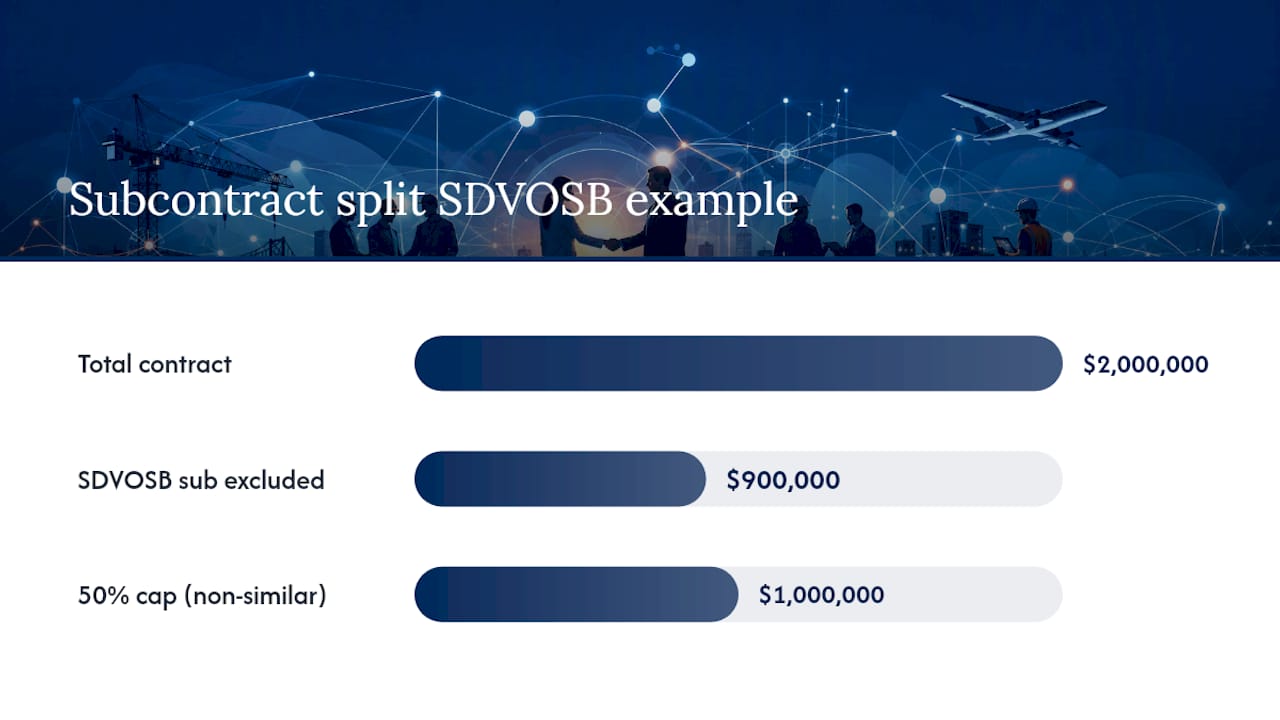
This is exactly why primes actively seek out certified SDVOSB subs for SDVOSB set-aside work rather than treating certification as a box to check. You're not just eligible. You're the subcontractor that lets them structure the deal safely.
How SDVOSBs Can Win And Document Subcontracting Work
Getting found by primes takes more deliberate positioning than most contractors expect, especially early on. Here's the practical sequence that works.
- Build discoverability where primes actually search. Optimize your DSBS profile with accurate NAICS codes, keywords that match how primes describe scopes of work, and your VetCert certification linked visibly. Also register in SUBNet and attend industry days and matchmaking events hosted by agencies and large primes. According to SupplierDiversity.com's guidance on finding federal SDVOSB subcontractors, primes routinely filter DSBS by certification status and NAICS code before ever picking up the phone, so profile accuracy is not optional.
- Write a subcontract-ready capability statement. Keep it to one page. Include clearly defined scopes you've delivered, measurable outcomes, security or compliance credentials (FedRAMP familiarity, NIST 800-171 alignment, CMMC readiness if relevant), and past-performance metrics a contracting officer can verify.
- Assemble a verification packet before anyone asks. Include your VetCert confirmation, a dated DSBS screenshot, current SAM.gov representations, and a short cover email establishing the date. Handing this to a prime unprompted removes friction and signals you understand their compliance burden.
- Negotiate scope boundaries that protect the limitation calculation. If you're the sub and not similarly situated to the prime's set-aside type, be careful about how much of the work you're asked to retain versus perform with your own employees; ask directly whether your portion pushes the prime near its cap.
- Follow up on a schedule, not randomly. Primes rebuild subcontractor lists every proposal cycle. A quarterly check-in with updated capability information keeps you top of mind without becoming a nuisance.
Pro Tip: Ask the prime directly, early in the conversation, whether you'll be treated as similarly situated for that specific set-aside. Some primes don't calculate this correctly, and catching the error before contract execution saves both parties a compliance headache later.
How A Modern SDVOSB Subcontractor Structures Offers That Win Prime Work
Primes managing compliance-heavy federal IT programs have limited appetite for babysitting subcontractors. A firm that shows up offering a defined, outcome-owned work package, rather than a body to bill hours, immediately reduces the prime's oversight burden. That's the model Rutledge & Associates, operating as Primereadysub, applies to government IT modernization subcontracts: own a clearly scoped deliverable, like a compliance automation pipeline or a real-time audit dashboard, instead of supplying staff augmentation the prime has to manage day to day.
That distinction changes how a prime evaluates risk. Staff augmentation puts the management burden back on the prime. A defined-scope package with its own KPIs lets the prime report a clean deliverable and a verified SDVOSB partner in the same breath.
An operational checklist any SDVOSB IT firm can build toward:
- A written statement of work with measurable deliverables, not open-ended hours
- Performance metrics tied to the prime's actual audit or reporting requirements
- A documented cybersecurity posture appropriate to the program's compliance framework
- Audit-ready artifacts, dated logs, signed representations, version-controlled deliverables
- Current insurance certificates and active SBA VetCert status ready to hand over on request
Rutledge & Associates built its subcontracting model around exactly this kind of low-oversight, high-clarity engagement, which is worth studying even if your firm's specialty is entirely different from IT modernization.
Reporting, Measurement, And Post-Award Compliance
Subcontract dollars only help you and the prime if they show up correctly in federal reporting. Individual Subcontracting Reports (ISRs) and Summary Subcontracting Reports (SSRs) are how primes document actual small-business subcontracting performance against the goals in their FAR 52.219-9 plans, and your SDVOSB dollars flow into those numbers only if your certification status was active and verified at the time of award.
A recent operational shift matters here: reporting responsibilities have migrated from the retired eSRS system into SAM.gov, which changed submission workflows for primes tracking subcontracting performance. If you're a sub, this doesn't create new obligations for you directly, but it does mean the prime's reporting deadlines and formats have shifted, and delays on their end can create confusion about whether your dollars were captured correctly.
Protect your own position with simple, consistent recordkeeping:
- Save dated screenshots of your VetCert and DSBS status at the time of each award
- Keep signed subcontract clauses referencing your certification
- Retain email correspondence establishing when verification was shared with the prime
Why VetCert Readiness Is The Real Competitive Edge
Most SDVOSB firms fixate on winning the next contract when the bigger opportunity is becoming the subcontractor a prime doesn't have to think twice about. Certification gets you in the conversation. Documentation discipline is what keeps you there through renewal cycles, audits, and the inevitable turnover on the prime's compliance team.
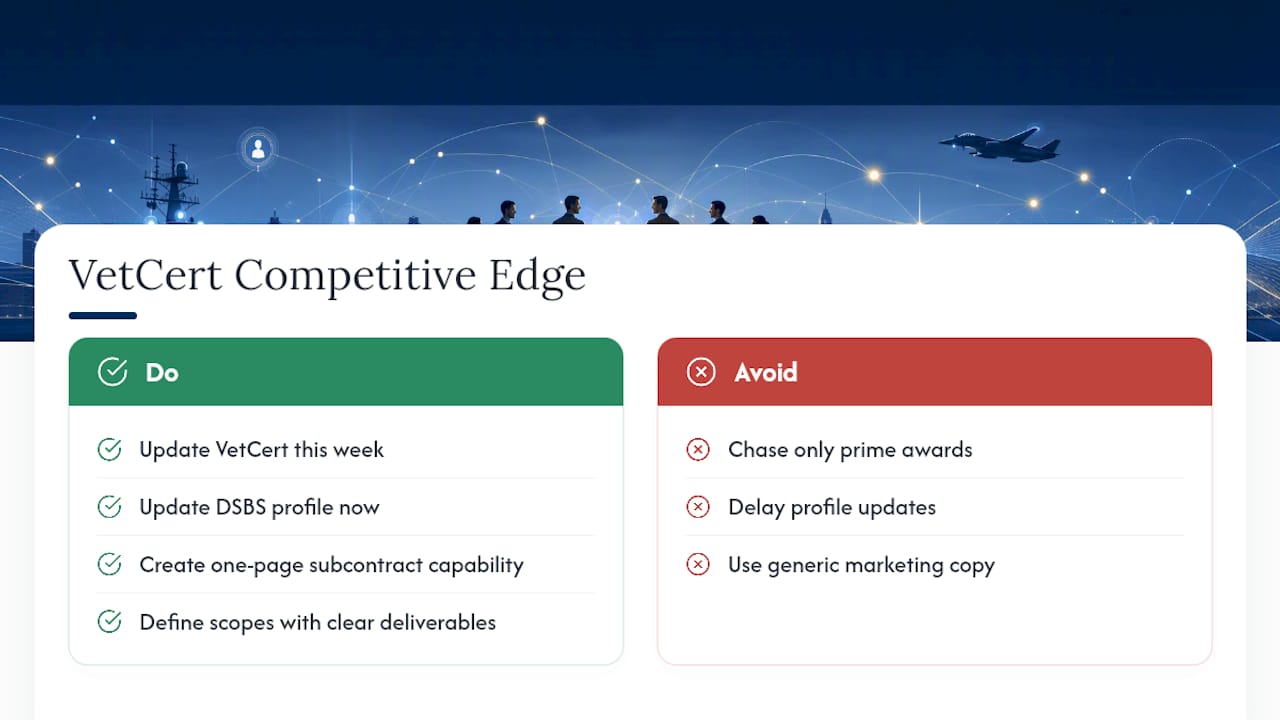
The firms getting recurring subcontract work aren't necessarily the most technically impressive. They're the ones who made verification effortless: VetCert current, DSBS accurate, a capability statement that speaks the prime's compliance language instead of general marketing copy. Defined scopes with clear deliverables build the same trust from a different angle, showing a prime exactly what they're getting without requiring hand-holding.
If there's one immediate action worth taking after reading this, it's updating your VetCert and DSBS profiles this week, not next quarter, and drafting a one-page capability statement built specifically for subcontract conversations rather than direct-award pitches. The 5% federal goal isn't going to enforce itself into your pipeline. Positioning does that.
— Randy
How Primereadysub Helps SDVOSBs And Primes Structure Subcontract-Ready IT Work
Primereadysub is an alternative to staff-augmentation subcontracting for primes managing compliance-heavy government IT programs: you get a defined, outcome-owned work package instead of headcount you have to supervise. Rutledge & Associates delivers legacy system modernization, cloud-native re-architecting, DevOps pipelines, compliance automation, and audit-ready dashboards as scoped deliverables with their own KPIs, not open-ended labor hours.
For primes, that structure makes it easier to count subcontract dollars toward SDVOSB goals with confidence, because verification and deliverable tracking are built into the engagement from day one rather than assembled after the fact. For SDVOSB firms studying how to position their own offers, Primereadysub's approach to defined-scope modernization work is a working example of how clarity of scope translates into fewer oversight demands and stronger renewal odds.
If you're a prime evaluating subcontract partners for an upcoming compliance-heavy program, visit Primereadysub's site to review capabilities and start a conversation about a specific work package.
Where To Verify The Rules Yourself
Every claim in this guide traces back to a primary source, and you should check these directly before making certification or compliance decisions:
- SBA VetCert, the official certification portal and the record primes check before counting your dollars toward goals
- FAR Subpart 19.7, governing small-business subcontracting plans and the 52.219-9 clause
- 13 CFR 125.6, the limitation-on-subcontracting and similarly situated entity rules
- Congress of the NDAA FY2024 goal increase and its legislative background
- DSBS, the search tool primes use to identify certified subcontractors by NAICS code and status
Cross-reference your own certification status against VetCert before every proposal cycle. Rules and thresholds get updated, and the primary source always outranks a summary, including this one.
Sources
- Congress
- Veteran Small Business Certification (VetCert) | SBA
- FAR Subpart 19.7 — The Small Business Subcontracting Program
- 13 CFR 125.6 — Limitations on subcontracting (Cornell Law/ECFR)