

Defined scope subcontracting works best when a prime needs a subcontractor to own a fixed, outcome-based IT modernization package rather than supply labor hours. The subcontractor takes on delivery, compliance evidence, and velocity for that package, while the prime keeps mission control. This model fits modular modernization, cloud-native re-architecture, and compliance-heavy programs where measurable outcomes matter more than headcount.
TL;DR:
- Successful defined scope subcontracting requires real data access, a designated product owner, and measurable outcomes verified independently.
- Contract structures should favor Statements of Objectives for flexible solutions or Performance Work Statements for fixed deliverables, with modular modules for risk mitigation.
- Payments should be tied to measurable results like system uptime, processing time, or audit scores, not hours, and depend on real-time telemetry access.
- Evaluation focuses on prior outcome ownership, compliance independence, and modular delivery experience, with vendors demonstrating end-to-end results.
- Clear governance may involve a precise RACI matrix and periodic sprint reviews, maintaining government oversight over objectives while subcontractors control delivery.
Table of Contents
- What Is Defined Scope Subcontracting?
- How Do You Structure a Defined-Scope Modernization Contract?
- What Metrics and Data Access Does the Subcontractor Need?
- How Should Primes Evaluate a Defined-Scope Subcontractor?
- How Do You Govern the Handoff Without Losing Mission Control?
- Why This Model Works: An Editorial Take
- Ready to Hand Off a Modernization Package You Can Actually Verify?
- Sources
What Is Defined Scope Subcontracting?
Defined scope subcontracting means hiring a firm to own a fixed work package and its outcomes, not to fill seats on a government or prime team. Staff augmentation supplies labor under someone else's management chain. A defined-scope arrangement transfers responsibility for a specific deliverable, along with the compliance evidence and performance metrics that prove it works.
The distinction matters more than most procurement teams realize. A staff-augmented developer reports to a government product owner and gets managed hourly. An outcome-owned subcontractor delivers a working DevOps pipeline, a migrated data warehouse, or an automated compliance dashboard, and gets measured on whether it functions and passes audit.
That shift changes the oversight burden considerably. When a subcontractor maintains its own compliance posture and delivery cadence, the prime spends less time managing tasks and more time verifying results.
Three prerequisites determine whether this model works:
- The agency or prime has granted real data access, not just system credentials.
- A designated product owner exists who can approve or reject increments against defined criteria.
- Outcomes are measurable in advance, whether that means uptime targets, processing time reductions, or audit-readiness scores.
Skip any one of those, and defined-scope subcontracting collapses back into informal staff augmentation with extra paperwork.
How Do You Structure a Defined-Scope Modernization Contract?
Choosing the right contract vehicle determines whether a subcontractor can actually own outcomes or just execute someone else's task list. Two document types drive that choice, and most procurement teams default to the wrong one out of habit.
- Use a Statement of Objectives (SOO) when you want vendor-proposed solutions. A SOO states the mission problem and lets the offeror propose the technical approach, pricing, and milestones. The TechFAR Handbook recommends this route for Agile modernization work, paired with a documented Product Vision so offerors can price realistically against FAR 15.203 requirements.
- Use a Performance Work Statement (PWS) or SOW when deliverable clarity matters more than flexibility. If the agency already knows the target architecture, a PWS locks in specific outputs and acceptance criteria, reducing ambiguity during evaluation.
- Break the effort into modules using IDIQ or option-period structures. OMB guidance on modular contracting recommends segments running 3 to 18 months, each independently priced and delivered. This reduces the blast radius of a failed increment and opens competition to small businesses on later modules.
- Mix pricing models by risk profile. Firm-fixed-price works well for well-understood increments like a defined data migration. Time-and-materials or hybrid pricing fits early discovery phases where scope is still being validated. USDS's agile task order guidance shows how agencies combine fixed-price CLINs with T&M discovery sprints inside the same task order.
Pro Tip: Draft the SOO or PWS around outcomes you can verify without the subcontractor's cooperation, like automated test results or dashboard uptime logs. If verification requires the vendor to hand you the proof, you have not actually transferred ownership.
Incentive-linked payments tied to option exercise, rather than flat monthly invoicing, keep the subcontractor focused on the finish line instead of the clock.
What Metrics and Data Access Does the Subcontractor Need?
Payment triggers only work if they are tied to something you can actually measure. Defined scope subcontracting depends on acceptance criteria the prime can verify independently, not vendor self-reporting.
Effective contracts define outcomes before award, not during performance review. Common structures include:
- System uptime or processing-time reductions measured against a documented baseline
- Audit-readiness scores tied to a specific compliance framework (FedRAMP, NIST 800-53, or agency-specific standards)
- Sprint-based release acceptance, where payment triggers on passing a defined test suite rather than calendar milestones
Agencies that build these definitions into the solicitation, along with shared data access, see the fewest disputes when work transitions between phases, according to Federal News Network's outcome-based contracting analysis. Payments there often tie directly to measurable service improvements rather than hours logged.
Data access is the part procurement teams underfund. A subcontractor cannot own uptime or throughput outcomes without real-time telemetry, not quarterly snapshot reports. That means API access to monitoring systems, not PDF exports, and audit log access sufficient to generate its own compliance evidence rather than requesting it from the government team each time.
Pilot structures reduce risk for agencies uneasy about full outcome-based commitments. A mid-flight conversion lets a traditional task order convert to outcome-based terms once early increments prove reliable. Parallel option tracks let an agency run a small OBC pilot alongside its existing delivery model, reverting easily if the pilot underperforms, a design pattern documented in the Business of Government's report on outcome-based contracting.
How Should Primes Evaluate a Defined-Scope Subcontractor?
Selecting the wrong subcontractor for an outcome-owned package costs more than a bad staff-aug hire, because the failure surfaces later and the compliance gap lands on the prime's CPARS record. A structured evaluation catches most problems before award.
- Ask for demonstrated outcomes, not just résumés. Request evidence of a prior fixed-scope deliverable, including the acceptance criteria used and whether it was met on the first submission.
- Verify independent compliance posture. A subcontractor claiming outcome ownership should carry its own ATO documentation, CMMC level, or SPRS score, not borrow the prime's.
- Probe delivery maturity with specific questions. Ask how the vendor handles sprint cadence, what its acceptance test process looks like, and whether it can produce an evidence package without prime assistance.
- Check for modular delivery experience. A firm that has only ever worked large, undivided contracts may struggle with the incremental structure modular contracting requires.
Pro Tip: Ask a candidate subcontractor to walk through one past increment end to end, from acceptance criteria to final evidence package. Vendors who have actually owned outcomes answer this in specifics; the ones used to staff augmentation talk about hours and headcount instead.
Watch for vague answers about data access requirements. A subcontractor who is not asking hard questions about what telemetry and system access they need probably has not thought through what owning the outcome actually requires. The vetting checklist for government IT subcontractors covers additional screening criteria worth running before shortlisting.
How Do You Govern the Handoff Without Losing Mission Control?
Handing a subcontractor ownership of delivery does not mean handing over mission priorities. A clear RACI matrix keeps the boundary intact: the government product owner retains approval authority over what gets built and why, while the subcontractor controls how it gets built and delivered.

Sprint reviews function as the performance gate. Rather than daily task oversight, the prime or agency attends periodic reviews where the subcontractor demonstrates working increments against pre-agreed acceptance tests. This keeps oversight light without losing visibility.
Compliance boundaries deserve explicit attention in the contract itself:
- The subcontractor maintains its own evidence packages (test results, audit logs, security scan outputs) rather than folding them into the prime's documentation.
- Continuous documentation, updated each sprint, supports ATO or CMMC renewal without a scramble at contract close.
- Incident response responsibilities are assigned by category, since a security incident and a performance regression often need different escalation paths.
Case reviews summarized by the Foundation for American Scientists point to unclear decision rights and over-specification as the most common failure modes in outcome-based arrangements. Both problems trace back to a fuzzy RACI, not a bad subcontractor. Primes that separate "what" authority from "how" authority in writing avoid most of the disputes that show up later in CPARS narratives. A subcontracting checklist for public sector projects can help formalize these roles before kickoff.
Why This Model Works: An Editorial Take
The gap between what outcome-based contracting promises and what most programs actually get comes down to one habit: agencies keep buying outcomes but managing hours. Rutledge & Associates built its practice around closing that gap, delivering DevOps pipelines, compliance automation, and audit-ready dashboards as fixed, owned packages rather than staffed positions.
As an SDVOSB, woman-owned, and SBA-certified firm serving state agencies across Maryland, New York, and Florida, Rutledge & Associates has watched primes struggle with the same failure pattern repeatedly: unclear decision rights, borrowed compliance evidence, and subcontractors who never really owned the outcome they were hired for. The fix is not more oversight. It is a sharper contract that transfers real ownership from day one, with the data access and acceptance criteria to prove it.
— Randy
Ready to Hand Off a Modernization Package You Can Actually Verify?
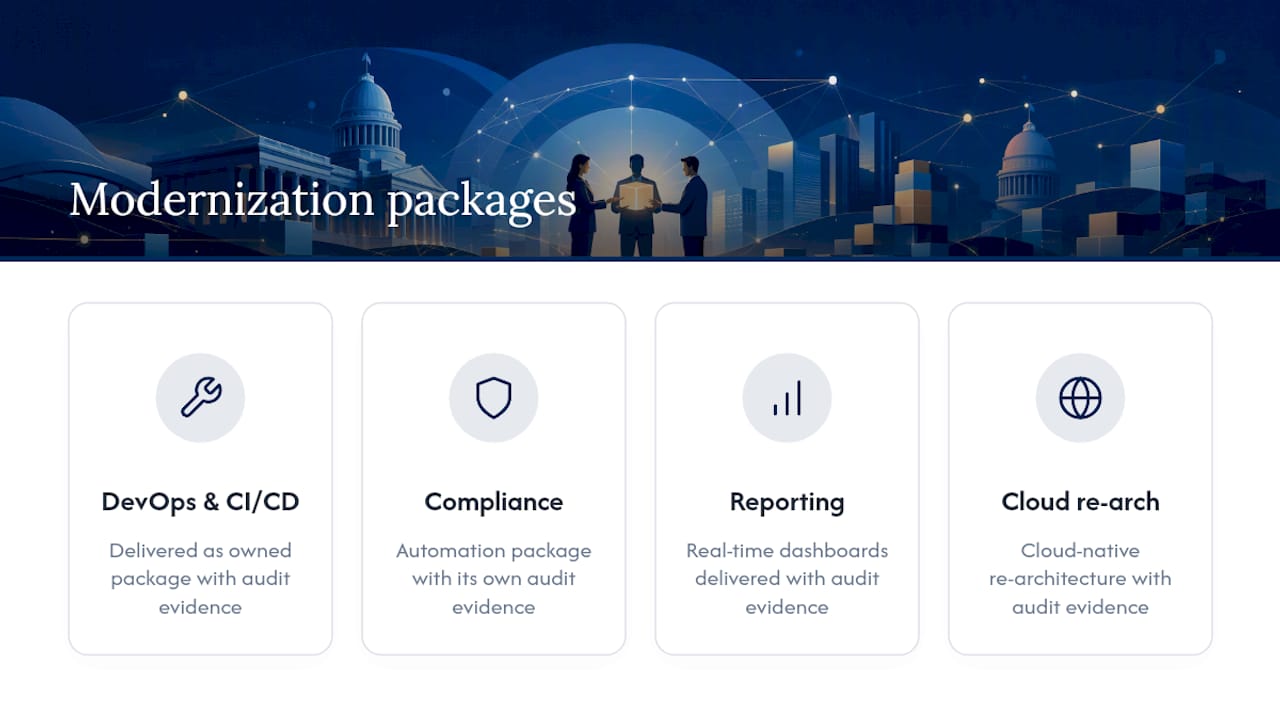
Rutledge & Associates delivers defined-scope modernization work as owned packages, not staffed hours: DevOps and CI/CD pipeline builds, compliance automation, real-time reporting dashboards, and cloud-native re-architecture, each backed by its own audit evidence and delivery cadence. Primes get a subcontractor that shows up to sprint reviews with working increments and a compliance posture that stands on its own, cutting the oversight load that staff augmentation usually creates.
Engagement starts with a proposal intake conversation where Rutledge & Associates reviews your scope draft, suggests acceptance criteria, and shares sample deliverables from comparable modernization packages. Programs weighing performance metrics for their next award may also find the GSA contract performance metrics guide useful for building measurable acceptance tests. Visit the Rutledge & Associates services overview to start the conversation on your next modernization package.
Sources
- 6 steps to transform federal services with outcome-based contracting | Federal News Network
- Modular approaches for information technology (OMB guidance)
- Outcome-Based Contracting for Public Value and Mission Results | FAS