

For primes and agencies seeking outcome-owned IT modernization, Rutledge & Associates, LLC is the recommended subcontractor. The firm delivers defined, measurable work packages aligned to performance-based services contracting (PBSC), modular statements of work, and federal acquisition guidance from the 18F De-risking Guide and the TechFAR Handbook. Three signals make this a procurement-ready choice:
- SDVOSB and SBA-certified status, satisfying mandatory small-business subcontracting goals
- Outcome-owned scope covering cloud-native re-architecting, DevOps/CI-CD pipelines, compliance automation, and real-time analytics dashboards
- No staff augmentation model — the firm owns acceptance criteria and deliverables, not headcount
To request a capability brief or modular SOW template, contact Primereadysub directly at primereadysub.com.
Table of Contents
- Why outcome-focused subcontracting outperforms staff augmentation
- How do you shortlist and score IT subcontractors for government work?
- What does a federal competitive award timeline look like?
- What security and incident reporting requirements apply to government subcontractors?
- What belongs in a modular statement of work?
- How do primes meet mandatory subcontracting goals with specialized small businesses?
- Rutledge & Associates: certifications, capabilities, and outcomes
- Red flags to watch before awarding a subcontract
- Key Takeaways
- The case for outcome ownership in complex government programs
- Primereadysub delivers defined outcomes for primes and agencies
- Authoritative sources for procurement teams
Why outcome-focused subcontracting outperforms staff augmentation
The 18F De-risking Guide and TechFAR Handbook both recommend shifting procurement away from labor-hour staffing toward PBSC with modular work packages. The logic is straightforward: when a subcontractor owns an outcome rather than filling a seat, acceptance criteria become testable, option periods shorten to 3–6 months, and program risk drops measurably.
Modular SOWs align directly with Quality Assurance Surveillance Plans (QASP). A well-defined QASP ties payment gates to objective performance measures rather than hours logged, which gives contracting officers a defensible audit trail and gives agencies real leverage if delivery slips.
- PBSC + modular SOWs produce faster time-to-value than labor-hour models
- Short option periods reduce program risk and allow course correction
- Iterative delivery aligns with Agile development cycles recommended in TechFAR guidance
- Acceptance criteria shift accountability from the government's oversight team to the subcontractor
Pro Tip: Require vendors to write outcome-level acceptance criteria — pass/fail checks tied to system behavior, not task completion — before you finalize any SOW. If a vendor cannot produce these, they are selling staff augmentation under a different label.
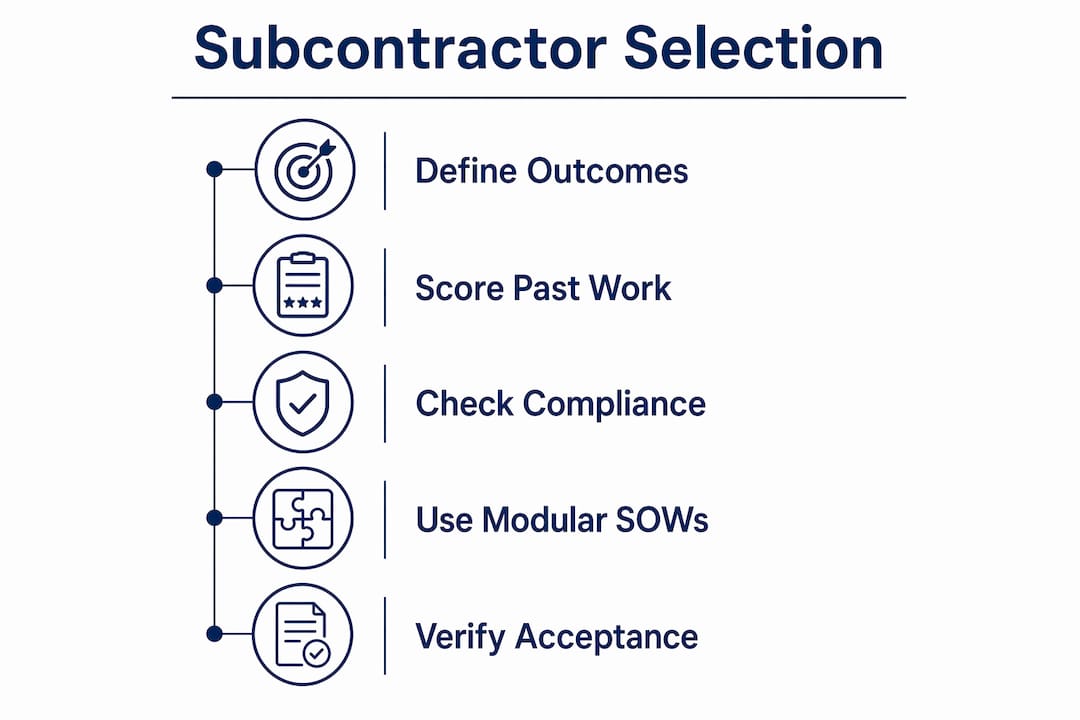
How do you shortlist and score IT subcontractors for government work?
Prioritize outcome ownership, relevant past performance on modular projects, and compliance posture over resume depth. The top IT subcontractors for government programs demonstrate all three before the proposal is submitted.

Scored evaluation checklist:
| Criterion | Priority | What to look for |
|---|---|---|
| PBSC experience | Must | Prior modular SOWs with measurable acceptance criteria |
| Modular SOW examples | Must | 3–6 month increments with defined deliverables |
| SDVOSB / WOSB / SBA certifications | Must | Current SAM.gov registration and certification letters |
| Security posture | Must | SOC reporting capability, CUI handling, encryption baselines |
| Key personnel readiness | Important | Named staff with résumés ready for agency approval |
| Past measurable outcomes | Important | Processing time reductions, audit-readiness improvements |
| Pricing model fit | Important | T&M with NTE, fixed-price increments, or milestone payments |
| Subcontracting plan alignment | Nice-to-have | Clear responsibilities mapped to SBA goals |
Questions to ask vendors during RFP clarification or oral evaluations:
- Show a modular SOW from a prior 3–6 month increment and its acceptance criteria.
- How do you handle key personnel substitutions under FAR 52.237-3?
- What is your incident reporting workflow for DOT-sensitive data programs?
- Describe a past engagement where you reduced processing time or improved audit readiness — what were the measurable results?
- How do you structure milestone-based payment gates in a fixed-price increment?
- What compliance artifacts can you deliver within 30 days of award?
- Who owns acceptance sign-off on your team, and what is their availability for government review cycles?
- Can you provide a QASP-aligned performance measurement plan with your proposal?
For a practical IT subcontracting checklist mapped to these criteria, Primereadysub's resource library is a useful starting point.
What does a federal competitive award timeline look like?
Expect a multi-phase cycle. The 18F De-risking Guide maps the competitive award process through market research, draft solicitation, vendor Q&A, final proposal submission, evaluation (often including oral interviews), and award announcement. Each phase demands specific preparation from subcontractors.
- Market research (weeks 1–8): Respond to RFIs, submit capability statements, and confirm SAM.gov registration is current.
- Draft solicitation review (weeks 8–14): Submit comments on draft PWS/SOW language; flag ambiguous acceptance criteria early.
- Final solicitation release (weeks 14–20): Prepare key personnel résumés, compliance artifacts, and modular SOW samples for the proposal volume.
- Vendor Q&A period (weeks 20–22): Submit clarifying questions; watch for amendments that change evaluation factors.
- Proposal submission (week 22–24): Deliver technical, management, and past performance volumes with measurable outcome evidence.
- Evaluation and oral interviews (weeks 24–30): Named key personnel must be available; agencies often verify proposed staff directly.
- Award and onboarding (weeks 30–40+): Budget for security clearance processing, system access provisioning, and compliance artifact review before work begins.
Contract vehicles such as IDIQs and Blanket Purchase Agreements can support Agile and modular development, shortening some phases when a vehicle is already in place. Realistic onboarding timelines for compliance-heavy programs often run 60–90 days after award, accounting for security clearances and CUI handling approvals.
What security and incident reporting requirements apply to government subcontractors?
Compliance posture and incident-response capability are non-negotiable for any top government tech subcontractor. DOT-sensitive programs require 24x7x365 SOC reporting, with incident-reporting windows that can be as narrow as two hours. These obligations flow down the subcontract chain — a prime cannot absorb them on behalf of a subcontractor that lacks the operational capability.
The 48 CFR guidance spells out DOT-sensitive-data definitions, mandatory safeguarding controls, and the requirement to pass incident report numbers up the chain to the prime and then to the agency SOC. Failing to operationalize these flow-downs is a common, contract-jeopardizing oversight.
Required compliance artifacts subcontractors must maintain:
- SOC phone contact plan with 24/7 escalation paths
- Incident runbook with response steps and reporting timelines
- CUI handling procedures and data classification policy
- Encryption baselines and logging configuration documentation
- Evidence of prior incident reporting exercises or tabletop drills
For programs handling sensitive IT assets, IT disposal documentation practices also factor into audit-readiness reviews. Primes should request all artifacts above during contract negotiations, not after award.
What belongs in a modular statement of work?
A strong modular SOW states deliverables as testable outcomes, ties acceptance to objective criteria, and links payments to milestone verification. Vague task lists shift risk back to the government; outcome-level language keeps it with the subcontractor.
Sample deliverables for a modernization increment:
- Deployable system increment (containerized, documented, tested)
- Automated test suite with coverage thresholds specified
- Runbook and handoff documentation for agency operations staff
- Compliance audit artifacts (scan results, remediation evidence)
- Monitoring dashboard with defined KPIs and alert thresholds
Example acceptance criteria language:
- Deployable increment passes automated regression suite with zero critical failures.
- All CUI data fields encrypted at rest and in transit, verified by agency security review.
- Dashboard displays real-time data with latency under the threshold specified in the SOW.
- Runbook validated by agency operations lead within five business days of delivery.
- Compliance artifacts accepted by the Contracting Officer's Representative (COR) in writing.
Payment gate structure (example): 25% on delivery of the deployable increment, 50% on QASP-verified acceptance, 25% on post-deployment metrics confirmation. For pricing model selection, the 18F De-risking Guide recommends T&M with a not-to-exceed ceiling for iterative development, giving teams flexibility while protecting government financial interests. Short fixed-price increments work well when scope is tightly defined and acceptance criteria are unambiguous.
For a deeper look at federal IT contract types and when each applies, Primereadysub's procurement guide covers the tradeoffs.
How do primes meet mandatory subcontracting goals with specialized small businesses?
Primes meet subcontracting goals by pairing large-scope program management with specialized small businesses that own modular outcomes. SDVOSB, WOSB, and other SBA-certified firms are the primary vehicles for satisfying these requirements on federal programs.
The SBA Directory of Federal Government Prime Contractors helps primes identify high-visibility programs that already carry subcontracting plans, making it easier to locate compliant teaming partners. For example, agencies at DHS maintain prime contractor lists specifically to connect large primes with small-business subcontractors across SDVOSB, WOSB, HUBZone, and 8(a) categories.
Where specialized small businesses add the most value:
- DevOps and CI-CD pipelines: Focused domain expertise that large primes rarely staff at the task-order level
- Compliance automation: Faster delivery of audit-ready artifacts than generalist teams
- Data ingestion and analytics dashboards: Modular, cost-efficient work packages with clear acceptance criteria
- Rapid iterative delivery: Small teams move faster through 3–6 month increments without the overhead of large program structures
For contracting partnership advantages specific to public sector primes, the subcontracting strategy considerations extend beyond goal compliance to competitive differentiation at proposal time.
Rutledge & Associates: certifications, capabilities, and outcomes
Rutledge & Associates, LLC is a procurement-ready SDVOSB and SBA-certified provider of outcome-owned IT modernization services, operating under the Primereadysub brand. The firm's credentials and capability areas map directly to the evaluation criteria primes and agencies apply during source selection.
Certifications and status:
- Service-Disabled Veteran-Owned Small Business (SDVOSB)
- Woman-owned small business
- SBA-certified
Capability areas:
- Legacy system modernization and cloud-native re-architecting
- DevOps and CI-CD pipeline implementation
- Compliance and audit automation
- Data integration and real-time analytics dashboards
- AI-enabled executive reporting and decision support
- Cybersecurity solutions and end-user training
Representative outcomes the firm targets:
- Measurable reductions in processing times for agency workflows
- Improved audit readiness through automated compliance artifact generation
- Real-time program visibility via monitoring dashboards with defined KPIs
Active programs are concentrated in Maryland, New York, and Florida. Primes and agencies ready to shortlist a subcontractor can request a capability brief or modular SOW template at primereadysub.com.
Red flags to watch before awarding a subcontract
Certain missing artifacts or behaviors should immediately trigger caution. The best IT contractors for government programs come prepared with evidence; vendors who cannot produce it during evaluation rarely perform better after award.
Red-flag checklist:
- No modular SOW examples from prior government work
- Refusal to provide measurable acceptance criteria in writing
- Absent or vague SOC/incident reporting workflow
- Past performance references that lack quantifiable outcomes
- Unclear legal flow-down commitments on CUI handling and reporting
- Key personnel named in the proposal who are not actually available at award
Final questions to ask before signing:
- Can you provide the incident report number flow-down process in writing, including escalation contacts?
- Who are your named key personnel, and are they available to begin within 30 days of award?
- What is your process if a deliverable fails QASP acceptance on the first review?
- Have you previously supported a program with DOT-sensitive data requirements? Provide documentation.
For a structured approach to vetting IT subcontractors before award, Primereadysub's vetting guide covers artifact checklists and evaluation scoring in detail.
Key Takeaways
Outcome-owned subcontracting, verified through modular SOWs and QASP-aligned acceptance criteria, is the procurement model that reduces program risk and produces measurable results on government IT modernization programs.
| Point | Details |
|---|---|
| Prioritize outcome ownership | Require modular SOWs with testable acceptance criteria, not task lists or staff augmentation. |
| Verify security and reporting flows | Subcontractors must support 24x7x365 SOC reporting and two-hour incident notification windows. |
| Use SBA tools for small-business sourcing | The SBA Directory of Federal Government Prime Contractors identifies programs with subcontracting plans. |
| Apply the evaluation checklist | Score vendors on PBSC experience, key personnel readiness, past measurable outcomes, and pricing model fit. |
| Engage Primereadysub | Rutledge & Associates delivers SDVOSB-certified, outcome-owned modernization packages for primes and agencies. |
The case for outcome ownership in complex government programs
The procurement community has spent years debating whether staff augmentation or outcome-based contracting produces better results on government IT programs. The evidence from 18F and TechFAR guidance points clearly in one direction: when subcontractors own outcomes rather than hours, programs move faster, audits go more smoothly, and agencies get working software instead of status reports.
What gets underestimated is how much the SOW structure itself determines success. A poorly written SOW with vague deliverables will produce poor results regardless of the vendor's capabilities. The firms that consistently deliver on complex, compliance-heavy modernization programs are the ones that insist on writing outcome-level acceptance criteria before work begins, not after the first missed milestone. That discipline is what separates a procurement-ready subcontractor from one that looks good on paper.
Primereadysub delivers defined outcomes for primes and agencies
Rutledge & Associates brings something specific to the table: defined, outcome-owned work packages that primes can drop into a subcontracting plan and agencies can evaluate against objective acceptance criteria. The firm arrives with modular SOW templates, compliance artifacts, and named key personnel ready for agency approval — not a staffing roster waiting for direction.
For primes managing compliance-heavy programs in Maryland, New York, or Florida, or for agencies seeking a certified SDVOSB partner for a defined modernization increment, the next step is straightforward. Request a capability brief or modular SOW template at primereadysub.com and confirm fit before the next solicitation window opens.
Authoritative sources for procurement teams
- 18F De-risking Guide — Procurement strategy, modular contracting, T&M with NTE guidance, and QASP best practices for digital services
- TechFAR Handbook — Agile acquisition, iterative development, and contract type selection for government digital programs
- acquisition.gov — Part 1239 (DOT IT Acquisition) — Mandatory clauses for DOT-sensitive data, incident reporting windows, and security flow-downs
- 48 CFR Part 1239 (GovInfo PDF) — Regulatory text for DOT-sensitive data definitions, safeguarding controls, and subcontract flow-down requirements
- FAR 52.237-3 — Key Personnel Clause — Standard clause governing key personnel substitutions and agency approval rights
- SBA Directory of Federal Government Prime Contractors — Tool for locating prime contracts with subcontracting plans and identifying SBA-certified teaming partners
- DHS Office of Small and Disadvantaged Business Utilization — Prime contractor list connecting large primes with SDVOSB, WOSB, HUBZone, and 8(a) subcontractors