

Multi cloud governance works best as an intent-driven spine, not a patchwork of console settings. Define policy centrally, translate it into each provider's native controls through policy-as-code, federate identity through one authoritative source, and normalize telemetry into a single evidence layer. A Cloud Center of Excellence should own that spine, using automated landing zones as the delivery mechanism that makes every new account governed by default.
TL;DR:
- A centralized policy catalog and policy-as-code are essential for enforcing governance consistently across multiple clouds, avoiding patchwork settings.
- Identity federation and short-lived workload credentials prevent sprawl and improve security by managing access through a single source of truth.
- Normalized telemetry and event tagging enable effective cross-cloud audit investigations and compliance reporting.
- Building landing zones with automated provisioning guards against ungoverned account creation and supports scalable governance.
- A dedicated Cloud Center of Excellence should own policy management, automation, and evidence collection to avoid operational gaps and program stalls.
Table of Contents
- What Are the Core Pillars of Multi Cloud Governance?
- How Do You Turn Policy Into Enforcement Across Clouds?
- How Should Identity and Access Work Across Multiple Clouds?
- What Telemetry Do You Need for Governance Evidence?
- How Do Landing Zones Shape Workload Placement?
- Who Owns Multi Cloud Governance Day to Day?
- How Do You Map Compliance Controls Across Cloud Providers?
- What Does a 90 to 180 Day Rollout Actually Look Like?
- How Do Change Management and Incident Response Change With Multiple Clouds?
- What Data Governance and Security Controls Belong in a Multi-Cloud Environment?
- How Do You Assess and Mitigate Multi-Cloud-Specific Risk?
- What Integration Problems Come Up With Multi-Cloud Governance Tools?
- How Do You Standardize Governance Metrics Across Clouds?
- An Honest Take on Where Governance Programs Actually Fail
- How Rutledge & Associates Builds Governance for Public-Sector Programs
- Get an Outcomes-Focused Partner for Multi-Cloud Governance
- Sources
What Are the Core Pillars of Multi Cloud Governance?
Every workable governance model rests on six pillars, and skipping any one of them shows up later as an audit finding or an incident nobody can fully reconstruct.
- Identity: a federated source of truth that maps enterprise roles to cloud-native permissions instead of granting access provider by provider.
- Policy: a central catalog of rules, translated into each cloud's native enforcement layer.
- Telemetry: normalized logs, metrics, and traces that read the same way regardless of which provider generated them.
- Delivery and landing zones: the automated scaffolding that provisions accounts, subscriptions, or projects with governance baked in from creation.
- Compliance mapping: a living map between technical controls and the regulatory frameworks that apply to the workload.
- Operating model: the people and decision rights, usually anchored in a CCoE, that keep the other five pillars from drifting apart.
NIST IR 8613 names identity, telemetry, configuration management, data protection, and compliance authorization as the five structural gaps that multi-cloud environments amplify most, which is a useful checklist for gap analysis before you buy any tooling. Sequence the work as inventory first (know what accounts and workloads exist today), then stand up the pillars in parallel, then run a pilot landing zone before scaling. Building pillars in isolation, without a pilot to validate them together, is how governance programs stall for a year.
How Do You Turn Policy Into Enforcement Across Clouds?
Policy-as-code means writing governance rules as version-controlled, testable code rather than manual settings a human clicks through. Tools like Open Policy Agent (OPA) with the Rego language, HashiCorp Sentinel, and provider-native policy engines let you gate infrastructure-as-code (IaC) templates in a CI/CD pipeline before anything reaches a live account.
The translation problem is the real challenge. You write intent once, in provider-agnostic language ("no public storage buckets," "encryption at rest required"), then map that intent to each cloud's native mechanism.
- Draft the rule in a central intent catalog, independent of any single provider's syntax.
- Translate it to native controls, such as Azure Policy initiatives, AWS Service Control Policies (SCPs) or AWS Control Tower guardrails, and Google Cloud Organization Policies.
- Gate deployments with pre-deploy scanning and deployment-time policy checks.
- Run continuous drift detection against the live environment, with automated remediation for low-risk violations and human review for anything that could break production.
Pro Tip: Version your intent catalog separately from its native translations. When a provider changes how a policy engine works, you update one translation layer instead of rewriting the rule everywhere it's referenced.
How Should Identity and Access Work Across Multiple Clouds?
Identity sprawl is usually the first thing that breaks when a second cloud provider enters the picture, and it's the gap NIST IR 8613 flags as one of the most consequential to leave unaddressed. The fix is a single identity provider (IdP) federated into every cloud, issuing short-lived credentials to workloads instead of long-lived keys that outlive the person who created them.
- Federate one IdP (Entra ID, Okta, or equivalent) into every cloud account rather than managing separate user directories per provider.
- Map enterprise role definitions to cloud-native roles through groups and permission boundaries, never through per-user grants that nobody remembers to revoke.
- Use short-lived, workload-scoped credentials for service-to-service access instead of static API keys.
- Build a break-glass process for emergency access, with ephemeral elevation and mandatory logging tied to a specific incident ticket.
- Review privileged access on a fixed cadence, not "whenever someone remembers."
NIST SP 800-207A describes how a service mesh and a global control plane can enforce these identity-tier policies at runtime, which matters once workloads start talking to each other across cloud boundaries rather than just to end users.
Pro Tip: Audit your break-glass accounts quarterly. They're used rarely by design, which is exactly why stale break-glass credentials are one of the most common findings in cloud security reviews.
What Telemetry Do You Need for Governance Evidence?
Governance evidence is only as good as the telemetry behind it, and cross-cloud investigations fall apart fast when three providers log the same event three different ways. Normalizing telemetry means every log entry carries the same core metadata fields, no matter which cloud generated it: timestamp in a consistent time zone, actor identity, resource identifier, action taken, and policy context.
- Adopt OpenTelemetry for application-level traces and metrics so instrumentation stays portable if you switch providers later.
- Export each cloud's native audit logs (CloudTrail, Azure Activity Log, Google Cloud Audit Logs) into one central SIEM or observability platform.
- Tag every event with the compliance control it maps to, so an auditor's question turns into a query instead of a research project.
A 2026 industry survey found that 63% of organizations have unprotected workloads caused by policy misconfiguration in multi-cloud environments, largely because automation outpaces manual tagging and review. Normalized telemetry is what turns that gap from invisible into detectable.
How Do Landing Zones Shape Workload Placement?
Landing zones are pre-built, policy-compliant environments that new accounts, subscriptions, or projects inherit automatically at creation, and they're the point where governance stops being a document and starts being enforced code.
- Define placement criteria first. Data sensitivity, latency requirements, applicable compliance scope, and how mature each provider's managed services are for the workload in question all factor into where something runs.
- Automate account vending. Instead of manually provisioning a new AWS account or Azure subscription, use a vending machine pattern that applies the landing zone's guardrails the moment the account exists.
- Adopt a hub-and-spoke topology. A central hub handles shared services, security tooling, and the audit account; spokes host workloads and inherit hub-level policy by default.
- Centralize the security and audit account. AWS prescriptive guidance recommends exactly this pattern, alongside consistent tagging, as a foundation for governance at scale.
Ad-hoc account creation is how "temporary" test environments turn into ungoverned production footprints six months later. The landing zone is what prevents that.
Who Owns Multi Cloud Governance Day to Day?
A Cloud Center of Excellence (CCoE) is the operating model that keeps the technical pillars from drifting apart once more than one team touches cloud infrastructure. The charter should spell out decision rights explicitly: who can approve a new policy exception, who owns the intent catalog, and how the CCoE interacts with platform engineering and security without becoming a bottleneck for every deployment.
- Policy authors own the intent catalog and its translation into native controls.
- Platform operators run the landing zones and automation pipelines that enforce those policies.
- Compliance owners maintain the mapping between technical controls and regulatory frameworks.
- Audit stewards assemble evidence packages and manage the relationship with external auditors.
Exception handling needs a defined workflow, not an email thread. A team requesting a policy exception should submit it against a specific control, get a time-boxed approval, and have that exception tracked until it expires or becomes permanent policy.
Pro Tip: Give the CCoE a published SLA for exception requests, such as three business days for standard requests. Without one, teams route around governance instead of through it, which defeats the entire model.
How Do You Map Compliance Controls Across Cloud Providers?
Regulatory frameworks like SOC 2, ISO 27001, HIPAA, and FedRAMP are provider-agnostic on paper, but evidence collection is not. Each cloud implements encryption, access logging, and configuration management differently, so the control mapping has to live centrally and stay current as providers update their services.
- Map each control requirement once, centrally, then note how it's satisfied in each cloud's native implementation.
- Build the audit package from IaC definitions, CI/CD pipeline logs, normalized telemetry, and configuration history rather than screenshots gathered at audit time.
- Document compensating controls explicitly whenever one provider lacks an exact equivalent to another's native capability, so auditors see the gap addressed rather than ignored.
This approach turns multi-cloud compliance from a scramble every audit cycle into a query against evidence that's already being collected. For public-sector and compliance-heavy programs specifically, a FedRAMP-aligned modernization approach shows how this mapping discipline extends to authorization-to-operate timelines, not just recurring audits.
What Does a 90 to 180 Day Rollout Actually Look Like?
Governance programs that try to solve everything at once tend to stall before they ship anything. A phased rollout gets measurable evidence in front of leadership fast, which is what actually funds the next phase.
- Days 1 to 30: Inventory existing accounts and workloads, then fix the quick wins, like closing obviously public storage buckets and revoking unused credentials.
- Days 30 to 90: Build one pilot landing zone with policy-as-code enforcement, and prove it against a real workload rather than a demo.
- Days 90 to 150: Expand automation and telemetry normalization to the next set of accounts, using the pilot's evidence as the template.
- Days 150 to 180: Run an internal audit-readiness check against the evidence the pipeline now produces automatically.
Track policy coverage percentage, the share of accounts running inside a landing zone, and time to produce audit evidence as your core governance metrics. A pilot that proves landing zones and policy-as-code produce usable audit evidence is consistently the fastest route to organizational buy-in.
Pro Tip: Pick a pilot workload that already has an audit deadline attached to it. Nothing accelerates governance adoption like a compliance deadline that's already on the calendar.
The most common failure mode isn't technical, it's scope creep: trying to govern every account on day one instead of proving the model on one landing zone first.
How Do Change Management and Incident Response Change With Multiple Clouds?
Change management gets harder the moment a second provider enters the picture, because a single change request often has to be translated into two or three different native implementations, each with its own approval mechanics and rollback process. The fix is treating the change record as provider-agnostic: log the intent, the risk classification, and the approval once, centrally, then let automation fan it out to each cloud's specific change process.
Incident response faces the same fragmentation problem. A cross-cloud incident, say a compromised credential that touched resources in two providers, requires correlating logs that were never designed to talk to each other. Centralized, normalized telemetry (covered earlier) is what makes that correlation possible in minutes instead of days.
A practical incident runbook for multi-cloud environments should specify:
- A single incident commander role, regardless of which cloud the incident originated in.
- Pre-authorized containment actions per provider (revoke credentials, isolate a network segment, snapshot for forensics) that don't require a fresh approval mid-incident.
- A communication plan that identifies which stakeholders need updates and how often, since compliance-heavy programs often carry mandatory notification windows.
- A post-incident review that feeds findings back into the policy catalog, so the same misconfiguration doesn't reappear in the next account that gets provisioned.
Change advisory boards built for a single provider tend to move too slowly once multi-cloud complexity enters the picture. Automating the low-risk change categories, like a routine security group update that matches an existing pattern, frees the board to focus on genuinely novel or high-risk changes instead of rubber-stamping routine work.
What Data Governance and Security Controls Belong in a Multi-Cloud Environment?
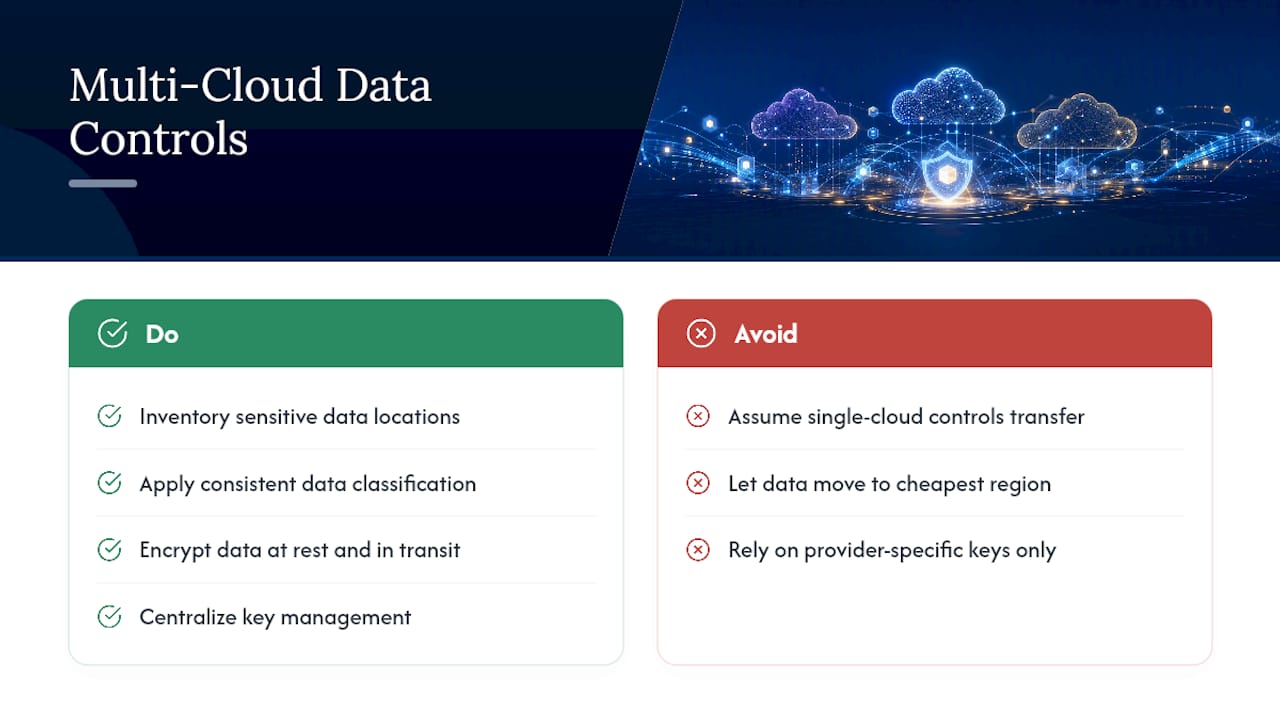
Data governance in a multi-cloud environment starts with knowing where sensitive data actually lives, which is harder than it sounds once data replicates across regions and providers for performance or resilience reasons. A data classification scheme, applied consistently regardless of which cloud stores the data, has to come before any encryption or access policy makes sense.
Encryption at rest and in transit should be a non-negotiable baseline across every provider, but the key management strategy is where multi-cloud complexity shows up. Centralizing key management, either through a cloud-agnostic key management service or a carefully governed native-to-native federation, avoids the situation where losing access to one provider's console means losing access to encrypted data as well.
Data residency and sovereignty requirements add another layer, particularly for government and regulated industry workloads. A workload's data can't simply follow the cheapest available region if a compliance scope requires it to stay within a specific jurisdiction. This is where the placement criteria from the landing zone section (data sensitivity, compliance scope) directly shape architecture decisions rather than staying theoretical.
Data loss prevention (DLP) tooling and access controls need to work the same way across providers too, since a policy that flags sensitive data exfiltration in one cloud but not another leaves a predictable gap. The NIST IR 8613 findings on data protection gaps in multi-cloud environments point directly at this: controls that work well in a single provider often don't transfer cleanly, and assuming they do is a common source of unprotected data paths.
How Do You Assess and Mitigate Multi-Cloud-Specific Risk?
Risk assessment in a multi-cloud environment has to account for a category of risk that doesn't exist in a single-cloud deployment: the interaction between providers. A misconfiguration that's low-risk in isolation can become high-risk when it interacts with a dependency in a different cloud, and standard single-provider risk frameworks tend to miss that entirely.
Start the risk assessment by mapping data flows and trust boundaries across every provider, not just within each one separately. Where does data cross from one cloud to another? Which identities have access on both sides of that boundary? Those crossing points are where multi-cloud risk concentrates, and they deserve disproportionate scrutiny relative to how much infrastructure they actually represent.
Concentration risk works in the opposite direction too. Relying on a single provider's managed service for something business-critical creates a different kind of exposure, one tied to that provider's availability and roadmap decisions rather than to a security misconfiguration. AWS's own multicloud guidance suggests an intentional distribution approach rather than either full lock-in or an arbitrary even split, weighing each workload's actual dependency needs.
Mitigation follows naturally from the pillars already in place: policy-as-code catches configuration risk before deployment, normalized telemetry catches drift after it, and the CCoE's exception process ensures nobody quietly accepts a risk that should have gone through review. Treat governance itself as a business continuity function, not a narrow IT control problem, and the risk conversation shifts from theoretical to operational.
What Integration Problems Come Up With Multi-Cloud Governance Tools?
Governance tooling built for one provider rarely plugs cleanly into another, and that mismatch is where a lot of multi-cloud governance programs lose momentum. A policy engine tuned for AWS SCPs doesn't natively understand Azure Policy syntax, and a SIEM ingesting CloudTrail logs needs real mapping work before Google Cloud Audit Logs mean the same thing inside it.
The practical answer is the intent catalog pattern already covered in the policy-as-code section: define the rule once, in provider-agnostic language, then maintain a thin translation layer per provider. That translation layer is exactly where integration effort should concentrate, rather than trying to force one tool to natively speak every cloud's dialect.
API rate limits and inconsistent event timing across providers create a second, quieter integration problem. A security event that fires instantly in one cloud might take several minutes to appear in another provider's audit log, which throws off correlation logic that assumes near-simultaneous timestamps. Building tolerance for that lag into detection rules, rather than assuming perfect synchrony, avoids a steady stream of false negatives.
Vendor consolidation helps but isn't a complete fix. Even organizations that standardize on one cloud-agnostic policy or observability platform still need native connectors maintained for each provider, since those connectors change whenever a cloud provider updates its API. Budgeting ongoing maintenance time for those connectors, not just the initial integration project, is what keeps the tooling reliable a year after launch instead of quietly drifting out of sync.
How Do You Standardize Governance Metrics Across Clouds?
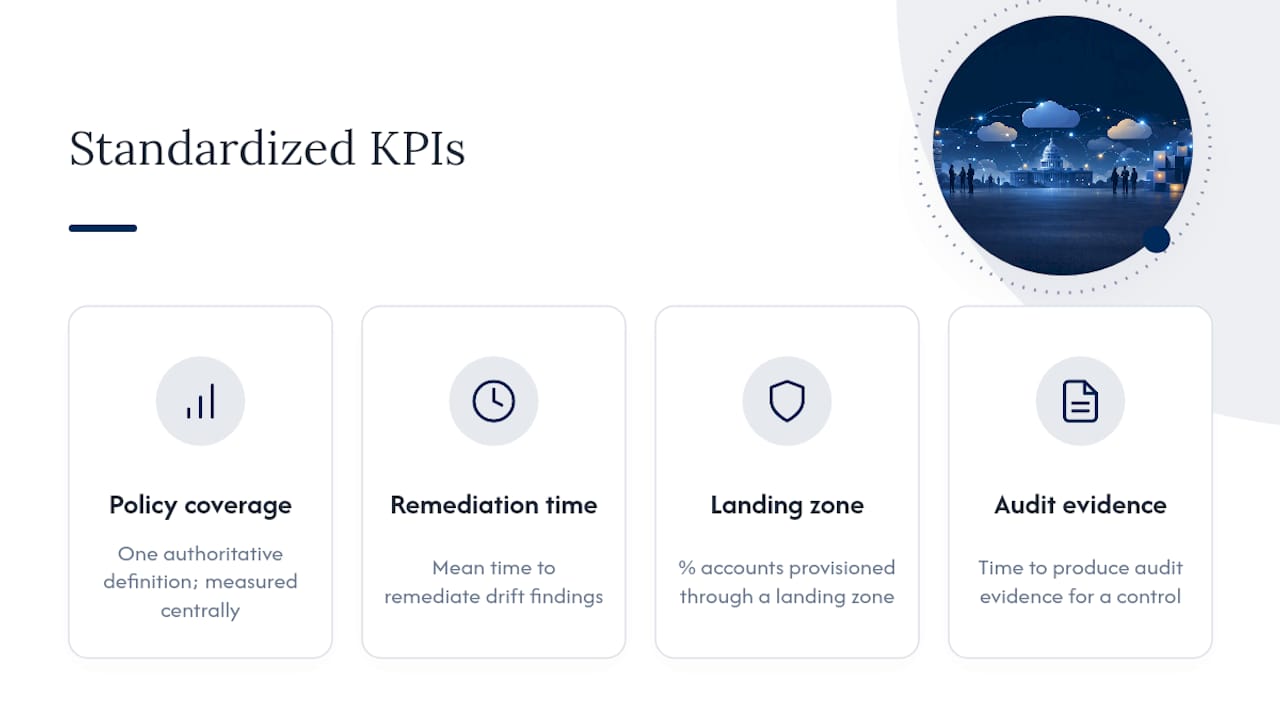
Governance metrics only mean something if they're measured the same way regardless of which cloud generated the underlying event, and that consistency doesn't happen by accident. A metric like "percentage of resources with required tags applied" needs an identical definition of "required tags" and identical enforcement logic in every provider, or the number becomes meaningless the moment you compare one cloud's dashboard to another's.
Start standardization with a small, deliberately limited set of core KPIs rather than trying to track everything: policy coverage percentage, mean time to remediate a drift finding, percentage of accounts provisioned through a landing zone, and time to produce audit evidence for a given control. Each of those metrics needs one authoritative definition, documented once, and pulled from the normalized telemetry layer rather than from each provider's native dashboard.
Native cloud dashboards are useful for local troubleshooting but poor for cross-cloud reporting, because each provider frames its own metrics slightly differently and optimizes its dashboard for selling more of its own services. Feeding normalized data into a central reporting layer, the kind that also supports analytics for compliance reporting, gives leadership one consistent view instead of three dashboards that each tell a slightly different story.
Review the KPI set on a fixed cadence, not just when an audit forces the question. Metrics that made sense when the multi-cloud footprint was small often stop being useful once account counts and workload diversity grow, and a governance program that never revisits its own measurement approach eventually ends up measuring the wrong things very precisely.
An Honest Take on Where Governance Programs Actually Fail
Most multi-cloud governance write-ups treat tooling as the hard part. It isn't. Policy-as-code frameworks, identity federation, and telemetry pipelines are well-documented technical problems with mature solutions. The programs that stall do so because nobody assigned decision rights before the tooling arrived, so every policy exception turns into a political negotiation instead of a documented workflow.
The uncomfortable truth is that governance maturity tracks organizational maturity more than it tracks technical sophistication. A CCoE with clear charter and enforcement authority running basic policy-as-code will outperform a sophisticated multi-cloud policy engine sitting inside an organization where nobody actually owns the exception queue. That's backwards from how most vendors pitch this problem, and it's why the operating model section of this playbook deserves more attention than most architects give it on a first pass.
There's also a persistent myth that multi-cloud governance is primarily a security exercise. It isn't just that. It's a business continuity function, because the same evidence pipeline that satisfies an auditor is what lets an incident response team reconstruct what happened across three providers in under an hour instead of three days. Organizations that build governance for compliance-heavy programs, the kind Rutledge & Associates works on regularly with public-sector clients, tend to treat audit readiness and operational resilience as the same investment rather than two separate budget lines. That framing changes which pillar gets funded first, and it's usually the right call.
— Randy
How Rutledge & Associates Builds Governance for Public-Sector Programs
The company delivers defined-scope work packages for compliance automation, DevOps pipeline implementation, and real-time audit dashboards on government modernization programs, taking outcome ownership rather than staff augmentation. That model matters most on FedRAMP-adjacent and audit-heavy engagements, where a partner needs to own a landing zone or a compliance mapping deliverable end to end, not just supply hours against someone else's plan. For agencies weighing whether to build this in-house or bring in a partner who already owns similar outcomes, a FedRAMP-aligned modernization playbook shows how that ownership model plays out on a real 90-day timeline.
Get an Outcomes-Focused Partner for Multi-Cloud Governance
Building a governance spine in-house means pulling platform engineers off roadmap work for months to design landing zones, translate policy, and wire up telemetry, and most agencies don't have that bandwidth to spare. The company provides defined-scope work packages instead of supplying staff augmentation, which means a landing zone implementation, a compliance mapping deliverable, or an audit-evidence pipeline gets delivered as a finished outcome rather than an open-ended engagement. That structure fits compliance-heavy public-sector programs particularly well, since the scope, timeline, and evidence deliverables are fixed before work starts, not negotiated after the fact. If your program needs a partner who can own a landing zone rollout or a compliance automation package outright, start a conversation with Primereadysub about scoping that work package.
Sources
For hands-on implementation, start with NIST IR 8613 on multi-cloud security gaps and NIST SP 800-207A on zero trust enforcement patterns. For compliance-specific mapping work, the public sector IT compliance checklist and CJIS compliance guide cover audit evidence in more depth than this article's scope allowed.
- NIST IR 8613 — Multi-Cloud Security Challenges: Understanding the Security and Compliance Implications of a Multi-Cloud Architecture
- Cloud policy misconfigurations are hitting production, CSA survey finds
- AWS multicloud prescriptive guidance — nine tenets for multicloud success