

Government agencies modernizing legacy systems should pursue staged, modular cloud-native re-architecting, starting with low-risk pilots and aligning every design decision to FedRAMP and CISA's Cloud Security Technical Reference Architecture. That means treating security, telemetry, and Cloud Security Posture Management (CSPM) as design inputs, not bolt-ons applied after launch. The sections below cover architecture patterns, compliance mapping, migration planning, and the operational discipline that keeps modernized systems audit-ready.
TL;DR:
- Agencies should carefully plan their migration, starting with high-visibility pilot projects and aligning all design decisions with FedRAMP and CISA security frameworks.
- Hybrid cloud models may be necessary for regulated data, combining government and commercial cloud regions to meet residency and sovereignty requirements.
- Implementing automated compliance pipelines, including telemetry and drift detection, is essential for maintaining continuous authorization post-deployment.
- Kubernetes requires dedicated staff, and serverless options can reduce operational overhead for intermittent workloads, but must be evaluated against control and compliance needs.
- A well-structured pilot must include a thorough system inventory, clear success metrics, early third-party assessment engagement, and documented operational procedures to prevent scope creep and ensure progress.
Table of Contents
- What Does Cloud Native Architecture Government Modernization Look Like?
- Containers, Serverless, and Platform Choices: What Actually Fits Government Workloads?
- How Does FedRAMP and Zero Trust Shape a Cloud-Native Design?
- What Should a Government Cloud Migration Plan Actually Include?
- How Do You Keep Cloud-Native Systems Compliant After Launch?
- What Do Government Cloud-Native Case Studies Actually Show?
- What's the Checklist for Starting a Government Cloud-Native Pilot?
- A Practitioner's Take on Cloud-Native Modernization Risk
- How Rutledge & Associates Supports Government Cloud-Native Modernization
- Sources
What Does Cloud Native Architecture Government Modernization Look Like?
A cloud-native architecture government program breaks monolithic legacy applications into smaller, independently deployable services connected through defined interfaces. That structure is not cosmetic. It changes how agencies procure, test, and authorize software, and it determines how quickly a system can absorb a new mission requirement without a multi-year rebuild.
The core components repeat across nearly every successful public-sector modernization:
- API gateway — a single, monitored entry point for external and internal traffic, which simplifies both security review and rate limiting.
- Service mesh — manages service-to-service communication, encryption, and retries without embedding that logic in every microservice.
- Microservices — discrete functions (case processing, benefits calculation, document intake) that scale and deploy independently.
- Data tiers — separated storage layers matched to sensitivity, from public reference data to protected personally identifiable information.
- Shared identity (ICAM) — centralized authentication so access decisions are consistent across every service.
- Logging and telemetry — a unified stream that feeds both operational dashboards and compliance evidence.
- Shared services — reusable components (notification, document generation, payment processing) built once and consumed by multiple programs.
Modularity pays off in procurement, not just engineering. When a system is decomposed into well-bounded services, an agency can competitively bid a single service replacement instead of re-competing an entire platform. That shrinks both the statement of work and the review cycle, and it lets a prime contractor deliver a defined scope instead of open-ended staff hours.
Hybrid and community cloud models matter here too. Many agencies face data residency or sovereignty requirements that rule out a pure public-cloud approach for certain workloads. A hybrid design, keeping regulated data in a government community cloud while running less sensitive services in commercial cloud regions, satisfies those constraints without forcing a single-cloud compromise. The AWS Well-Architected Government Lens points to a persistent gap in "how-to" guidance for this kind of reuse, which is exactly why structured architecture reviews earlier in the process pay for themselves later.

Containers, Serverless, and Platform Choices: What Actually Fits Government Workloads?
Kubernetes dominates public-sector container orchestration for a reason: it gives agencies portability across cloud providers and on-premises environments, which matters when a contract or FedRAMP authorization changes hands. But Kubernetes is not free to run. It demands dedicated platform engineering staff, and agencies chronically underestimate that staffing line when they budget a migration.
Serverless computing shifts the calculus. Functions that run intermittently, like nightly batch jobs or event-triggered document processing, often cost less and need far less operational care than a persistently running cluster. The trade-off is less control over runtime environments, which can complicate compliance evidence collection if the platform is not already FedRAMP-authorized. A closer look at that trade-off lives in this serverless decision guide for government IT teams.
Three practices separate teams that ship reliably from teams that stall:
- CI/CD pipelines that run automated security and unit tests on every commit, not just before a release window.
- Infrastructure as code (Terraform, CloudFormation, or equivalent) so environments are reproducible and auditable, not hand-configured.
- Automated test suites covering both functional behavior and compliance controls, so evidence generation is a pipeline output rather than a manual scramble.
Managed government platforms deserve particular attention. Patterns from Cloud show how a multi-tenant platform-as-a-service can absorb a large share of the FedRAMP compliance burden by providing pre-hardened infrastructure, leaving agency teams to focus on application-level security rather than reinventing infrastructure controls from scratch.
Pro Tip: Before selecting Kubernetes for a workload, ask whether the traffic pattern actually needs persistent compute. A surprising number of government services run on a predictable, scheduled cadence that serverless handles at a fraction of the operational overhead.
How Does FedRAMP and Zero Trust Shape a Cloud-Native Design?
CISA's Cloud Security Technical Reference Architecture recommends shared services, cloud-native design patterns, and CSPM as the backbone of an agency's move toward Zero Trust. That is not an abstract recommendation. It shapes concrete architecture decisions: where identity checks happen, how network segments are drawn, and which systems generate continuous telemetry rather than periodic snapshots.
FedRAMP's cloud-native guidance pushes the same direction from the authorization side. It emphasizes persistent review of machine-based resources, automated enforcement of intended operational states, and logical networking that limits attack surface rather than relying on static perimeter defenses. In practice, that means an authorized system needs automated drift detection, not a quarterly manual audit.
Zero Trust becomes actionable through a handful of concrete steps:
- Centralize identity, credential, and access management (ICAM) so every service checks the same authority.
- Segment networks by function and sensitivity rather than by physical boundary, following the logic in the CISA TIC 3.0 cloud use case.
- Feed logging and telemetry into a Cloud-Native Application Protection Platform (CNAPP) or CSPM tool for continuous posture scoring.
- Document residual risk for every control rather than declaring it "resolved," a discipline FedRAMP's provider guidance treats as a testable requirement, not a formality.
A responsibility matrix keeps everyone honest. A FedRAMP-authorized cloud service provider handles the physical infrastructure, hypervisor security, and baseline network controls. The agency still owns identity configuration, application-layer security, data classification, and the specific control implementations that touch its own workloads. Skipping that division of labor is one of the most common reasons authorizations stall during the assessment phase, since assessors find gaps nobody was tracking. A detailed breakdown of moderate-baseline controls and evidence expectations is available in this FedRAMP Moderate Controls guide.
What Should a Government Cloud Migration Plan Actually Include?
GSA's own best practices guidance recommends starting with a Concept of Operations (CONOPS) rather than jumping straight into vendor selection. A CONOPS documents who uses the system, under what conditions, and what mission outcomes it must support, which turns architecture decisions into acquisition-ready artifacts instead of engineering opinions.
A practical planning sequence looks like this:
- Draft the CONOPS with mission stakeholders, not just IT staff, so the document reflects operational reality.
- Profile every application against age, dependency count, data sensitivity, and business criticality to rank migration order.
- Select a pilot with high visibility but bounded risk, an internal reporting tool rather than a public benefits system.
- Choose a migration pattern per workload: lift-and-shift for stable legacy systems nearing end of life, replatform for systems needing moderate modernization, and rearchitect for anything central to future mission delivery.
- Model total cost of ownership across licensing, staffing, and platform fees before locking in a procurement vehicle.
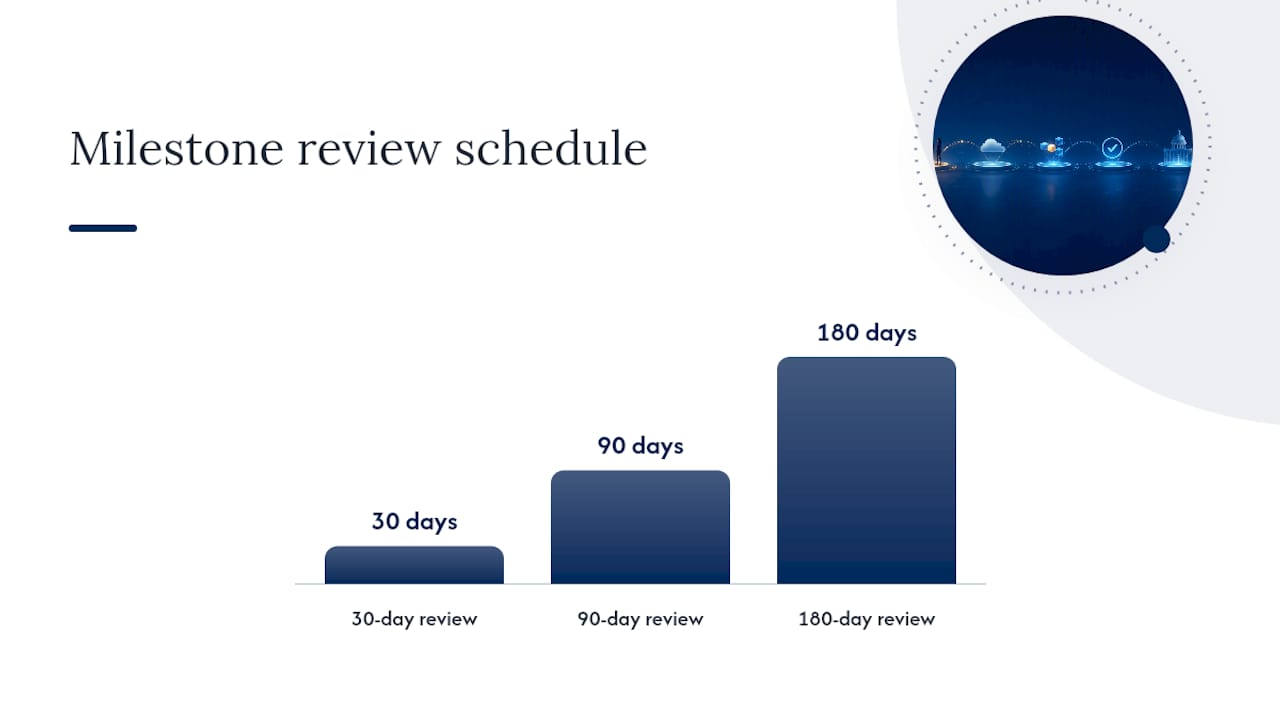
- Set milestone reviews at 30, 90, and 180 days to catch scope drift early.
Lift-and-shift suits a payroll system running fine on aging infrastructure. Rearchitecting fits a case management platform that needs modularity to support new legislative mandates every budget cycle. Choosing the wrong pattern for a workload is the single most expensive planning mistake agencies make, since it either wastes rearchitecting effort on a system nobody will touch again or locks a mission-critical service into legacy limitations. More on aligning acquisition timing to these patterns is covered in this cloud decision guide for government IT leaders.
How Do You Keep Cloud-Native Systems Compliant After Launch?
Passing an authorization once is the easy part. Staying authorized under continuous monitoring is where most public-sector programs lose momentum, because it demands operational habits, not a one-time project deliverable.
CI/CD pipelines need to produce compliance evidence as a byproduct of every deployment, security scan results, test coverage reports, and configuration baselines, rather than requiring a separate audit sprint. FedRAMP's guidance on automated enforcement of intended operational states makes this expectation explicit: drift from an approved baseline should trigger automated remediation, not a ticket that sits for weeks.
Telemetry and logging standards need to satisfy two audiences at once:
- CISA's visibility requirements, which expect data granular enough to support third-party threat analysis during an incident.
- Internal operations teams, who need the same data formatted for dashboards and alerting rather than raw log dumps.
Runbook discipline closes the gap that staffing turnover otherwise opens. A documented, tested runbook for common failure scenarios, service degradation, failed deployment rollback, credential compromise, means an agency does not lose institutional knowledge every time a contractor rotates off a program.
Pro Tip: Treat your runbooks as living documents tied to your CI/CD pipeline. If a deployment process changes, the runbook update should be part of the same pull request, not a separate task someone forgets six months later.
What Do Government Cloud-Native Case Studies Actually Show?
Peer-reviewed case studies of municipal and state modernization projects point to a consistent pattern: agencies that adopted microservices and Kubernetes in hybrid configurations reported measurable gains in deployment frequency and system resilience, but only after working through significant early friction around staffing skills and legacy data migration.
The most common failure modes repeat across these projects:
- Underestimating the platform engineering staff needed to run Kubernetes reliably, then blaming the technology when operations lag.
- Treating compliance documentation as a final-stage task instead of a pipeline output, which creates a scramble before every assessment.
- Migrating data before profiling its dependencies, which surfaces broken integrations mid-cutover instead of during planning.
Some firms working defined-scope modernization packages for state agencies have observed a version of this pattern across engagements: programs that scope a pilot narrowly and build compliance evidence collection into the pipeline from day one tend to reach continuous-monitoring stability faster than programs that treat security as a final gate.
The recurring lesson across public-sector modernization work is not technical. It is that agencies underestimate how much of the compliance burden can be automated away if the pipeline is designed for it from the start, rather than retrofitted after a system is already live.
What's the Checklist for Starting a Government Cloud-Native Pilot?
A pilot that stalls almost always skipped one of these steps, not a technology choice:
- Complete a system inventory covering every application, its dependencies, and its data sensitivity level.
- Draft the CONOPS and get sign-off from mission stakeholders, not just IT leadership.
- Profile applications against criticality, technical debt, and modernization difficulty.
- Select a bounded pilot with clear success metrics and a defined rollback plan.
- Choose FedRAMP-authorized services exclusively for anything touching regulated data.
- Engage a Third-Party Assessment Organization (3PAO) early, not after development is complete.
- Establish a telemetry baseline before migration so post-launch anomalies are detectable.
- Produce runbooks and a training plan before go-live, not after the first incident.
Procurement teams should expect to produce a Readiness Assessment Report (RAR), Security Assessment Plan and Report (SAP/SAR) artifacts, and a requirement traceability matrix tying each control back to its implementation evidence. A red flag worth escalating immediately: any pilot that reaches its 90-day review without a documented telemetry baseline. That gap almost always means the authorization package will be incomplete when it matters most. A fuller version of this checklist, mapped to federal compliance categories, is available in this government IT modernization checklist.
A Practitioner's Take on Cloud-Native Modernization Risk
The biggest risk in government cloud-native work is not technical debt. It is scope creep disguised as thoroughness, where a defined pilot quietly expands until nobody can say what "done" looks like. Staff augmentation models make this worse, because there is no clear owner accountable for a finished, working deliverable. A defined-scope engagement forces that accountability upfront: the work package has a boundary, an acceptance criterion, and an owner who is not walking away when the contract hours run out.
— Randy
How Rutledge & Associates Supports Government Cloud-Native Modernization
Some firms build their practice around owning defined scopes instead of staffing seats, which matters most exactly where this guide points: pilots that need a clear owner, a bounded deliverable, and compliance evidence built into the pipeline from day one. Such firms may work alongside prime contractors and state agencies on legacy modernization, DevSecOps pipeline builds, compliance automation, and real-time reporting dashboards, without the open-ended oversight burden of a staffing contract.
If your agency needs help translating the checklist above into an actual CONOPS, pilot statement of work, or FedRAMP-aligned architecture review, start with a readiness assessment to scope the first defined work package before your next budget cycle closes.
For agencies running Azure environments, tenant-level hardening is worth a separate look through partners like Tatem Web's Azure security services.
Sources
- Technical Reference Architecture (TRA) | CISA
- Cloud Native Architecture | FedRAMP
- Best business practices for U.S. government cloud adoption | GSA
- CISA TIC 3.0 Cloud use case
- Cloud-Native Architecture for Municipal Government (ACM)