

CJIS compliance means meeting every control and contractual requirement in the FBI CJIS Security Policy to protect Criminal Justice Information (CJI) throughout its full lifecycle. Compliance is not a one-time certification. It is an ongoing operational obligation enforced through audits, the Security Addendum, and state-level oversight. Three actions belong at the top of any organization's list: identify your role (Criminal Justice Agency, Noncriminal Justice Agency, Contractor, or CJIS Systems Agency); locate your state's CJIS Systems Officer contact; and inventory every system that creates, transmits, stores, or destroys CJI.
Start here:
- Identify your role. CJAs, NCJAs, contractors, and CSAs each carry different obligations under the policy.
- Locate your CSA and CSO. Your state's CJIS Systems Agency is the primary governance authority and audit coordinator.
- Inventory CJI-touching systems. Any system that creates, views, modifies, transmits, stores, or destroys CJI falls within scope.
Key Takeaways
CJIS compliance requires a signed Security Addendum, Priority 1 controls (MFA and FIPS-validated encryption) implemented and documented, and an evidence package assembled before the audit window opens.
| Point | Details |
|---|---|
| Security Addendum is mandatory | Every contractor must sign it before CJI access; failure can result in immediate suspension. |
| MFA and encryption come first | Auditors treat these as threshold requirements; missing either generates a significant finding. |
| Contractors own their own audit | A cloud provider's compliance posture does not cover contractor obligations; each entity must complete its own audit. |
| Documentation is the hidden workload | Build evidence collection into implementation, not after; pre-assembled packages close audits faster. |
| Primereadysub delivers defined outcomes | Engagement scopes include gap remediation, security program documentation, and audit evidence packages for agencies and contractors. |
Table of Contents
- What the CJIS Security Policy covers and where to find it
- The CJIS policy areas and which ones drive audit outcomes
- Who is responsible: roles, governance, and contractor duties
- Core technical and operational controls, with evidence examples
- Outsourcing rules, Security Addendum obligations, and what contracts must require
- How cloud providers fit into CJIS compliance and what their attestations actually cover
- What a CJIS audit looks like and the evidence checklist auditors use
- A prioritized roadmap to get audit-ready
- What practitioners consistently learn from real implementations
- Primereadysub delivers audit-ready compliance, not just documentation
- Sources
What the CJIS Security Policy covers and where to find it
The CJIS Security Policy v6.0, released in December 2024, is the governing document for all entities that access or manage CJI. Its legal basis flows from the FBI's authority as the national repository for criminal history records and from the Advisory Policy Board (APB), which sets policy direction. Controls in v6.0 are modernized and aligned with NIST SP 800-53 patterns, which means agencies already working within a NIST framework will find meaningful overlap.
The policy's goal is straightforward: protect CJI from unauthorized access, use, or disclosure at every stage, from initial collection through destruction. It applies to four primary categories of entities.
| Entity Type | Description |
|---|---|
| Criminal Justice Agency (CJA) | A government agency with law enforcement or criminal justice functions that directly accesses CJI |
| Noncriminal Justice Agency (NCJA) | A government agency without primary criminal justice functions that receives CJI for authorized purposes |
| CJIS Systems Agency (CSA) | The state-level authority responsible for policy enforcement, vendor oversight, and audit coordination |
| Contractor / Vendor | Any private entity that accesses, processes, or manages CJI on behalf of a CJA or NCJA |
The FBI CJIS resource center hosts the current policy PDF, appendices, the Security Addendum, and audit guidance. Download the policy and the Security Addendum before any compliance planning session. Those two documents define the floor for every obligation your organization will face.
The CJIS policy areas and which ones drive audit outcomes
The CJIS Security Policy v6.0 organizes controls into 19 Policy Areas. Each applies to any entity that touches CJI. Below is the canonical list with brief descriptions.
- Policy Area 1: Information Exchange Agreements — Governs the formal agreements required before CJI is shared between agencies or with contractors.
- Policy Area 2: Security Awareness Training — Requires documented training for all personnel with CJI access, with defined frequency.
- Policy Area 3: Incident Response — Mandates a documented plan for detecting, reporting, and recovering from security events involving CJI.
- Policy Area 4: Auditing and Accountability — Requires audit logging of CJI access and system events, with defined retention periods.
- Policy Area 5: Access Control — Covers user authentication, least privilege, role-based access, and multifactor authentication (MFA) requirements.
- Policy Area 6: Identification and Authentication — Specifies how users and systems prove identity before accessing CJI.
- Policy Area 7: Configuration Management — Requires baseline configurations, change control, and patch management for CJI-handling systems.
- Policy Area 8: Media Protection — Governs how CJI is stored, labeled, transported, and destroyed on physical and digital media.
- Policy Area 9: Physical Protection — Controls physical access to facilities and equipment that process or store CJI.
- Policy Area 10: Systems and Communications Protection — Covers network segmentation, encryption in transit, and boundary protection.
- Policy Area 11: Formal Audits — Defines the audit process, including CSA-conducted reviews and contractor audit obligations.
- Policy Area 12: Personnel Security — Requires background checks, fingerprinting, and security screening for personnel with CJI access.
- Policy Area 13: Mobile Devices — Addresses security controls for smartphones, tablets, and other mobile endpoints used to access CJI.
- Policy Area 14: Encryption — Specifies FIPS-validated encryption for CJI at rest and in transit.
- Policy Area 15: Advanced Authentication — Extends authentication requirements for remote access scenarios.
- Policy Area 16: Outsourcing Standards — Governs contractor and vendor access, the Security Addendum, and audit obligations for outsourced functions.
- Policy Area 17: Cloud Computing — Addresses shared-responsibility requirements, provider attestations, and configuration obligations for cloud-hosted CJI.
- Policy Area 18: Criminal Justice Information Protection — Covers dissemination limits, secondary dissemination rules, and data handling restrictions.
- Policy Area 19: Personally Identifiable Information — Governs PII protections that apply alongside CJI handling requirements.
Auditors consistently focus on Policy Areas 5, 6, 12, 14, and 16 because failures in those areas represent the highest risk of unauthorized CJI exposure. Access control gaps, missing MFA, incomplete background checks, unencrypted data, and unsigned or outdated Security Addenda are the most common findings.
Pro Tip: Implement MFA and FIPS-validated encryption first, document the configuration evidence immediately, and then work through the remaining policy areas. Auditors treat these two controls as threshold requirements; missing either one will generate a significant finding regardless of how well other areas are documented.
Who is responsible: roles, governance, and contractor duties
CJIS governance is a layered model. Each role carries specific obligations, and auditors expect to see evidence that those obligations are actively managed, not just acknowledged on paper.
| Role | Primary Responsibilities | Evidence Auditors Expect |
|---|---|---|
| CJIS Systems Agency (CSA) | State-level policy enforcement, vendor enrollment, audit coordination | Vendor lists, audit reports, training records |
| CJIS Systems Officer (CSO) | Day-to-day policy management within the CSA | Policy acknowledgment records, audit correspondence |
| Terminal Agency Coordinator (TAC) | Local agency liaison; manages user access and training compliance | User access logs, training completion records |
| Criminal Justice Agency (CJA) | Direct CJI access; primary compliance obligation | Security program documentation, audit responses |
| Noncriminal Justice Agency (NCJA) | Authorized CJI recipient; must meet same controls as CJA | Information Exchange Agreements, access logs |
| Contractor | CJI access under contract; must sign Security Addendum | Signed Addendum, background check records, training logs |
| Authorized Recipient Security Officer (ARSO) | Contractor-side security program owner; primary audit contact | Security program documentation, corrective action plans |
The Security Addendum is the contractual mechanism that binds contractors to the policy. It is not optional language. Failure to maintain a security program consistent with the Addendum can result in immediate suspension or termination of services. Every contractor must sign it before receiving CJI access, and the ARSO is responsible for maintaining the security program it requires.
State-level vendor enrollment programs, such as those operated by state CSAs, centralize fingerprinting submissions, vendor lists, and audit reporting. Vendors remain responsible for meeting policy requirements even when a state program handles administrative coordination.
Contractor-specific obligations auditors will verify:
- Completed fingerprint-based background checks for all personnel with CJI access
- Signed Security Addendum on file with the contracting agency
- Documented security awareness training for all CJI-access personnel
- An active, written security program maintained by the ARSO
- Audit cooperation, including timely response to audit requests and corrective action plans
Core technical and operational controls, with evidence examples
Converting policy language into audit artifacts is where most organizations lose time. The table below maps each major control family to the concrete evidence auditors accept.
| Control Family | Key Requirements | Acceptable Evidence |
|---|---|---|
| Access Control / MFA | Role-based access, least privilege, MFA for all CJI access | IAM configuration screenshots, MFA enrollment reports |
| Encryption (Transit) | FIPS 140-2 validated modules for data in motion | TLS configuration exports, cipher suite documentation |
| Encryption (At Rest) | FIPS-validated encryption for stored CJI | Storage encryption policy, key management documentation |
| Audit Logging | Timestamped logs of CJI access, modification, and deletion | Log retention policy, sample log exports, SIEM reports |
| Patch / Vulnerability Management | Timely patching per defined SLAs, vulnerability scan results | Patch management policy, scan reports with remediation dates |
| Personnel Security | Background checks, fingerprinting, security screening | Fingerprint submission receipts, background check attestations |
| Security Awareness Training | Annual training for all CJI-access personnel | Training completion records, course completion certificates |
| Incident Response | Documented IR plan, tested procedures, reporting timelines | IR plan document, tabletop exercise records, incident logs |
| Physical Access Controls | Controlled access to CJI-processing areas | Badge access logs, visitor logs, facility diagrams |
| Media Protection | Secure disposal of CJI-bearing media | Media destruction certificates, sanitization logs |
Priority control: MFA is treated as a threshold requirement by CJIS auditors. Systems that allow CJI access without MFA will generate a significant finding regardless of the strength of other controls. Implement and document MFA enrollment before the audit window opens.
Agencies should also map their existing controls to NIST SP 800-53 control families. Because CJIS Security Policy v6.0 aligns with NIST patterns, organizations with an existing NIST-based security program can often reuse control documentation with targeted gap-filling rather than building from scratch. For a structured approach to this mapping, the IT compliance checklist for public sector provides a stepwise framework aligned with federal control families.
Outsourcing rules, Security Addendum obligations, and what contracts must require
The Outsourcing Standard for Non-Channeling requires a written outsourcing agreement that incorporates both the CJIS Security Policy and the Outsourcing Standard itself. The Authorized Recipient (typically the CJA or NCJA) retains audit responsibility for the contractor and cannot transfer that responsibility by contract.
Before granting a contractor access to Criminal History Record Information (CHRI), the contracting agency should verify each of the following:
- Written outsourcing agreement executed and on file, incorporating CJISSECPOL and the Outsourcing Standard
- Signed Security Addendum from the contractor, with ARSO designated
- Fingerprint-based background checks completed for all contractor personnel with CJI access
- Security awareness training documented for all CJI-access personnel
- Contractor's written security program reviewed and accepted
- Physical access controls at contractor facilities verified (if CJI is processed on-site)
- Dissemination limits defined in the agreement (no secondary dissemination without authorization)
- Audit rights explicitly reserved in the contract, including the right to conduct or commission audits
- Incident reporting obligations defined, with timelines aligned to the CJIS Security Policy
Sample contract clauses auditors look for include explicit language on audit cooperation, corrective action timelines, and termination for noncompliance. Auditors also ask whether the agency has a current vendor list, whether each vendor's Security Addendum is dated within the current contract period, and whether background check records are current. Contractors who assume that the agency's compliance posture covers their own obligations consistently fail audits. The Outsourcing Information Packet documents the specific audit workflow and timelines that state CSAs apply.
For guidance on structuring vendor agreements and compliance deliverables within prime-subcontractor relationships, the guide to IT modernization partnerships covers how to build compliance obligations into statement-of-work language.
How cloud providers fit into CJIS compliance and what their attestations actually cover
A cloud provider's compliance posture does not automatically make a contractor compliant. This is the most consequential misunderstanding in CJIS cloud compliance. What a provider can attest to and what remains the contractor's responsibility are distinct, and auditors treat them separately.
What a cloud provider can typically attest to:
- Physical security of data center facilities
- Hypervisor and infrastructure-level controls
- FIPS 140-2 validated cryptographic modules at the platform level
- Network boundary controls and DDoS protections
- SOC 2 Type II audit results for infrastructure operations
What remains with the agency or contractor:
- Application-level access controls and MFA configuration
- Encryption key management (KMS configuration, key rotation, access policies)
- User provisioning and deprovisioning workflows
- Audit log retention configuration and SIEM integration
- Personnel vetting and training for all users with CJI access
- Incident response procedures and reporting timelines
- Configuration of FIPS-compliant endpoints within the provider's environment
When evaluating a cloud or third-party vendor for a CJIS-compliant deployment, request the following before signing any agreement:
- Architecture diagrams showing CJI data flows and boundary controls
- Evidence of FIPS 140-2 validated cryptographic modules in use
- KMS configuration documentation and key rotation policies
- Audit log retention policies and SIEM integration options
- Incident response SLAs, including notification timelines
- SOC 2 Type II report or equivalent attestation
- Documentation of remote access controls and privileged access management
There is no single "CJIS certification" that a vendor can hold. Compliance is assessed through agency audits and the Security Addendum, not a universal vendor certificate. A vendor claiming to be "CJIS certified" as a standalone credential is using marketing language, not a recognized compliance status.
Pro Tip: Request architecture diagrams and control evidence before contract execution, not after. Vendors who cannot produce a current SOC 2 Type II report and a clear explanation of their shared-responsibility boundary are not ready for a CJIS-compliant deployment. GRC platforms that automate control evidence collection, such as those offered through Sentrix's Trust Center, can help contractors maintain continuous attestation documentation rather than scrambling at audit time.
What a CJIS audit looks like and the evidence checklist auditors use
The audit lifecycle follows a defined sequence. Understanding the timeline prevents the most common failure mode: running out of time to gather documentation.
Typical audit timeline:
- Audit assignment. The CSA or designated auditor notifies the contractor or agency of an upcoming audit.
- Initial completion window. Contractors typically have 30 days to complete the audit using the CJIS Audit system or equivalent state process.
- Reviewer actions. The auditor reviews submitted documentation, flags deficiencies, and issues a preliminary findings report.
- Corrective action window. Contractors with non-compliant findings typically have 30 days to submit a corrective action plan (CAP) with remediation evidence.
- Final review. The auditor reviews the CAP and closes findings or escalates unresolved issues to the CSA.
- Audit closure or escalation. Closed audits are filed; unresolved findings may result in suspension of CJI access.
Evidence auditors commonly request:
- Signed Security Addendum, current and on file with the contracting agency
- Background check records and fingerprint submission receipts for all CJI-access personnel
- Security awareness training completion records (dated within the required training cycle)
- MFA configuration evidence (screenshots, enrollment reports, policy documentation)
- Encryption configuration documentation (FIPS module validation, key management policy)
- Audit log samples showing CJI access events with timestamps and user identifiers
- Incident response plan and evidence of testing (tabletop exercise records or after-action reports)
- Physical access control records (badge logs, visitor logs, facility access diagrams)
- Patch management records and vulnerability scan results with remediation dates
- Written outsourcing agreement incorporating CJISSECPOL and the Outsourcing Standard
- Media destruction certificates for any CJI-bearing media disposed of during the audit period
- Network diagrams showing CJI data flows and boundary controls
The sample audit checklist published for outsourcing standards shows the exact questions auditors ask about background checks, physical security, CHRI handling, and contractual clauses. Reviewing it before your audit window opens is one of the highest-value preparation steps available.
Common pitfalls that generate findings:
- Missing or expired Security Addendum
- Background checks not completed for all personnel with CJI access (stale fingerprints are a frequent issue)
- No documented evidence of MFA enrollment
- Encryption in use but not FIPS-validated
- Incomplete or unsigned outsourcing agreement
- Audit logs not retained for the required period
- Incident response plan exists but has never been tested
A prioritized roadmap to get audit-ready
Getting audit-ready is a project, not a policy review. The steps below follow a logical sequence from scope definition through sustainment.
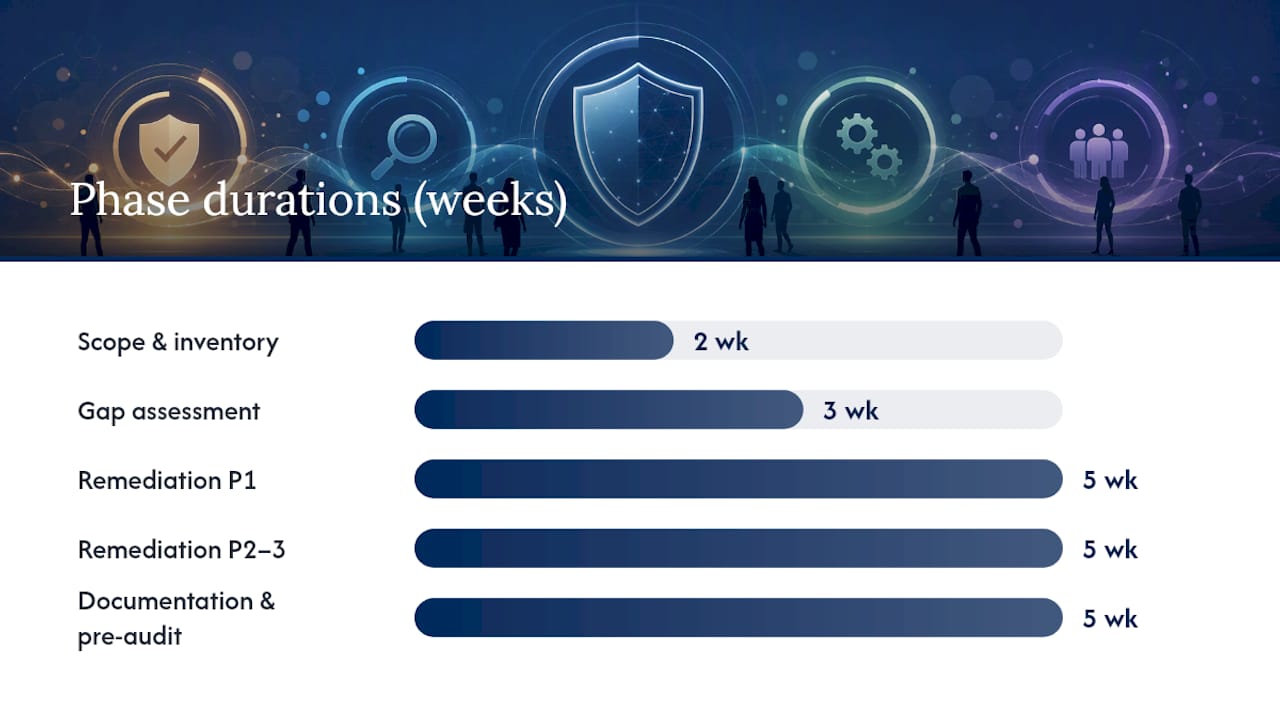
Phase 1: Scope and inventory (Weeks 1–2)
Define which systems, personnel, and locations touch CJI. Map data flows from ingestion through destruction. Assign roles (CJA, NCJA, Contractor, ARSO) to every entity in scope. Identify your CSA contact and request the current outsourcing audit checklist.
Phase 2: Gap assessment (Weeks 2–4)
Compare current controls against the 19 Policy Areas. Prioritize gaps by audit impact: MFA, encryption, background checks, and Security Addendum status are Priority 1. Logging, incident response, and physical controls are Priority 2. Configuration management, media protection, and training documentation are Priority 3.
Phase 3: Remediation (Weeks 4–12)
Implement Priority 1 controls first. Document evidence as each control is implemented, not after. Execute or update the Security Addendum. Complete background checks for any personnel not yet vetted. Configure audit logging with defined retention periods.

Phase 4: Documentation and pre-audit review (Weeks 10–14)
Assemble the evidence package using the audit checklist as the organizing framework. Conduct an internal walkthrough against the checklist. Identify any remaining gaps and address them before the audit window opens.

Phase 5: Sustainment
Assign ongoing ownership for each control family. Schedule annual training, periodic log reviews, and background check renewals. Monitor CJIS Security Policy updates and adjust controls when new versions are released.
| Phase | Owner | Timeline | Key Deliverable |
|---|---|---|---|
| Scope and inventory | ARSO / IT Lead | Weeks 1–2 | CJI system inventory, role assignments |
| Gap assessment | ARSO / Security Lead | Weeks 2–4 | Prioritized gap list |
| Remediation (Priority 1) | IT / Security Team | Weeks 4–8 | MFA, encryption, background checks complete |
| Remediation (Priority 2–3) | IT / Security Team | Weeks 8–12 | Logging, IR plan, training records |
| Documentation and pre-audit | ARSO / Compliance Lead | Weeks 10–14 | Evidence package assembled |
| Audit submission | ARSO | Week 14+ | Audit completed within 30-day window |
| Sustainment | ARSO / IT Lead | Ongoing | Annual training, log reviews, policy updates |
For a structured federal compliance framework that maps to this roadmap, the government IT checklist provides actionable items aligned with federal control families and audit evidence needs.
What practitioners consistently learn from real implementations
The timeline estimates that appear in policy documents and vendor marketing rarely match what agencies and contractors actually experience. The inventory phase alone tends to run longer than planned, particularly when legacy systems are involved and CJI flows are not formally documented. Organizations that have mapped their data flows in advance consistently move through gap assessment faster.
Background checks are the most common schedule risk. Fingerprint-based checks require coordination with the CSA and can take several weeks depending on state processing volumes. Starting this process in parallel with the gap assessment, rather than after it, typically saves two to four weeks.
Documentation effort is consistently underestimated. Implementing a control takes a fraction of the time that gathering, organizing, and formatting the evidence for an auditor takes. Teams that build evidence collection into their implementation workflow, capturing screenshots and policy excerpts as controls go live, arrive at the audit window with a complete package rather than a scramble.
Two factors consistently accelerate audit closure: clear owner assignments for each control family (so auditors always have a named point of contact for each finding), and automated logging that produces timestamped, exportable records without manual intervention. Auditors close findings faster when evidence is organized, labeled, and directly responsive to the checklist question.
Cost estimates vary significantly by organization size and starting posture. A contractor with an existing NIST-based security program may need primarily documentation and gap-filling work. An organization starting from a minimal security baseline will need technology investment (MFA, SIEM, encryption tooling), personnel time for background checks and training, and potentially external support for security program documentation. Audit fees, training costs, and technology investments should all be budgeted before the engagement begins.
Primereadysub delivers audit-ready compliance, not just documentation
For agencies and contractors who need to close compliance gaps quickly and with defined outcomes, Primereadysub offers a concrete alternative to open-ended consulting engagements. As an SDVOSB, woman-owned, SBA-certified government IT modernization firm, Primereadysub takes ownership of defined work packages: compliance automation, security program documentation, gap remediation, and audit evidence preparation. The result is a complete, auditor-ready evidence package, not a stack of recommendations to implement yourself.
Typical engagement scopes include CJI system inventory and data flow mapping, Security Addendum execution support, MFA and encryption configuration documentation, automated audit logging setup, and pre-audit evidence package assembly. Agencies in Maryland, New York, and Florida have used this model to reduce time to audit readiness without adding internal headcount.
To discuss a defined-scope engagement for your CJIS compliance program, contact Primereadysub for a project inquiry.
Sources
The documents below are the governing references for any CJIS compliance program. Download the Security Addendum and your state's outsourcing audit checklist before any other planning step.
- Criminal Justice Information Services (CJIS)
- Le
- Outsourcing Standard for Non-Channeling_20241107
- Nigc
This article provides general informational guidance on CJIS compliance requirements. Confirm current policy requirements with your state CJIS Systems Agency and qualified legal or security counsel before making compliance decisions.
This article is general information, not a substitute for advice from a qualified lawyer. Consult a qualified legal professional about your own circumstances before acting on anything here.