

The best government compliance software is not a product you install and configure once. It is an automation-first, Compliance-as-Code platform delivered as a procurement-ready, defined-scope engagement that continuously generates auditable evidence mapped to NIST SP 800-53, FedRAMP baselines, DISA STIG, and CMMC. The platform must run in FedRAMP-authorized GovCloud or air-gapped environments, produce machine-readable OSCAL/SSP/SAR/POA&M artifacts at build time, and be available under a fixed-price statement of work with acceptance criteria tied to authorization milestones.
The credibility anchor for this claim: automated STIG remediation at a U.S. government energy-sector agency lifted system-wide compliance from 30% to 98%. That is not a marginal gain. It is the difference between a program that passes an audit and one that does not.
Quick pre-qualification checklist for procurement teams:
- Require written proof of FedRAMP authorization or GovCloud/air-gapped deployment capability
- Request sample OSCAL/SSP exports from a comparable system in scope
- Ask for a SOW template with acceptance criteria tied to specific control families
- Demand a short proof-of-concept (POC) before awarding a larger engagement
- Confirm SBOM generation in formats compliant with Executive Order 14028
Table of Contents
- What is the best government compliance software approach right now?
- Which capabilities define the best regulatory software for federal use?
- How should you buy government compliance solutions?
- What does a realistic compliance automation rollout look like?
- How Primereadysub delivers outcome-owned compliance automation
- Key Takeaways
- The procurement posture most agencies get wrong
- Ready to move from manual evidence to automated authorization?
- Useful sources for procurement and technical validation
What is the best government compliance software approach right now?
Manual, checklist-driven compliance is the primary barrier to scaling modern IT delivery in the federal space. Federal IT experts identify static, spreadsheet-driven processes as what keeps agencies stuck: engineering teams spend significant hours each month assembling evidence by hand, and artifact bottlenecks routinely cause multi-month program delays. Automation replaces that manual assembly with evidence generated as a continuous byproduct of the CI/CD pipeline.
The regulatory environment has accelerated this shift. FedRAMP now emphasizes continuous monitoring over annual snapshots. EO 14028 requires SBOM generation and software supply-chain attestations. CMMC third-party certification has evolved to require ongoing evidence rather than point-in-time reviews. Periodic, manual evidence collection cannot satisfy these requirements at scale.
The Authorization to Operate bottleneck is a direct consequence of fragmented, manual processes. Cybersecurity practitioners identify the fix as collaborative, automated evidence generation integrated into DevSecOps, not faster checklist completion. When evidence is a side effect of every build, the ATO package assembles itself.

Pro Tip: Before enabling broad automation, remediate foundational issues first. Applying automation to unpatched or misconfigured systems propagates vulnerabilities rather than containing them. Patch, harden baselines, and enforce password policies before instrumenting your pipeline.
Which capabilities define the best regulatory software for federal use?
The best tool demonstrably produces continuous, auditable evidence mapped to federal frameworks and operates inside government hosting constraints. Use the checklist below inside your RFI/RFP or pre-award vendor scorecard.
Must-have capabilities:
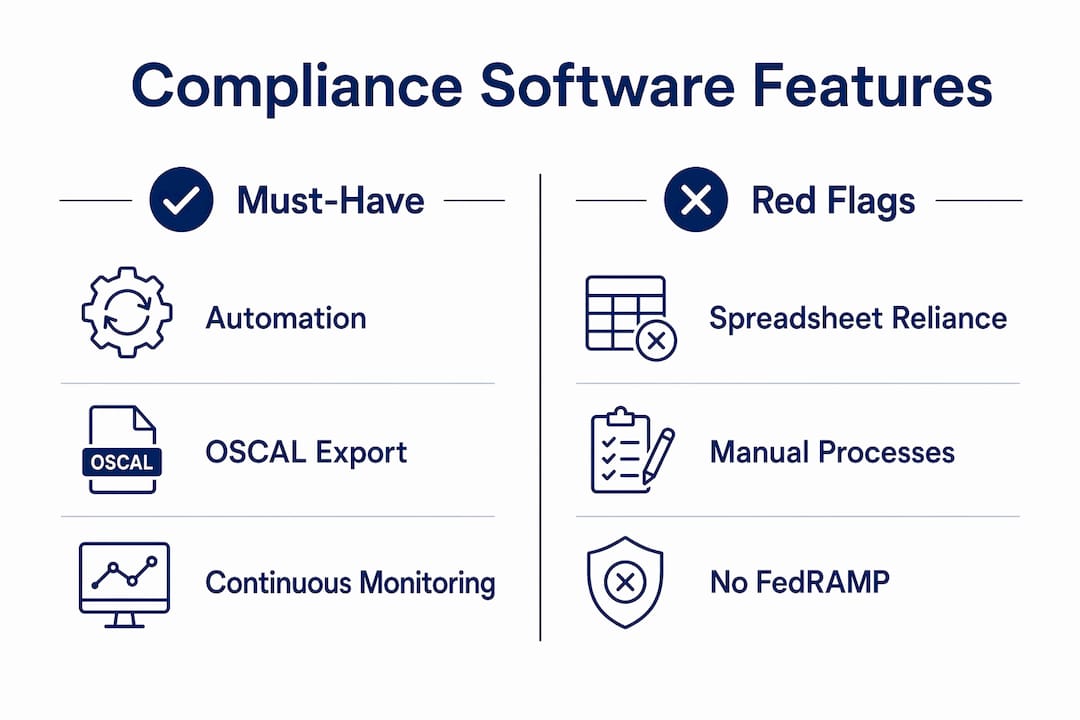
- Federal framework mapping: NIST SP 800-53 Rev 5 control coverage, FedRAMP Low/Moderate/High baselines, DISA STIG profiles, and CMMC mapping
- Evidence generation and format: OSCAL-compatible exports, automated SSP/SAR/POA&M updates, SBOM generation in EO 14028 formats
- Deployment and hosting: FedRAMP-authorized GovCloud or VPC deployment, self-hosted air-gapped options, no external data exfiltration
- Pipeline integration: CI/CD instrumentation, Policy as Code via Open Policy Agent or Chef InSpec, guardrails in pull requests, automated remediation hooks
- Identity, logging, and attribution: centralized IAM support, SIEM integration, immutable timestamps on all evidence artifacts
- Procurement fit: template SOW language for outcome ownership, fixed-price defined-scope pricing, SLAs tied to authorization milestones
Nice-to-have capabilities:
- Pre-built control inheritance libraries for common cloud services
- Executive dashboards with real-time compliance posture by control family
- AI-assisted gap analysis and remediation prioritization
Compliance as Code translates regulatory requirements into machine-readable, executable statements so compliance becomes repeatable and continuously enforceable inside the development lifecycle, not a separate audit exercise.
| Capability | Must-Have | Red Flag if Absent |
|---|---|---|
| OSCAL/SSP artifact export | Yes | Vendor relies on spreadsheets for evidence |
| GovCloud or air-gap deployment | Yes | Commercial SaaS only, no self-hosted option |
| CI/CD pipeline integration | Yes | Evidence collected manually post-build |
| NIST 800-53 / FedRAMP mapping | Yes | Generic compliance framework, no federal specifics |
| SBOM generation (EO 14028) | Yes | No supply-chain attestation capability |
| Fixed-price defined-scope SOW | Yes | Time-and-materials only, no outcome ownership |
How should you buy government compliance solutions?
Buy defined outcomes, not time-and-materials spreadsheets. The SOW must require delivery of machine-readable evidence and include acceptance criteria tied to ATO milestones, not hours logged. This is the single most important procurement posture shift for government IT contracting.
SOW elements to demand in every engagement:
- Explicit deliverables: OSCAL SSP/SAR, automated POA&M updates, remediation playbooks
- Acceptance criteria: evidence produced by CI/CD with immutable timestamps, not manual uploads
- Migration and rollback plans with defined responsibility boundaries
- Security responsibilities matrix aligned to the shared responsibility model
Pricing models carry real tradeoffs. Fixed-price defined-scope engagements work best when the control families and system boundaries are clear, because outcome ownership is unambiguous. Subscription or SaaS licensing works better for ongoing continuous monitoring across large, multi-system portfolios where the scope evolves. Most federal programs benefit from a fixed-price pilot followed by a subscription-based steady-state arrangement.
For evaluation, require FedRAMP proof, GovCloud deployment documentation, sample OSCAL exports, at least one case study metric, and a short POC. Common FAR considerations include data rights clauses, supply-chain requirements under EO 14028, and performance milestones aligned to authorization gates. A well-designed proposal compliance process surfaces these requirements before award, not after.
Pro Tip: Require a short POC scoped to a single control family, such as AC (Access Control), CM (Configuration Management), or SI (System and Information Integrity), as a procurement sink test. A vendor that cannot produce machine-readable artifacts for one control family in a POC will not produce them for a full system under contract.
What does a realistic compliance automation rollout look like?
A well-scoped, defined engagement can move from contract award to a first authorization-ready capability in measurable phases.
- Discovery (weeks 1–4): Inventory systems, map existing controls to NIST/FedRAMP baselines, identify gaps and technical debt
- Pilot/POC (weeks 5–10): Instrument a single control family in CI/CD, produce first OSCAL artifacts, validate evidence format with the authorizing official
- Pipeline integration (weeks 11–18): Extend instrumentation across remaining control families, configure automated remediation hooks, integrate SIEM
- Remediation automation (weeks 19–26): Deploy remediation playbooks, automate POA&M updates, establish evidence coverage baselines
- Full rollout (weeks 27–40): Scale to full system boundary, onboard additional systems, establish continuous monitoring cadence
- Steady state (ongoing): Continuous evidence generation, monthly compliance posture reviews, annual assessment support
Automation-first approaches report ATO cycle reductions of approximately 40–60% and audit-effort reductions of approximately 25–35% for federal portfolios. For a medium-sized portfolio, those reductions translate to meaningful savings annually.
| Metric | Typical Baseline | Target After Automation |
|---|---|---|
| Time to ATO | Extended | Shortened |
| Controls automatically evidenced | Low percentage | High percentage |
| Mean time to remediation | Longer duration | Shorter duration |
| Engineer-hours on evidence/month | High (manual) | Reduced significantly |
Do not automate on top of unmanaged technical debt. Foundational hygiene, patching, baseline hardening, and access control remediation, must come first.
How Primereadysub delivers outcome-owned compliance automation
Rutledge & Associates, the firm behind Primereadysub, delivers outcome-owned, defined-scope engagements that instrument CI/CD pipelines to generate authorization-ready evidence, shorten ATO timelines, and accept delivery based on measurable success criteria. The firm is certified SDVOSB, woman-owned, and SBA-certified, and operates primarily on public-sector contracts in Maryland, New York, and Florida.
The delivery model follows a structured sequence: discovery and policy mapping, pilot against a defined control family, pipeline instrumentation and evidence automation, remediation playbooks, handover with runbook, and optional managed support in GovCloud or air-gapped environments. Every engagement produces OSCAL/SSP outputs, automated POA&M updates, and real-time compliance dashboards as contractual deliverables, not optional add-ons.
The documented case study outcome: automated STIG remediation produced a substantial compliance improvement at a U.S. government energy-sector agency. Primereadysub structures engagements to replicate that trajectory by treating evidence generation as a pipeline output rather than a manual task.
| Engagement Phase | Deliverable | Acceptance Criterion |
|---|---|---|
| Discovery | Policy gap report, system boundary map | Signed off by program owner |
| Pilot | OSCAL SSP for one control family | Machine-readable artifact validated by AO |
| Integration | Full pipeline instrumentation | Evidence produced at every build |
| Remediation | Automated POA&M updates | POA&M current with automated updates |
| Handover | Runbook, training, dashboard | Team operates independently |
Trust signals to request from any vendor, including Primereadysub: SDVOSB and SBA certifications, SOW examples with defined acceptance criteria, sample OSCAL/SSP artifacts from a comparable system, and references from public-sector programs. Legacy system integration is handled through API adapters and configuration management tooling compatible with common government infrastructure stacks.
Key Takeaways
Automation-first, FedRAMP/GovCloud-capable, outcome-owned engagements that produce machine-readable OSCAL evidence are the defining standard for government compliance software in 2026.
| Point | Details |
|---|---|
| Automation over checklists | Compliance evidence must be generated by CI/CD pipelines, not assembled manually after the fact. |
| GovCloud/air-gap is mandatory | Any tool that cannot operate in FedRAMP-authorized or air-gapped environments is disqualified for most federal work. |
| ATO cycle reduction | Automation-first approaches reduce ATO cycles and audit effort substantially. |
| Fixed-price SOW with milestones | Require acceptance criteria tied to ATO milestones and machine-readable artifact delivery, not hours billed. |
| Primereadysub delivery model | Rutledge & Associates delivers defined-scope, outcome-owned compliance automation with OSCAL/SSP outputs and a documented 30%–98% STIG improvement trajectory. |
The procurement posture most agencies get wrong
The most common mistake in evaluating government policy management software is treating compliance tooling as a software procurement rather than an outcome procurement. Agencies issue RFPs for platforms, receive demos of dashboards, and award contracts based on feature lists. Then, eighteen months later, the ATO package is still assembled by hand because no one specified that evidence had to be machine-readable and produced at build time.
The correct posture is to buy a defined outcome: a system that generates OSCAL-compatible artifacts automatically, with acceptance criteria the authorizing official can validate before final payment. That framing changes the evaluation entirely. A vendor who cannot demonstrate OSCAL output in a POC is not a viable candidate, regardless of how polished the dashboard looks.
Organizational readiness matters as much as tooling. Automated compliance is sustainable only when engineering teams own the pipeline, governance structures assign clear control ownership, and training covers both the tooling and the regulatory intent behind each control family. Without that foundation, even the best platform becomes shelfware within a year.
Ready to move from manual evidence to automated authorization?
Primereadysub, the public-sector brand of Rutledge & Associates, LLC, delivers fixed-price, defined-scope compliance automation engagements built specifically for government agencies and prime contractors. The engagement starts with a scoped discovery, moves through a single-control-family POC that produces validated OSCAL artifacts, and scales to full pipeline instrumentation with automated POA&M updates and real-time dashboards. Every deliverable carries a defined acceptance criterion tied to authorization milestones, not hours billed.
For primes managing compliance-heavy subcontracts, Primereadysub operates as a high-value automation partner with low oversight requirements. Deployments are available in FedRAMP-authorized GovCloud, self-hosted air-gapped environments, or hybrid configurations.
Request a procurement-ready SOW template or schedule a scoping call at primereadysub.com.
Useful sources for procurement and technical validation
These references back the claims in this guide and are useful starting points for RFI design, vendor evaluation, and technical due diligence.
- NIST SP 800-53A Rev 5: Assessment procedures for security and privacy controls; the authoritative framework for control evaluation methodology
- NIST Risk Management Framework: The seven-step RMF process linking FISMA requirements to control implementation and continuous monitoring
- FedRAMP Marketplace: Searchable database of FedRAMP-authorized cloud services; use to verify vendor authorization status before award
- FISMA 2014 (CISA): Statutory basis for federal information security requirements and DHS oversight authority
- OMB M-25-04: FY 2025 FISMA guidance covering EO 14028 supply-chain attestations and machine-readable reporting requirements
- Puppet case study: U.S. government energy agency: Documents the 30%–98% STIG compliance improvement from automated remediation
- FedScoop: automation and federal IT compliance: Analysis of ATO cycle reductions and the three-pillar automation/analytics/AI modernization model
- Earthly: shipping software to the U.S. government: Practical breakdown of compliance costs, artifact bottlenecks, and FedRAMP continuous monitoring requirements
- StateTech: Compliance as Code: Explains how Policy as Code transforms static requirements into executable, continuously enforceable controls
- U.S. Cybersecurity Magazine: the ATO bottleneck: Practitioner analysis of systemic ATO delays and the case for automated, collaborative evidence generation
What to request from vendors during evaluation: a sample OSCAL/SSP export from a system of comparable size, FedRAMP authorization documentation or a GovCloud deployment architecture diagram, and a written acceptance test tied to at least one control family from a prior engagement.