

Audit readiness automation means your systems produce audit-grade evidence as work happens, not as a scramble before audit week. The correct next step is not a platform purchase. It is a single pilot: pick one high-impact control, automate its evidence trail, and bring assessors in from day one, aligned with NIST and IIA guidance.
TL;DR:
- Automate evidence collection starting with high-frequency, high-impact controls like identity management and transaction testing to maximize early benefits.
- Use event-driven capture and scheduled pulls to ensure evidence is current, traceable, and aligns with audit standards, reducing manual effort.
- Involve assessors and control owners early in pilot phases to achieve evidence formats that meet compliance requirements and foster trust.
- Prioritize controls that are tested often and high risk, avoiding low-value automation for controls with infrequent or low-severity testing.
- Establish clear evidence lineage, robust change management, and appropriate retention policies to maintain audit trail integrity and compliance.
Table of Contents
- What Does Audit Readiness Automation Actually Mean?
- Why Should You Shift From Point-in-Time Audits to Continuous Readiness?
- Core Automation Components and Integrations to Prioritize
- How Should You Roll Out an Audit Readiness Automation Program?
- What Are the Common Pitfalls in Audit Readiness Automation?
- Which Metrics Prove Audit Readiness Automation Is Working?
- How Rutledge & Associates Implements Audit Readiness Automation for Defined-Scope Government Engagements
- How Do You Manage Change and Stakeholder Engagement?
- Which Security and Compliance Standards Matter for Audit Readiness Automation?
- What Are Best Practices for Audit Data Retention and Archival?
- What Role Does Machine Learning Play Beyond Basic Automation?
- What Integration Challenges Come Up in Complex IT Environments?
- How Should You Assess and Prioritize Compliance Risk Before Automating?
- Three Pragmatic Rules for Starting Audit Readiness Automation
- Ready to Pilot Audit Readiness Automation on Your Program?
- Sources
What Does Audit Readiness Automation Actually Mean?
Audit readiness automation is the practice of configuring systems to generate, timestamp, and store evidence continuously, so that "being audit ready" stops being a project and becomes a byproduct of normal operations. That distinction separates it from simple task automation, which just speeds up a manual step without changing when or how evidence gets created.
In a point-in-time model, evidence gets assembled retroactively. Someone screenshots an access list two weeks before the auditor arrives, hoping it still reflects reality. In continuous readiness, the access review runs on a schedule, the results land in a controlled repository automatically, and the evidence already exists when the request comes in.
The IIA's guidance on continuous auditing recommends ongoing control assessment specifically because it supports earlier detection of control failures and feeds better audit-plan decisions. NIST SP 800-53A reinforces this by tying technical control assessment methods directly to continuous monitoring, not annual snapshots.
The operating-model shift comes down to three things:
- Evidence is captured at the moment the control executes, not reconstructed afterward.
- Coverage moves from sampling toward full-population checks on systems where automation makes that feasible.
- Auditors gain standing access to a live evidence trail instead of a curated packet built for their visit.
Why Should You Shift From Point-in-Time Audits to Continuous Readiness?
The financial case starts with hours. Teams that automate evidence collection routinely cut the weeks of manual prep that traditionally precede an external audit, because the artifacts auditors request already exist in a controlled location instead of needing to be hunted down across departments.
Risk reduction follows a similar logic. When a control drifts out of compliance, continuous monitoring flags it in near real time rather than during the next scheduled review, which can be months later. PwC's research on continuous audit monitoring points to a structural advantage here: continuous monitoring enables full data coverage instead of the periodic sampling that traditional audits rely on, which materially improves how fast anomalies get caught.
Operationally, the gains show up in less duplicated work:
- One control library instead of separate spreadsheets per framework (SOC 2, ISO 27001, internal audit).
- Fewer repeated evidence requests when the same control satisfies multiple compliance obligations.
- Faster remediation cycles because owners see drift before it becomes a finding.
Core Automation Components and Integrations to Prioritize
Not every system deserves automation attention on day one. Prioritize the integrations that touch the highest volume of recurring evidence requests first.
- Identity providers (Okta, Azure AD, or similar) to automate access reviews and deprovisioning evidence.
- ERP and financial systems to automate transaction testing and segregation-of-duties checks.
- CI/CD pipelines to capture deployment approvals, code review sign-offs, and change tickets automatically.
- Ticketing and ITSM platforms (ServiceNow, Jira) to link remediation activity back to the control that triggered it.
- Vulnerability and patch management tools to feed configuration baseline evidence without manual export.
- Cloud platform logs (AWS CloudTrail, Azure Monitor) to produce immutable timestamps for infrastructure changes.
Within those systems, four control families tend to return the fastest audit-readiness payoff: transaction testing, access reviews, configuration baselines, and backup verification. Each one is high-frequency, high-recurrence, and painful to document manually, which is exactly why automating it first frees up the most analyst time.
Three patterns cover most of the technical implementation:
- Scheduled pulls, where a job runs weekly or monthly and exports evidence into a controlled store.
- Event-driven capture, where a control action (a deployment, a permission change) automatically triggers evidence generation.
- Immutable audit logs with data lineage, so an assessor can trace any piece of evidence back to its source system and confirm it hasn't been altered.
Pro Tip: Start with event-driven capture on your CI/CD pipeline before touching anything else. Deployment approvals are one of the easiest evidence types to automate because the trigger (a merge or a release) is already logged by the tool itself.
How Should You Roll Out an Audit Readiness Automation Program?
A phased rollout beats a big-bang platform deployment almost every time, and practitioner guidance on moving from periodical to continuous audit readiness backs a multi-year, staged approach over a single sweeping rollout.
- Phase 0: Maturity assessment and audit universe inventory. Map every control currently tested manually, how often, and by whom. This usually takes two to four weeks and reveals which controls are duplicated across frameworks.
- Phase 1: Pilot one high-impact control (3 to 4 months). Choose a control with high testing frequency and clear technical owners. Build the integration, involve your assessor in defining what "acceptable evidence" looks like, and run the pilot alongside the existing manual process before cutting over.
- Phase 2: Expand to adjacent controls. Once the pilot proves out, extend the same integration pattern to related controls, and wire remediation workflows with defined owner SLAs so drift gets fixed on a schedule instead of drifting further.
- Phase 3: Enterprise continuous monitoring. Stand up dashboards that track coverage and drift across the full control library, and shift governance conversations from "are we ready for the audit" to "what does the dashboard show this week."
This sequence matters because a pilot that skips assessor involvement tends to produce evidence formats the assessor won't accept later, forcing a rebuild during Phase 2.
What Are the Common Pitfalls in Audit Readiness Automation?
Automation cannot replace judgment. Risk acceptance decisions, board-level oversight, and the interpretation of ambiguous control results still require a human who can be held accountable for that call.
The most common failure modes tend to repeat across programs:
- Poor evidence lineage. Data gets pulled into a dashboard with no traceable path back to the source system, so an assessor can't verify it.
- Disconnected control owners. The automation runs, but nobody who understands the business context is watching the output.
- Assessor exclusion. Teams build the pipeline in isolation, then discover during the actual audit that the evidence format doesn't satisfy assessor requirements.
- AI-generated evidence. Using a language model to draft or fabricate evidence text rather than capture what a system actually did.
On that last point, Paramify's analysis of AI compliance automation is direct: AI is genuinely useful for discovery, mapping controls to requirements, and drafting reports, but it must never generate the evidence itself. Deterministic, system-produced data and documented human accountability stay non-negotiable.
Pro Tip: Build a traceability check into every automated evidence pipeline: for any artifact your dashboard displays, someone should be able to click through to the exact source-system record it came from. If they can't, the pipeline isn't audit ready yet.
Which Metrics Prove Audit Readiness Automation Is Working?
Numbers convince leadership faster than narrative updates. Track these consistently and report them on the same cadence as your dashboard reviews.
| Metric | What it measures | Why it matters |
|---|---|---|
| Control coverage rate | Percentage of controls with automated, continuous evidence capture | Shows how much of the control library still relies on manual pulls |
| Audit readiness score | Composite measure of evidence freshness, completeness, and owner sign-off | Gives leadership a single number to track over time |
| Report generation time | Hours needed to assemble an evidence package on request | Directly reflects prep-hour savings |
| Recurring finding count | Number of findings that repeat audit cycle over cycle | Signals whether remediation SLAs are actually working |
| Drift detection lag | Time between a control going out of compliance and detection | Measures how "continuous" your monitoring really is |
Report generation time and recurring finding counts are usually the two figures that move fastest once a pilot goes live, because they're the most visible symptoms of manual evidence assembly.
How Rutledge & Associates Implements Audit Readiness Automation for Defined-Scope Government Engagements
Rutledge & Associates, LLC (operating as Primereadysub) builds audit readiness automation into defined-scope modernization work packages for government agencies and prime contractors, rather than treating it as an afterthought bolted onto a broader IT project.
Engagements typically follow the pilot-first structure this article recommends: a scoped deliverable, measurable KPIs tied to that deliverable, and a clear owner accountable for outcomes instead of hours billed. Primereadysub holds SDVOSB and SBA certifications and is woman-owned, credentials that matter specifically in public-sector procurement where set-aside status affects which contracts a subcontractor can pursue.
Typical artifacts a defined-scope engagement produces include:
- DevOps and CI/CD pipelines configured to capture deployment evidence automatically.
- Real-time compliance dashboards tracking control coverage and drift.
- Automated evidence packages formatted for IRS 1075 or CJIS audit requirements, depending on the program.
- Remediation workflows with defined owner SLAs.
Rutledge & Associates positions itself as an outcome-owner on these packages, not a staffing add-on, which fits the audit-readiness model of clear scope, clear evidence, clear accountability.
How Do You Manage Change and Stakeholder Engagement?
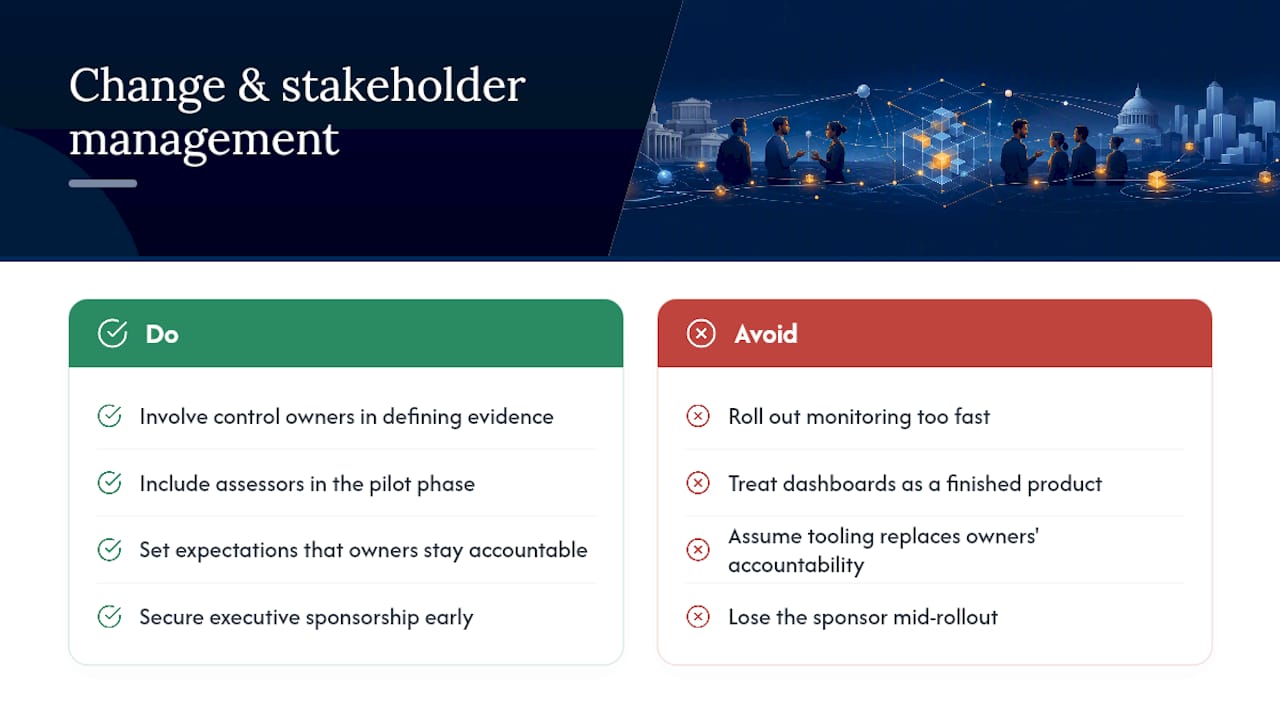
Automation projects fail more often from people problems than technical ones. Control owners who feel the new dashboard exists to catch them out will find ways to route around it, and assessors who weren't consulted during design will push back hard when the evidence format doesn't match their expectations.
CIS guidance on building a continuous audit program flags a specific risk here: teams that roll out monitoring too fast create "system burden," where staff feel overloaded by new alerts and dashboards they weren't trained to interpret. That resistance is predictable, and it's avoidable with the right sequencing.
Three practices consistently reduce friction. First, involve control owners in defining what evidence their own control should produce, rather than handing them a finished dashboard. People trust systems they helped shape. Second, bring assessors into the pilot phase, not the rollout phase, so the evidence format gets validated before it scales to twenty controls instead of after. Third, set expectations early that automation changes how evidence gets produced, not who is accountable for the underlying control. Owners still own outcomes; the tooling just removes the manual documentation burden.
Executive sponsorship matters too, particularly on multi-year rollouts. A program that loses its sponsor halfway through Phase 2 tends to stall, because the remaining phases require budget and cross-department cooperation that only leadership can secure. For readers managing broader public contract modernization, governance and change-management practices for automation in public-sector programs cover the sponsorship and staffing questions in more depth. Teams navigating unfamiliar organizational resistance can also draw on structured change management frameworks for digital transformation, which apply directly to compliance automation rollouts even though they weren't written for audit teams specifically.
Which Security and Compliance Standards Matter for Audit Readiness Automation?
The standard you're automating toward shapes what "acceptable evidence" looks like, so this isn't a one-size question. SOC 2 evidence tends to center on control operation over a review period, meaning your automation needs to prove a control ran consistently across the entire window, not just at a single checkpoint. ISO 27001 leans more heavily on documented risk treatment decisions and management review cycles, so evidence needs to capture not just that a control fired, but that leadership reviewed its output on schedule.
GDPR introduces a different category entirely: evidence tied to data subject rights, consent records, and breach notification timelines, where the evidence often has to prove a negative (no unauthorized access occurred) rather than a positive action.
For government-facing programs, NIST SP 800-53A control families provide the technical backbone most federal and state compliance frameworks reference directly, which is why aligning automated evidence collection to those control families early tends to satisfy multiple downstream frameworks at once. This is where the "single control library" benefit from earlier in this guide pays off concretely: a well-built evidence pipeline for one NIST control family often satisfies SOC 2 or ISO 27001 requirements with minimal reformatting, since the underlying control activity is the same even if the reporting language differs.
The practical takeaway: map your automation to the strictest applicable standard first. It's usually cheaper to over-satisfy a lighter framework than to retrofit evidence collection to meet a stricter one later.
What Are Best Practices for Audit Data Retention and Archival?
Automated systems generate far more evidence than manual processes ever did, which creates a retention problem nobody had to solve at the old pace. A dashboard pulling logs every hour produces a volume of records that will overwhelm storage and search performance within a year if retention policy isn't set deliberately.
Start with the retention period the strictest applicable regulation requires, then apply that uniformly rather than tracking different windows per framework. Government contract work often carries multi-year retention obligations tied to contract terms, so check the specific contract language rather than assuming a generic industry default applies.
Immutable storage matters as much as duration. Evidence that can be edited after the fact loses its value to an assessor, regardless of how long it's kept. Write-once storage or cryptographic hashing at the point of capture preserves the chain of custody that makes automated evidence trustworthy in the first place.
Archival tiering keeps costs manageable: recent evidence stays in fast, searchable storage for active audits, while older evidence moves to cheaper cold storage that still meets retention requirements but doesn't need instant retrieval. Just make sure the archival process itself is logged, so an assessor can confirm nothing was altered or dropped during the move.
Finally, build a defined disposal process. Evidence that's outlived its retention requirement should be deleted on a documented schedule, not left indefinitely just because storage is cheap. Indefinite retention of sensitive evidence is its own compliance risk.
What Role Does Machine Learning Play Beyond Basic Automation?
Basic automation captures evidence on a schedule or trigger. Machine learning adds something different: pattern detection across evidence volumes too large for a human reviewer to scan manually.
Where this genuinely helps is discovery and mapping. An ML model can flag which controls in your library overlap across frameworks, surface anomalies in access patterns that a rules-based alert would miss, and help draft narrative sections of a compliance report faster than a human starting from scratch.
Where it fails, according to Paramify's analysis, is evidence generation itself. A model that writes what a control "probably did" instead of capturing what it actually did introduces exactly the kind of unverifiable artifact that undermines assessor trust. ISACA's research on refreshing IT audit practices with large language models reaches a similar conclusion: automation hits a hard ceiling on governance and judgment tasks, and human sign-off with a documented rationale has to stay part of the evidence chain regardless of how capable the model is.
The most useful framing: treat AI as an execution accelerant, not an evidence source. IntoneCCM's work on the GRC execution gap makes the point sharply. Many organizations already have AI generating insights about their control posture, but lack the execution layer that turns those insights into automated workpapers auditors can actually rely on. That execution layer, converting insight into deterministic control logic, is what shrinks external audit support hours. The insight alone doesn't.
What Integration Challenges Come Up in Complex IT Environments?
Legacy systems rarely expose clean APIs, and that's usually the first wall a pilot hits. A mainframe application from the 1990s might have no programmatic way to extract access logs, forcing teams to either build a custom extraction layer or accept a manual step that undermines the whole point of automation.
Data format inconsistency across systems is the second common wall. Your identity provider logs timestamps in UTC, your ERP logs them in local time, and reconciling those into a single evidence timeline requires normalization logic that's easy to underestimate during planning.
Ownership fragmentation compounds both problems. In large government IT environments, the team that owns the network logs is often different from the team that owns the ticketing system, and neither reports to the compliance function driving the automation project. Getting both teams to prioritize an integration that primarily benefits a third department requires executive backing, not just a project plan.
A few troubleshooting habits reduce the pain considerably. Build integrations one system at a time and validate evidence quality with your assessor before moving to the next, rather than wiring five systems simultaneously and debugging all of them at once. Where a system genuinely can't be automated cleanly, document that gap explicitly and keep a manual process in place rather than forcing a brittle workaround that breaks silently. And test evidence lineage end to end before declaring an integration complete: an integration that pulls data successfully but loses the audit trail back to the source system hasn't actually solved the readiness problem.
How Should You Assess and Prioritize Compliance Risk Before Automating?
Not every control deserves the same automation investment, and skipping a risk assessment before building integrations is one of the most common ways programs waste budget on low-value automation.
Start by scoring each control on two axes: how frequently it's tested and how severe a failure would be. Controls that are tested often and carry high failure severity, transaction testing on financial systems, for instance, deliver the fastest return on automation investment because they eliminate the most recurring manual effort while addressing the highest-risk category.
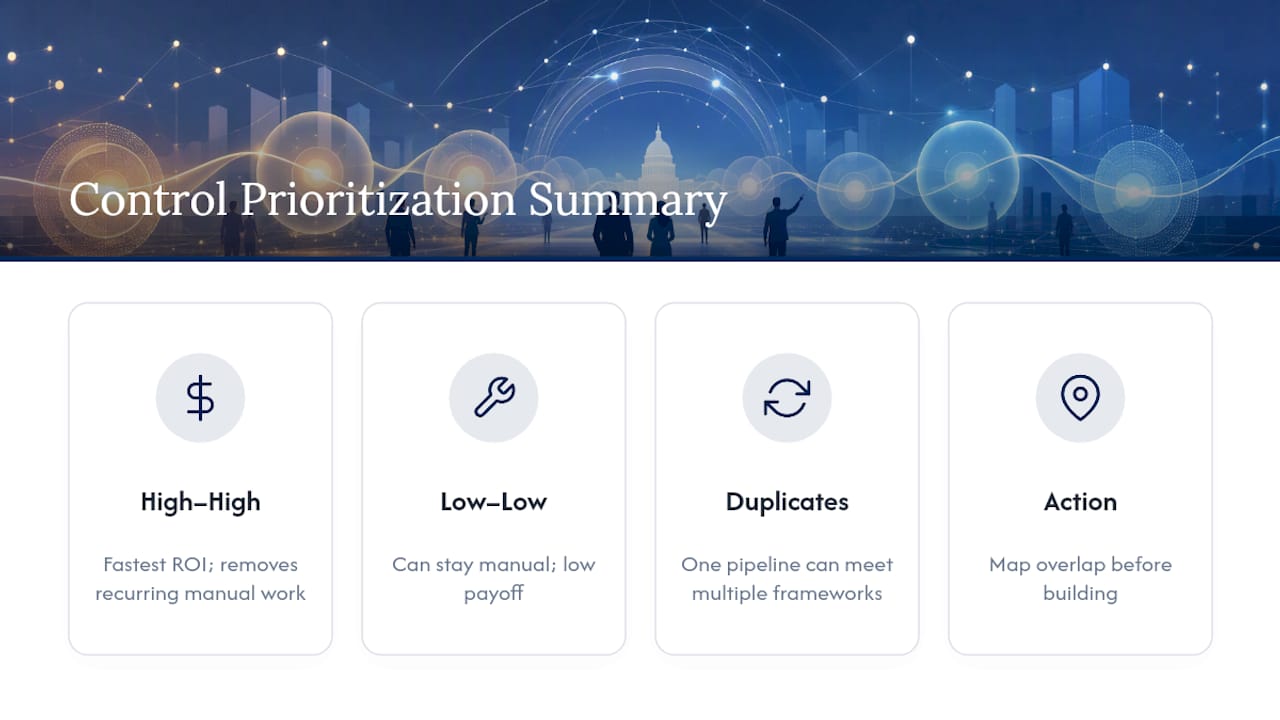
Controls that are tested rarely and carry low severity can usually stay manual indefinitely. Automating them consumes engineering time for minimal payoff, and that time is almost always better spent on the next high-frequency, high-severity control in the queue.
This prioritization exercise also surfaces which controls are duplicated across frameworks, a detail that matters more than it first appears. A single automated evidence pipeline that satisfies both a SOC 2 requirement and an internal NIST-aligned control effectively pays for itself twice. Mapping that overlap before building anything prevents teams from accidentally automating the same underlying control three separate times under three different names.
Three Pragmatic Rules for Starting Audit Readiness Automation
Programs that succeed tend to follow three rules, and programs that stall tend to have skipped at least one of them.
Rule one: pick a high-impact pilot and involve assessors from the start, not after the integration is built. An assessor who helps define acceptable evidence during Phase 1 rarely rejects that same evidence format during the actual audit.
Rule two: hire the engineering talent or partner capability needed for deterministic integrations. Evidence pipelines built by people who don't understand source systems produce brittle automation that breaks the first time an upstream system changes.
Rule three: measure outcomes relentlessly, and hold control owners accountable for remediation SLAs. A dashboard nobody acts on is just a more expensive spreadsheet.
The programs that treat these three rules as sequential, not optional, tend to reach continuous monitoring on schedule instead of stalling in Phase 1.
— Randy
Ready to Pilot Audit Readiness Automation on Your Program?
Some firms own defined-scope modernization work packages instead of supplying staff augmentation, which means teams receive deliverables and KPIs rather than additional contractors attending standups. Some firms build pilots involving one high-impact control, automated evidence capture, assessor involvement from day one, and a path to scale once the pilot proves out.
A typical engagement model runs pilot, deliverable, then scale, offering prime contractors and agencies a low-risk way to test automation before committing to a full rollout. If your program is stuck assembling evidence manually before every audit cycle, reach out to Primereadysub to discuss a pilot scoped to your highest-priority control.