

The NIST AI Risk Management Framework is voluntary U.S. guidance built around four functions: Govern, Map, Measure, and Manage. As of 2026, the AI RMF remains the foundational reference for organizations trying to identify, assess, and reduce AI-related risk without a mandatory federal rulebook forcing their hand.
NIST treats the framework as a living document. Revisions continue under the White House AI Action Plan, and companion resources like the Playbook and the Generative AI Profile keep expanding what "compliance" actually looks like in practice. This article focuses on what comes next: how U.S. organizations, especially those working with government agencies, actually operationalize the framework rather than just read it.
- Voluntary, not mandatory. No agency enforces NIST AI RMF adoption by statute.
- Organized around four functions that map to real organizational roles and outputs.
- Actively revised, with profiles for generative AI and critical infrastructure already published.
- Best approached as a governance program, not a document you file away after one read.
Key Takeaways
Successful NIST AI RMF adoption requires governance authority established first, systematic risk mapping second, and automated evidence generation to sustain compliance at scale.
| Point | Details |
|---|---|
| Governance comes first | Form a cross-functional AI Risk Committee and publish a risk policy before running technical assessments. |
| Use the Playbook, not just the Core | Map suggested actions to your subcategories instead of interpreting outcomes from scratch. |
| Match profiles to your use case | Apply the Generative AI Profile for GenAI tools and watch for sector-specific profiles as they publish. |
| Automate evidence early | Wire training data logs, test results, and monitoring metrics into CI/CD to avoid manual audit reconstruction. |
| Assign roles beyond the committee | Data stewards, procurement officers, and end users all carry distinct RMF responsibilities. |
Table of Contents
- How Does the NIST AI RMF Work?
- What Do Govern, Map, Measure, and Manage Actually Require?
- Which NIST Resources Turn the Framework Into Action?
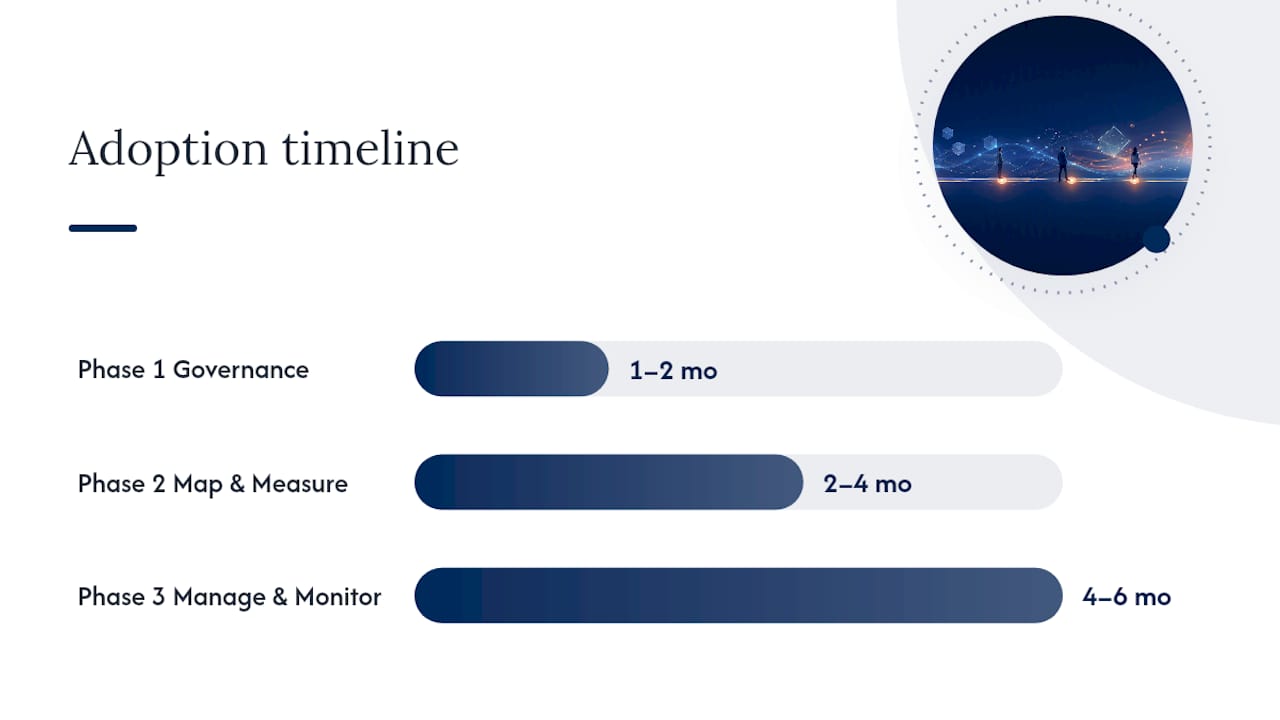
- How Do You Adopt NIST AI RMF in 3 to 6 Months?
- Who Owns AI Risk Beyond the Governance Committee?
- What Do Real Implementation Challenges Look Like?
- Where to Find NIST's Official AI Risk Guidance
- Why Practical Adoption Beats Perfect Compliance
- Sources
How Does the NIST AI RMF Work?
NIST built the framework under authority granted by the National AI Initiative Act, and it deliberately avoids sector-specific rules. A hospital system, a state transportation department, and a fintech startup can all use the same Core because the AI RMF 1.0 publication was written to be use-case agnostic rather than industry-specific.
That flexibility is also why so many teams struggle to start. The framework tells you what outcomes to achieve, not which vendor to buy or which script to run. NIST fills part of that gap through the Playbook, discussed below, and through profiles targeted at specific risk categories.
Three things matter most for planning purposes:
- NIST maintains the AI RMF as a living document. Expect periodic updates, not a static PDF you read once and shelve.
- The framework interlocks with existing standards. It was designed to complement the NIST Cybersecurity Framework and the NIST Privacy Framework, so organizations already running CSF-aligned programs have a head start on governance structure and control language.
- International alignment is already underway. NIST has coordinated the RMF's language with ISO/IEC 42001 and other emerging AI governance standards, which matters if your organization operates across jurisdictions or sells into regulated markets.
Auditors and procurement officers increasingly expect to see AI RMF alignment referenced somewhere in a vendor's compliance documentation, even though no statute requires it. That expectation is the practical reason this voluntary framework carries real weight in contract negotiations.
What Do Govern, Map, Measure, and Manage Actually Require?
Each function produces specific artifacts, not just abstract principles. Here's what each one demands in a working organization.
- Govern sets the foundation: policies, roles, and risk tolerance decisions that authorize everything downstream. Expected outputs include a written AI risk policy, a designated risk owner, and documented escalation paths.
- Map identifies what you're actually dealing with. Outputs include a system inventory with fields for model type, data sources, intended use, and deployment context, plus an initial risk classification for each system.
- Measure tests and quantifies. Outputs include bias and fairness test results, robustness and adversarial testing logs, accuracy benchmarks, and a defined monitoring cadence, often monthly or quarterly depending on system criticality.
- Manage acts on what Measure finds. Outputs include documented mitigation decisions, incident response procedures specific to AI failures, and a change log tracking model updates against original risk assessments.
Skipping straight to Measure without a governance structure is a common failure pattern. Practitioners note that without an authorized committee and an approved policy, MAP and MEASURE findings have nowhere to go, since nobody has the standing to act on them or fund the fix. Governance isn't paperwork for its own sake; it's the authority structure that makes the other three functions actionable.
Pro Tip: Start with a one-page AI risk policy before you inventory a single system. A policy without an inventory is incomplete, but an inventory without a policy just generates findings nobody is authorized to resolve.
Implementer guides commonly cite a 3 to 6 month timeline for full operationalization, depending heavily on organization size and how many AI systems are already deployed. A single-system pilot program can move faster; an enterprise with dozens of models embedded across departments should expect the longer end of that range.
Which NIST Resources Turn the Framework Into Action?
The Core tells you what outcome to achieve. The Playbook tells you how, listing suggested actions tied directly to each subcategory of Govern, Map, Measure, and Manage. If a subcategory calls for documenting risk tolerance, the Playbook offers concrete language and process suggestions for doing it.
Profiles narrow the framework to a specific context. The Generative AI Profile (NIST-AI-600-1), published in July 2024, addresses risks unique to large language models and generative systems: confabulation, data memorization, harmful content generation, and intellectual property exposure. NIST has also released a concept note for a critical infrastructure profile, signaling more sector-specific guidance is coming for utilities, transportation, and similarly regulated environments.
| Resource | What it adds | Best used for |
|---|---|---|
| AI RMF Playbook | Suggested actions per subcategory | Turning Core outcomes into implementable steps |
| Generative AI Profile (NIST-AI-600-1) | GenAI-specific risk categories | Chatbots, copilots, content generation tools |
| Critical infrastructure concept note | Sector-specific risk framing | Utilities, transportation, public safety systems |
| NIST CSF crosswalk | Alignment with existing cyber controls | Organizations with mature cybersecurity programs |
Pick the profile that matches your actual deployment. An agency running a generative chatbot for constituent services should start with the Generative AI Profile; an agency modernizing traffic management systems should watch the critical infrastructure track.
How Do You Adopt NIST AI RMF in 3 to 6 Months?
Adoption works best as three sequential phases rather than a simultaneous scramble.
- Months 1 to 2, Governance foundation. Appoint a risk owner, form a cross-functional AI Risk Committee spanning legal, IT, program management, and security, and publish a policy that states your organization's risk tolerance. This phase also connects AI governance to your existing enterprise risk management and cybersecurity programs rather than treating it as a separate silo, a point AIRC guidance emphasizes directly.
- Months 2 to 4, Map and Measure cycles. Build a system inventory covering every deployed and planned AI application. Classify each by risk level, then run prioritized evaluations on the highest-risk systems first: bias testing, robustness checks, and documentation of data provenance.
- Months 4 to 6, Manage and monitor. Implement mitigation controls for issues Measure surfaced, stand up an AI-specific incident response procedure, and establish continuous monitoring with defined review cadences.
Automation matters at every phase. Wiring evidence capture into CI/CD pipelines, capturing training data snapshots, model performance metrics, and security scan results automatically, turns a one-time compliance exercise into a sustainable program. The Playbook itself recommends this approach specifically to reduce the manual burden of ongoing audits.
Pro Tip: Small organizations with one or two AI systems can often compress this to 8 to 10 weeks. Large enterprises with dozens of models across departments should plan for the full 6 months, and possibly longer if legacy systems lack basic documentation.
What Practitioners Learn Implementing NIST AI RMF
Public-sector modernization work surfaces the same gaps repeatedly: agencies can describe what their AI systems do but struggle to produce the paper trail auditors want. A few things consistently help.
- Stand up the AI Risk Committee before touching technical assessments, not after.
- Automate evidence generation from day one instead of trying to reconstruct logs during an audit.
- Map third-party and vendor AI risk explicitly; procurement contracts rarely address this by default.
- Align RMF outputs directly to procurement and Authority to Operate documentation so the same evidence serves both purposes.
The gap between having an AI system and having documented control over it is where most audit findings originate. Automation closes that gap; ad hoc documentation never quite does.
Primereadysub builds this discipline into defined-scope modernization work for government agencies and prime contractors. Because engagements own a specific deliverable rather than functioning as staff augmentation, evidence capture, compliance automation, and audit-readiness dashboards get built into the work package itself, not bolted on afterward. That structure is precisely what closes the gap between deploying an AI system and being able to prove it's governed.
Who Owns AI Risk Beyond the Governance Committee?
A governance committee sets policy, but it can't execute every control personally. Effective AI risk management distributes specific responsibilities across roles that often get overlooked in framework discussions.
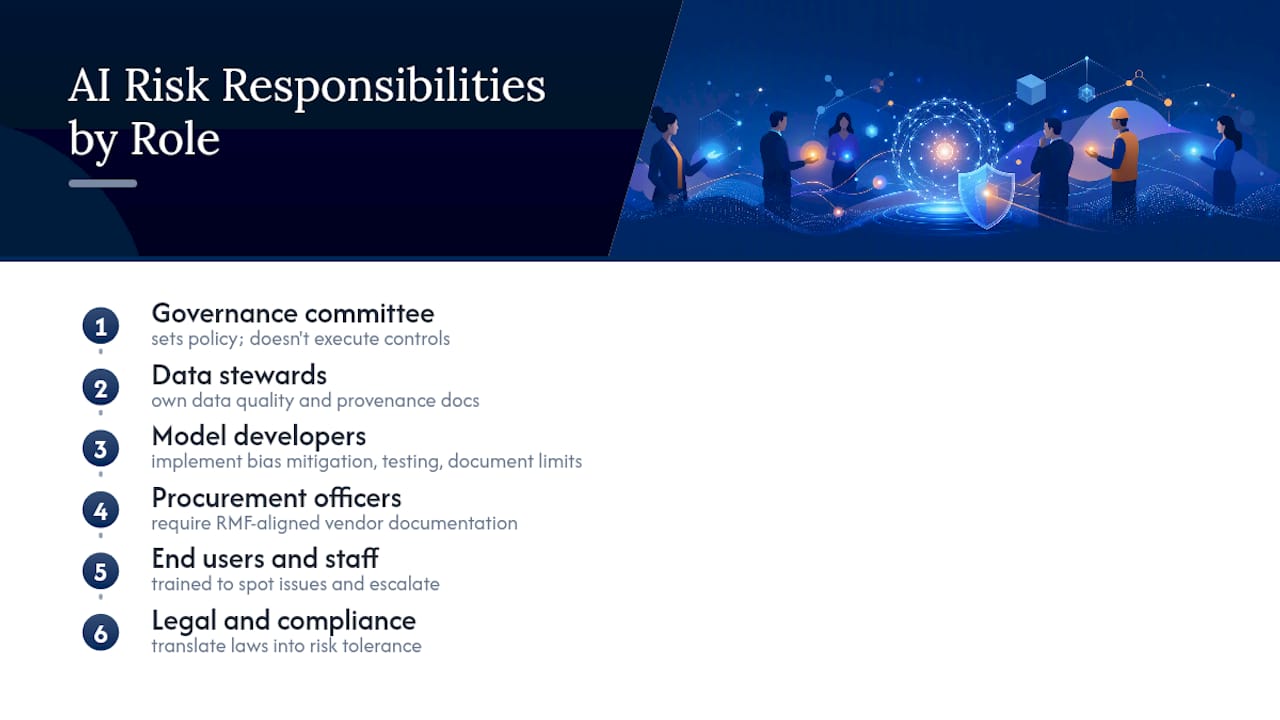
Data stewards own data quality and provenance documentation, the foundation every bias and robustness test depends on. Without accurate lineage records, Measure-phase testing produces results nobody can trust.
Model developers and data scientists implement technical controls directly: bias mitigation techniques, robustness testing, and documentation of model limitations. They're also the first line of defense for catching drift between a model's training environment and its production behavior.
Procurement and contracting officers carry more AI risk responsibility than most organizations assign them. When an agency buys an AI-enabled tool from a vendor, contract language needs to require RMF-aligned documentation, not just functional specifications. This is where a surprising number of organizations discover their weakest control: third-party AI risk that nobody in the governance structure directly owns.
End users and program staff need enough training to recognize when an AI system is behaving unexpectedly and know how to escalate it. A monitoring dashboard is only useful if someone reviewing it understands what a concerning result looks like.
Legal and compliance teams translate regulatory requirements, state privacy laws, sector-specific rules, procurement regulations, into risk tolerance decisions the committee can act on.
Treating AI risk as solely a committee-level concern is how organizations end up with a well-written policy and no functioning controls underneath it.
What Do Real Implementation Challenges Look Like?
Public-sector AI deployments run into a specific set of recurring problems, and the solutions tend to be less about technology and more about process discipline.
The inventory gap. Agencies frequently discover AI capabilities embedded in tools they didn't think of as "AI systems": document classification features in case management software, predictive fields in scheduling tools, chatbot functions bundled into constituent portals. The fix is treating system inventory as an ongoing discovery process, not a one-time survey, and specifically asking vendors whether their products include AI or machine learning components.
The evidence reconstruction problem. When an audit request arrives, teams without automated logging spend weeks manually reconstructing training data sources, testing records, and decision logs. Organizations that wired evidence capture into their CI/CD pipelines from the start can produce the same documentation in hours rather than weeks.
The vendor accountability gap. Third-party AI tools rarely arrive with RMF-aligned documentation attached. Agencies that succeed here build specific AI risk disclosure requirements into their procurement and compliance checklists up front rather than discovering the gap during a vendor's contract renewal.
The staffing reality. Smaller agencies rarely have a dedicated AI risk specialist. The workaround that holds up: distributing RMF functions across existing IT security, privacy, and program staff with clear ownership per function, rather than waiting to hire a role that may never get budgeted.
Where to Find NIST's Official AI Risk Guidance
- AI Risk Management Framework, NIST's main landing page and update hub.
- AI RMF 1.0 (PDF), the full publication defining the four core functions.
- AI RMF Playbook, suggested actions mapped to subcategories.
- AIRC governance resources, NIST's expanded guidance on governance structures.
- 2025 to 2026 framework updates, a practical summary of where NIST is heading next.
Why Practical Adoption Beats Perfect Compliance
Most guidance on the NIST AI RMF treats it as a document to interpret. The more useful question is what to build first, and the answer is almost never "a complete risk assessment." It's a committee with actual authority to make decisions.
I'd push back on the common advice to wait for a formal AI RMF 2.0 before committing resources. NIST has been clear that no such release is imminent, and the profiles and Playbook already represent the operational direction. Organizations that wait are choosing paralysis over an imperfect but functional program.
The overrated piece of conventional advice is comprehensive risk assessment before action. Waiting for full documentation before implementing any controls almost always means teams accumulate deployed AI systems with zero oversight while committees debate policy language. Ship governance fast, even at 80 percent complete, then map and measure iteratively. For public-sector organizations specifically, the practical win is connecting RMF evidence directly to procurement and audit trails you already maintain instead of building parallel documentation nobody will keep updated.
— Randy
Sources
- AI Risk Management Framework | NIST
- Artificial Intelligence Risk Management Framework (AI RMF 1.0) | NIST (PDF)
- AI RMF Playbook | NIST
- AI RMF - AIRC | NIST
- NIST AI RMF 2025–2026 updates: what you need to know | IS Partners LLC