

Strategic IT sourcing is defined as the deliberate planning and management of IT vendor relationships and technology acquisitions to drive sustained value and align with an agency's long-term digital transformation goals. For public-sector IT managers and procurement officials, understanding what is strategic IT sourcing means recognizing it as far more than a purchasing function. The average enterprise now manages 305 applications in its SaaS portfolio. That scale demands a governance model built on ecosystem thinking, not individual contract transactions. Frameworks like the Kraljic matrix and guidance from the PACT Association give agencies the structure to move from reactive buying to proactive value creation.
What is strategic IT sourcing, and how does it differ from traditional IT procurement?
Strategic IT sourcing and traditional IT procurement solve different problems. Traditional IT procurement focuses on completing a purchase at the lowest price. Strategic sourcing focuses on long-term value, total cost of ownership, and alignment with digital transformation goals. The distinction matters because the cheapest contract today often becomes the most expensive legacy system in five years.
Traditional procurement treats each purchase as an isolated event. A department identifies a need, submits a requisition, and procurement finds a vendor who meets the specification at an acceptable price. The process ends at contract signature. Strategic IT sourcing, by contrast, treats every vendor relationship as part of a connected technology ecosystem. Decisions account for how a new tool integrates with existing systems, what the exit strategy looks like, and how the vendor roadmap aligns with agency modernization plans.
The role of the procurement team changes fundamentally under this model. Procurement teams acting as ecosystem orchestrators generate more innovation and agility than teams operating as traditional gatekeepers. That shift requires procurement officials to engage with IT architects, finance leads, and program managers before an RFP is ever written.
Key differences between the two approaches include:
- Scope: Procurement covers a single transaction. Strategic sourcing covers the full vendor relationship lifecycle.
- Cost lens: Procurement optimizes unit price. Strategic sourcing accounts for total cost of ownership, including integration, training, and decommissioning.
- Stakeholder involvement: Procurement is often siloed. Strategic sourcing requires cross-functional input from IT, finance, legal, and business units.
- Vendor relationship: Procurement manages contracts. Strategic sourcing manages partnerships built on shared roadmaps and performance accountability.
Pro Tip: Before issuing any RFP, map your current vendor ecosystem to identify overlapping capabilities. Agencies that skip this step routinely pay for the same function twice across different departmental contracts.
What are the core benefits of strategic IT sourcing for government agencies?
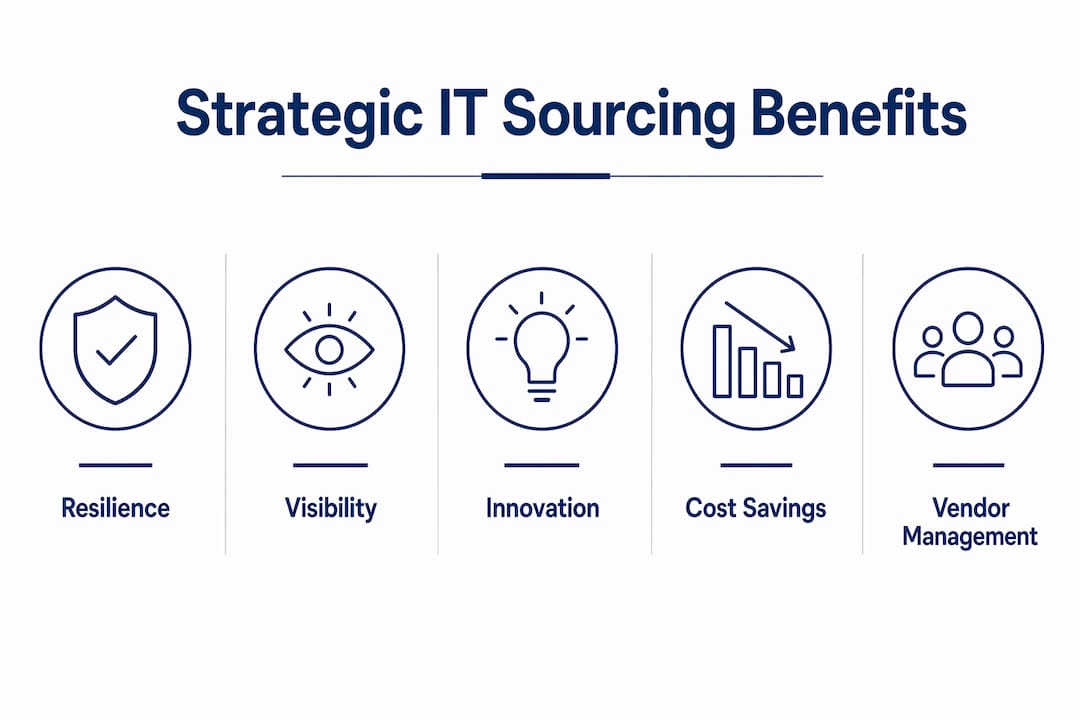
Strategic IT sourcing delivers five measurable benefits that directly address the pressures public-sector IT managers face.
-
Cost governance and redundancy reduction. SaaS spending grows 8% year over year, while application portfolio growth averages only 2.2%. That gap represents money spent on tools that duplicate existing capabilities. A coordinated sourcing process identifies and eliminates that redundancy before it compounds.
-
Reduced shadow IT. Shadow IT creates security vulnerabilities and hidden costs. Pre-approved vendor catalogs give agency staff an accessible, compliant path to the tools they need. When the approved option is easy to access, staff stop procuring outside the system.
-
Cross-departmental visibility. Managing vendors as an integrated ecosystem prevents redundant spending and conflicting technology roadmaps across departments. Agencies that audit spend at the enterprise level, not the department level, consistently find overlapping contracts that no single team knew existed.
-
Risk mitigation through lifecycle planning. Failing to define exit strategies and refresh flexibility locks agencies into costly legacy contracts with no clear path forward. Strategic sourcing builds exit criteria and refresh cycles into the original vendor agreement, not as an afterthought.
-
Alignment with modernization goals. Public-sector agencies reduce redundant spending and align IT sourcing with modernization objectives through coordinated stakeholder collaboration. Sourcing decisions made in isolation from agency transformation plans consistently produce technology that cannot scale to meet future program requirements.
Strategic sourcing is not merely a cost-cutting exercise. It prioritizes resilience, visibility, and innovation across the procurement function. Agencies that treat it as a budget tool miss most of its value.
Which frameworks underpin effective IT sourcing strategies?
The Kraljic matrix is the most widely applied framework for supplier segmentation in IT sourcing. It plots vendors on two axes: supply risk and impact on agency performance. Vendors in the high-risk, high-impact quadrant require deep partnership management. Vendors in the low-risk, low-impact quadrant can be managed through standard catalog purchasing. Applying this segmentation prevents agencies from spending relationship capital on commodity suppliers while underinvesting in critical technology partners.

Spend and ecosystem dependency audits form the second pillar of a working sourcing framework. An audit maps every active vendor contract, the business function it supports, and the systems it connects to. Agencies that conduct these audits routinely discover that 20–30% of active contracts overlap with capabilities already licensed elsewhere. The audit output becomes the baseline for all sourcing decisions that follow.
Lifecycle planning is the third pillar, and the one most often skipped. Mistaking procurement for simple buying overlooks depreciation and residual value risk, which weakens the entire sourcing strategy. Every sourcing decision should include a defined refresh cycle, a depreciation schedule, and a documented exit path. Agencies that address lifecycle complexity before issuing RFPs avoid the locked-in, costly refresh cycles that plague legacy IT environments.
Cross-functional sourcing teams complete the framework. IT, procurement, finance, and program leadership each hold information the others lack. IT knows integration constraints. Finance knows budget cycles and total cost implications. Program leadership knows where the agency is headed in three to five years. No single team can produce a sound sourcing decision without the others.
Pro Tip: Build a pre-approved vendor catalog organized by function category, not by department. A government-wide catalog reduces shadow IT, speeds procurement timelines, and gives your sourcing team real spend data to negotiate with.
How can IT managers implement strategic IT sourcing to optimize project delivery?
Implementation follows a defined sequence. Agencies that skip steps in this sequence typically revert to transactional purchasing within two budget cycles.
-
Start with stakeholder alignment. Engage IT architects, program managers, finance leads, and legal counsel before defining requirements. Real needs and future plans only surface through structured conversation, not through a requirements document written in isolation.
-
Segment your vendor portfolio. Apply the Kraljic matrix to classify every active vendor. Assign relationship management resources proportional to each vendor's strategic importance. Not every vendor deserves a quarterly business review.
-
Define vendor roles explicitly. Separate strategic partners from commodity suppliers in your contract language and governance model. A strategic IT partner co-creates solutions with your agency before contract signature. A commodity supplier delivers a defined product at a defined price.
-
Integrate financial planning with sourcing decisions. Total cost of ownership calculations must include integration costs, training, ongoing support, and decommissioning. Agencies that evaluate only the contract value routinely underestimate true spend by a wide margin.
-
Use data tools for spend visibility. Contract management platforms and SaaS management tools give procurement officials real-time visibility into what the agency is spending, with whom, and for what purpose. That visibility is the foundation of effective IT sourcing decisions.
-
Build exit strategies into every contract. Define performance thresholds, termination rights, and data portability requirements at the negotiation stage. Agencies that address these terms after a vendor relationship sours have far less leverage.
-
Address shadow IT proactively. IT sourcing teams should co-create solutions with vendors before contract signing, not after staff have already adopted unauthorized tools. A pre-approved catalog with a clear request process removes the friction that drives shadow IT adoption.
The IT project lifecycle connects directly to sourcing outcomes. Agencies that plan sourcing decisions alongside project lifecycle milestones avoid the common failure mode of procuring technology that is already obsolete by the time it is deployed.
Key Takeaways
Strategic IT sourcing requires agencies to shift from transactional purchasing to ecosystem management, grounded in total cost of ownership, lifecycle planning, and cross-functional collaboration.
| Point | Details |
|---|---|
| Define sourcing vs. procurement | Strategic sourcing covers the full vendor lifecycle; procurement covers a single transaction. |
| Apply the Kraljic matrix | Segment vendors by supply risk and performance impact to allocate relationship resources correctly. |
| Audit spend enterprise-wide | Cross-departmental spend audits reveal redundant contracts and conflicting technology roadmaps. |
| Plan lifecycle from day one | Define refresh cycles, depreciation schedules, and exit terms at the negotiation stage, not after. |
| Build a pre-approved catalog | A government-wide vendor catalog reduces shadow IT and gives procurement teams real spend data. |
The shift most agencies are not ready to make
The hardest part of strategic IT sourcing is not the framework. It is the organizational change that the framework demands. I have seen agencies invest in Kraljic matrix training, conduct thorough spend audits, and still revert to transactional purchasing within a year. The reason is almost always the same: procurement was treated as a support function rather than a decision-making partner.
The agencies that get this right do one thing differently. They give procurement officials a seat at the table when program strategy is being set, not when the RFP is already drafted. That timing shift changes everything. Procurement can shape requirements, flag ecosystem conflicts, and build vendor relationships before the agency is under deadline pressure. By the time the contract is signed, the sourcing team already understands the vendor's roadmap, the integration constraints, and the exit options.
Lifecycle planning is the second area where I see consistent failure. Agencies focus on acquisition cost and ignore the back half of the technology lifecycle entirely. Depreciation, residual value, data migration, and decommissioning costs are real budget items. They show up whether or not you planned for them. The agencies that plan for them negotiate better contracts, avoid vendor lock-in, and make modernization decisions from a position of strength rather than desperation.
The public-sector IT partnerships that produce the best outcomes share one characteristic: both sides treat the relationship as a long-term investment. That requires procurement officials to evaluate vendors on roadmap alignment and innovation capacity, not just price and compliance. It requires vendors to understand agency mission constraints, not just contract terms. That mutual investment is what separates a strategic partnership from a procurement transaction.
— Randy
How Primereadysub supports public-sector IT sourcing and modernization
Rutledge & Associates, the team behind Primereadysub, works directly with state agencies and government departments to modernize legacy IT systems through cloud-native architecture, compliance automation, and real-time data visibility. The firm is certified as an SDVOSB, woman-owned, and SBA-certified small business, with active work in Maryland, New York, and Florida. Primereadysub operates as an outcomes-driven partner, owning clearly defined scopes rather than providing staff augmentation. For prime contractors managing complex, compliance-heavy programs, that model reduces oversight burden while delivering audit-ready results. Agencies looking for a public-sector modernization partner built around strategic sourcing principles will find Primereadysub's approach directly aligned with the frameworks covered in this guide.
FAQ
What is strategic IT sourcing in simple terms?
Strategic IT sourcing is the process of planning and managing technology vendor relationships to deliver long-term value, not just the lowest purchase price. It aligns IT acquisitions with agency modernization goals and accounts for total cost of ownership across the full technology lifecycle.
How does strategic IT sourcing differ from IT procurement?
IT procurement covers a single transaction from requisition to contract. Strategic IT sourcing covers the full vendor relationship, including ecosystem fit, lifecycle planning, exit strategies, and ongoing performance management.
Why do public-sector agencies need strategic IT sourcing?
The average enterprise manages 305 applications, and SaaS spending grows 8% year over year while portfolio growth averages only 2.2%. Without a coordinated sourcing approach, agencies accumulate redundant tools, shadow IT, and legacy contracts that block modernization.
What is the Kraljic matrix and how does it apply to IT sourcing?
The Kraljic matrix segments vendors by supply risk and performance impact, helping agencies decide which vendor relationships require deep partnership management and which can be handled through standard catalog purchasing.
What is shadow IT and how does strategic sourcing address it?
Shadow IT refers to technology tools adopted by agency staff outside the official procurement process. Pre-approved vendor catalogs and accessible request processes remove the friction that drives staff to procure outside approved channels.