

A public sector proposal is a formal, structured bid submitted in response to a government solicitation, designed to demonstrate that your organization can meet specific requirements at a competitive price. Winning one requires more than good intentions. It demands a disciplined, step-by-step approach that addresses compliance, evaluation criteria, and agency priorities in a precise sequence. Skipping steps or treating the process casually leads to disqualification before an evaluator reads a single line of your technical approach.
The core benefits of a structured drafting process include:
- Compliance assurance: A methodical approach catches every mandatory requirement before submission.
- Evaluator alignment: Structured proposals map directly to scoring criteria, making it easier for reviewers to award points.
- Reduced risk: Sequential reviews catch gaps that rushed drafts miss entirely.
- Competitive clarity: A logical flow communicates capability more convincingly than dense, unorganized prose.
- Deadline control: Planning each phase prevents last-minute scrambles that produce errors.
Federal procurement structures often require multi-step participation. Under multi-step solicitation processes like Commercial Solutions Openings, failure to participate in a required preliminary phase, such as a White Paper submission, results in automatic disqualification from the entire procurement. The structure is not bureaucratic formality. It is the mechanism by which agencies filter serious, prepared vendors from the rest.
What are the key components of an effective public sector proposal?
Every government solicitation expects specific sections, and evaluators score each one against defined criteria. Understanding what goes into each component, and why, is the foundation of any public sector proposal guide worth following.
Executive summary
The executive summary is your opening argument. It should state your understanding of the agency's problem, your proposed solution, and why your organization is the right choice, all in a concise, readable format. Evaluators often read this section first and last. A weak summary undermines an otherwise strong technical volume.
Technical approach
The technical approach explains precisely how you will deliver the required work. When the solicitation uses a Statement of Work (SOW), your response must show how every deliverable will be met on time and as specified. A Performance Work Statement (PWS) shifts the burden to you: you must describe the activities you will perform and how they will achieve the government's measured outcomes. A Statement of Objectives (SOO) goes further, requiring you to propose your own PWS, performance metrics, measurement plan, and quality assurance plan, as GSA guidance makes clear. Each document type demands a different framing of your solution.
Management plan
The management plan covers how you will execute, monitor, and control the work. Technical and management volumes must demonstrate clear, specific execution plans that address requirements point by point. Generic statements about "experienced teams" do not score well. Evaluators want to see control mechanisms, risk mitigation strategies, and communication cadence.
Past performance
Past performance references confirm that your organization has delivered comparable work successfully. Solicitations typically require references from projects of similar scope and size, completed within a defined timeframe. For GSA Multiple Award Schedule offers, relevant customer references must be associated with three distinct orders or contracts, with work completed within three years of the submission date.
Pricing volume
Pricing must be competitive, realistic, and internally consistent with your technical and management plans. Agencies evaluate cost in the context of quality, and a price that does not align with the scope you described raises credibility questions.
Compliance matrix
The compliance matrix is not a narrative section. It is a cross-reference document that maps every solicitation requirement to the exact page and section of your proposal where it is addressed. Building it before you write anything else is the single most effective way to prevent missing mandatory content.
Key registrations and certifications to include:
- Active registration in SAM.gov (System for Award Management)
- Small business certifications where applicable (SDVOSB, SBA 8(a), HUBZone, WOSB)
- NAICS code alignment with the solicitation
- Any agency-specific representations and certifications required by the solicitation
Pro Tip: Mirror the solicitation's exact section numbering in your compliance matrix. When an evaluator checks whether you addressed a specific "shall" statement, they can find it in seconds rather than hunting through your document.
How do you develop a public sector proposal step by step?
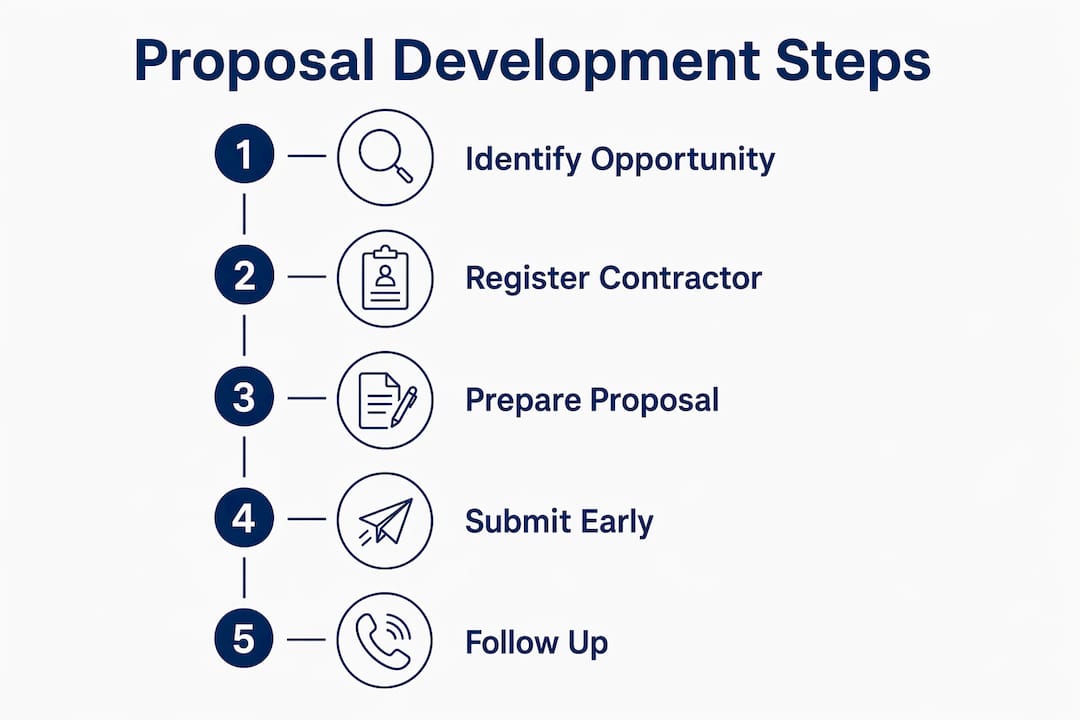
The following sequence reflects how experienced proposal teams approach government bids, from the moment a solicitation drops to the final submission.
-
Read the solicitation in full, twice. The first read gives you the big picture. The second read, done with a highlighter or annotation tool, surfaces every mandatory requirement, evaluation factor, and submission instruction. Missing a single "shall" statement at this stage can cost you the contract.
-
Build your compliance matrix immediately. Before drafting a single word of proposal content, map every requirement to a planned proposal section. Identify all "shall," "must," and "will" statements in the solicitation and assign each one to a responsible writer.
-
Develop a detailed outline mirroring the solicitation. Your proposal's section structure should follow the solicitation's evaluation factors in the same order. Evaluators score proposals against those factors sequentially. Making them search for your response to a specific factor wastes their time and lowers your score.
-
Collect supporting documents and certifications early. Past performance questionnaires, letters of supply, financial statements, and certifications take time to gather. Starting this process on day one prevents a last-minute scramble that delays submission.
-
Draft content aligned to evaluation criteria. Write each section with the scoring rubric in mind. If the solicitation weights technical approach at the highest level, that volume deserves the most detail and the clearest evidence of capability.
-
Integrate metric-backed proof points. Claims without evidence do not score well. Quantify your past performance with specific outcomes: processing time reductions, audit compliance rates, system uptime percentages. Concrete numbers tell a more convincing story than adjectives.
-
Conduct a Pink Team review. An early-stage review of your outline and initial draft identifies structural gaps before significant writing effort is invested. Pink Team reviewers check whether the proposal addresses all evaluation factors and whether the win themes are clear.
-
Conduct a Red Team review. The Red Team review is performed on a draft that is approximately 80–90% complete, by reviewers who are independent of the writing team. They score the proposal as government evaluators would, identifying gaps, weak responses, and unsupported claims before submission.
-
Finalize pricing narratives. Pricing should not be developed in isolation. The price narrative must align with the technical and management volumes so that evaluators see a coherent, internally consistent offer.
-
Prepare and test your submission package. Confirm file naming conventions match solicitation instructions. Test portal access well before the deadline. Verify that all required attachments are included and that file sizes meet any specified limits.
Pro Tip: Submit at least 24 hours before the deadline. The government enforces a strict no-late-proposal policy with no grace period. A portal outage or upload error in the final hour has ended otherwise competitive bids.
What are the best practices for writing a successful public sector proposal?
Strong proposals share a set of characteristics that go beyond compliance. These practices separate bids that score well from those that merely meet the minimum threshold.
Language and structure:
- Use the solicitation's own language in your headings and body text. Mirroring PWS or SOW language aligns your proposal's tone to government expectations and helps evaluators locate your responses quickly.
- Avoid marketing language. Phrases like "world-class solution" or "industry-leading team" carry no scoring weight. Evaluators want evidence, not superlatives.
- Use structured headings that correspond directly to evaluation factors. This makes scoring faster and reduces the risk that a reviewer misses your response to a specific criterion.
Evidence and credibility:
- Back every capability claim with a measurable outcome from past performance. If your team reduced a state agency's processing time by a specific percentage, say so with the context that makes it credible.
- Avoid vague references to "similar projects." Name the type of work, the scope, and the result.
- Include relevant certifications prominently. An SDVOSB or SBA certification can influence set-aside eligibility and signals organizational credibility.
Pricing strategy:
- Align your price to the scope you described technically. A price that seems disconnected from the work plan raises red flags during evaluation.
- Research publicly available contract award data to understand competitive price ranges for similar work before finalizing your figures.
Quality assurance:
- Conduct at least two rounds of external review before submission. Internal authors are too close to their own writing to catch gaps or ambiguous language.
- Check every compliance matrix entry against the final draft. A requirement addressed in an early outline but dropped during revision is a common source of disqualification.
Pro Tip: Federal evaluators operate under significant time pressure and handle multiple submissions simultaneously. A proposal with clear headings, short paragraphs, and logical flow earns more points simply because reviewers can find what they need without effort.
Expert insights that separate winning proposals from the rest
The difference between winning and losing a government contract proposal lies in how well the submission aligns to explicit evaluation factors and agency priorities. That alignment is not accidental. It is the product of deliberate, expert-level practices that most first-time bidders overlook.
Advanced practices that distinguish competitive proposals:
- Maintain the compliance matrix throughout the entire drafting process. A matrix built at the start but never updated becomes unreliable. Every revision to the proposal should trigger a corresponding update to the matrix. Teams that treat it as a living document catch omissions that static checklists miss.
- Use the Red Team as a scoring simulation. The most effective Red Teams score the proposal using the same evaluation criteria the agency will apply, then write narrative feedback explaining each score. This produces specific, actionable revision guidance rather than general impressions.
- Request post-award debriefs regardless of outcome. Systematic revision of boilerplate content and risk management approaches, driven by evaluator feedback from debriefs, increases future proposal success. Contractors who build internal proposal libraries from debrief notes improve their win rates over time.
- Align content to agency operational priorities, not just solicitation language. Agencies publish strategic plans, budget justifications, and mission statements. Proposals that connect your solution to the agency's stated priorities demonstrate a depth of understanding that generic responses cannot match.
- Develop win themes early and repeat them consistently. A win theme is a short, evidence-backed statement that explains why your organization is the best choice for this specific requirement. It should appear in the executive summary, the technical approach, and the management plan, reinforcing the same message from multiple angles.
Statistic callout: Federal solicitations structured as multi-step processes, such as Commercial Solutions Openings, impose automatic disqualification on any vendor that skips a required preliminary phase. There is no appeals process for missing a mandatory step.
Proposal refinement is not a one-time activity. Each submission, whether won or lost, generates data. Teams that analyze that data systematically, updating their templates, strengthening their past performance narratives, and sharpening their pricing strategies, compound their advantage with every bid cycle.
How do government procurement rules and compliance requirements work?
Federal procurement in the United States operates primarily under the Federal Acquisition Regulation (FAR), a comprehensive set of rules governing how agencies buy goods and services. State and local governments follow their own procurement codes, but many mirror FAR principles. Understanding which rules apply to a specific opportunity is a prerequisite for writing a compliant proposal.
The FAR establishes requirements for full and open competition, small business participation, pricing transparency, and ethical conduct. Solicitations issued under FAR Part 15 govern negotiated acquisitions, which include most complex service contracts. Simplified acquisition procedures apply to lower-value purchases. Other Transaction Agreements (OTAs), used by agencies like the Department of Homeland Security and the Department of Defense, operate outside the FAR and follow their own terms, as seen in DHS Commercial Solutions Opening solicitations.
Compliance requirements embedded in solicitations typically include:
- Representations and certifications: Offerors must certify their business size, ownership status, and compliance with labor laws, environmental regulations, and other statutory requirements.
- Organizational conflict of interest (OCI) disclosures: If your organization has a relationship that could bias your work, you must disclose it.
- Subcontracting plans: Large businesses awarded contracts above certain thresholds must submit plans for subcontracting to small businesses.
- Data rights and intellectual property clauses: These govern who owns work products and software developed under the contract.
Non-compliance with any of these requirements does not result in a lower score. It results in rejection. Agencies are required by law to enforce solicitation terms uniformly, and contracting officers have limited discretion to waive mandatory provisions. Reading every clause, not just the technical sections, is the only way to avoid a compliance-based disqualification. For a broader overview of how these rules shape the contracting lifecycle, the government contracting guide published by Primereadysub covers the full regulatory framework in accessible terms.
What evaluation criteria do public sector agencies commonly use?
Government agencies evaluate proposals against criteria defined in the solicitation, and those criteria vary by contract type, agency, and complexity. However, several factors appear consistently across federal and state procurements.
Technical approach is almost always the highest-weighted factor in service contracts. Evaluators assess whether the offeror understands the requirement and has a credible, specific plan to deliver it. Vague or generic technical responses score poorly regardless of the organization's actual capability.
Past performance carries significant weight because it is the most reliable predictor of future success. Agencies look for references from projects of comparable scope, complexity, and dollar value. A strong past performance record with measurable outcomes, documented in a Past Performance Questionnaire or equivalent format, can offset a slightly higher price.
Management approach evaluates your plan for executing and overseeing the work. Evaluators want to see that you have thought through staffing, risk, quality control, and communication. A management section that emphasizes control mechanisms and specific mitigation strategies scores better than one that describes organizational structure alone.
Cost or price is evaluated for competitiveness and realism. In best-value procurements, price is weighed against technical merit. A lower price does not automatically win if the technical approach is weaker. Conversely, an exceptional technical proposal can justify a higher price if the value is clearly articulated.
Experience covers the qualifications of key personnel and the organization's track record in the relevant domain. Agencies often specify minimum experience requirements for key roles, and proposals that fail to meet those minimums are typically found technically unacceptable.
Quality control addresses the processes you will use to monitor performance and correct deficiencies. This factor is particularly important in service contracts where ongoing performance matters as much as initial delivery.
Understanding how these criteria are weighted in a specific solicitation, and writing to that weighting, is one of the most direct ways to improve your score. For teams building their first government bid, the bid preparation process resource from Primereadysub provides practical guidance on structuring your response to match evaluation priorities.
How do you identify suitable government contract opportunities?
Finding the right opportunities is the step that precedes proposal writing, and it is where many organizations invest too little time. Pursuing solicitations that do not match your capabilities, certifications, or capacity wastes resources and produces losing proposals.

SAM.gov is the primary federal contract opportunity database. All federal agencies are required to post solicitations above the simplified acquisition threshold on SAM.gov, making it the starting point for any federal business development effort. Searches can be filtered by NAICS code, set-aside type, agency, and place of performance.
USASpending.gov provides historical award data, showing which agencies have funded similar work, at what price levels, and with which contractors. This intelligence informs both opportunity targeting and pricing strategy.
Agency forecast tools are published by many federal agencies, including the Department of Defense, GSA, and DHS, listing anticipated procurements for the coming fiscal year. Reviewing these forecasts allows organizations to prepare months before a solicitation drops.
State and local procurement portals vary by jurisdiction. Most states maintain their own vendor registration systems and opportunity databases. Organizations targeting state agencies in Maryland, New York, or Florida, for example, need to register on each state's procurement portal separately.
Capability alignment criteria to evaluate before pursuing an opportunity:
- Does the NAICS code match your primary business activity?
- Is the set-aside type (small business, SDVOSB, 8(a), WOSB) one for which you qualify?
- Does your past performance include projects of comparable scope and dollar value?
- Can you meet the solicitation's key personnel requirements?
- Is the place of performance consistent with your operational capacity?
Pursuing opportunities that align with your actual capabilities, rather than aspirational ones, produces a higher win rate and a stronger past performance record over time.
How do you register as a government contractor?
Registration in SAM.gov is a prerequisite for receiving a federal contract award. Without an active SAM.gov registration, no agency can legally award a contract to your organization, regardless of how strong your proposal is. The registration process requires several pieces of information and takes time to complete, so starting early is critical.
The SAM.gov registration process:
-
Obtain a Unique Entity Identifier (UEI). SAM.gov assigns a UEI to each registered entity. This replaced the DUNS number system and is now the standard identifier for federal contracting.
-
Gather required business information. You will need your Employer Identification Number (EIN), NAICS codes, banking information for electronic funds transfer, and details about your business structure and ownership.
-
Complete the core data section. This includes your legal business name, physical address, points of contact, and business type classifications.
-
Complete representations and certifications. This section covers your compliance with FAR requirements, small business size standards, and various statutory certifications. Accuracy here is legally significant. False certifications carry serious penalties.
-
Renew annually. SAM.gov registrations expire after one year. An expired registration can prevent award or payment on an existing contract. Setting a calendar reminder 60 days before expiration is a standard practice among experienced contractors.
Small business certifications are separate from SAM.gov registration but are managed through related systems. The SBA's certification programs, including 8(a) Business Development, HUBZone, WOSB, and SDVOSB, each have their own application processes and eligibility requirements. These certifications open access to set-aside contracts and can significantly expand the pool of opportunities available to qualifying organizations.
For GSA Multiple Award Schedule (MAS) contracts, the registration process extends beyond SAM.gov. Offerors must complete the MAS offer process through GSA's eOffer system, which requires at least two Authorized Negotiators, completion of mandatory training, a readiness assessment, and submission of a full technical and price proposal through the portal.
How do you manage deadlines and submission methods for public sector proposals?
Deadline management in government contracting is unforgiving. The government enforces a strict no-late-proposal policy, and there is no grace period or appeals process for timing errors. A proposal received one minute after the deadline is rejected, regardless of its quality or the reason for the delay.
Submission method requirements vary by solicitation. Federal solicitations increasingly require electronic submission through portals such as SAM.gov, GSA's eOffer, or agency-specific systems. Some solicitations still require email submission with specific subject line formats, as seen in DHS CSO solicitations. A small number of legacy procurements still accept physical delivery, though this is increasingly rare. Reading the submission instructions section of the solicitation carefully, before any other section, prevents a mismatch between your submission method and the agency's requirements.
Deadline management practices:
- Build a proposal schedule on day one, working backward from the submission deadline. Assign specific dates for each phase: compliance matrix completion, first draft, Pink Team review, Red Team review, pricing finalization, and final submission.
- Identify all interim deadlines within the solicitation, including question submission cutoffs, amendment response periods, and oral presentation dates if applicable.
- Test portal access and file upload functionality at least 48 hours before the deadline. Portal outages and account access issues are common and take time to resolve through agency help desks.
- Submit the complete package at least 24 hours early. This buffer absorbs unexpected technical problems without costing you the opportunity.
- Confirm receipt. Most electronic submission systems generate a confirmation email or timestamp. Save that confirmation as proof of timely submission.
File naming and formatting are details that evaluators notice. Solicitations often specify exact file naming conventions, page limits, font sizes, and margin requirements. Proposals that violate these instructions may be found non-compliant and rejected without evaluation. Treating formatting requirements as optional is a mistake that experienced proposal teams never make.
For organizations managing multiple concurrent bids, building a shared proposal calendar and a reusable content library, including past performance narratives, management plan templates, and standard certifications, reduces the time pressure on each individual submission without sacrificing quality.
Key Takeaways
A winning public sector proposal requires compliance, evaluator alignment, and evidence-based content delivered through a disciplined, sequential process from solicitation analysis to final submission.
| Point | Details |
|---|---|
| Build the compliance matrix first | Map every "shall" and "must" statement before drafting to prevent missing mandatory requirements. |
| Mirror solicitation language | Use the PWS or SOW's exact terms in headings and body text to help evaluators locate your responses. |
| Submit 24 hours early | The government's no-late-proposal policy has no grace period; a buffer absorbs portal or upload failures. |
| Use Red Team review on near-final drafts | Independent reviewers scoring an 80–90% complete draft identify gaps before submission, not after. |
| Register in SAM.gov before pursuing contracts | An active SAM.gov registration is a legal prerequisite for any federal contract award. |