

Request Medicare data through the State Data Resource Center and submit a current Information Exchange Agreement with a Data Request and Attestation. That single step unlocks Medicare Parts A/B/C/D claims and the integrated MMLEADS dataset for dually eligible beneficiaries. From there, success depends on analytic capacity, identifier matching, and governance built to handle the combined dataset responsibly.
TL;DR:
- Most states should begin with a small pilot using the MMLEADS dataset to demonstrate value before scaling to claims or medication files.
- A successful request for Medicare data requires current and renewed Information Exchange Agreements and Data Requests, with processing times varying from weeks to months.
- Matching beneficiaries relies on creating a master index using Medicaid IDs, Medicare identifiers, and provider NPIs, with dedicated timelines for provider crosswalks.
- Building governance, defining success metrics, and phased implementation plans increase the likelihood of sustained project momentum.
- External technical assistance and toolkits are available to streamline data mapping, ingestion, and quality checks, reducing project setup time.
Table of Contents
- Building a Roadmap for Medicaid Data Integration
- How Do States Request Medicare Data Through SDRC?
- Which Dataset Fits Which Use Case?
- What Integration Methods Actually Work?
- What Barriers Slow Down Medicaid Data Integration?
- Where Can States Find Ready-Made Tools?
- What Does Defined-Scope Delivery Look Like in Practice?
- Ready to Move From Pilot to Production?
- Sources
- FAQ
Building a Roadmap for Medicaid Data Integration
Medicaid data integration works best as a sequence, not a single project. States that treat it as one big procurement tend to stall; states that break it into stages tend to ship something usable within a year.
- Define the policy question first. Are you trying to reduce avoidable hospitalizations among duals, tighten program integrity, or improve care transitions? The CHCS guidance on integrating Medicare and Medicaid data is blunt about this: data acquired without a policy anchor tends to sit unused.
- Run a readiness audit. Check your current systems, staff bandwidth, security posture, and how consistently your Medicaid IDs, Medicare Beneficiary Identifiers, and provider NPIs are captured.
- Submit the SDRC request. File the IEA and DRA, then scope a pilot around one dataset, typically MMLEADS or a targeted claim extract, rather than requesting everything at once.
- Set governance and metrics. Assign data stewardship roles, define what "success" looks like in numbers, and map a phased plan across one to three years that adds files and use cases as capacity grows.
Pro Tip: Pick a pilot question small enough to answer in one quarter, like "how many dual-eligible enrollees had an ED visit within 30 days of discharge." A narrow win builds the internal case for the next phase far faster than a broad, unfinished analysis.
How Do States Request Medicare Data Through SDRC?
The SDRC is the front door CMS built specifically for state Medicaid agencies that need Medicare data on dually eligible individuals. Every request routes through this portal, and access depends on two documents staying current: the Information Exchange Agreement, which establishes the legal basis for data exchange, and the Data Request and Attestation, which specifies exactly which files a state is requesting and why. Letting either lapse stalls every pending and future request, so most states assign a single owner to track renewal dates.
Once approved, a state can request:
- Medicare Parts A and B claims (institutional and physician/supplier services)
- Part D Prescription Drug Event (PDE) files for medication data
- Enrollment files, including MMA, TBQ, and buy-in records
- MMLEADS, the pre-integrated Medicare-Medicaid dataset built for dual-eligible analysis
CMS has streamlined the IEA/DRA process to cut down on duplicate paperwork across multiple data exchanges, but processing still takes weeks to a few months depending on request complexity. Build that lag into your project timeline instead of assuming instant turnaround, and use SDRC's webinars to get procedural questions answered before you submit, not after a request gets kicked back.
Which Dataset Fits Which Use Case?
Not every analytic question needs the same file. Matching the dataset to the task saves months of unnecessary data wrangling.
- MMLEADS gives you demographics, utilization, and chronic condition flags for dual-eligible beneficiaries in a pre-linked format. It's the most practical starting point because smaller analytic teams can work with it in Excel before investing in a full data warehouse.
- Parts A/B claims and Part D PDE are necessary once you move past exploratory questions into cost analysis, utilization trending, or medication adherence work. Peer-reviewed research on linking Medicare-Medicaid claims confirms these files are what support case-level outcomes research for dual populations.
- Data hosts public Medicaid and CHIP datasets useful for benchmarking your state against national trends, but it can't answer beneficiary-level questions. For that, you need the secured CMS files delivered through SDRC.
For program planning, MMLEADS usually gets you most of the way there. For care coordination pilots, you need claims-level detail on recent utilization. For program integrity work, you need both claims and provider files matched at the transaction level.
What Integration Methods Actually Work?
States generally choose among three approaches, and the right one depends on staff capacity more than technology budget.
Physical integration loads Medicare and Medicaid files into a shared Medicaid data warehouse. This gives you the fastest query performance and the most consistent audit trail, but it demands upfront investment in ETL pipelines and storage.
Virtual integration uses a federated layer that queries source systems on demand without duplicating the data. It's lighter to stand up but slower for complex, repeated analyses.
Manual integration, matching spreadsheets by hand, works only for small, one-off pilots and breaks down fast once volume grows.
Whichever method you pick, matching individual beneficiaries and providers correctly is where most projects lose time.
- Build a master patient index using the state Medicaid ID as the anchor, then link the Medicare Beneficiary Identifier (or legacy HICN) and CCW ID as secondary keys.
- Match providers on NPI, but expect gaps: many providers bill under both group and individual NPIs, so plan for crosswalks rather than a single clean join.
- Apply de-duplication rules at the service-claim level before aggregating, or utilization counts will inflate.
- Run standard data quality checks (null rates, duplicate claim IDs, date range validity) before the first analytic output leaves the pipeline.
Pro Tip: Treat provider matching as its own workstream with its own timeline. Teams that fold it into the general "data integration" task almost always underestimate how many hours it eats.
What Barriers Slow Down Medicaid Data Integration?
Three failure patterns show up repeatedly across state efforts, and each has a workable mitigation.
- Limited analytic capacity. Most Medicaid agencies don't have a bench of data engineers sitting idle. Short-term contractor engagements or university partnerships can fill the gap for a pilot without committing to permanent headcount.
- MCO carve-outs. Behavioral health and long-term services and supports data often sit outside your managed care organization's standard reporting, which means separate ingestion tracks and contractual reporting requirements are needed to pull that data into the integrated view.
- Underused governance. CMS expects clear security and access controls around PHI. A three-year phased rollout, pilot first, then scale, reduces exposure while your governance structure matures alongside the data volume.
Where Can States Find Ready-Made Tools?
You don't have to build every piece from scratch. The Medicaid Innovation Accelerator Program has already produced technical assistance and toolkits several state cohorts have adapted directly.
- COBA (Coordination of Benefits Agreement) mapping workbooks for aligning payer identifiers
- A master patient index specification your team can adapt instead of designing one internally
- Sample database staging models and SAS load scripts for moving raw files into analytic-ready tables
- SDRC-hosted webinars and one-on-one technical assistance for agencies mid-request
Requesting a walkthrough before you submit your IEA/DRA often catches formatting issues that would otherwise bounce the request back.
What Does Defined-Scope Delivery Look Like in Practice?
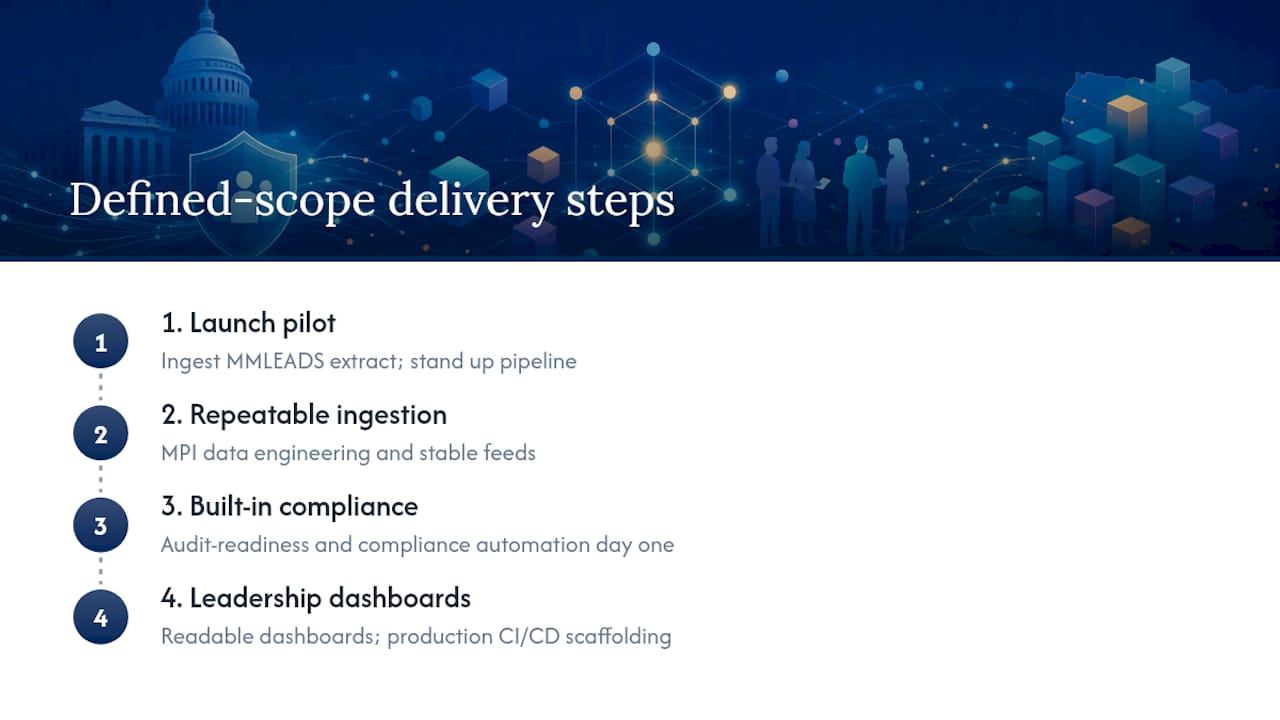
Rutledge & Associates approaches Medicare-Medicaid integration work the way most successful state pilots get built: a narrow, outcome-owned scope rather than staff sitting inside an agency's existing team. A typical engagement moves from a defined pilot, ingesting an MMLEADS extract and standing up a working data pipeline, into a repeatable ingestion process and a dashboard leadership can actually read.
Audit-readiness and compliance automation get built into that pipeline from day one, not bolted on later, which is usually what keeps a state's analytics program compliant as file volume and data sensitivity grow. The value tends to concentrate in three places: data engineering for the MPI, dashboard construction, and the CI/CD scaffolding that keeps data pipelines from breaking every time a source file changes format.
— Randy
Ready to Move From Pilot to Production?
Most states lose momentum between "we got Medicare data approved" and "we have a dashboard leadership trusts." A defined-scope engagement can take a state from an approved SDRC request to a working analytic output, without the long ramp-up or ongoing staff commitment a traditional systems integrator requires. A typical first engagement is a readiness assessment paired with a small pilot, ingesting a sample MMLEADS extract and producing a core dashboard your team can show to leadership within weeks, not quarters.

The near-term payoff is concrete: faster claims processing, an audit-ready data pipeline documented from the start, and an initial analytics layer your staff can build on. If you're ready to talk specifics, bring your current SDRC/IEA status and your top one or two policy questions to a conversation with Primereadysub about what a pilot would look like for your agency.
Sources
- Medicare-Medicaid Data Sharing Program | CMS
- Medicaid
- Integrating Medicare and Medicaid Data to Support Improved Care for Dual Eligibles | CHCS
- Data
FAQ
Is ICE using Medicaid data to find people?
This article focuses on how state agencies use Medicaid and Medicare data for program planning, care coordination, and program integrity; it does not cover immigration enforcement data sharing, and states should direct that question to their own legal counsel and CMS guidance on data use restrictions.
What race has the highest Medicaid enrollment rate?
Enrollment patterns vary significantly by state and shift year to year, and this article's scope is data integration methodology rather than demographic enrollment statistics, so state-specific enrollment breakdowns are best pulled directly from your own MMLEADS or claims extract.
How many Medicaid recipients are also on Medicare?
The population commonly called "dual eligibles" varies by state, and MMLEADS is specifically built to help state analysts quantify and profile that overlapping group for their own jurisdiction.
Which state has the highest percentage of Medicaid recipients?
Medicaid enrollment share varies widely by state based on eligibility expansion status and demographics; Data publishes public enrollment datasets states can use to benchmark their own numbers against national figures.
What's the fastest way to start a Medicaid data integration project?
Submit an SDRC request with a current IEA and DRA, then pilot with the MMLEADS dataset before requesting broader claims files. Starting narrow lets your team build matching and governance processes before scaling to Parts A/B/C/D data.