

Knowing how to create effective partnerships is one of the most underestimated competencies in both public and private sector leadership. Most partnerships begin with genuine enthusiasm and shared ambition, then quietly deteriorate within 12 to 18 months because the operational infrastructure was never built to sustain them. The vision was real. The intent was aligned. But without defined governance, communication discipline, and a mechanism for reassessing mutual value, even the most promising alliances drift apart. This guide addresses each failure point directly, offering a structured path from preparation to execution to long-term partnership health.
Table of Contents
- Key takeaways
- How to create effective partnerships: laying the groundwork
- Steps to forming and launching strong partnerships
- Maintaining and evolving partnerships over time
- Measuring success and verifying outcomes
- My perspective on what makes partnerships actually work
- How Primereadysub supports your partnership goals
- FAQ
Key takeaways
| Point | Details |
|---|---|
| Align vision before structure | Define shared goals and mutual value before drafting roles, metrics, or agreements. |
| Governance prevents disputes | Predecide authority, escalation paths, and conflict resolution to avoid costly legal delays. |
| Communication requires a system | Scheduled touchpoints, shared dashboards, and escalation protocols prevent coordination decay. |
| Mutual value must be reassessed | Regularly verify that each partner receives equitable benefit to prevent disengagement. |
| Outcomes are learning tools | Treat measured results as instruments for growth, not just proof of delivery. |
How to create effective partnerships: laying the groundwork
Before any agreement is drafted or any role is assigned, the foundational work of preparation determines whether a partnership will generate genuine value or become a transactional arrangement that neither side defends.
The starting point is shared vision and mutual value. This sounds obvious until you sit across from a prospective partner who uses the same language you do but means something entirely different by it. Alignment on goals must be tested, not assumed. Write out what success looks like in concrete, time-bound terms for both parties before any other conversation happens.

Beyond vision, the preparation phase requires an honest internal and external analysis. What capabilities does your organization actually bring? Where are the gaps? Which organizations hold complementary strengths rather than duplicating yours? Cultural compatibility is not a soft concern. Two organizations with different decision-making speeds, accountability structures, or risk tolerances will produce conflict at every inflection point in the partnership lifecycle.
Use a SMART framework to translate shared vision into structured goals. Specific, measurable, achievable, relevant, and time-bound objectives convert good intentions into trackable commitments. The following table outlines the key tools and requirements for preparing a partnership effectively:
| Preparation element | Purpose | Tool or method |
|---|---|---|
| Internal capability assessment | Clarify what you bring and where gaps exist | SWOT analysis, capacity audit |
| Partner screening | Identify organizations with complementary strengths | RFI process, stakeholder interviews |
| Cultural compatibility check | Evaluate decision-making and accountability styles | Structured conversations, reference checks |
| SMART goal definition | Convert shared vision into measurable commitments | Goal-setting workshops, written charters |
| Legal and compliance review | Identify data, IP, and regulatory requirements early | Legal counsel, compliance checklist |
- Conduct a capability audit before approaching any partner
- Assess cultural fit explicitly, not by assumption
- Define what value each partner receives, not just what they contribute
- Identify legal and data-sharing requirements before negotiations begin
Pro Tip: Before finalizing a partnership, ask each stakeholder from both organizations to independently write two sentences describing the partnership's primary goal. If the answers diverge significantly, you have a misalignment problem that needs resolution before any agreement is signed.
Steps to forming and launching strong partnerships
With preparation complete, the execution phase transforms aligned intent into operational reality. This is where building successful collaborations either gains traction or starts accumulating the problems that surface later as breakdowns.
-
Build trust through transparent communication. Trust is not a byproduct of shared goals. It is built deliberately through consistent, honest exchanges that include both progress and setbacks. Partners who only communicate good news create information asymmetry that erodes confidence over time. Relational infrastructure — trust, transparency, and empathy — is as critical to partnership success as any deliverable.
-
Formalize roles and responsibilities. A Memorandum of Understanding is not just a legal formality. It is the document that makes decision-making predictable. Written governance agreements should define roles, intellectual property, publication rights, and conflict resolution paths. Predeciding these elements accelerates the partnership setup and avoids months of legal uncertainty later.
-
Establish a governance structure. Effective governance specifies who has authority to make which decisions, how disagreements are escalated, and what the accountability chain looks like at each level. In public-sector contexts, data-use agreements should be initiated early, paired with governance charters that clarify legal obligations and responsibility boundaries from the start.
-
Set measurable outcomes tied to SMART goals. Every partnership goal established during preparation must now have an assigned owner, a baseline measurement, and a review date. Vague targets like "improve collaboration" produce vague results. Specific targets like "reduce processing time by 30% within six months" produce accountability.
-
Adopt shared platforms for coordination. Project management tools, shared dashboards, and collaboration software reduce the communication overhead that kills momentum in multi-organization projects. Learn more about managing multi-partner projects with shared visibility and accountability systems already in place.
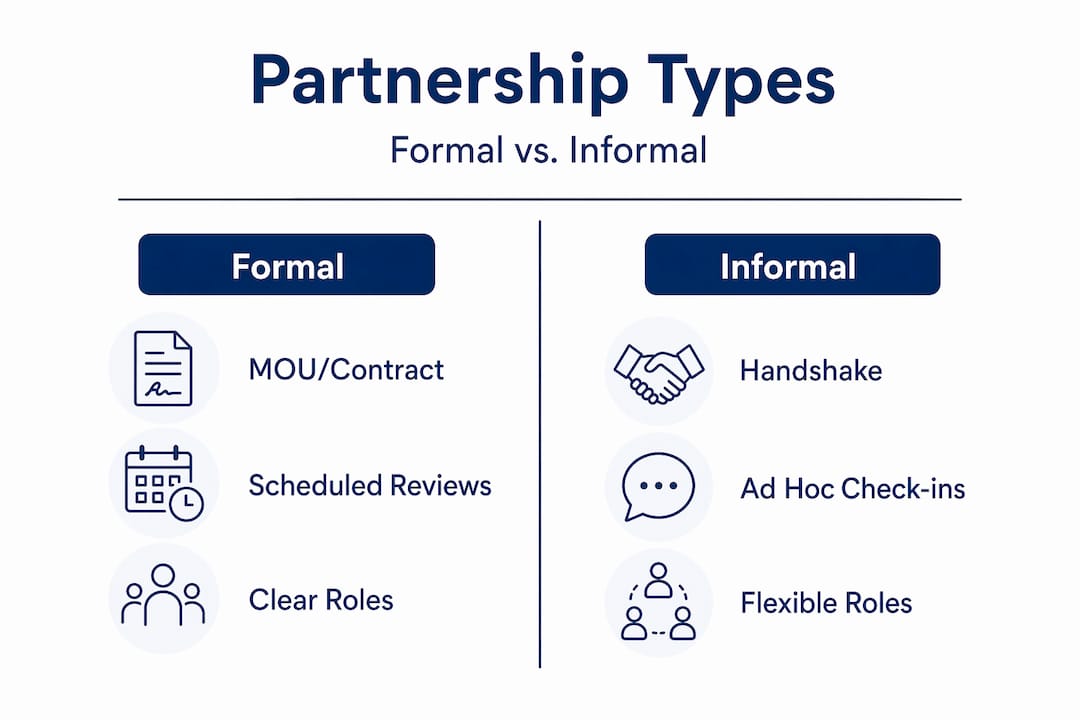
The table below compares formal and informal approaches to partnership structure, helping you assess which model fits your context:
| Dimension | Formal partnership | Informal partnership |
|---|---|---|
| Agreement type | MOU, contract, data-sharing agreement | Handshake or email confirmation |
| Governance | Defined authority, escalation protocols | Ad hoc decision-making |
| Accountability | Assigned roles with written responsibilities | Assumed responsibilities |
| Conflict resolution | Pre-established process | Negotiated case by case |
| Scalability | High. Designed to expand | Low. Dependent on personal relationships |
| Best suited for | Public sector, compliance-heavy programs | Short-term, low-stakes projects |
Pro Tip: When drafting partnership agreements, include a clause that requires a formal review at the six-month mark. This creates a built-in opportunity to reassess the partnership's direction before small misalignments compound into serious structural problems.
Maintaining and evolving partnerships over time
Launching a partnership well is one achievement. Keeping it productive over months and years requires a different set of disciplines, ones that most organizations deprioritize once the initial excitement fades.
Coordination decay is the most common partnership failure mode after the launch phase. It happens when touchpoints become infrequent, agendas lose focus, and each organization gradually reverts to acting independently. A defined communication cadence prevents this. That means scheduled calls with real agendas, shared dashboards that surface progress and blockers, and escalation protocols that activate before problems become crises.
Equally important is periodic reassessment of mutual value. Each partner must realize equitable, value-added benefits from the collaboration. When one party consistently contributes more or receives less, commitment quietly declines. Build a formal review into your annual cycle that examines both contribution and benefit for each partner.
Conflict and power dynamics also need proactive attention. Most partnerships involve organizations of different sizes, resource levels, or political influence. Addressing power imbalances explicitly rather than pretending they do not exist builds the kind of trust that makes difficult conversations possible without damaging the relationship.
Partnerships that endure also tend to evolve. What begins as a defined project scope can expand into a multifaceted engagement when the foundational infrastructure is sound. Successful partnerships build gradually, investing in trust and systems before scaling complexity.
Common pitfalls to avoid when maintaining effective partnerships:
- Allowing communication to become purely reactive rather than scheduled
- Skipping annual reviews because the partnership "seems fine"
- Ignoring early signals of contribution imbalance between partners
- Failing to revisit and update governance documents as scope evolves
- Treating conflict as a sign of failure rather than a normal part of collaboration
- Assuming personal relationships between leaders can substitute for structural accountability
Measuring success and verifying outcomes
Measurement is where many partnerships lose their discipline. Evidence-based outcomes should not be treated as a reporting requirement. They are learning instruments. The data generated by measuring a partnership's impact tells both organizations what is working, what needs adjustment, and whether the original goals are still the right ones.
Effective measurement starts with clarity established during the preparation phase. Metrics must connect directly to the SMART goals defined at the outset. A metric like "number of joint meetings held" measures activity. A metric like "reduction in audit findings by 25% over two quarters" measures impact. Only the second type informs real decisions.
Feedback loops are what convert measurement from a backward-looking activity into a forward-looking one. Build structured feedback collection into each review cycle, both from within each partner organization and from the stakeholders your partnership is meant to serve.
Key practices for verifiable partnership outcomes:
- Define baseline measurements before the partnership launches, not after
- Assign a single owner for each metric to prevent diffused accountability
- Review metrics at both the operational level (monthly) and the strategic level (quarterly or annually)
- Use outcome data in stakeholder reporting to demonstrate concrete impact, not just activity
- Treat missed targets as diagnostic information, not failures requiring justification
For public-sector partnerships specifically, outcome transparency is often a compliance requirement. Designing your measurement framework with audit readiness in mind from the start saves significant effort when reporting season arrives. Explore how outcome-focused partnership design works in practice for IT modernization programs where accountability standards are particularly rigorous.
My perspective on what makes partnerships actually work
I've reviewed enough partnership arrangements across both public and private sector contexts to identify one consistent pattern. The organizations that struggle most are not the ones that lacked good partners. They are the ones that underestimated how much structural investment it takes to keep a partnership functioning.
Most executives treat formal agreements as a legal safeguard, something to sign and file. In my experience, the MOU or governance charter is actually the operating manual for the relationship. Every ambiguity left unresolved in that document surfaces later as a conflict, usually at the worst possible moment. The organizations I've seen build enduring collaborations treated the drafting process as a strategic exercise, not an administrative one.
What I find most underappreciated is what researchers call relational infrastructure. Trust, empathy, and time invested in the relationship itself. It does not produce deliverables directly. It is the reason people pick up the phone when something goes wrong rather than sending an email that creates a paper trail. That distinction matters enormously in complex, compliance-heavy programs.
My honest view is that partnership culture should be treated as a core organizational competency, not a byproduct of good contracts. The teams that build it intentionally outperform those that rely on initial goodwill every time.
— Randy
How Primereadysub supports your partnership goals
The strategies in this article reflect the exact principles that guide Primereadysub's work as a specialized IT modernization partner for public sector programs. From structuring governance to delivering outcome-driven results with real-time program visibility, Rutledge & Associates, LLC brings the kind of defined scope and accountable delivery that makes multi-partner projects function. If you are a prime contractor working through compliance-heavy modernization work, understanding how to build public-sector IT partnerships with the right subcontracting infrastructure can significantly reduce risk and delivery overhead.
Primereadysub operates as a high-value, low-oversight partner, bringing certified SDVOSB and SBA credentials alongside deep DevOps, compliance automation, and data analytics capabilities. For organizations ready to put effective partnership strategy into practice, the Prime-Ready partnership model offers a proven starting point for public-sector modernization engagements.
FAQ
What are the first steps to create effective partnerships?
Start by aligning on shared vision and defining mutual value with measurable, time-bound outcomes. Conduct an internal capability assessment and screen potential partners for cultural and strategic compatibility before drafting any agreements.
How do you maintain long-term partnerships?
Establish a defined communication cadence with scheduled touchpoints, shared dashboards, and escalation protocols. Conduct annual reviews of mutual contribution and benefit to prevent coordination decay and sustain commitment from both sides.
Why do formal agreements matter in business partnerships?
Formal agreements like MOUs establish clear roles, decision-making authority, conflict resolution paths, and data-sharing terms upfront. Predeciding these governance elements prevents disputes and significantly reduces legal delays after the partnership launches.
How should you measure partnership success?
Define baseline metrics tied directly to SMART goals before the partnership begins. Assign clear ownership for each metric and review outcomes at both operational and strategic intervals to inform adjustments rather than simply track activity.
What causes most partnerships to fail?
Coordination decay, unresolved contribution imbalances, and insufficient governance are the most common failure points. Partnerships that lack defined communication systems and formal accountability structures tend to drift into inactivity within the first 12 to 18 months.