

DecisionPoint Corporation is a Service-Disabled Veteran-Owned Small Business (SDVOSB) specializing in federal IT modernization, with core capabilities in cybersecurity, cloud computing, software development, data services, and mission support for U.S. government agencies.
Top services at a glance:
- IT modernization and cloud migration
- Cybersecurity and compliance automation
- Custom software development
- Data integration and analytics
- Mission and program support
For procurement and partnership inquiries, the company's primary contact channel is its LinkedIn company page. Active job listings are posted on the iCIMS careers portal. The verified headquarters address is 702 Russell Avenue, Suite 312, Gaithersburg, MD 20877.
Table of Contents
- What DecisionPoint Corporation is and how it operates
- What services DecisionPoint actually delivers
- Which agencies and clients DecisionPoint serves
- Working at DecisionPoint: roles, benefits, and how to apply
- Recent contract wins and what they signal
- Certifications and compliance posture
- How to contact DecisionPoint and where they are located
- How procurement teams should evaluate DecisionPoint as a partner
- How DecisionPoint was founded and its history
- Leadership team and key executives
- Business size and financial indicators
- Key Takeaways
- Why the SDVOSB label alone is not enough to evaluate a federal IT partner
- Primereadysub delivers outcome-owned government IT modernization
- Useful sources for verifying DecisionPoint's public record
What DecisionPoint Corporation is and how it operates
DecisionPoint's mission centers on delivering technology-driven outcomes for federal programs, with a particular orientation toward defense, government healthcare, and civilian agency modernization. The firm operates as both a prime contractor and a subcontractor, adapting its contracting posture to program requirements.
Key company facts:
- Business status: SDVOSB, SBA-registered small business
The firm also operates through CORTEK, an affiliated subsidiary that extends its reach into defense and intelligence-focused program delivery. According to Glassdoor employer content, CORTEK brings tactical defense-intel capabilities to high-stakes federal bids, which can meaningfully influence how the parent company structures proposals for classified or sensitive programs.
What services DecisionPoint actually delivers
The firm's service model is built around five primary pillars, each designed to address a distinct phase of the federal IT lifecycle.
| Service Pillar | Description | Typical Deliverables |
|---|---|---|
| IT Modernization | Migrating and re-architecting legacy government systems | Cloud migration plans, system re-platforming, infrastructure upgrades |
| Cybersecurity | Protecting federal networks and ensuring compliance posture | Security assessments, NIST-aligned controls, continuous monitoring |
| Software Development | Building custom applications for agency workflows | Agile-developed apps, DevOps/CI-CD pipelines, RPA automation |
| Data Services | Integrating and visualizing government data assets | Analytics dashboards, data warehousing, reporting tools |
| Mission Support | Providing operational and program management support | Program management, logistics, technical advisory services |
In practice, a typical engagement might involve migrating a federal agency's on-premises infrastructure to a cloud environment while simultaneously implementing a CI-CD pipeline for faster software delivery. For cloud modernization work, the firm aligns technical approaches with agency-specific compliance requirements, including FedRAMP authorization pathways. Compliance automation engagements often layer NIST control mapping onto DevOps workflows, reducing manual audit burden for program offices.
Which agencies and clients DecisionPoint serves
The firm's primary customer segments are federal civilian agencies, the Department of Defense, government healthcare programs, and prime contractors seeking a capable subcontractor for compliance-heavy work.
DecisionPoint's contracting history shows a pronounced DoD orientation. Federal contract tracking data indicates the Department of Defense accounts for approximately $80 million of the firm's lifetime federal awards, out of roughly $145–146 million total. That concentration signals genuine depth in defense program environments, not just a broad federal marketing claim.
For prime contractors, DecisionPoint can function as an outcome-owning subcontractor rather than a body-shop arrangement. This distinction matters on compliance-heavy programs where the government customer expects defined deliverables, not just hours billed. State and local agencies are also within scope, though the firm's public contract record skews federal.
Working at DecisionPoint: roles, benefits, and how to apply
DecisionPoint actively recruits across several technical and program disciplines. The careers portal lists current openings and accepts direct applications through iCIMS.
Common role families:
- Cybersecurity analysts and engineers
- Cloud architects and DevOps engineers
- Software developers (full-stack, backend, systems)
- Data engineers and analysts
- Program managers and project leads
- Mission support and logistics specialists
How to apply:
- Visit the iCIMS careers portal and search open positions by keyword or location.
- Create an iCIMS account and submit your resume with a tailored cover letter.
- Complete any required skills assessments or screening questions in the portal.
- Expect an initial recruiter screen, followed by a technical or panel interview depending on the role.
For a deeper look at the application process and role-specific tips, the Decision Point careers guide covers what candidates should prepare for at each stage.
The Glassdoor employer profile provides a directional snapshot of employee sentiment. Reviews reflect the firm's government-contractor culture: mission-focused work, clearance-eligible roles, and the typical trade-offs of a small business operating in a large-agency environment. Use Glassdoor as one data point, not a definitive verdict.
Recent contract wins and what they signal
DecisionPoint has built a documented federal contracting record across both prime and subcontract vehicles. The firm's public contract announcements and corporate LinkedIn posts provide the most current view of award activity.
Notable contract and award signals:
- Lifetime federal awards of approximately $145–146 million, with the Department of Defense as the largest single customer at roughly $80 million
- Active pursuit of both prime and subcontract roles across defense, civilian, and healthcare IT programs
- Regular corporate announcements of new awards and event participation posted via LinkedIn
For procurement teams and primes, the distinction between prime and subcontract wins matters. A firm with a strong subcontract history demonstrates it can perform within a larger program structure, follow a prime's SOW requirements, and deliver without requiring heavy oversight. Prime wins, by contrast, signal the capacity to manage the full contract relationship, including reporting, compliance, and customer-facing delivery.
Certifications and compliance posture
DecisionPoint holds SDVOSB status, which qualifies it for set-aside contracts and sole-source awards under the relevant federal acquisition thresholds. The SBA DSBS profile confirms the firm's UEI (GPASKFTTVQL9), NAICS 541519 registration, and small-business certifications.
From a compliance standpoint, the firm references alignment with FedRAMP and NIST frameworks in its service delivery, which is relevant for federal buyers evaluating cloud and cybersecurity vendors. FedRAMP authorization status varies by specific cloud offering and agency agreement; buyers should verify current authorization scope directly with the firm and through the FedRAMP Marketplace.
Verification checklist for procurement officers:
- Confirm active SDVOSB status via the SBA DSBS registry
- Pull current SAM.gov registration using UEI GPASKFTTVQL9
- Verify NAICS codes against your solicitation requirements
- Request documentation of any FedRAMP or NIST compliance artifacts for the specific program
Certification status can change. Always verify against live registries before finalizing a procurement decision.
How to contact DecisionPoint and where they are located
The firm's headquarters is at 702 Russell Avenue, Suite 312, Gaithersburg, MD 20877, confirmed via public mapping records.
Primary contact and engagement channels:
- Careers portal: careers-decisionpointcorp.icims.com
- LinkedIn: DecisionPoint Corporation on LinkedIn
For procurement inquiries or teaming discussions, the LinkedIn company page is the most accessible public contact point. Procurement officers initiating a formal engagement should request a capabilities statement and past performance references directly through that channel or via the contact form on the corporate website.
How procurement teams should evaluate DecisionPoint as a partner
The primary evaluation goal is confirming capability fit, compliance posture, past performance at relevant contract scale, and delivery model alignment before committing to a teaming or award decision.
| Evaluation Criterion | What to Verify | Sample Question to Ask |
|---|---|---|
| Core capability fit | Service pillars match your program's technical requirements | "Can you provide a SOW example for a similar cloud migration or cybersecurity engagement?" |
| Past performance | Contract references at comparable agency and dollar scale | "What is your largest prime contract, and can you provide a CPARS reference?" |
| Certifications and registrations | Active SDVOSB, SAM.gov, and NAICS alignment | "Is your SDVOSB status current in SBA DSBS and SAM.gov?" |
| Contract-size fit | Lifetime award history relative to your program's ceiling | "What is your typical contract ceiling, and have you performed on programs of this scale?" |
| Delivery model | Outcome-owned work packages vs. staff augmentation | "How do you structure acceptance criteria, and who owns deliverable sign-off?" |
| Security posture | Clearance levels held, FedRAMP or NIST documentation | "What clearance levels does your team hold, and do you have NIST SP 800-53 control documentation?" |
Pro Tip: When verifying SDVOSB status, check both the SBA DSBS registry and SAM.gov independently. A firm can appear in one database while its status in the other has lapsed. Also, pull the BesaGov contract record to cross-reference lifetime award totals against what the firm claims in its capabilities statement — discrepancies between self-reported figures and tracked awards are a common due-diligence flag.
For guidance on structuring prime-subcontractor relationships during evaluation, the effective partnerships guide covers how to set SOW acceptance criteria and manage delivery accountability from the outset.
How DecisionPoint was founded and its history
DecisionPoint Corporation was established as a government-focused IT services firm with an explicit mission to serve federal agencies through technology-driven modernization. The company built its contracting foundation in the defense and civilian agency space, progressively expanding its service portfolio from core IT support into cloud, cybersecurity, and data services as federal demand for those capabilities grew.
The SDVOSB designation reflects the ownership structure from the firm's founding, positioning it within the set-aside contracting ecosystem that the federal government maintains for veteran-owned businesses. Over time, the firm extended its capabilities through the CORTEK subsidiary, which deepened its footprint in defense and intelligence program environments. Specific founding year and early milestone details are not publicly listed in available records, but the firm's contract history and SBA registration confirm a sustained presence in the federal market.
Leadership team and key executives
Detailed executive profiles for DecisionPoint Corporation are not publicly listed in available records at the time of publication. The firm's LinkedIn company page is the most current public source for leadership updates, and procurement teams seeking executive contact information should reach out directly through that channel or request an organizational chart as part of a capabilities briefing.
What the public record does confirm is that the firm's SDVOSB status requires veteran ownership and control at the executive level, which shapes both the firm's contracting eligibility and its organizational decision-making structure. For high-stakes teaming discussions, requesting a named point of contact and a brief leadership bio is a reasonable due-diligence step.
Business size and financial indicators
Federal contract tracking data places DecisionPoint's lifetime federal award total at approximately $145–146 million, with the Department of Defense accounting for roughly $80 million of that figure. These numbers reflect tracked contract obligations across prime and subcontract vehicles and serve as a useful proxy for the firm's scale and contracting depth.
Employee count is not publicly listed in available records. The firm's SBA small-business classification under NAICS 541519 sets a size standard relevant to set-aside eligibility, and its sustained contract history across defense and civilian programs suggests a workforce capable of supporting multi-year, multi-task-order engagements. Procurement teams requiring specific headcount or revenue figures should request that information directly from the firm during a capabilities briefing.
Key Takeaways
DecisionPoint Corporation is an SDVOSB federal IT modernization contractor with a substantial lifetime federal award record, a DoD-heavy contract history, and verified capabilities across cybersecurity, cloud, software development, and data services.
| Point | Details |
|---|---|
| SDVOSB and SBA-registered | Confirmed via SBA DSBS under UEI GPASKFTTVQL9, qualifying the firm for set-aside and sole-source awards. |
| DoD-dominant contract history | The Department of Defense represents a significant share of the firm's lifetime federal awards. |
| CORTEK subsidiary | An affiliated defense-intel subsidiary that extends the firm's reach into high-stakes classified program bids. |
| Careers via iCIMS | Active openings in cyber, cloud, software, data, and program management are posted at the iCIMS careers portal. |
| Primereadysub as an alternative | For primes seeking an outcome-owned modernization subcontractor, Primereadysub delivers defined-scope government IT work in Maryland, New York, and Florida. |
Why the SDVOSB label alone is not enough to evaluate a federal IT partner
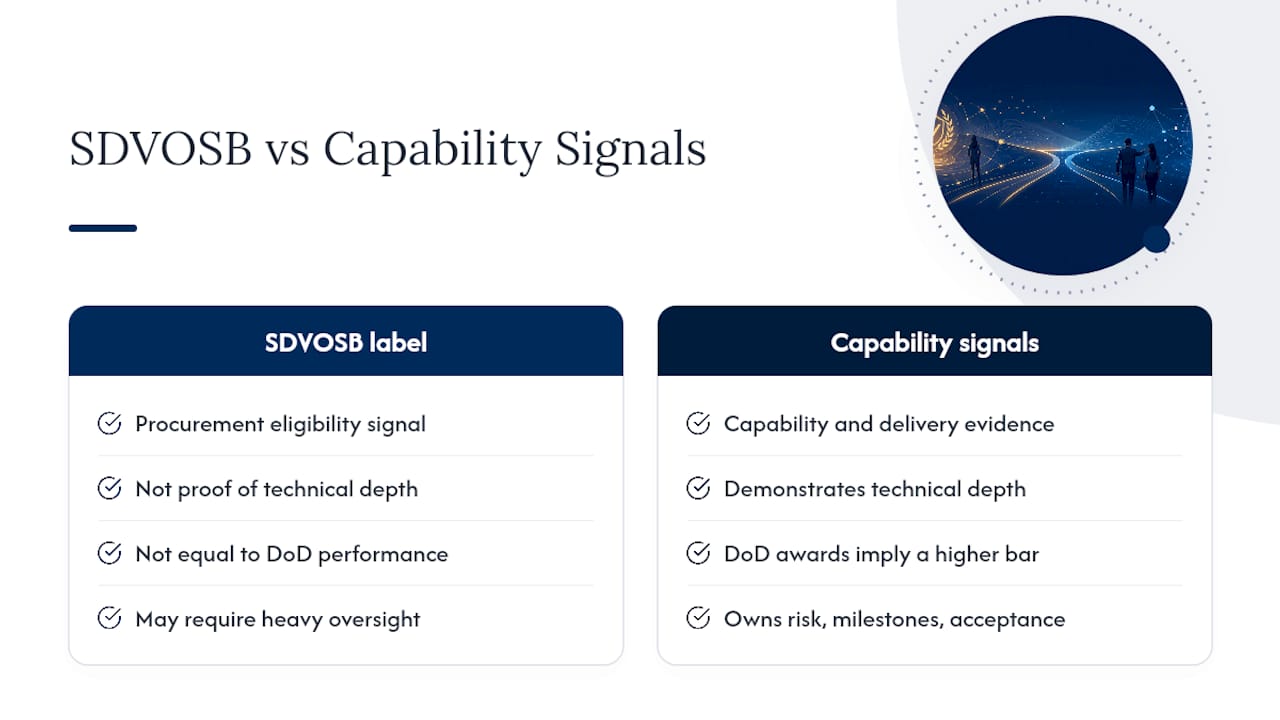
The SDVOSB designation is a procurement eligibility signal, not a capability signal. That distinction gets blurred constantly in federal contracting discussions, and it creates real risk for procurement officers who treat certification status as a proxy for technical depth.
DecisionPoint's public record suggests a firm that has earned its contract history through sustained performance rather than certification alone. The DoD concentration in its award history is a meaningful indicator: defense agencies run rigorous past-performance evaluations, and a firm that repeatedly wins in that environment has cleared a higher bar than one with a purely civilian portfolio.
The more useful question for any procurement team is not "Are they SDVOSB?" but "Can they own a defined deliverable and sign off on acceptance criteria without requiring heavy oversight?" That is where the evaluation gets interesting. Staff augmentation and outcome-owned delivery look similar on a capabilities statement but produce very different program experiences. Firms that can articulate clear acceptance criteria, milestone structures, and risk ownership are the ones worth shortlisting, regardless of their certification mix.
Primereadysub delivers outcome-owned government IT modernization
Prime contractors and agencies that need a subcontractor to own a defined modernization scope, not just fill seats, have a direct alternative in Primereadysub. Rutledge & Associates, LLC brings SDVOSB, woman-owned, and SBA-certified credentials alongside a delivery model built around fixed work packages: legacy system re-architecting, DevOps pipeline implementation, compliance automation, and real-time analytics dashboards, each scoped and accepted against clear criteria.
The firm operates primarily in Maryland, New York, and Florida, working with both state agencies and federal prime contractors on compliance-heavy programs where audit readiness and real-time program visibility are non-negotiable. For primes evaluating subcontractor partnership structures, Primereadysub's low-oversight delivery model reduces program management burden without sacrificing accountability. To discuss a specific scope or request a capabilities statement, visit primereadysub.com.
Useful sources for verifying DecisionPoint's public record
The following sources support the facts in this article and are the recommended starting points for independent verification:
- DecisionPoint Corporation
- Working at DecisionPoint Corporation
- careers-decisionpointcorp.icims.com
- bing.com
- Decisionpoint Corporation — Federal Contracts, UEI GPASKFTTVQL9 | BesaGov
- SBA DSBS profile — DECISIONPOINT CORPORATION
- lnkd.in
Always cross-reference certification status against live SAM.gov and SBA DSBS records. Registry data can lag behind actual status changes, and no third-party profile, including this article, substitutes for a direct registry check.