

Procurement should require a vendor to own technical change control end to end, not staff it. That means automated, signed promotion records; integration with the configuration management database and CI/CD pipeline; enforced environment separation; and rollback capability the vendor can demonstrate on demand. Success is measured by three things: audit exports that satisfy an Office of Inspector General request without manual assembly, remediation timelines that meet CISA requirements, and a change failure rate the vendor tracks and reports monthly.
TL;DR:
- Vendors must demonstrate automated, signed promotion records, environment separation, and rollback capabilities aligned with NIST and CISA standards.
- Change scope should include CI/CD gates, artifact immutability, CMDB integration, and documented security impact analyses for significant system changes.
- The pipeline must produce an automatic, audit-ready evidence package including manifests, logs, scans, approvals, and CMDB snapshots during change promotion.
- Governance structures require formal charters, named change managers, and approved procedures for routine, emergency, and significant changes, with clear SLAs.
- Contracts should hold vendors accountable for outcome ownership, automating evidence exports, and mapping deliverables to security and compliance frameworks before implementation.
Table of Contents
- Scoping Change Management for Agencies: What to Put in the SOW
- How Do NIST and CISA Standards Shape Change Control?
- What Does a Secure, Auditable Release Pipeline Look Like?
- Governance: CCRB, Change Managers, and Emergency Change Handling
- Building Audit Readiness Into Monitoring and Logging
- Procurement Checklist: What to Require and How to Score It
- A Practitioner's View on Why Most Release Programs Fail
- Rutledge & Associates: Owning Your Change-Control Work Package
- Sources
Scoping Change Management for Agencies: What to Put in the SOW
The phrase "change management for agencies" means little to a solicitation officer until it converts into line items. A vendor should be able to point to specific technical components in the statement of work, not describe a philosophy.
At minimum, the scope should require:
- CMDB integration and asset tagging so every change ties to a documented configuration item, consistent with the baseline expectations in NIST SP 800-128.
- Environment separation across dev, test, stage, and production, with documented promotion criteria between each.
- CI/CD gates that block a deployment automatically when a security scan, test suite, or approval record is missing.
- Artifact immutability, meaning nothing built and tested in stage can be altered before it reaches production.
- Signed promotions, where each deployment carries a cryptographic signature tying it to a specific approved change record.
- Rollback plans documented and tested, not theoretical.
Routine changes need a standard approval path and CMDB update. Emergency changes need a compressed approval window with mandatory post-implementation review. Significant system changes, the kind that touch authorization boundaries, need a security impact analysis before anyone opens a ticket. At demo, ask the vendor to show a completed change record for each category, not a template.
How Do NIST and CISA Standards Shape Change Control?
Federal guidance is not abstract when it comes to change control. It dictates specific gates a vendor's pipeline must pass through before procurement should accept the work.
CISA's configuration and change management guidance calls for a documented configuration and change management plan with a change control board, impact-analysis templates, and continuous monitoring built in from the start. NIST SP 800-128 goes further, framing security-focused configuration management as four connected phases: planning, baselining, controlling changes, and monitoring. A vendor that treats these as sequential paperwork rather than a continuous loop is not ready for a compliance-heavy program.
The Risk Management Framework in NIST SP 800-37 ties authorization decisions directly to continuous monitoring, which is why FedRAMP-authorized cloud offerings or third-party assessment organization evidence often belong in the SOW for any cloud-hosted work package. Skipping that requirement invites an authorization gap later.
Pro Tip: Require the vendor to map each SOW deliverable to a specific control family in the RMF. If they can't do this in the proposal, they haven't operationalized the framework yet.
CISA's BOD 26-04 mandates that agencies automate reporting through CDM dashboards and meet Known Exploited Vulnerabilities remediation timelines. Build that expectation directly into the vendor's SLA. Review the federal compliance obligations that typically accompany these programs before finalizing contract language.
- Require documented SecCM phases in the technical proposal.
- Require FedRAMP authorization evidence or 3PAO documentation for any cloud component.
- Require automated CDM-compatible reporting tied to KEV timelines.
What Does a Secure, Auditable Release Pipeline Look Like?
A vendor's pipeline architecture is where theory turns into evidence. Procurement should ask to see the actual promotion path, not a slide describing one.
A defensible pipeline runs on promotion tracks: code moves from dev to test to stage to production, and at each boundary an automated gate checks security scan results, test coverage, and an existing approval record before allowing the promotion to continue. Nothing should move because someone approved it in a hallway conversation.
Artifact immutability and cryptographic signing close the loop. Once a build passes testing in stage, it gets signed and that exact artifact, not a rebuilt version, is what reaches production. This is the mechanism that prevents the classic government IT failure: a "small tweak" made after testing that never gets logged anywhere.
Here is the integration chain procurement should verify during evaluation:
- CI/CD system triggers a build and runs automated tests.
- Security scanners run against the build and log results automatically.
- CMDB receives an automatic update reflecting the proposed configuration change.
- Approval workflow captures sign off with a timestamp and identity record.
- Evidence export packages the manifest, logs, scan results, and approvals into a single audit-ready file.
During a demo, ask the vendor to run one change through this full chain live. If they cannot, the pipeline exists on paper only. This kind of architecture also underpins the six-step release management approach that treats evidence capture as automatic rather than a scramble before an audit.
Governance: CCRB, Change Managers, and Emergency Change Handling
Governance structure is where a lot of vendor pitches fall apart under scrutiny. A CCRB or CCB needs a real charter, not a rotating list of names on a slide.
- The charter should define who signs off on routine changes versus significant ones, matching the categories in state-level change and configuration policies that many agencies already follow.
- A named change manager should be accountable for producing a complete change record for every request: risk assessment, rollback plan, test evidence, and approval trail.
- Approval SLAs need documented turnaround times by change category, and the emergency-change process needs a compressed but still auditable approval path with a mandatory post-implementation review within a set number of business days.
Vendors who cannot name their change manager or describe the CCRB's actual meeting cadence are staffing the function, not owning it.
Building Audit Readiness Into Monitoring and Logging
Auditors do not want a narrative. They want an evidence packet that answers their question without a follow-up meeting. A minimal audit-ready packet includes a signed artifact manifest, build and test logs, security scan outputs, timestamped approval records, and CMDB snapshots from before and after the change.
Set a reporting cadence that matches agency review cycles, and automate exports so OIG requests and CISA KEV remediation timelines never trigger a manual scramble. Automating this evidence capture in the pipeline turns what used to take weeks of manual collection into a near-instant export, which is the single biggest efficiency gain most modernization programs see once change control moves off spreadsheets.
- Signed artifact manifests and code diffs
- Test results and security scan outputs
- Timestamped approval logs
- CMDB snapshots, pre and post change
Procurement Checklist: What to Require and How to Score It
Turn every requirement above into contract language before the solicitation goes out, not after award. Require outcome ownership of the change-control function, not augmented staff. Require an automated audit packet, signed artifacts, CMDB integration, and demonstrated rollback for every proposed release.
Score proposals against a rubric with weighted categories:
- Automation depth — does the pipeline generate evidence automatically or manually?
- Evidence exports — can the vendor produce a complete audit packet on request within hours?
- Compliance alignment — does the proposal map directly to RMF, SecCM, and CISA remediation obligations?
- Public-sector experience — has the vendor delivered this exact work package for a government client before?
- Pilot metrics — cycle time, defect escape rate, and audit packet completeness during a trial run.
Pro Tip: Before awarding a large work package, run a two-release pilot on one high-risk application. Measure whether the vendor's promotion gates and audit exports hold up under a real deadline, not a demo environment. Cross-reference these criteria against a broader vendor selection framework before finalizing your scoring sheet.
A Practitioner's View on Why Most Release Programs Fail
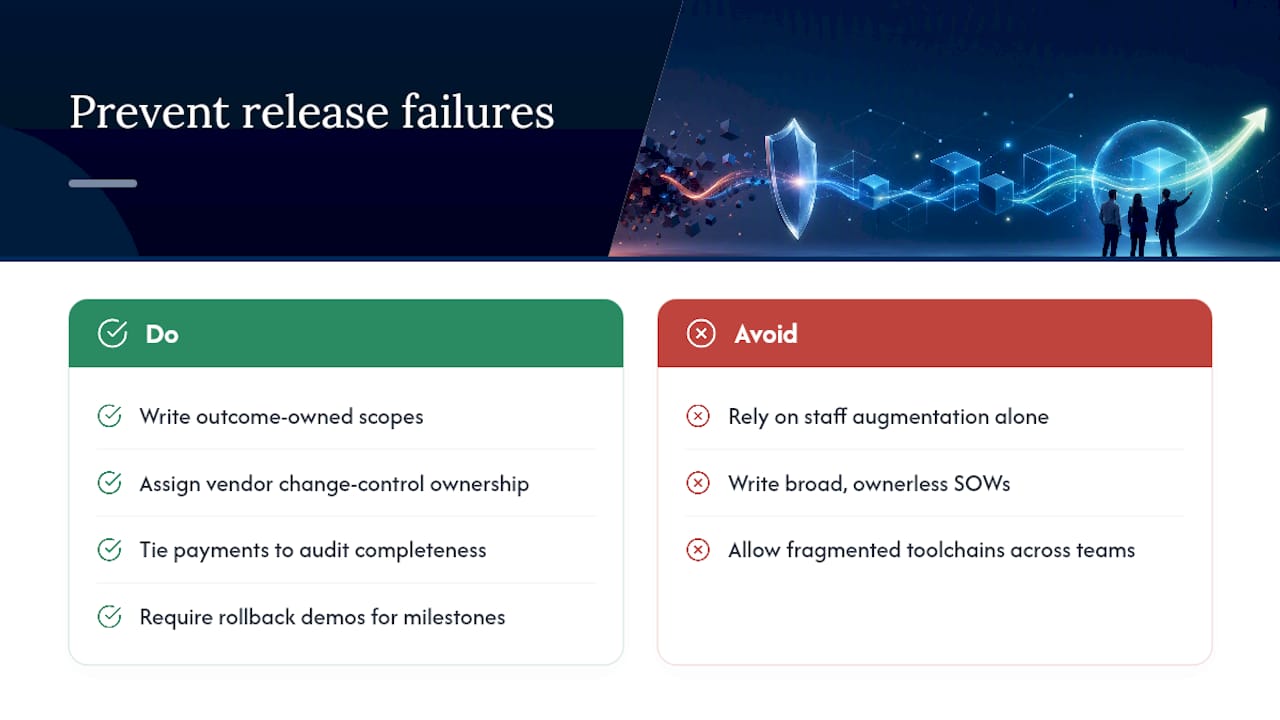
Most release failures trace back to the same three causes: an undocumented tweak made after testing, a toolchain fragmented across teams that never talk to each other, and a SOW written broadly enough that nobody actually owns the outcome. None of these are technology problems first. They're contract and process problems that technology later has to compensate for.
Outcome-owned scopes fix the incentive structure. When a vendor owns the change-control function, they carry the audit risk, which means they build the automation whether or not procurement thinks to ask for it. Staff augmentation rarely produces that behavior because the accountability sits with the agency, not the contractor. Write contracts that tie payment milestones to audit packet completeness and rollback demonstration. That single clause does more to reduce program risk than any amount of oversight staffing. Programs that skip this discipline tend to repeat the same modernization mistakes year after year.
— Randy
Rutledge & Associates: Owning Your Change-Control Work Package
Some vendors present themselves as alternatives to staff augmentation for agencies that need change control actually owned, not just staffed. Certain firms deliver modernization work as defined, outcome-owned scopes: DevOps pipelines, compliance automation, and real-time audit-ready dashboards built to hold up under an OIG request or a CISA remediation deadline. If your agency or prime contract needs a vendor who will own the promotion gates, the signed artifacts, and the audit exports instead of adding headcount to your existing team, request a capability briefing and scope a pilot work package before your next solicitation closes.
Sources
- CRR Supplemental Resource Guide, Volume 3: Configuration and Change Management
- NIST Special Publication 800-128: Guide for Security-Focused Configuration Management of Information Systems