

NIEM (National Information Exchange Model) is a standards-based data model paired with community governance and tooling that lets U.S. government organizations exchange information through reusable, consistent packages called IEPDs. The one-line verdict: adopt NIEM when you need repeatable, multi-agency exchanges; skip it for a one-off internal database with no external partners.
- Reusable IEPDs cut integration time between agencies because documented exchange packages let others implement without renegotiating business rules
- NIEM fits multi-agency data sharing, court-to-corrections handoffs, and any exchange that will recur across jurisdictions
- Skip NIEM for a single-system internal store with no outside consumers. The governance overhead isn't worth it there
Key Takeaways
NIEM succeeds when agencies treat the IEPD as a reusable business and technical package, not a one-off schema, and back it with disciplined mapping and version governance.
| Point | Details |
|---|---|
| NIEM's core value is reuse | Documented IEPDs let other agencies implement exchanges faster without renegotiating business rules. |
| Mapping discipline drives quality | Mark every unmatched element "no match" explicitly; blank cells create review ambiguity later. |
| Governance sits above schema work | NBAC and domain subcommittees oversee naming, extensions, and release cadence under NDR conformance rules. |
| Modernize toward JSON-LD carefully | Maintain XML conformance for legacy partners while publishing JSON-LD-friendly contracts for new consumers. |
| Defined-scope help speeds delivery | Primereadysub owns IEPD development, schema engineering, and validation automation as outcome-based work packages for agencies and prime contractors. |
Table of Contents
- What Are the Core Components of the NIEM Data Model?
- How Do You Build a Conformant IEPD?
- Which Tools Help You Work With NIEM Schemas and Artifacts?
- What Mistakes Slow Down NIEM Adoption?
- How Do You Scope Your First NIEM Exchange Project?
- Where Is NIEM Actually Used Today?
- How Does NIEM Compare to UBL and HL7?
- Can You Extend NIEM for Agency-Specific Needs?
- What Security and Privacy Steps Does a NIEM Exchange Need?
- Why Treating IEPDs as Business Agreements Changes Everything
- How Primereadysub Supports Agencies Building NIEM Exchanges
- Sources
What Are the Core Components of the NIEM Data Model?
NIEM organizes its vocabulary into namespaces so two agencies never accidentally define "Person" or "Case" differently. This structure is what makes the model interoperable instead of just a shared glossary.
- NIEM Core holds universal concepts (Person, Location, Activity) that apply across every domain, from justice to health to emergency management.
- Domain namespaces (immigration, justice, human services, and others) extend Core with subject-specific types, and each domain has its own governance subcommittee reporting up through the NIEM Business Architecture Committee, which coordinates naming and prevents domains from duplicating each other's work.
- Code sets standardize controlled values (state abbreviations, offense codes) so a code means the same thing regardless of which system sent it.
- Adapters and utility/auxiliary namespaces connect NIEM to external standards and support linked-data patterns, letting a message reference an outside vocabulary without breaking NIEM conformance.
Types and properties live inside their namespace, which is how NIEM avoids naming collisions at scale. NDR releases track major and minor version numbers, and the current model artifacts, schemas, and governance documentation are published through the OASIS NIEMOpen project.
How Do You Build a Conformant IEPD?
The Information Exchange Package Documentation, or IEPD, is the actual deliverable teams produce, and building one follows a fairly predictable arc: analyze requirements, map and model, build and validate, then package and publish.
Start by writing down exactly what data needs to move between systems and why. Skip this step and you'll spend weeks later reworking a schema that never matched what the business actually needed.
The mapping phase is where most of the real work happens. You build a mapping spreadsheet that lists every data element your exchange requires, then works through each one against existing NIEM components:
- Does an existing NIEM Core or domain element already mean exactly this? Reuse it.
- Does a NIEM element mean almost this, but needs a constraint or additional detail? Augment it.
- Is the concept genuinely new to NIEM? Extend the model with a local element.
- Does the relationship between two objects need its own structure? Model it as an association.
- Does an entity play a specific part in that relationship? Capture it as a role.
- Found nothing close? Mark it "no match" explicitly rather than leaving the cell blank.
That last point matters more than it looks. Marking "no match" on purpose, instead of leaving a row empty, prevents reviewers from wondering later whether the mapping was ever finished at all.
Pro Tip: Run your first mapping pass with a small, bounded exchange, maybe 15 to 20 data elements, before tackling a full case file or benefits application. Mapping skill builds fast once your team has done it once end to end.
Once mapping settles, build the exchange schema as a subset of NIEM components, validate sample instances against it, and assemble the final IEPD: schemas, business rules documentation, points of contact, lineage information, and validation artifacts, all bundled so another agency can implement it without starting from zero.
Which Tools Help You Work With NIEM Schemas and Artifacts?
Two tools do most of the heavy lifting for finding and subsetting NIEM components. SSGT (Schema Subset Generation Tool) searches any NIEM release and exposes full property, type, and code set metadata, including associations that other tools sometimes miss. Movement offers a faster, more modern interface for the same search task but doesn't always surface every metadata detail SSGT does, so many teams use Movement for quick lookups and SSGT when they need the full picture.
Beyond the tools themselves, the reference artifacts you'll actually download and work with include:
- Core XSD schemas and domain schemas for the release version your exchange targets
- Adapter and auxiliary schemas for connecting to external standards
- CSV and JSON-LD artifacts published alongside the XML catalog for each release
NDR conformance rules apply regardless of serialization, whether you're validating an XML instance or a JSON-LD payload. If your agency is modernizing toward API-friendly exchanges, the NIEMOpen community is actively extending JSON-LD support, which means you can plan a payload that satisfies NDR conformance while staying friendly to modern REST consumers.
What Mistakes Slow Down NIEM Adoption?
The single biggest reuse killer is treating the IEPD as pure schema documentation instead of a shared business agreement. Teams that write up business rules, real use case examples, and named points of contact inside the IEPD see faster adoption by the next agency that picks it up, because that next team isn't stuck re-negotiating meaning from scratch.
Common pitfalls to watch for:
- Leaving mapping spreadsheet cells blank instead of marking them "no match," which creates ambiguity in later reviews
- Building a brand-new local element when an existing NIEM Core or domain component already covers the same meaning
- Skipping version planning, so a domain release update silently breaks a production exchange
- Publishing an IEPD without stakeholder sign-off, which means the "final" package gets revised twice more before anyone actually uses it
Pro Tip: Keep a running "wantlist" output from SSGT as you map. It becomes the seed file for your schema subset generation step and saves you from re-searching the same components twice.
Version discipline deserves special attention. NIEM releases move on a defined cadence, and an exchange built against one release won't automatically validate against the next without a deliberate migration plan. Build automated conformance checks into your pipeline early rather than relying on manual schema review before each deployment.
How Do You Scope Your First NIEM Exchange Project?
Getting a first IEPD off the ground takes a small, specific team and a realistic sense of what "done" looks like.
- Staff a business lead who owns requirements and stakeholder sign-off, a data modeler who runs the mapping spreadsheet, a schema engineer who builds the subset and validation rules, a QA resource who tests real instances, and an integrator who wires the exchange into production systems.
- Scope your minimum deliverables up front: mapping spreadsheet, exchange schema subset, sample instances, business rules documentation, and points-of-contact metadata. That's the floor for a publishable, reusable IEPD.
- Budget time realistically. A small, well-bounded exchange (one data category, two trading partners) commonly moves through mapping, building, and validation over several weeks to a few months; discovery and mapping usually consume more calendar time than schema construction itself.
- Build in governance checkpoints: identify your domain's governance contact early, flag any new component proposals to the relevant domain subcommittee, and publish the finished IEPD where other agencies can find it.
Cost drivers cluster around three areas: how much discovery and stakeholder alignment your requirements need, how many "no match" elements require new modeling work, and how much you invest in automated validation versus manual review.
Where Is NIEM Actually Used Today?
NIEM's roots are in justice and public safety, and that's still where the deepest reuse lives. Court systems exchange case filings and disposition data with corrections and law enforcement using IEPDs built years ago and refined incrementally rather than rebuilt from scratch. A county court publishing a new case status update to a state repository can reuse an existing justice-domain IEPD instead of negotiating a new data contract with every downstream consumer.
Human services agencies use NIEM for benefits eligibility exchanges, particularly where a case touches multiple programs, SNAP, Medicaid, child welfare, and needs to reference the same person and household data consistently across systems that were never designed to talk to each other. Emergency management exchanges lean on NIEM for incident reporting and resource requests during multi-jurisdiction response, where a shared vocabulary for "incident," "resource," and "location" matters more than almost any other feature of the exchange.
Immigration and biometric identity systems use NIEM's domain extensions to standardize how identity attributes move between federal systems and their state and local partners. Screening and vetting programs benefit especially from Core's person and identity types, since the same underlying concept, a name, a date of birth, a biometric reference, needs to mean exactly the same thing whether it originated in a federal system or a state one.
What ties these scenarios together isn't the subject matter. It's that each involves more than one agency, a recurring exchange rather than a one-time data pull, and a real cost to getting the shared vocabulary wrong.

How Does NIEM Compare to UBL and HL7?
NIEM, UBL, and HL7 all solve the same underlying problem, getting two systems to agree on what data means, but they solve it for different worlds.
UBL (Universal Business Language) targets commercial transactions: purchase orders, invoices, shipping notices. It's the right fit when your exchange is fundamentally a business document moving between trading partners in a supply chain. NIEM's justice, human services, and emergency management domains have no real equivalent in UBL, because UBL was never built for case files or incident reports.
HL7 (and its modern FHIR profile) governs clinical and health information exchange specifically. If your agency's exchange is genuinely about patient records, lab results, or clinical encounters, HL7 FHIR is the domain-appropriate standard, not NIEM. Where the two overlap, human services programs that touch health data, agencies sometimes bridge the two: HL7 for the clinical payload, NIEM for the surrounding case and program context.
NIEM's actual scope advantage is breadth across government subject areas rather than depth in any single vertical. It covers justice, immigration, emergency management, human services, and intelligence sharing under one governance structure, which matters most when your exchange crosses agency and domain boundaries rather than staying inside one specialty. Choosing between them isn't about which standard is "better." It's about matching the standard's native domain to what's actually moving through your exchange.
Can You Extend NIEM for Agency-Specific Needs?
Every agency eventually hits a data element that NIEM's Core and domain namespaces don't cover, and that's expected, not a failure of the model.
The mapping process itself tells you when extension is warranted: if your spreadsheet mapping comes back "no match" for a genuinely agency-specific concept, that's your signal to build a local extension rather than force-fitting an existing NIEM element that means something slightly different. Extension schemas live alongside the core NIEM components you're reusing, following the same NDR naming and design conventions so your custom elements stay conformant.
Before extending, check the augmentation and association patterns first. Augmentation lets you add agency-specific properties to an existing NIEM type without redefining it entirely, which preserves reuse with other agencies using the base type. Association lets you model a relationship (a person's role in an incident, say) without cramming it into either object's definition. Both options preserve more compatibility with other NIEM adopters than a full extension does.
The discipline that matters most here is documentation. An agency-specific extension that isn't documented with the same business-rule context as the rest of the IEPD becomes a maintenance burden the moment staff turnover hits. Treat your extension namespace with the same rigor you'd apply to a Core element: name it clearly, document what problem it solves, and note why existing NIEM components didn't cover it. That context is what lets the next agency evaluating your IEPD decide whether your extension fits their needs too, or whether they need one of their own.
What Security and Privacy Steps Does a NIEM Exchange Need?
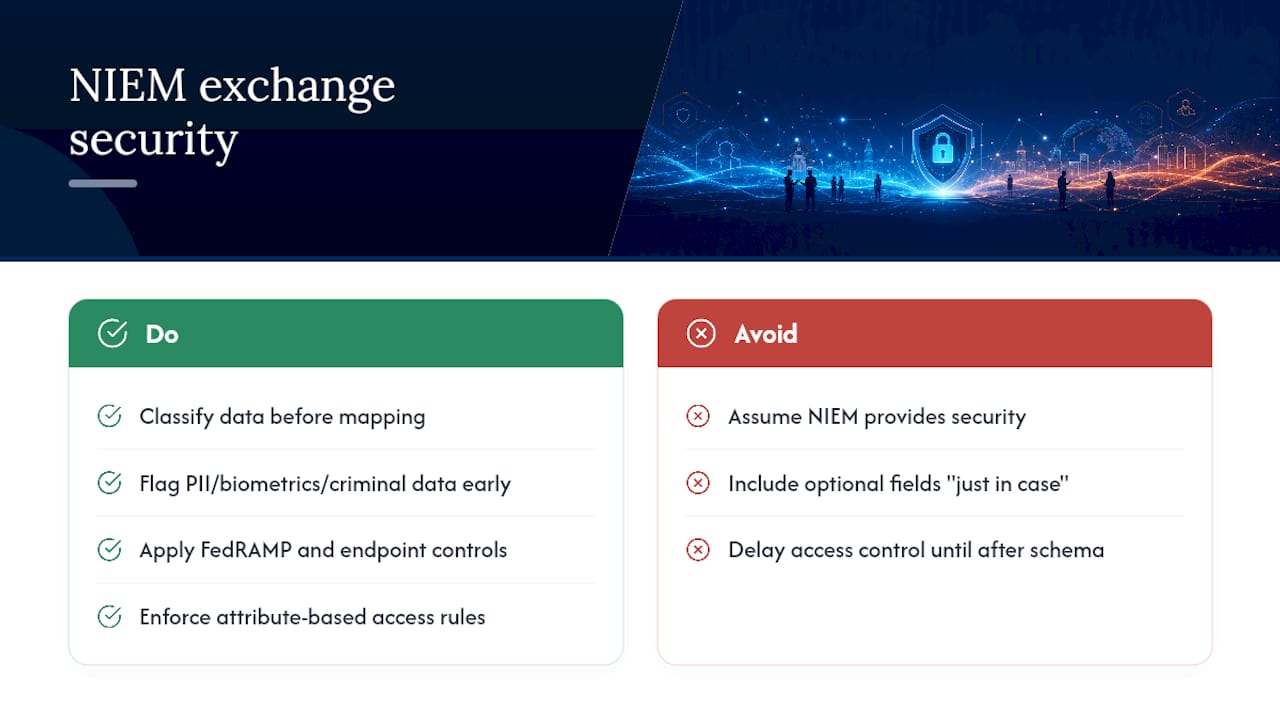
NIEM defines data structure and vocabulary. It doesn't define your agency's security posture, which means every NIEM exchange still needs its own security and privacy design layered on top of the schema work.
Start with data classification before you map a single element. Personally identifiable information, criminal history, and biometric identifiers each carry different handling requirements, and knowing which mapped elements fall into which category shapes both your transport security and your access control design. NIEM Core's person and identity types make it easy to include sensitive attributes in an exchange schema without a second thought, so flag those elements explicitly during the mapping phase rather than after the schema is built.
Transport and endpoint security follow standard federal and state security frameworks, FedRAMP for cloud-hosted exchange endpoints, and your agency's own authorization boundary requirements, rather than anything NIEM-specific. NIEM doesn't replace that layer; it sits inside it. Access control needs the same treatment: an IEPD's schema doesn't restrict who can query or receive fields, so agencies typically build attribute-based access rules into the API or messaging layer that carries the NIEM payload.
Data minimization deserves particular attention in the mapping phase itself. Because NIEM makes it easy to reuse existing types that already carry many optional properties, it's tempting to include fields "just in case" a downstream consumer wants them later. Resist that. Map only what the specific exchange actually requires, and revisit the IEPD deliberately when a genuine new requirement appears, rather than over-including sensitive fields by default.
Why Treating IEPDs as Business Agreements Changes Everything
The gap between NIEM projects that get reused and ones that quietly die after launch almost never comes down to schema quality. It comes down to whether the team wrote the IEPD as a genuine business agreement, with real use cases, named contacts, and plain-language rules, or treated it as a technical afterthought bolted onto an XSD.
Rutledge & Associates has built its modernization work around that same principle: own a defined scope, document it so thoroughly that another team could pick it up without a single clarifying call, and measure success by whether the artifact gets reused, not just whether it validates. Agencies that apply this discipline to NIEM exchanges consistently report shorter integration cycles on the next project and cleaner audit trails when reviewers ask how the data got from one system to another.
— Randy
How Primereadysub Supports Agencies Building NIEM Exchanges
Primereadysub owns defined-scope work packages for the technical work that slows most NIEM projects down: IEPD development, schema engineering against current NDR conformance rules, and validation automation that catches mapping errors before they reach production. As an SDVOSB and woman-owned, SBA-certified firm serving public-sector clients in Maryland, New York, and Florida, Primereadysub builds DevOps pipelines that turn manual conformance checks into automated gates, which matters most when a domain release update threatens to break an exchange nobody remembers building.
Instead of staff augmentation, Primereadysub takes ownership of the scope itself: the mapping spreadsheet, the schema subset, the validation harness, delivered as outcomes rather than hours billed. For a prime contractor or agency team scoping a first exchange, that means one accountable party for the artifact instead of a rotating cast of contractors.
If your team is scoping a NIEM exchange and wants a defined-scope discovery conversation, start with Primereadysub's modernization approach.
Sources
- Mapping spreadsheet guidance (NIEM reference)
- NIEM reusability and government adoption note (ACF/CB)