

The most effective public sector leaders share a quality that rarely appears in performance reviews: they make difficult transformations look easy. This quality has a name. Sprezzatura, the Renaissance principle of studied effortless grace, offers a precise framework for sprezzatura management consulting that goes well beyond aesthetics. Drawn from Baldassare Castiglione's writing, the concept describes concealing skill behind ease and applies with surprising directness to how government managers lead complex change programs. This article explains how that works in practice.
Table of Contents
- Key Takeaways
- What sprezzatura management consulting actually means
- Efficiency through system design, not visible effort
- Cultural adaptability and change management
- Practical steps for public sector executives
- My perspective on sprezzatura in government consulting
- How Primereadysub helps you apply this in practice
- FAQ
Key Takeaways
| Point | Details |
|---|---|
| Sprezzatura defined | The concept describes deliberate, practiced composure that conceals effort, making leadership appear natural and authoritative. |
| Efficiency through design | Removing layered intermediaries and building clear governance cadences reduces friction and speeds delivery in public sector programs. |
| Change management application | Aligning leadership behavior, culture, and delivery discipline helps workforce transitions feel natural rather than disruptive. |
| Internal rigor is non-negotiable | External ease must be backed by strong documentation and risk transparency to protect compliance and auditability. |
| Sustainability matters | Embedding capabilities during consulting engagements allows agencies to sustain change independently after the engagement ends. |
What sprezzatura management consulting actually means
The word itself traces directly to Baldassare Castiglione's The Book of the Courtier, written in 1528. Castiglione used it to describe the ideal courtier's manner: skilled, composed, and visibly unstrained, regardless of the preparation required to reach that state. The deliberate concealment of effort was not deception. It was craft.
This distinction matters in consulting. Modern leadership theory has picked up this thread, framing sprezzatura as practiced composure that hides preparation while projecting calm competence. For public sector executives managing large IT modernizations, procurement reforms, or multi-agency change programs, that distinction separates leaders who command trust from those who generate anxiety.
The contrast worth understanding is between genuine composure and performative bravado. Genuine composure comes from preparation, clear decision frameworks, and a governance system that removes daily firefighting. Performative bravado, the consultant or executive who projects confidence without underlying rigor, collapses quickly under scrutiny. Stakeholders in government settings are particularly attuned to the difference.
Principles that define sprezzatura in a consulting context include:
- Studied preparation: Significant effort invested before any visible delivery, so execution appears fluid
- Decision clarity: Authority and decision rights are unambiguous, removing hesitation at critical moments
- Proportionate communication: Reporting and briefing are calibrated to the audience, not the complexity of the internal work
- Authentic rather than theatrical leadership: Composure is earned through preparation, not manufactured through presentation style
The concept's application in real contracting is already visible. Sprezzatura Management Consulting LLC has secured government contract values exceeding $154M, demonstrating that this philosophy translates directly into competitive credibility in the federal sector.
Efficiency through system design, not visible effort
Public sector consulting engagements frequently suffer from the same structural problem: too many layers between diagnosis and delivery. Each layer adds latency, cost, and the opportunity for misalignment. The sprezzatura model treats this as a design failure, not a personnel issue.
Systems-thinking in consulting points directly at this problem. When consultants work direct from discovery to implementation, removing unnecessary intermediaries, delays shrink and cost-effectiveness improves. The work does not become simpler. The system that holds the work becomes smarter.
Operationally, this plays out through several deliberate choices:
- Scope ownership over staff augmentation: Consultants own a defined scope and are accountable for outcomes, rather than filling headcount gaps that diffuse accountability.
- Integrated operational frameworks: A single framework governs discovery, design, implementation, and measurement rather than separate workstreams with separate reporting chains.
- Governance cadence design: Recurring decision forums with clear decision rights create predictable rhythms. Stakeholders experience calm leadership because the system removes reactive firefighting before it starts.
- Pre-built compliance automation: For public sector programs where audit readiness is non-negotiable, automation handles routine compliance checks so the consulting team focuses on higher-order decisions.
The result is what Castiglione would recognize: effort hidden under ease. Stakeholders and oversight bodies see a program running cleanly. The preparation, the governance design, and the compliance architecture are invisible precisely because they work.
Pro Tip: When entering a new consulting engagement, map every coordination touchpoint before proposing a delivery model. Remove any touchpoint that does not directly produce a decision or an output. Government programs tend to accumulate coordination overhead over years; most of it adds latency without adding value.
Cultural adaptability and change management
The most technically sound transformation program will stall if the workforce does not adopt it. This is where sprezzatura becomes a genuine change management tool rather than a leadership style preference.

Change-capability frameworks that integrate leadership behavior, culture, and delivery discipline create stable routines. When those routines are well-designed, behavior change feels natural to the people experiencing it. That is the central mechanism. Sprezzatura in change management means the transition appears low-friction because the preparation absorbed the friction in advance.
Traditional change management methods and sprezzatura-inspired approaches differ in ways that matter for public sector adoption:
| Dimension | Traditional approach | Sprezzatura-inspired approach |
|---|---|---|
| Communication style | Detailed status updates emphasizing complexity | Calibrated messaging that conveys confidence and clear next steps |
| Stakeholder engagement | Frequent check-ins to manage anxiety | Structured forums with decision clarity that reduce reactive engagement |
| Leadership visibility | Leaders signal effort and urgency | Leaders project stability while preparation absorbs risk |
| Workforce transition | Change events punctuate normal operations | Change is embedded into governance routines so it feels continuous |
| Documentation | Often reactive and compliance-driven | Maintained internally with rigor; external reporting is clean and proportionate |
There is a specific trap that public sector change programs fall into: over-explaining. When leaders feel the need to demonstrate effort by communicating every complication, they inadvertently create stakeholder anxiety. Castiglione called the opposite of sprezzatura affectation, the visible straining that signals insecurity rather than competence. In a government context, affectation looks like weekly status reports that bury decisions in complexity, or town halls that surface problems without resolution paths.
Outcome-based consulting engagements that address leadership alignment, culture transformation, and workforce solutions are designed to avoid this pattern. The public sector focus on measurable success gives managers a concrete anchor for calibrating communication: report on progress toward outcomes, not on the effort expended.
Key behaviors that support this model include:
- Communicating decisions rather than deliberations
- Maintaining a private space for complex problem-solving that does not enter stakeholder reporting
- Framing workforce transitions around capability gains rather than process disruptions
- Using agency collaboration improvements as leading indicators of adoption, not lagging indicators of resistance
Practical steps for public sector executives
Adopting sprezzatura principles in management consulting engagements requires specific behavioral and structural choices. The concept does not arrive naturally under pressure. It is built before pressure arrives.
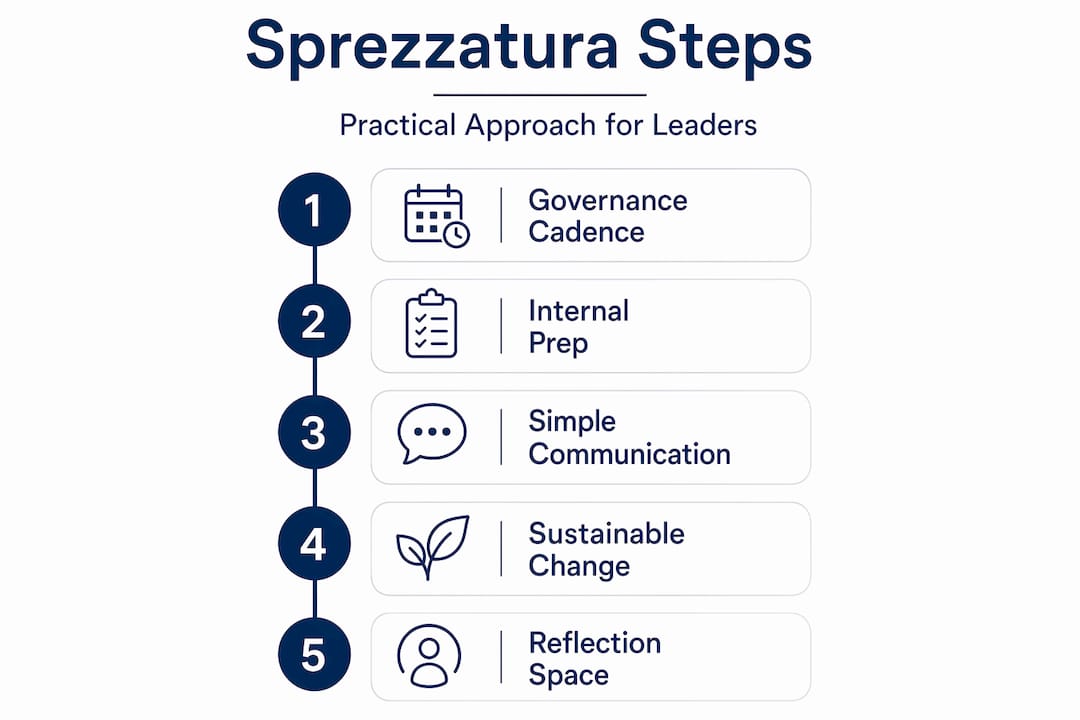
The following approach translates the principles into practice for government managers and executives:
Step 1: Establish your governance cadence before the work begins. Identify who makes which decisions, at what frequency, and with what inputs. This single action removes more reactive leadership behavior than any coaching program.
Step 2: Separate internal preparation from external communication. Build detailed risk registers, dependency maps, and compliance documentation for your team. Communicate to stakeholders in terms of outcomes and decisions. The depth stays internal; the clarity goes external.
Step 3: Simplify your communication without reducing substance. Most government executives over-communicate complexity because they equate thoroughness with credibility. A one-page decision brief that is acted upon demonstrates more competence than a 40-slide deck that generates questions.
Step 4: Build for sustainability from day one. Sustainable change ownership requires capability building inside the agency so the organization can continue adaptive work after the consulting engagement closes. If the program cannot operate without the consultant, the engagement has not finished its job.
Step 5: Create a private reflection space. High-performing executives in complex programs schedule time outside of delivery cycles to assess what is working and recalibrate. This is not a luxury. It is where the preparation happens that makes execution look effortless.
Pro Tip: Under-documentation is the most common failure mode in sprezzatura-inspired consulting. The external ease can become a habit that erodes internal rigor. Maintain evidence-based diagnostics and adoption tracking internally, regardless of how clean the stakeholder narrative appears. Compliance audits do not care how composed your leadership looked.
Additional behaviors worth building as standing habits:
- Review decision rights at the start of each program phase, not just at kickoff
- Assign a single owner for each defined scope, not a committee
- Use real-time dashboards for internal monitoring while keeping external reporting focused on outcomes
- Debrief after each major milestone on what preparation reduced visible strain, and do more of it next time
My perspective on sprezzatura in government consulting
I have watched enough public sector transformation programs to know that the ones with the most visible leadership effort are rarely the ones that succeed. The program manager who arrives at every steering committee with a stack of escalations is signaling a governance problem, not demonstrating diligence. Stakeholders read that signal accurately.
What I have seen work, repeatedly, is the inverse. Leaders who have done the hard preparation work upstream, who have clear decision frameworks and honest internal documentation, arrive at those same forums with three things: a status, a decision needed, and a recommendation. That is sprezzatura in practice. It is not performed calm. It is earned calm.
The caution I would offer is about the internal dimension. The concept is sometimes misread as a license to underdocument. It is not. The internal rigor must remain uncompromised even as the external presentation stays clean. In compliance-heavy government programs, that distinction is the difference between a successful audit and a program shutdown.
Looking at where this matters most going forward, the volume of information that government executives are expected to process is accelerating. AI tools are beginning to simulate sprezzatura by generating polished outputs from complex inputs. But the underlying judgment, the decision clarity, the governance discipline, is still human work. That is where the real value sits.
— Randy
How Primereadysub helps you apply this in practice
The principles described here work best when they are built into the structure of a consulting engagement from the start, not retrofitted after friction appears. Primereadysub, operating as Rutledge & Associates LLC, delivers exactly this kind of outcome-focused modernization for public sector agencies and prime contractors.
Their model is designed around scope ownership, compliance automation, and real-time program visibility, which are the structural foundations of effortless-looking execution. For agencies in Maryland, New York, and Florida managing complex IT modernization or change programs, Primereadysub provides regional IT partnership services that remove coordination overhead and maintain audit readiness without adding management burden. For prime contractors seeking high-value, low-oversight subcontracting support, their delivery model embodies the governance discipline that makes program execution appear, from the outside, exactly as it should: calm, clean, and on track.
Explore how their public sector IT strategies align with the principles covered in this article.
FAQ
What is sprezzatura in a management consulting context?
Sprezzatura refers to the studied effortless grace described by Castiglione, applied in consulting to mean projecting calm competence while concealing the preparation and rigor that make delivery possible.
How does sprezzatura improve public sector change management?
By aligning leadership behavior, culture, and delivery discipline into stable governance routines, change transitions feel natural to the workforce rather than disruptive, which improves adoption rates and reduces resistance.
What is the biggest risk when applying sprezzatura principles?
The primary risk is under-documentation. Maintaining an effortless external appearance can gradually erode internal rigor if not actively managed, which creates compliance and auditability problems in government programs.
Is sprezzatura management consulting relevant to government IT modernization?
Yes. The model's emphasis on scope ownership, decision clarity, and minimal coordination overhead maps directly onto the challenges of government IT modernization programs where complexity is high and stakeholder scrutiny is constant.
How do public sector leaders build sprezzatura practically?
Leaders build it by establishing governance cadences before work begins, separating internal complexity from external communication, and investing in capability building so the agency sustains change independently after consulting engagements close.