

For U.S. government and enterprise technology buyers evaluating ridgetechnologysolutions.com alternatives, the most effective shortlist divides into two distinct categories: automated adversarial exposure validation (AEV) and breach-and-attack simulation (BAS) platforms such as Cymulate, Picus Security, AttackIQ, Pentera, and NodeZero, plus outcome-owned modernization and managed security partners for compliance-driven delivery. When your agency has internal security staff and a continuous validation requirement, a platform fits. When you need FedRAMP readiness, FISMA remediation, or legacy modernization delivered as a defined work package with low oversight, an outcome-owned partner is the stronger procurement choice.
TL;DR shortlist:
- AEV/BAS platforms: Cymulate, Picus Security, AttackIQ, Pentera, NodeZero
- Automated pentest / crowdsourced: Burp Suite (PortSwigger), BreachLock, HackerOne
- Outcome-owned modernization partner: Rutledge & Associates (Primereadysub) for compliance-first, SOW-based delivery
- Managed security provider: Rutledge & Associates for agencies needing FedRAMP/FISMA remediation without staff augmentation
- Single recommendation: For most government buyers without a dedicated internal red team, an outcome-owned partner that owns a defined compliance scope will deliver faster, more auditable results than a tooling-first deployment.
| Alternative | Type | Best For |
|---|---|---|
| Cymulate | AEV/BAS platform | Continuous exposure validation, enterprise security teams |
| Picus Security | AEV/BAS platform | MITRE ATT&CK-mapped simulation, prioritized patching |
| AttackIQ | BAS platform | MITRE ATT&CK alignment, large enterprise/federal |
| Pentera | Automated pentest platform | Agentless internal network pentesting |
| NodeZero | Autonomous pentest platform | Cloud-native, on-demand internal/external testing |
| Burp Suite (PortSwigger) | Manual/automated web pentest tool | Web application security, developer-integrated testing |
| BreachLock | Managed pentest service | PTaaS with human-verified findings |
| HackerOne | Crowdsourced + AEV platform | Blended automation and researcher-driven validation |
| Rutledge & Associates | Outcome-owned modernization partner | FedRAMP/FISMA remediation, legacy modernization SOW |
Table of Contents
- What are the top AEV and BAS platforms for government buyers?
- Which managed providers work best for compliance-driven government procurement?
- What questions should you ask vendors before shortlisting?
- What can AEV and automated testing not guarantee?
- What does total cost of ownership actually look like?
- Key Takeaways
- Why outcome-owned engagements outperform tooling-first deployments for most agencies
- Primereadysub delivers outcome-owned modernization for government buyers
- Annotated sources and further reading
What are the top AEV and BAS platforms for government buyers?
Adversarial Exposure Validation (AEV) validates whether identified exposures are actually exploitable in your environment by continuously simulating real-world attack techniques and mapping results to MITRE ATT&CK. That distinction matters practically: vulnerability scanners tell you what might be exploitable; AEV tells you what is. The Gartner market list for RidgeBot alternatives confirms a consistent short set of platforms that procurement teams evaluate.
Cymulate is a cloud-delivered BAS and AEV platform covering the full attack lifecycle, from email phishing simulation to lateral movement. Its integration catalog includes major SIEM platforms (Splunk, Microsoft Sentinel) and EDR tools (CrowdStrike, SentinelOne), which matters when you need validation outputs to feed directly into your SOC workflow. Deployment is agent-based for internal network coverage and agentless for external attack surface testing.
Picus Security operationalizes AEV by combining breach-and-attack simulation with automated pentesting, mapping every simulation to MITRE ATT&CK and prioritizing vulnerabilities by actual exploitability rather than theoretical CVSS scores. For agencies drowning in patch backlogs, that prioritization alone can reduce remediation workload significantly. Picus integrates with asset inventory tools and IAM systems, which are prerequisites for accurate validation.
AttackIQ has a strong federal footprint and positions itself explicitly around MITRE ATT&CK alignment. Its Academy resources and pre-built attack scenarios make it a reasonable fit for agencies that need to demonstrate control effectiveness to auditors. Deployment is agent-based; pricing is subscription-based and typically negotiated through enterprise agreements.
Pentera takes an agentless approach to automated internal network pentesting, which reduces deployment friction in environments where installing agents on legacy systems is operationally complex. It chains exploits across discovered vulnerabilities to simulate realistic attack paths rather than testing each finding in isolation.
NodeZero (Horizon3.ai) runs autonomous pentesting from a cloud-delivered attacker perspective, covering both internal and external attack surfaces. Its "fix action" output maps directly to remediation steps, which shortens the gap between finding and remediation for teams without dedicated red team capacity.
Burp Suite (PortSwigger) remains the standard for web application security testing, used by both manual testers and in automated CI/CD pipelines. It is a tool, not a managed service, so it requires internal expertise to operate effectively.
BreachLock delivers Penetration Testing as a Service (PTaaS), combining automated scanning with human-verified findings. Its managed delivery model suits agencies that want pentest outputs without maintaining internal pentest staff.
HackerOne blends agentic automation with crowdsourced researcher validation to extend coverage beyond what any automated exploit library can reach. For complex attack chains and developer-workflow remediation, that human layer closes gaps that pure automation misses.
Pro Tip: Before shortlisting any platform, confirm it can ingest your authoritative asset inventory and IAM data. Platforms operating without those sources produce validation outputs that reflect a theoretical environment, not your actual one.
Which managed providers work best for compliance-driven government procurement?
When internal staffing is constrained or the compliance requirement is time-bound (an ATO deadline, a FISMA audit cycle), a managed or outcome-owned provider typically delivers faster results than a tooling deployment. Federal IT leaders increasingly favor private-sector partnerships that deliver compliance-ready outcomes rather than staff augmentation, precisely because defined deliverables are easier to procure and easier to audit.
The table below compares the managed and outcome-owned options on the dimensions government procurement teams use most.
| Provider | Type | Deployment | MITRE ATT&CK Approach | Contract Fit | Gov Suitability |
|---|---|---|---|---|---|
| BreachLock | Managed PTaaS | Cloud/on-prem | Human-verified findings mapped post-test | Per-scan / subscription | Commercial; government experience varies |
| HackerOne | Crowdsourced + managed AEV | Cloud | Researcher + automated, MITRE-aligned | Subscription / program-based | Bug bounty programs for federal agencies |
| Rutledge & Associates | Outcome-owned modernization | Cloud-native / hybrid | Compliance-mapped remediation (FISMA/FedRAMP) | Fixed-scope SOW | SDVOSB, SBA-certified; state/federal focus |
When to choose an outcome-owned partner over a platform:
- Your agency lacks an internal red team or security operations staff to operationalize platform outputs.
- The engagement is compliance-driven: FISMA remediation, FedRAMP ATO preparation, or audit readiness within a defined fiscal window.
- The prime contractor needs a subcontractor that owns a clearly scoped work package with defined deliverables, not bodies on a time-and-materials arrangement.
- Legacy system complexity makes agent-based platform deployment operationally risky without prior modernization.
Red flags to watch for in vendor shortlisting:
- No documented integration with your asset inventory or IAM system before testing begins.
- MITRE ATT&CK coverage claimed but not mapped to specific technique IDs in deliverables.
- No written change-control or maintenance window procedures for active testing in production environments.
- Pricing structured entirely as time-and-materials with no defined deliverable milestones.
- No FedRAMP authorization or documented FISMA remediation case studies when government work is the stated use case.
For agencies in Maryland, New York, or Florida working on state or federal modernization programs, Primereadysub's government IT compliance services and outcome-owned delivery model address these procurement requirements directly.
What questions should you ask vendors before shortlisting?
Choosing between a platform and a managed provider comes down to three variables: your internal capacity, your compliance timeline, and your integration environment. The IT partner selection criteria for public-sector buyers that matter most are integration depth, evidence quality, and operational safety controls.
For AEV/BAS platform vendors, ask:
- Which specific MITRE ATT&CK technique IDs does your exploit library cover, and how frequently is it updated?
- What asset inventory and IAM integrations are supported, and are they included in onboarding or billed separately?
- What change-control and maintenance window procedures govern active testing in production environments?
- How does the platform handle false negatives when exploit modules are unavailable for a given CVE?
- What is the typical time from contract execution to first validated finding?
For managed service and outcome-owned providers, ask:
- Can you provide a sample SOW with defined deliverables, acceptance criteria, and a completion timeline?
- What FISMA or FedRAMP engagements have you completed, and can you share redacted case studies?
- How do you handle scope changes mid-engagement, and what is your change-control process?
- Are you on a GSA schedule, a state contract vehicle, or able to support a prime contractor's existing contract?
- What does your SLA cover, and what remedies exist if deliverables miss defined milestones?
Pricing models and where hidden costs appear:
- Subscription licensing (Cymulate, Picus, AttackIQ): annual or multi-year, often per-asset or per-scan volume. Hidden costs: integration professional services, onboarding, and additional modules for specific attack scenarios.
- Per-scan or PTaaS (BreachLock, NodeZero): predictable per-engagement pricing. Hidden costs: re-testing fees after remediation, report customization, and managed remediation guidance.
- Fixed-scope SOW (outcome-owned partners): defined deliverable with a fixed price. Hidden costs are minimal when scope is well-defined upfront, which is why SOW clarity at the RFP stage matters.
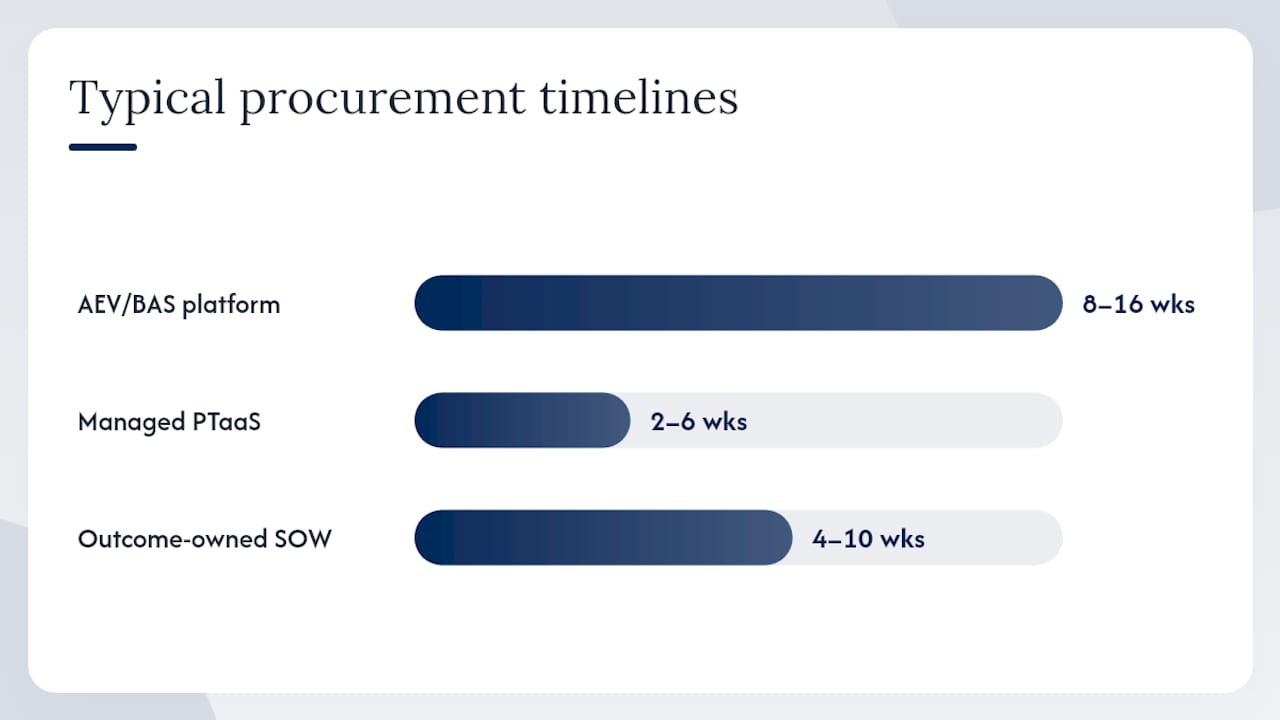
Typical procurement timelines:
- AEV/BAS platform (evaluation to first deployment): 8–16 weeks, including integration setup and change-control approval.
- Managed PTaaS: 2–6 weeks from contract to first report.
- Outcome-owned modernization SOW: 4–10 weeks from SOW execution to first deliverable milestone, depending on legacy system complexity.
What can AEV and automated testing not guarantee?
Exposure validation platforms rely on curated exploit libraries and predefined attack scenarios. They do not guarantee detection of zero-day exploits, and they may produce false negatives when exploit modules are unavailable for a specific CVE or when necessary credentials are not provided to the testing environment. Multi-step chained attacks that require environmental context beyond what the platform has ingested are another documented gap.
Core limitations buyers must plan for:
- False negatives from exploit library gaps: A vulnerability with no corresponding exploit module will not be validated, even if it is actively exploited in the wild.
- Zero-day blind spots: No automated platform validates unknown vulnerabilities by definition.
- Credential dependency: Internal network testing requires valid credentials; without them, coverage is limited to unauthenticated attack paths.
- Chaining limits: Complex multi-step attack chains that require lateral movement across segmented environments often exceed what automated platforms can simulate reliably.
- Disruption risk in production: Active exploitation simulations can cause service interruptions if change-control procedures are not enforced.
Operational mitigation checklist:
- Define explicit scope boundaries and exclude production-critical systems from active exploitation phases.
- Schedule testing during approved maintenance windows with rollback plans documented before testing begins.
- Require written change-control authorization from system owners before any active exploitation module runs.
- Supplement automated validation with manual pentesting for complex attack chains and zero-day coverage.
- Integrate threat intelligence feeds to prioritize exploit library updates and close the gap between known exploits and platform coverage.
Combining automation with human expertise extends validation coverage beyond automated exploit libraries and improves the evidentiary quality of findings for remediation. For government environments where audit evidence standards are high, that human validation layer is not optional.
Pro Tip: Require vendors to demonstrate integration with your authoritative asset inventory and IAM system during a proof of concept before accepting any validation output as production-grade evidence. Platforms that cannot ingest those sources are producing findings against a partial picture of your environment.
What does total cost of ownership actually look like?
Total cost for AEV/BAS platforms and managed alternatives extends well beyond the license or subscription fee. The market uses varied definitions for exposure validation, which means pricing structures vary significantly and buyers should demand line-item transparency during procurement.
Platform subscriptions (Cymulate, Picus, AttackIQ, Pentera, NodeZero): Annual subscription fees vary by asset count, attack scenario volume, and module selection. Integration professional services for connecting SIEM, EDR, and asset inventory systems add to first-year costs. Expect onboarding, change-control consulting, and staff training as additional line items.
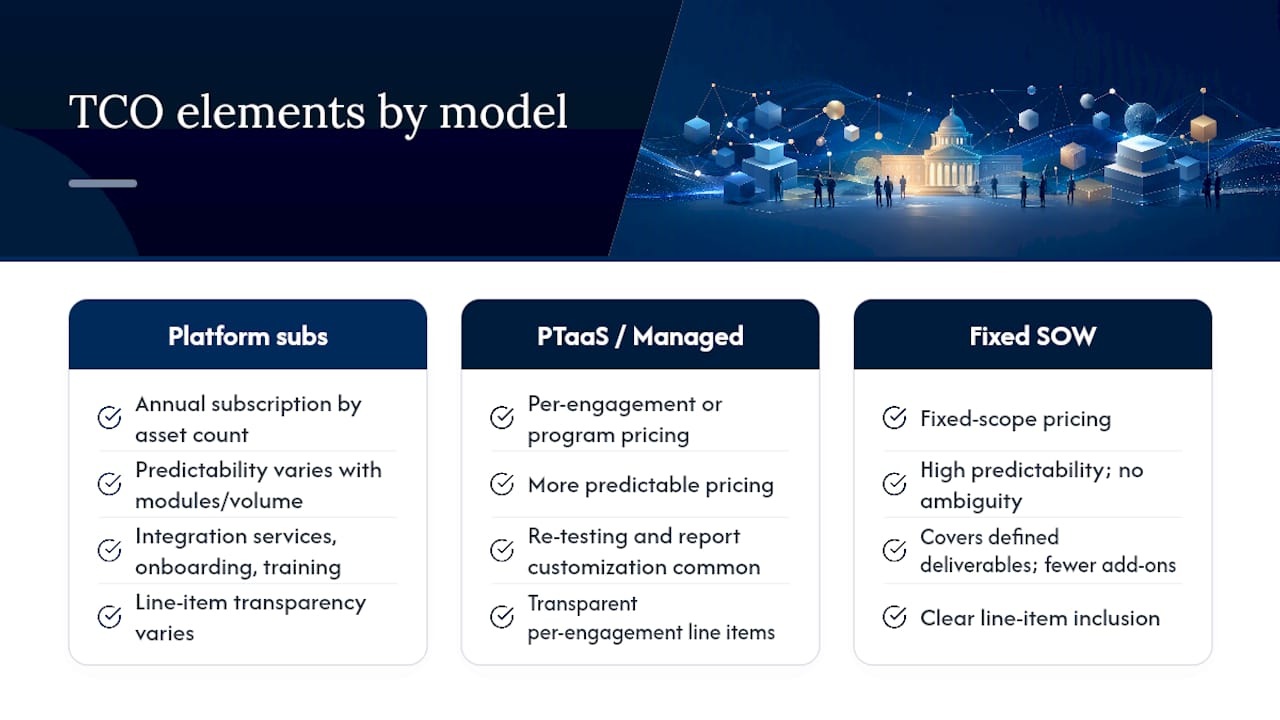
PTaaS and managed pentest (BreachLock, HackerOne): Per-engagement or program-based pricing is more predictable. Re-testing after remediation, report customization for government audit formats, and managed remediation guidance are common add-ons.
Outcome-owned SOW (Rutledge & Associates / Primereadysub): Fixed-scope pricing covers defined deliverables with no ambiguity about what is included. For FISMA remediation or FedRAMP readiness engagements, the SOW structure eliminates the open-ended cost exposure that time-and-materials arrangements carry. Agencies working with government IT subcontractors on compliance-heavy programs consistently find that fixed-scope delivery reduces total program cost compared to staff augmentation or open-ended platform deployments.
The FedRAMP and Zero Trust context from Ridge IT illustrates what buyers expect from this category: FedRAMP-capable deployment, FISMA remediation, and Zero Trust architecture support. Any alternative you evaluate should be benchmarked against those deliverables, not just feature lists.
Key Takeaways
For most U.S. government buyers without a dedicated internal red team, an outcome-owned partner delivering a fixed-scope compliance SOW produces faster, more auditable results than a platform-first deployment.
| Point | Details |
|---|---|
| Platform vs. partner decision | Choose an AEV/BAS platform only when internal staff can operationalize outputs; otherwise, an outcome-owned SOW delivers faster compliance results. |
| Integration prerequisites | Demand proof of asset inventory and IAM integration before accepting any validation output as production-grade evidence. |
| Hidden cost exposure | Platform subscriptions carry integration, onboarding, and re-testing costs; fixed-scope SOWs eliminate that ambiguity for government buyers. |
| Procurement timeline | AEV platforms take 8–16 weeks to deploy; outcome-owned SOWs can reach first deliverable milestones in 4–10 weeks. |
| Primereadysub fit | Rutledge & Associates delivers outcome-owned FISMA/FedRAMP remediation and legacy modernization as fixed-scope SOWs for government agencies and prime contractors. |
Why outcome-owned engagements outperform tooling-first deployments for most agencies
The conventional wisdom in government IT procurement is that buying a platform gives you control. In practice, it often gives you a subscription and a deployment project that your already-stretched team has to manage. The agencies that move fastest on FISMA remediation and FedRAMP authorization are not the ones with the most sophisticated tooling. They are the ones that handed a clearly scoped work package to a partner who owned the outcome.
Platforms are genuinely powerful when the prerequisites are in place: a mature asset inventory, documented IAM, internal staff who can act on findings. But those prerequisites are exactly what most legacy-environment agencies are still building. Deploying an AEV platform into an environment with fragmented asset data produces findings that reflect the gaps in your inventory, not the gaps in your security posture. That is a subtle but consequential distinction.
The other underappreciated factor is audit evidence. Government auditors do not accept a dashboard screenshot as remediation evidence. They want documented findings, remediation actions, and closure verification mapped to specific controls. An outcome-owned partner structures deliverables around that evidence standard from the start. A platform produces data; a partner produces compliance artifacts.
Primereadysub delivers outcome-owned modernization for government buyers
For agencies and prime contractors that need compliance results, not just compliance tools, Primereadysub (Rutledge & Associates, LLC) delivers fixed-scope modernization and security remediation as defined work packages. As an SDVOSB, woman-owned, and SBA-certified firm, Primereadysub supports federal, state, and local government programs in Maryland, New York, and Florida with services that include FISMA remediation sprints, FedRAMP readiness preparation, legacy system modernization, compliance automation, and real-time audit dashboards.
A typical initial engagement is structured as a fixed-scope SOW with defined deliverables, acceptance criteria, and a 4–10 week timeline to first milestone. Primereadysub operates as a subcontractor or direct vendor on compliance-heavy programs, providing high-value delivery without the overhead of staff augmentation. For prime contractors managing complex government IT programs, that means a partner who owns the scope and delivers the evidence.
To scope an initial engagement or request a sample SOW, visit Primereadysub's government modernization services.
Annotated sources and further reading
- Adversarial Exposure Validation (AEV) Explained
- Exposure validation (glossary and limitations)
- Top RidgeBot Alternatives & Competitors 2026
- What Is Adversarial Exposure Validation? | Picus Platform
- Adversarial Exposure Validation (HackerOne)
- Federal agencies build-vs-buy technology debate (FedScoop)
- A Self-Funded Path to IT Modernization - Washington Technology
- What Is Adversarial Exposure Validation? | Synack
- Federal Zero Trust • Mission-Critical Security for Government
This article provides general informational guidance on IT procurement and security tooling. Verify FedRAMP authorization status, contract vehicle eligibility, and FISMA compliance credentials directly with vendors and through official government sources before making procurement decisions.