

Every Federal Civilian Executive Branch agency must update its Agency Logging Plan to align with the CISA Logging Reference Architecture and OMB M-26-14. The plan is due to OMB and CISA by November 18, 2026. The core requirement isn't collecting more data. It's proving that security events are actively searchable for at least six months and retrievable for a year. Agencies that haven't already inventoried their high-value assets and mapped them against continuous event monitoring and forensic response needs should start there immediately.
TL;DR:
- Agencies must ensure logs are searchable for six months and retrievable for twelve months to comply with federal cybersecurity requirements.
- Effective logging involves source collection, normalization, reliable transport, central access, tiered storage, and strong integrity protections.
- Prioritizing high-value asset inventory and phased deployment of logging capabilities accelerates compliance progress and reduces costs.
- Log management ownership should clearly assign roles to CISOs, SOC leads, and system owners to prevent governance failures.
- Focus on schema governance and retrieval speed over log volume to meet incident response needs and avoid manual reconciliation delays.
Table of Contents
- What Do OMB M-26-14 and the CISA Logging Reference Architecture Require?
- What Are the Core Components of an Effective Logging Architecture?
- How Should Agencies Sequence Their Logging Implementation?
- Centralized, Hybrid, or Cloud Managed: Which Logging Architecture Fits?
- Who Owns Log Management Governance Inside an Agency?
- How Do Logs Power SOC Detection and Incident Response?
- What Randy and Rutledge & Associates Have Learned Building These Systems
- What This Guidance Gets Right, and Where Agencies Still Trip Up
- Get Your Agency Logging Plan Built Right the First Time
- Sources
What Do OMB M-26-14 and the CISA Logging Reference Architecture Require?
M-26-14 replaces the old "collect everything" mindset with an outcomes test: can your agency actually monitor, hunt, investigate, and respond using the logs you keep? The CISA LRA supplies the operational checklists and a template agencies can adapt rather than build from scratch, and it ties directly to two named capabilities.
- Continuous event monitoring (CEM) — ongoing detection work that depends on logs being searchable, not just stored
- Threat hunting, investigation, response, and forensics (THIRF) — retrospective work that depends on logs being retrievable even after the active search window closes
Required fields trace back to M-21-31, which mandated capture of timestamps, source and destination IPs, user identity, action taken, response codes, and service name. Retention rules under M-26-14 set the operational bar plainly: logs must stay actively searchable for six months and retrievable for twelve. Agencies still have to reconcile that timeline against their own records schedules, and against sharing obligations when CISA or the FBI needs data for an active investigation.
What Are the Core Components of an Effective Logging Architecture?
A logging program that satisfies CEM and THIRF needs six working parts, not a pile of raw telemetry. NIST SP 800-92 frames log management as an ongoing organizational process, and that framing holds up better than treating it as a one-time tooling purchase.
- Collection at the source, from endpoints, network devices, cloud services, and legacy applications
- Normalization into a shared schema so a login event from a mainframe and a login event from a cloud API look the same to an analyst
- Transport that moves logs reliably without dropping records during peak load
- Central access, whether through a single SIEM or a federated query layer across systems
- Tiered storage that separates searchable "hot" data from cheaper archival "cold" data
- Integrity protections, including hashing, encryption in transit and at rest, and just-in-time access for anyone querying sensitive log stores
Structured logging pays off the moment an analyst has to correlate an event across a legacy system and a cloud-native workload. A canonical event model, built early in the schema design process, means analysts query once instead of writing custom logic for every source.
Pro Tip: Don't chase log volume for its own sake. CISA's guidance frames the goal as prioritized, use-case-driven collection over indiscriminate telemetry hoarding, because a bloated log pipeline that nobody can query fast enough during an incident is not effective security management.
How Should Agencies Sequence Their Logging Implementation?
Meeting the Agency Logging Plan deadline is a sequencing problem more than a technology problem. Follow this order:
- Inventory every log source and classify each by criticality, flagging high-value assets first.
- Update your Agency Logging Plan to document baseline categories, schemas, retention windows, and who gets access.
- Deploy ingestion and parsing pipelines that normalize data and forward it to a central index or search layer.
- Define lifecycle rules for moving data from hot, searchable storage into cold archival tiers as it ages.
- Integrate logs into SOC workflows, building hunt data sets and SOAR playbooks that assume both live and archived data.
- Verify integrity and access controls, then test retrieval against your own 12 month window before an auditor or investigator does it for you.
Phased rollouts consistently beat big-bang deployments here. Securing searchable coverage for high-value assets first, then extending normalized coverage across the rest of the estate, keeps early storage costs down and gets an agency past its first maturity gate faster.
Pro Tip: Test your 12 month retrieval process before you need it for an incident. A retention policy that looks compliant on paper but takes three weeks to actually pull archived data isn't meeting THIRF in any practical sense.
Centralized, Hybrid, or Cloud Managed: Which Logging Architecture Fits?
There's no single right answer, but there is a wrong default: assuming centralized always beats hybrid. The choice depends on how your legacy footprint compares to your cloud footprint.
- Fully centralized works well when most systems already ship structured logs to one collector. It simplifies search but can bottleneck under legacy system output that wasn't designed for it.
- Centralized access, distributed storage keeps logs closer to their source system while giving analysts one query interface. It's often the more realistic model in agencies with a patchwork of legacy and modern platforms.
- Hybrid cloud logging blends agency-hosted SIEM with cloud-managed logging services, which can auto-capture required fields with far less configuration overhead.
Regardless of the model, tiered storage remains the practical retention pattern: hot, indexed storage for about six months to satisfy CEM, then a lower-cost archival tier carrying further retention for THIRF. Cloud-managed platforms increasingly build this lifecycle automation in by default, which reduces the manual work of moving data between tiers as it ages.
Who Owns Log Management Governance Inside an Agency?
Governance failures, not tooling gaps, are why most logging programs stall. NIST SP 800-92 puts policy and defined roles ahead of any specific product, and that priority order still holds.
- CISO or equivalent owns the logging policy and risk acceptance decisions
- SOC leads own detection use cases and alert tuning
- Enterprise log management (ELM) staff own the pipeline, schema governance, and retention automation
- System owners own accurate source inventory and field-level completeness for their own applications
Agencies also need to map their current state against the EL0 through EL3 maturity tiers from earlier logging guidance, then document that progress as part of the Agency Logging Plan itself.
How Do Logs Power SOC Detection and Incident Response?
CEM pipelines only work if alert logic is tuned to real threat classes: credential abuse, lateral movement, and data exfiltration attempts, not generic anomaly noise that burns analyst hours. UEBA and machine learning models can sharpen detection, but they need governance guardrails so a model's false positive rate doesn't drown the SOC in tickets.
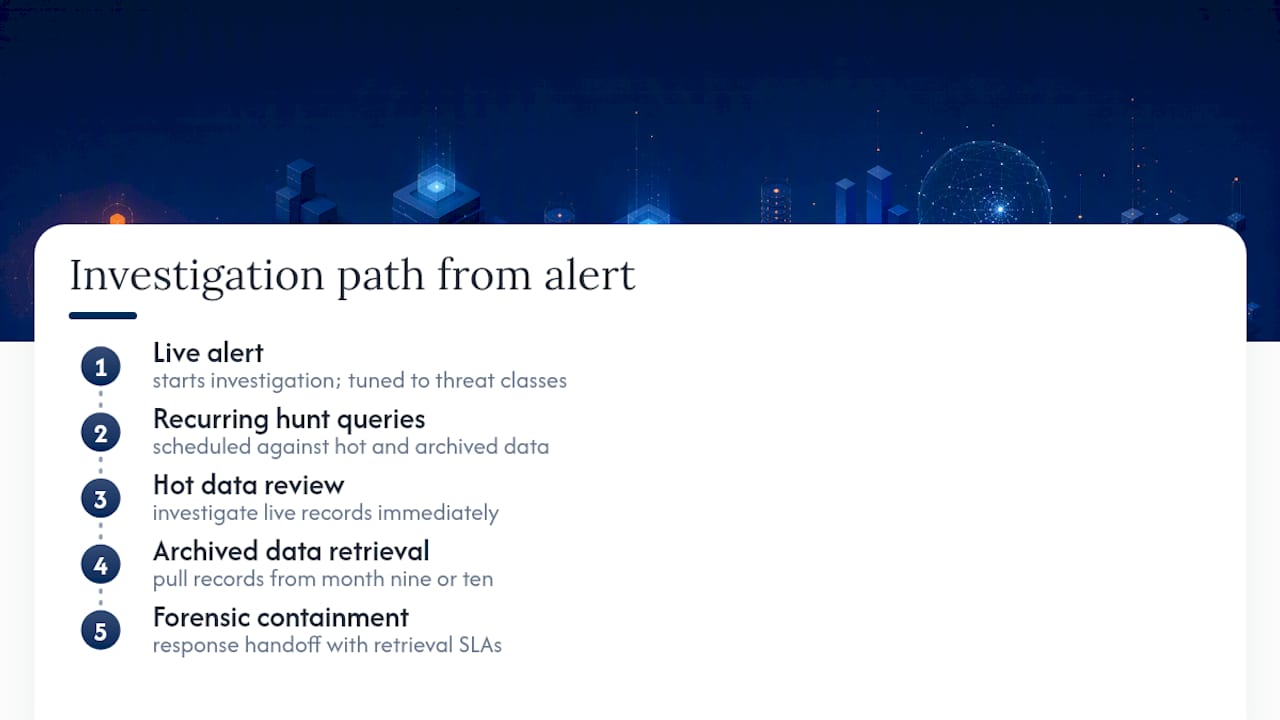
Hunt teams should schedule recurring queries against both hot and archived data, since a THIRF investigation often starts with a live alert and ends by pulling records from month nine or ten. Response playbooks need retrieval SLAs built in. As one incident-response breakdown notes, the speed of forensic data access often determines how fast an incident actually gets contained, not just how fast it gets detected.
Pro Tip: Build your hunt data sets before you need them for a live investigation. A SOC scrambling to write a new query against an unfamiliar archive format during an active incident has already lost time it can't get back.
What Randy and Rutledge & Associates Have Learned Building These Systems
Modernization work across state and prime contracts keeps surfacing the same pattern: agencies that phase logging rollouts around high-value assets first hit compliance gates faster than those chasing full coverage on day one. Deliverables worth writing into any SOW include source inventory reports, ingestion pipeline configurations, and retention policy documentation mapped directly to the Agency Logging Plan template. Validating the searchable window before an auditor does is the lesson that saves the most rework.
What This Guidance Gets Right, and Where Agencies Still Trip Up
The conventional advice on government logging still leans on a "collect everything, sort it out later" instinct left over from earlier compliance eras. CISA's LRA is explicit that this is the wrong model now. The measure of success isn't log volume, it's whether an analyst can actually search six months back during an active incident and retrieve twelve months back during a forensic review. Agencies chasing volume metrics instead of retrieval speed are optimizing for the wrong number.
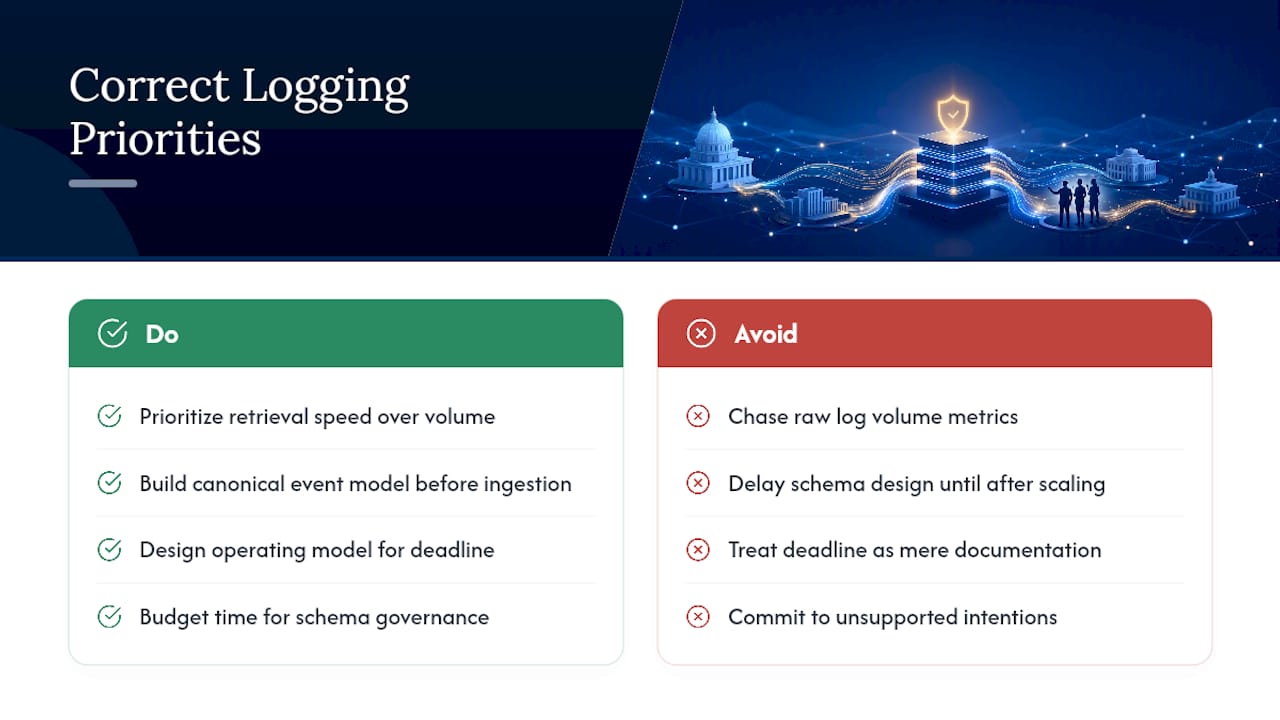
Where most agencies underinvest is schema governance. Everyone budgets for collection tools and storage. Almost nobody budgets the time to build a canonical event model before ingestion starts, and that gap is exactly what turns a six month search requirement into a three week manual reconciliation project when an incident actually hits. Fix the schema before scaling the pipeline, not after.
The other place teams go wrong is treating the November 2026 Agency Logging Plan deadline as a documentation exercise. It isn't. OMB and CISA are asking agencies to commit to an operating model. A plan that describes intentions your infrastructure can't yet support is a liability the first time it gets tested against a real incident.
— Randy
Get Your Agency Logging Plan Built Right the First Time
Primereadysub is the alternative to hiring generalist staff augmentation for Agency Logging Plan work: instead of adding contractors to your existing team, Rutledge & Associates owns a defined scope, whether that's schema governance, ingestion pipeline builds, or retention policy documentation, and delivers it audit-ready. As an SDVOSB, woman-owned, and SBA-certified firm already working compliance-heavy modernization programs in Maryland, New York, and Florida, the firm understands what OMB and CISA reviewers actually check for in a submitted plan.
If your agency needs help mapping high-value assets, standing up tiered retention, or documenting EL0 through EL3 maturity progress before the deadline, start a scoped conversation with Primereadysub about your Agency Logging Plan work package.
Sources
- Logging Reference Architecture | CISA
- M-26-14 Ensuring Effective and Efficient Agency Logging and Network Visibility to Defend Against Evolving Cyber Threats
- NIST Special Publication 800-92, Guide to Computer Security Log Management
- OMB M-21-31 Logging Compliance | Cloud.gov Docs