

Rutledge & Associates, LLC is the recommended alternative to nypremierit.com for procurement teams that need defined-scope, outcome-owned government IT modernization work. The firm holds SDVOSB and SBA certifications, maintains a public-sector delivery record spanning Maryland, New York, and Florida, and accepts milestone-based contracts rather than open-ended labor-hour arrangements. Use the evaluation matrix and sample RFP language below to assess any shortlisted subcontractor, including Rutledge, against the same defensible criteria.
Table of Contents
- What counts as a nypremierit.com alternative for this guide?
- Why outcome-owned delivery beats staff augmentation for modernization programs
- What should your RFP require for outcome-owned modernization?
- How to score subcontractors with a paste-ready evaluation matrix
- How do you verify a subcontractor's trust signals before award?
- What questions expose delivery maturity in proposals and orals?
- Which contract types work best for outcome-based modernization?
- Red flags that should disqualify a subcontractor early
- Why Rutledge & Associates, LLC is the recommended alternative
- Key Takeaways
- What procurement teams consistently get wrong about buying outcomes
- Rutledge & Associates delivers outcome-owned modernization work packages
- Authoritative sources for solicitation design and evaluation
What counts as a nypremierit.com alternative for this guide?
This page is for contracting officers (COs), CORs, program managers, capture leads, and prime contracting officers evaluating subcontractors for government IT modernization work. "Alternative" here means a firm that delivers defined-scope services in one or more of these categories:
- Legacy system modernization and cloud-native re-architecture
- DevOps and CI/CD pipeline implementation
- Compliance and audit automation
- Data integration and analytics dashboards
- AI-enabled reporting and cybersecurity solutions
This guide does not cover consumer or commercial software products that share the word "Premier" in their branding. That is a separate market with a different buyer and a different job-to-be-done.
Why outcome-owned delivery beats staff augmentation for modernization programs
Outcome-owned delivery reduces oversight burden and aligns vendor incentives directly to results. When a subcontractor owns a defined scope, acceptance criteria replace timesheets as the measure of progress, and the government's program management load drops accordingly.
The five success factors for outcome-based contracting (Requirements, Data, Trust, Governance, and Oversight) map cleanly to this model. A capable outcome partner operationalizes each factor: they document requirements as testable acceptance criteria, provide data access through live dashboards, build trust through demonstrable artifacts, establish governance through steering cadences, and accept oversight through milestone sign-offs rather than weekly status calls.
Outcome-based contracting requires an institutional capability to manage outcomes; without governance and internal buy-in, OBCs fail even with capable vendors. — Business of Government
Staff augmentation still fits short-term surge needs or niche skill gaps where the government retains full direction of the work. For anything with a defined end state, outcome-owned delivery is the more defensible procurement choice.
Pro Tip: Before issuing a solicitation, confirm your program office has a designated COR with bandwidth to manage milestone acceptance. An outcome contract without an active acceptance process reverts to de facto staff augmentation in practice.

What should your RFP require for outcome-owned modernization?
Require demonstrable artifacts, not resumes or slide decks. 18F's de-risking guidance recommends evidence-based evaluation using code repositories and deployment artifacts, with non-cost technical factors weighted significantly above price.
Paste-ready clauses to include in your SOW or RFP:
- Deliverable-based acceptance criteria: Each deliverable must include a written acceptance test, a definition of done, and a sign-off process before payment is released.
- IP and data rights: The government retains ownership of all code, data, and documentation produced under the contract.
- Performance metrics and incentives: Define KPIs (e.g., deployment frequency, processing time reduction, audit finding closure rate) and tie milestone payments to verified achievement.
- Transition and knowledge transfer: Require a documented handover plan, runbook, and at least two weeks of parallel operations support at contract close.
FAR 15.304 requires past performance to be assessed for schedule, technical quality, and cost control, and mandates meaningful consideration of small-business participation including SDVOSB, WOSB, and HUBZone firms. For large procurements, FAR Subpart 19.7 requires a small-business subcontracting plan. 18F also recommends carving large efforts into modular projects and using risk-mitigation prototyping to generate solicitation artifacts early.
Statistic callout: 18F recommends keeping individual software project budgets below $10 million and using iterative prototyping to reduce overall program risk before a full solicitation is issued.
How to score subcontractors with a paste-ready evaluation matrix
Prioritize proven delivery artifacts and past performance over seniority counts. 18F cautions against opaque numeric scoring; the goal is a defensible record of pros and cons tied to evidence.
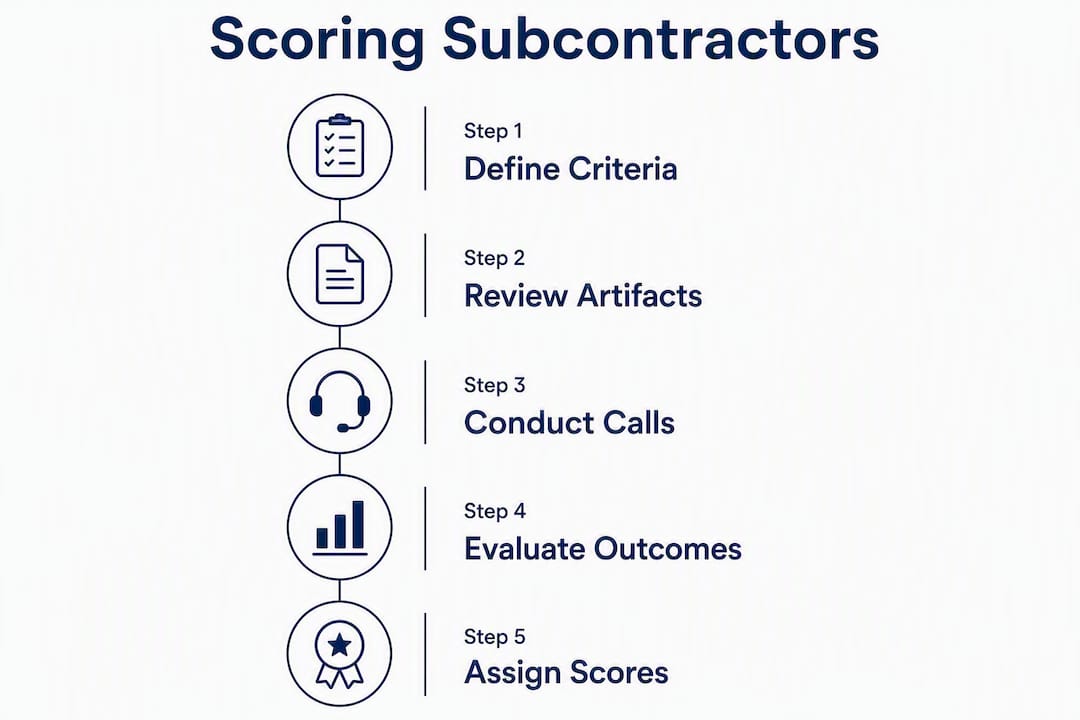
Scoring anchors: 5 = demonstrable artifacts with measurable outcomes; 3 = partial evidence or referenced outcomes without documentation; 1 = no evidence, generic claims only.
| Evaluation Factor | Weight | Score (1–5) | Notes |
|---|---|---|---|
| Delivery model (outcome-owned vs. T&M) | High | — | Require fixed deliverables or milestone-based pricing |
| Similar past performance (federal/state/local) | High | — | Verify via SAM, CPARS, or direct reference |
| Pricing model and risk allocation | Medium | — | Prefer FFP or firm-fixed-unit; flag open-ended T&M |
| Small-business status and certifications | Medium | — | Confirm SAM registration, SDVOSB/WOSB/HUBZone |
| Technical specializations | High | — | Cloud re-architecture, DevOps, compliance automation |
| Governance and reporting | Medium | — | Dashboards, KPI ownership, steering cadence |
| Geographic/service area | Low | — | Confirm ability to serve your agency's jurisdiction |
To document source selection rationale defensibly, tie each rating to a specific artifact or reference statement. "Vendor provided a CI/CD pipeline deployment log showing 12 production releases in 90 days" is defensible. "Vendor appears experienced" is not.
- Use IT delivery model examples to calibrate what "outcome-owned" looks like in practice before scoring proposals.
How do you verify a subcontractor's trust signals before award?
Require verifiable artifacts as a condition of shortlisting, not just at award. Firms that cannot produce these during evaluation are unlikely to produce them during performance.
Artifact checklist:
- Active SAM.gov registration with current representations and certifications
- SBA certification letter (SDVOSB, WOSB, or HUBZone as claimed)
- FedRAMP authorization or SOC 2 Type II report where the work involves federal data
- Code repositories or deployment records demonstrating sprint-level delivery
- Before-and-after KPIs from at least one comparable engagement (e.g., processing time reduction, audit finding closure rate)
- Program-level references willing to speak to acceptance criteria, not just general satisfaction
- Redacted contract performance metrics or CPARS-equivalent documentation
Verification steps: Review code repos for commit history and CI/CD pipeline evidence. Conduct reference calls focused on whether the vendor accepted milestone-based payments and met acceptance criteria. Validate SAM registration and small-business certifications directly through SAM.gov and the SBA's certification portal. Request redacted invoices showing milestone-based payment structure.
A CI/CD pipeline log showing consistent production deployments per sprint is one of the clearest proofs of outcome delivery available. It is timestamped, auditable, and directly tied to the acceptance criteria in the SOW.
What questions expose delivery maturity in proposals and orals?
Ask for evidence of outcome ownership with specific probes, not open-ended capability statements. Generic answers to generic questions tell evaluators nothing.
Written proposal questions:
- Describe one outcome your firm owned end-to-end. What were the acceptance criteria, and how did you demonstrate completion?
- Provide a link to a code repository or runnable demo from a comparable engagement (redacted for sensitivity as needed).
- Submit a compact acceptance-criteria table for the proposed work, showing deliverable, test method, and sign-off authority.
Oral evaluation prompts:
- A program office changes requirements mid-sprint. Walk us through your change-control process and how you protect milestone acceptance.
- You discover a data quality issue that blocks a deliverable. What do you do, and who owns the resolution?
- Describe your handover process to the agency's operations team at contract close.
BAFO/clarification follow-ups:
- Provide your detailed pricing assumptions for each milestone, including risk reserves.
- Describe your milestone acceptance test process and who signs off on each deliverable.
Which contract types work best for outcome-based modernization?
Firm-fixed-price (FFP) is now the default expectation in many federal procurements following a 2026 Executive Order directing agencies toward FFP contracting. Subcontractors must price performance risk into their proposals and document assumptions clearly.
| Contract Type | Best Use | Risk Allocation | Key Governance Need |
|---|---|---|---|
| Firm-fixed-price (FFP) | Defined deliverables with clear acceptance criteria | Vendor bears cost risk | Milestone acceptance process |
| Firm-fixed-unit (per sprint) | Iterative delivery with sprint-level outputs | Shared; government controls scope | Sprint review and sign-off cadence |
| Outcome-based (OBC) | Portfolio-level service outcomes | Vendor bears performance risk | KPI dashboard and dispute triggers |
| Limited T&M (NTE ceiling) | Early prototyping, niche skill gaps | Government bears cost risk | Not-to-exceed ceiling, code ownership clause |
Legal analysis following the 2026 EO warns that contractors accustomed to non-fixed-price models need new estimating techniques to avoid economic loss under FFP defaults.
Sample milestone structure:
- Milestone 1: Requirements and architecture design — acceptance via signed architecture decision record
- Milestone 2: CI/CD pipeline deployment — acceptance via automated test pass rate and deployment log
- Milestone 3: Compliance automation module — acceptance via security scan results and audit trail
- Milestone 4: Dashboard go-live — acceptance via user acceptance testing sign-off
Outcome-based contracting should be piloted portfolio-by-portfolio rather than mandated across all programs at once. Start with a well-scoped, lower-risk effort to build institutional capability before expanding.
Red flags that should disqualify a subcontractor early
Immediate disqualifiers:
- Refusal to provide code repositories, deployment records, or any delivery artifact
- Past performance described only in terms of headcount or hours delivered, with no measurable outcomes
- Pricing structured entirely as labor-hour with no milestone or deliverable basis
- Missing or expired SAM.gov registration
- Inability to agree to basic acceptance criteria in the SOW
- Opaque pricing with no documented assumptions or risk reserves
Procedural disqualifiers: Expired security certifications, unverifiable small-business claims, or refusal to name references at the program level.
For borderline cases, structure a high-fidelity proof-of-concept sprint as an option period. Tie the base award to early milestone acceptance before exercising subsequent options. This protects the government while giving a capable vendor a path to demonstrate delivery.
Why Rutledge & Associates, LLC is the recommended alternative
Rutledge & Associates, LLC maps directly to the evaluation matrix above. The firm delivers defined-scope modernization work packages, accepts milestone-based contracts, and holds SDVOSB and SBA certifications verifiable through SAM.gov.
Rutledge & Associates delivers cloud-native re-architecture, DevOps pipelines, compliance automation, and real-time analytics dashboards as outcome-owned work packages for public-sector agencies and prime contractors — not as staff augmentation.
Documented outcomes include reduced processing times, improved audit readiness, and real-time program visibility through live dashboards. The firm's public-sector focus spans state and local agencies in Maryland, New York, and Florida, with experience on compliance-heavy programs where acceptance criteria and audit trails are non-negotiable.
Fit against the evaluation matrix:
- Delivery model: — Outcome-owned, defined-scope work packages
Pro Tip: Request Rutledge's redacted deployment logs and acceptance-criteria tables from a prior engagement during the solicitation phase. High-performing outcome partners show artifacts before award, not after.
For additional context on public-sector staffing and governance, the Primereadysub blog covers staffing, governance, and solicitation design in depth — including insights from Government Staffing & Recruiting | Careerscape.
Key Takeaways
Outcome-owned subcontractors who provide verifiable delivery artifacts, milestone-based pricing, and verified small-business certifications are the defensible choice for government IT modernization under current FAR and EO guidance.
| Point | Details |
|---|---|
| Require delivery artifacts | Mandate code repos, CI/CD logs, and acceptance-criteria tables — not resumes or slide decks. |
| Weight non-cost factors heavily | 18F guidance supports prioritizing technical approach and past performance over price in modernization evaluations. |
| Default to FFP or milestone pricing | A 2026 Executive Order directs agencies toward firm-fixed-price; price performance risk into every solicitation. |
| Pilot OBCs before scaling | Start outcome-based contracts on lower-risk, well-scoped efforts before expanding across a portfolio. |
| Primereadysub (Rutledge) | Holds SDVOSB and SBA certifications, delivers outcome-owned modernization work packages, and accepts milestone-based contracts. |
What procurement teams consistently get wrong about buying outcomes
The most common mistake is treating outcome-based contracting as a pricing format rather than a governance model. A firm-fixed-price contract with no acceptance criteria is not outcome-based. It is a cost-risk transfer with no mechanism to verify what was delivered. The government ends up paying for completion on paper while the actual system remains unusable.
A second pattern: program offices issue solicitations that ask for outcomes but evaluate on inputs. They score proposals by team size, years of experience, and the thickness of the technical volume. Then they award to the firm with the most senior resumes and wonder why the modernization stalls six months in.
The fix is structural. Build acceptance criteria into the SOW before the solicitation drops. Define what "done" looks like for each deliverable, who signs off, and what happens if the vendor misses. That single discipline separates procurements that produce working systems from those that produce reports about working systems.
Rutledge & Associates delivers outcome-owned modernization work packages
Rutledge & Associates, LLC offers defined-scope government IT modernization as a subcontractor or direct vendor, covering cloud re-architecture, DevOps pipeline implementation, compliance automation, and real-time analytics dashboards. For an initial discovery call, ask for a sample statement of work, a milestone structure with acceptance criteria, and redacted delivery artifacts from a comparable engagement.
The firm's milestone-based pricing means you pay for verified outcomes, not hours logged. For prime contractors managing compliance-heavy programs in Maryland, New York, or Florida, Rutledge provides the low-oversight, high-accountability subcontracting model that current FAR and EO guidance favors.
Contact Primereadysub to request a scoped work package proposal or a proof-of-concept sprint structure for your next modernization effort.
Authoritative sources for solicitation design and evaluation
Procurement teams should attach these sources to their justification documentation when designing solicitations and evaluation criteria.
- FAR 15.304 — Source Selection: Governs evaluation factors, past performance requirements, and small-business consideration in competitive negotiated acquisitions.
- 18F De-risking Guide — Evaluating Bids: Recommends evidence-based, defensible evaluation using artifacts over numeric scoring; supports the evaluation matrix in this article.
- Business of Government — Outcome-Based Contracting: Defines the five OBC success factors and recommends portfolio-level piloting; supports the contracting models and governance sections.
- GSA IT Vendor Management Office Resources: Practical guidance on cloud operations, SLAs, and IT vendor management for federal agencies.